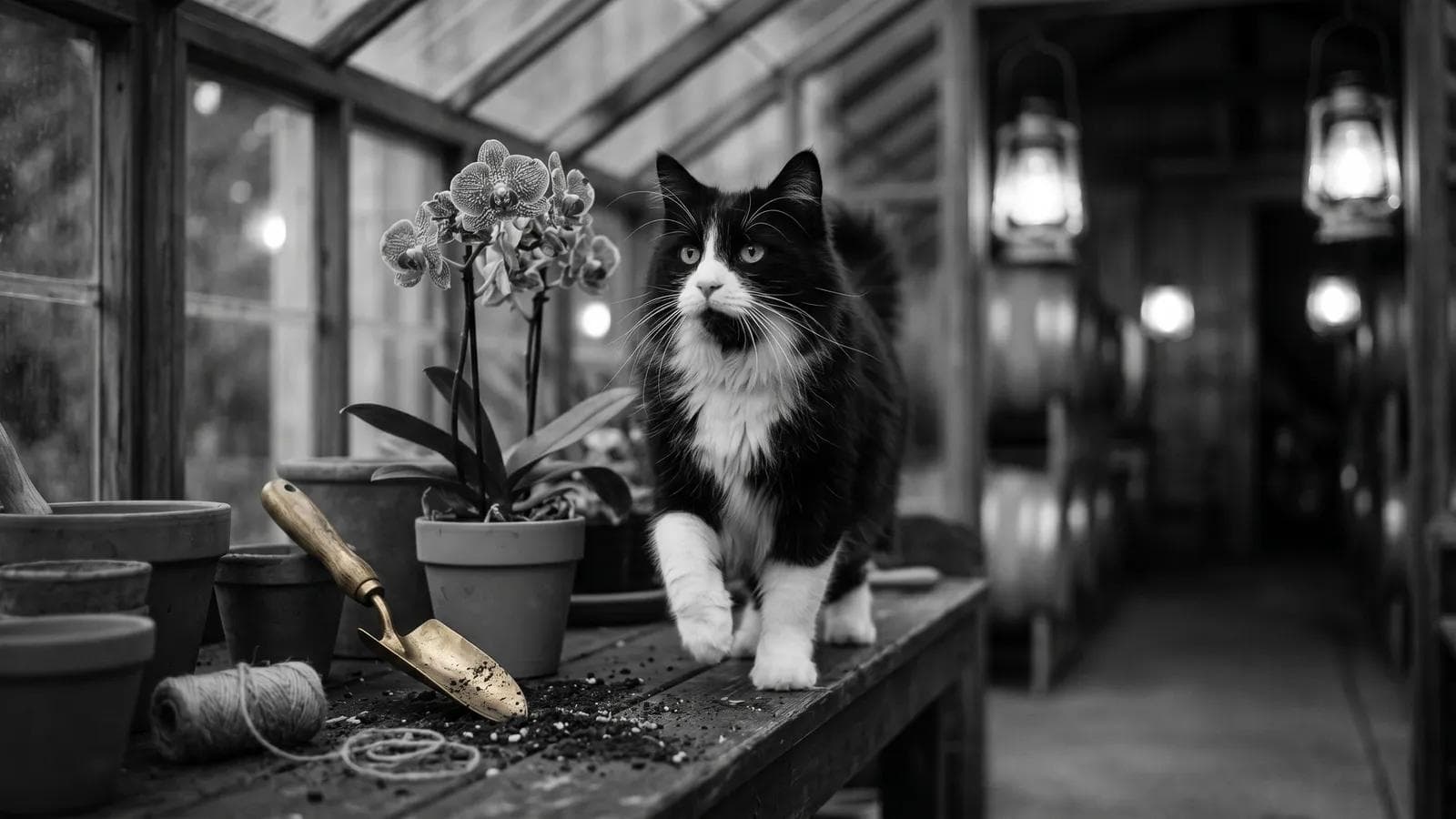
I arrived at the winery barn with something to collect. I did not get it. Viniferous "The Mischievous" Messiah was already there, and he had opinions about the schedule.
This is, by any reasonable account, where the current employment arrangement began: not with a formal offer, not with negotiated terms, but with a tuxedo cat walking deliberately between my legs, leaping onto whatever I was reaching for, and maintaining eye contact until the point was understood. The point being that whatever I had come to do was secondary. Attending to Vino was primary. Everything else could wait.
Years on, the terms of service have not changed. They have, if anything, been refined.
What follows is a considered assessment of how I'm performing against those terms, with particular attention to my longest tenure and therefore my fewest excuses.
On the Question of Punctuality
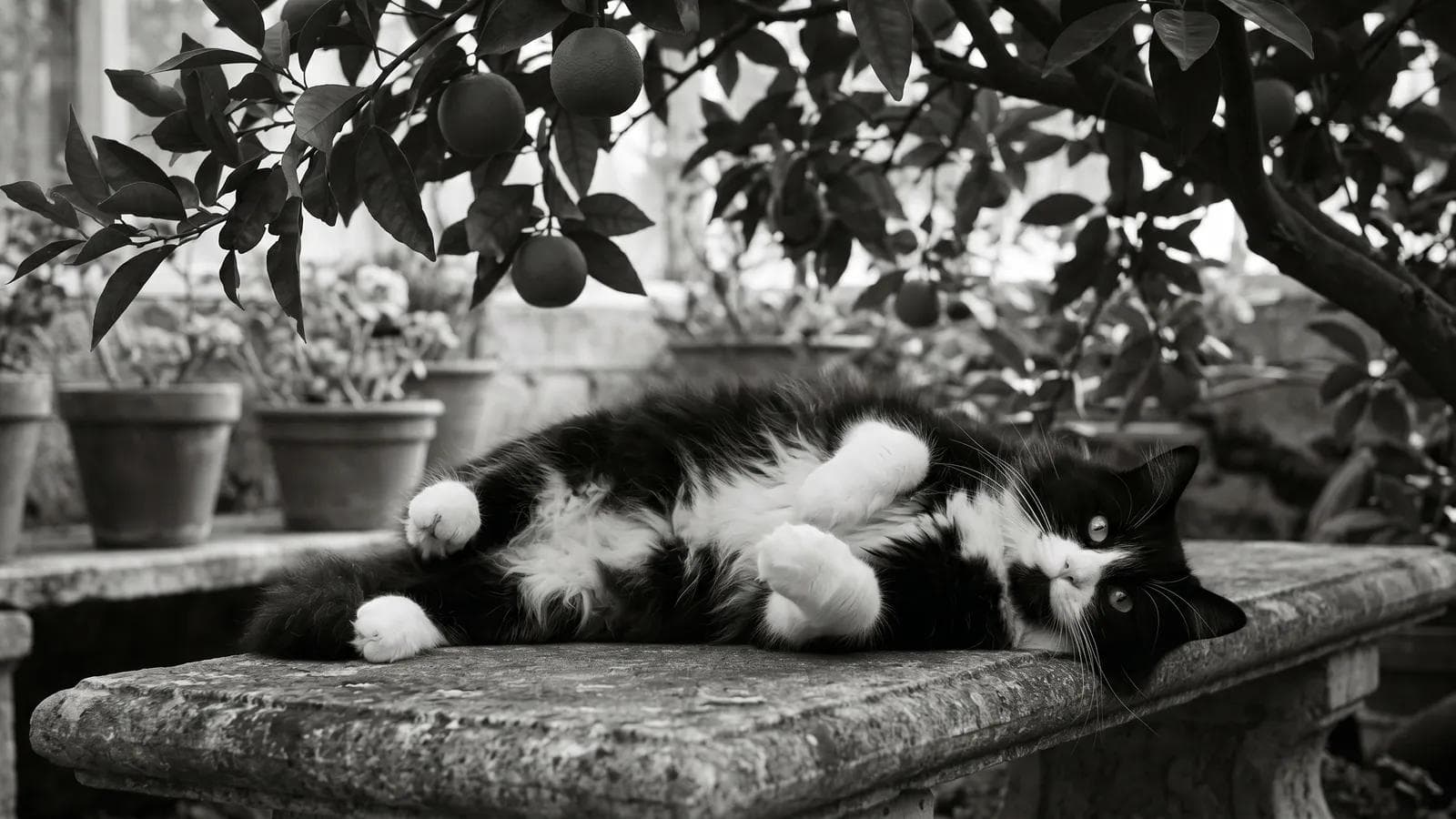
Our household operates on Vino's schedule. This has always been the arrangement and it is not up for renegotiation.
The morning routine is, to my credit, one area where Vino has shown patience. He does not wake me at random hours. He waits for the rooster. At the old house the rooster crowed at first light, and the moment it did, Vino was already in motion: across the floor, onto the bedside table, and at close range, delivering his breakfast demand.
He doesn't escalate immediately. He gives me a moment. One moment. Then the meowing begins.
What's notable here is not the demand itself but the precision of it. Vino has, over years of consistent practice, calibrated his morning timing to first light with the kind of accuracy that suggests he's thought about this more than I have. He has identified the earliest socially defensible moment to begin proceedings and he takes it, without fail, every single morning.
I would likely prefer a later start. My preferences are not part of the schedule.
Rating: I get out of bed. This is the minimum requirement. I meet it.
On Attentiveness During Working Hours
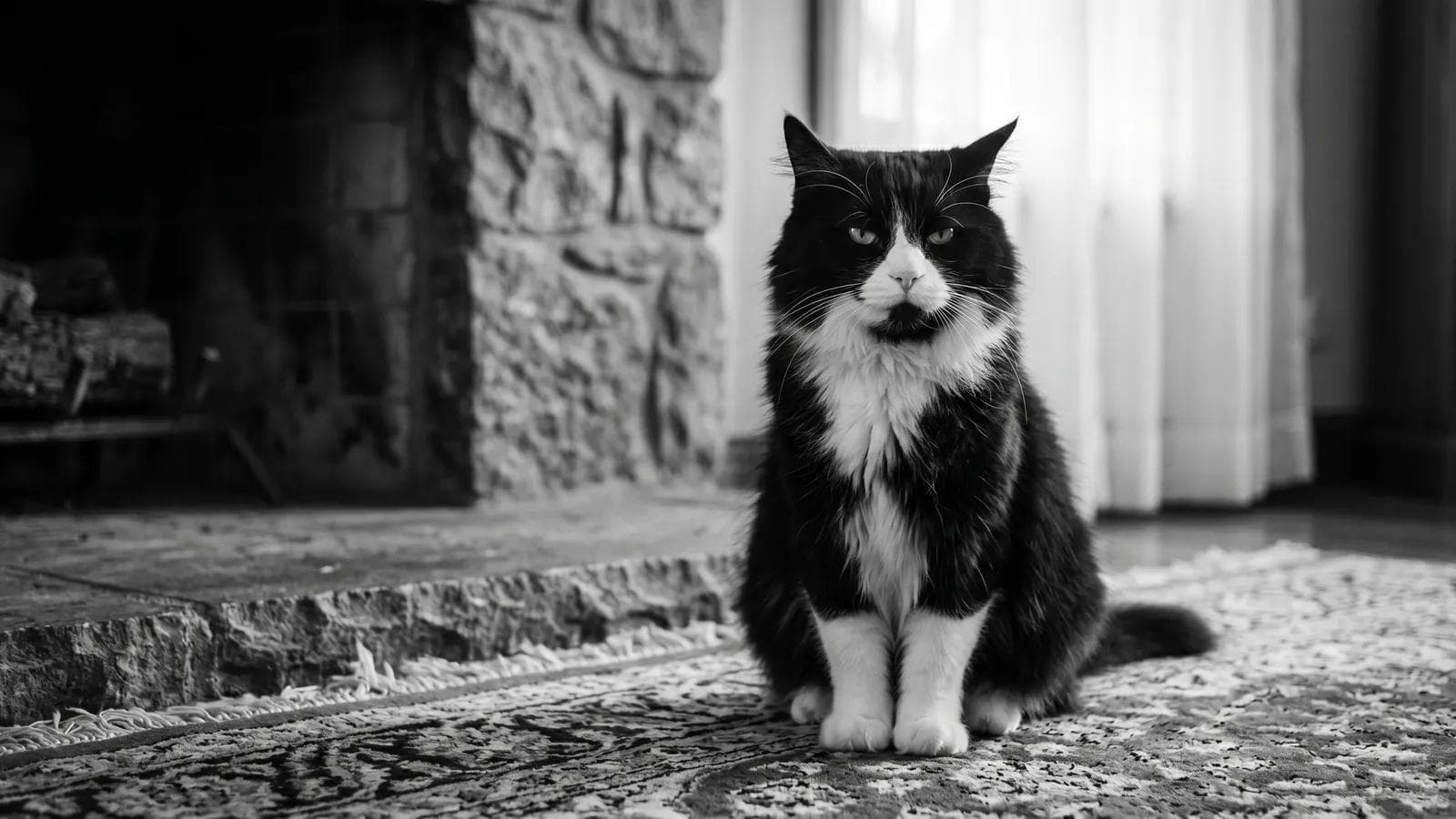
The desk situation requires discussion.
When I'm at the computer, Vino is also at the computer. This is not negotiable and it is not new. It is, in fact, the same dynamic that played out in the winery barn, simply transposed to an indoor setting with a keyboard instead of farm equipment.
He gets onto the desk. He positions himself between the screen and me. He does not knock things over, which would be rude and which he understands implicitly, but he makes his presence felt in ways that are more sophisticated than destruction: slow, deliberate placement of one white paw on the keyboard; the sustained, direct gaze from a distance of fifteen centimetres; the gradual lowering of his body onto whatever document happens to be open on the surface. If I move him, he returns. He's patient about it. He'll do this four or five times before settling into a position that technically allows the work to continue, while making clear that the work is continuing only because he's permitting it.
This is not, I would point out, curiosity. Cats who are curious about computers behave differently. They glance, they sniff, they move on. What Vino conducts at the desk is a performance review. He is checking that I'm still employed, still engaged with my responsibilities, and still appropriately aware that my first responsibility is Vino. The computer comes after. It has always come after.
I continue to attempt to work during these sessions. My perseverance is noted. My effectiveness is a separate matter.
Rating: Attendance is consistent. Focus, from my side, is a work in progress.
On the Management of the Outdoor Access Protocol
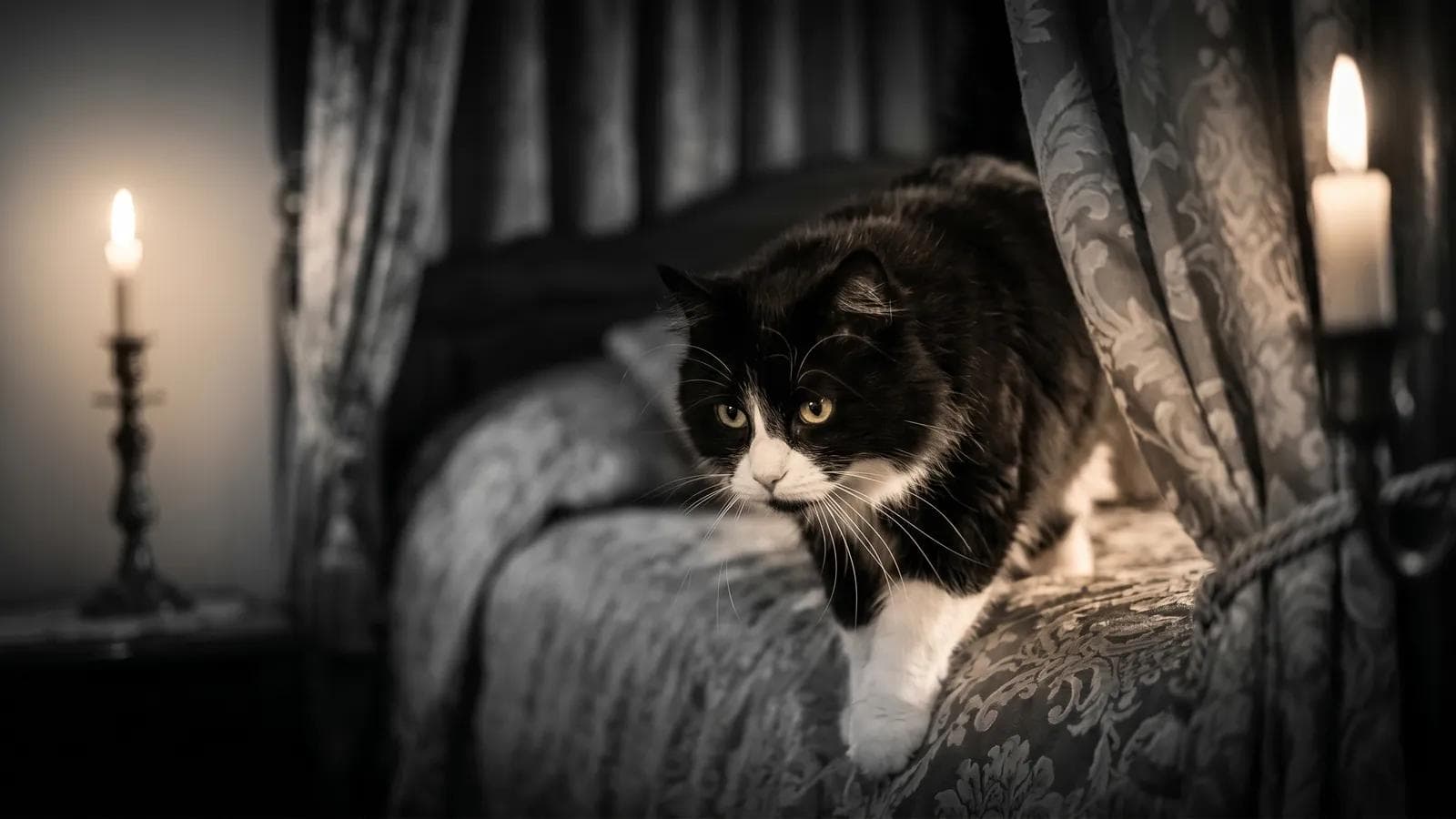
Every afternoon, before dinner, Vino goes outside. Sometimes in the mornings as well, if the schedule allows. These are not requests. They are appointments.
The problem, as Vino has communicated through official channels on multiple occasions, is that the doors do not always open at the correct time. I sometimes finish whatever I'm doing first. I sometimes check on things. I occasionally take several minutes.
When this happens, Vino files a grievance.
The grievance takes a specific form: a single sustained meow, delivered at consistent volume and consistent tone, for five seconds or longer. It is not a question. It carries no inflection of pleading, no notes of urgency, nothing that could be mistaken for a request. It is a statement of record. It says: this delay has been noted; the terms of the afternoon access agreement have not been honoured; this will be reflected in the quarterly assessment.
He does this once. He waits. If the door opens, the grievance is considered resolved. If it doesn't, he issues a second statement and continues at intervals until the situation is rectified.
What makes this communication style particularly effective is its restraint. A cat who scratched at the door, who yowled and threw himself at the woodwork, could be managed. What Vino delivers is administrative. It's the meow of a senior executive who has already spoken to legal. It leaves me with the distinct impression that there are forms being filled in somewhere.
Outside, incidentally, the dynamic does not change. Vino will follow me around the yard demanding pats and meowing with the same energy he brought to the winery barn a decade ago. The setting is different. The property is different. The cat is, if anything, more confident in his position. Same walk, same meow, same refusal to accept that pats have ended until he personally decides they have. I, to my credit, generally oblige. The alternative is continued commentary.
Rating: Door response times are improving. There is room for growth.
On Delegation and Relationship Management
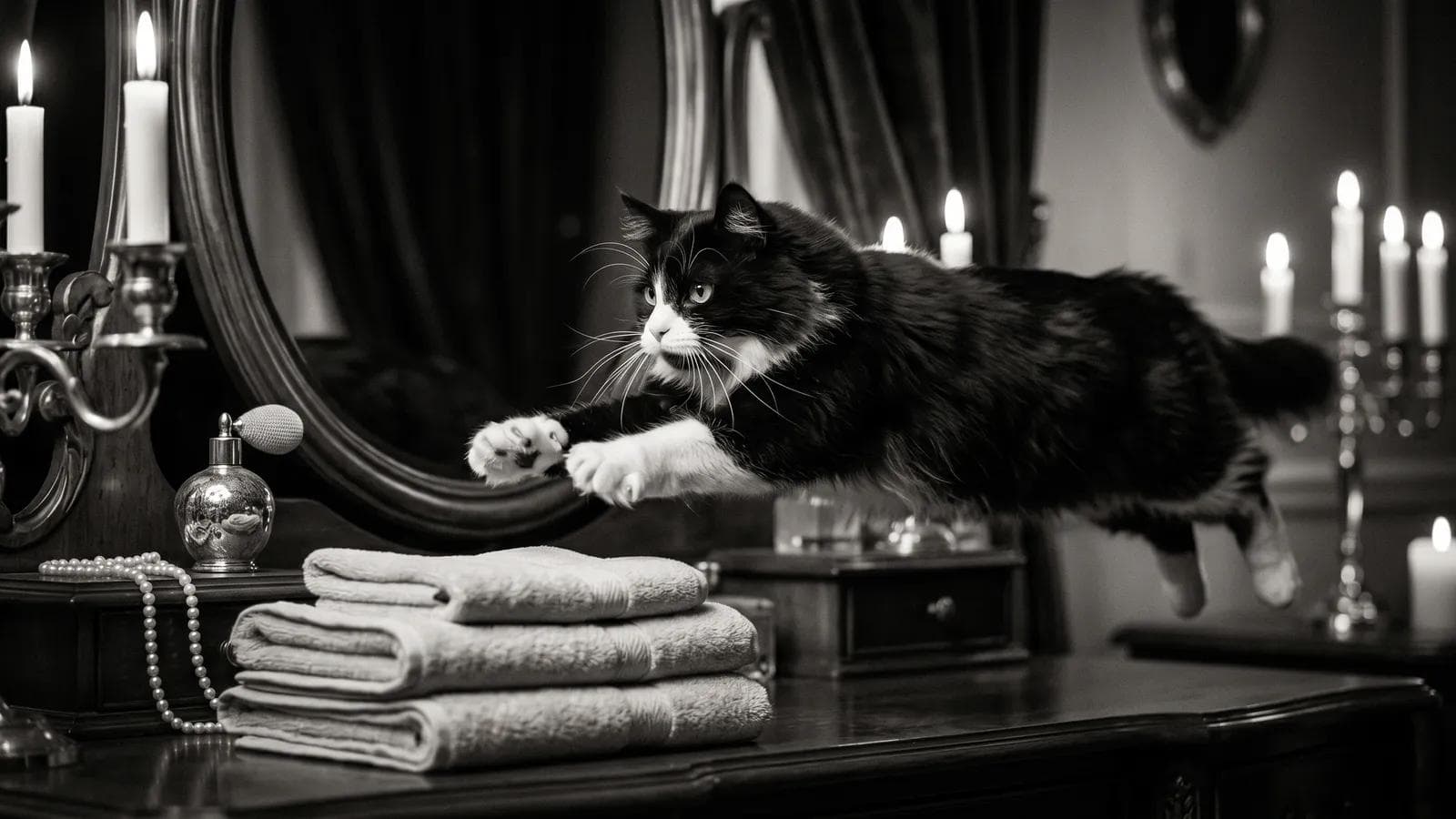
I am not, it should be noted, the only staff member in our household. There is also what might be described as the junior tier of household management, and there are occasional visitors who find themselves, without quite intending it, incorporated into Vino's staffing arrangements.
Vino's approach to these interactions is broadly generous. He does not hold visitors to the same standard he holds permanent staff. If someone is sitting down, he'll join them. He does not require references or prior relationship. He requires, simply, a lap and a reasonable willingness to run a hand along his back. Most people can manage this.
What he does not do is pretend these interactions are optional once he's initiated them. A visitor who has accepted Vino onto their lap has entered into a contract. The terms, as always, are his.
Within our home, though, I remain the primary point of contact. I have the longest service record. I was the one who was in the barn. I was the one who, when Vino made the terms of our arrangement clear in April 2022, took him home. This is either loyalty or an inability to read the situation. The practical outcome is the same either way.
The relationship should be understood, in this context, not as a bond between a man and his cat but as a working arrangement between a household director and his most senior field operative. Vino sets expectations. I attempt to meet them. The gap between these two activities is the comedy of daily life in our household, and it has been running since a Tasmanian winery barn, when a black-and-white cat with a natural bow tie on his chest decided that a new employee had arrived and that he, Vino, would be managing the onboarding.
Frequently Asked Questions
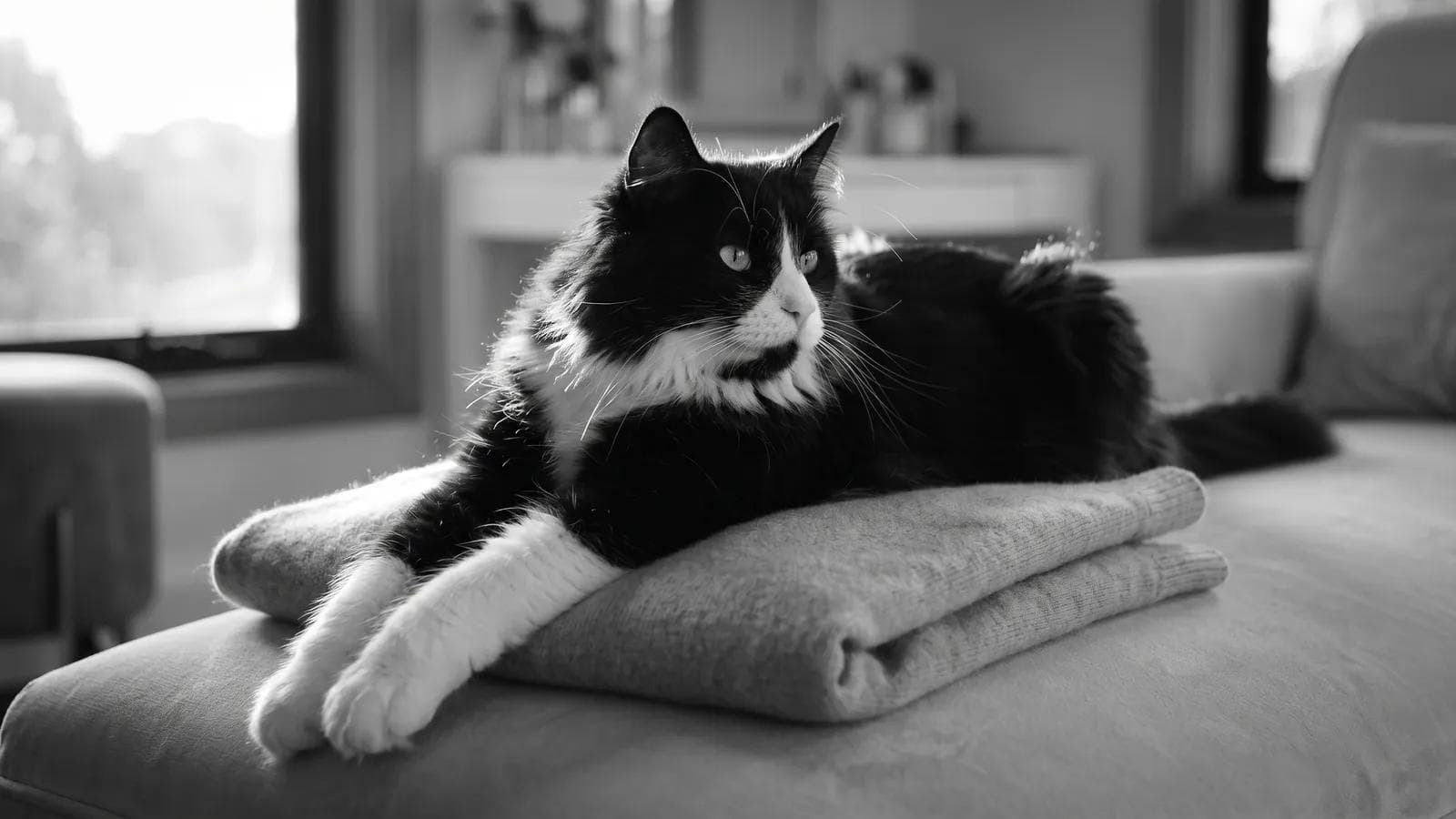
Why does my tuxedo cat follow me everywhere?
This is consistent with what I've observed across multiple households and, specifically, within this one. Vino does not follow me around the yard out of anxiety or attachment in the sentimental sense. He does it because I am doing something and Vino has not authorised it. Following is supervision. The meowing that accompanies it is commentary. Tuxedo cats, and demanding cats generally, tend to treat human activity as an event that requires their input. Vino treats it as an event that requires his approval.
Is it normal for a cat to get on the desk every single time you sit down?
Normal is not the right framework here. Vino's desk behaviour is purposeful and consistent. He's not exploring. He's not bored. He's conducting a check-in. Whether this is "normal" depends on whether you think your cat has opinions about your productivity. Vino does. He's had them for years and he shows no signs of moderating them.
Why does my cat wake me up at the same time every morning?
Cats are not operating on your schedule. You are, without realising it, operating on theirs. Vino waits for the rooster, which gives the impression of external coordination, but the outcome is the same: he has identified breakfast time, he has built a system around it, and my participation is mandatory. If your cat is waking you up at consistent times, it means the schedule has been set. You didn't set it.
What does it mean when a cat makes a long, sustained meow?
In Vino's case, it means a grievance has been formally lodged. The sustained meow, held at a steady pitch for several seconds, is not distress and it's not playfulness. It's documentation. Something hasn't happened that was supposed to happen, usually involving the back door, and the record is being updated accordingly. With Vino, a single long, flat meow reliably means something specific is going on, not a general complaint. Pay attention to what was supposed to happen in the thirty seconds before the sound occurred. You'll find your answer there.
Do tuxedo cats have particularly strong personalities?
I cannot speak to tuxedo cats as a category, having only this particular sample to work from. What can be said is that Vino has a personality strong enough to have secured himself employment, housing, and a daily schedule across two separate properties in two different contexts, and has maintained consistent working conditions at both. He was running the barn before I arrived. He was running it while I was there. He brought me home with him when he decided the arrangement should continue off-site. Draw your own conclusions about breed temperament, but note that the evidence in our household suggests the stronger the personality, the less interested the cat is in your opinion of it.
A Final Assessment
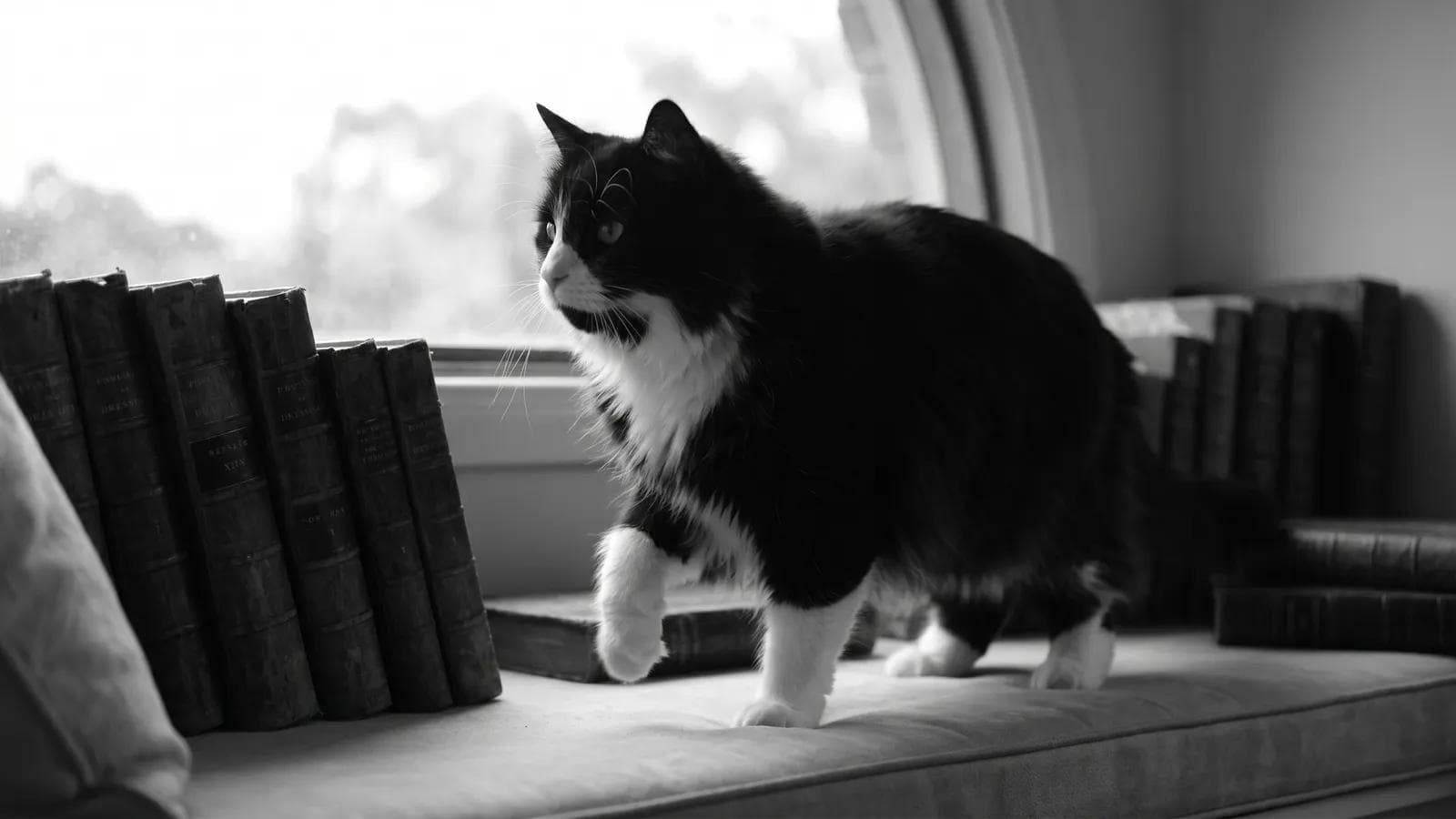
I'm performing adequately. This is not a complaint. It is an observation.
I have years of service behind me, a reasonable response time on the morning protocol, and a demonstrated willingness to provide pats during yard supervision, which Vino has made clear is expected and non-negotiable. My desk-side manner remains imperfect, but I've seen worse. I showed up at the barn. I kept showing up. I eventually came to understand, at least partially, what had been asked of me.
Vino, for his part, has not reduced his expectations. He has no intention of doing so. He arrived in our home with a set of requirements, a natural bow tie, and years of experience managing an agricultural workforce, and he has applied all of it with the quiet confidence of someone who has never once doubted that the arrangement is correct.
I presumably have thoughts about this. I have not been asked for them.
The performance review, as always, runs one direction only.