
Sex tells you very little about what a tuxedo cat will be like to live with, and coat pattern tells you nothing at all.
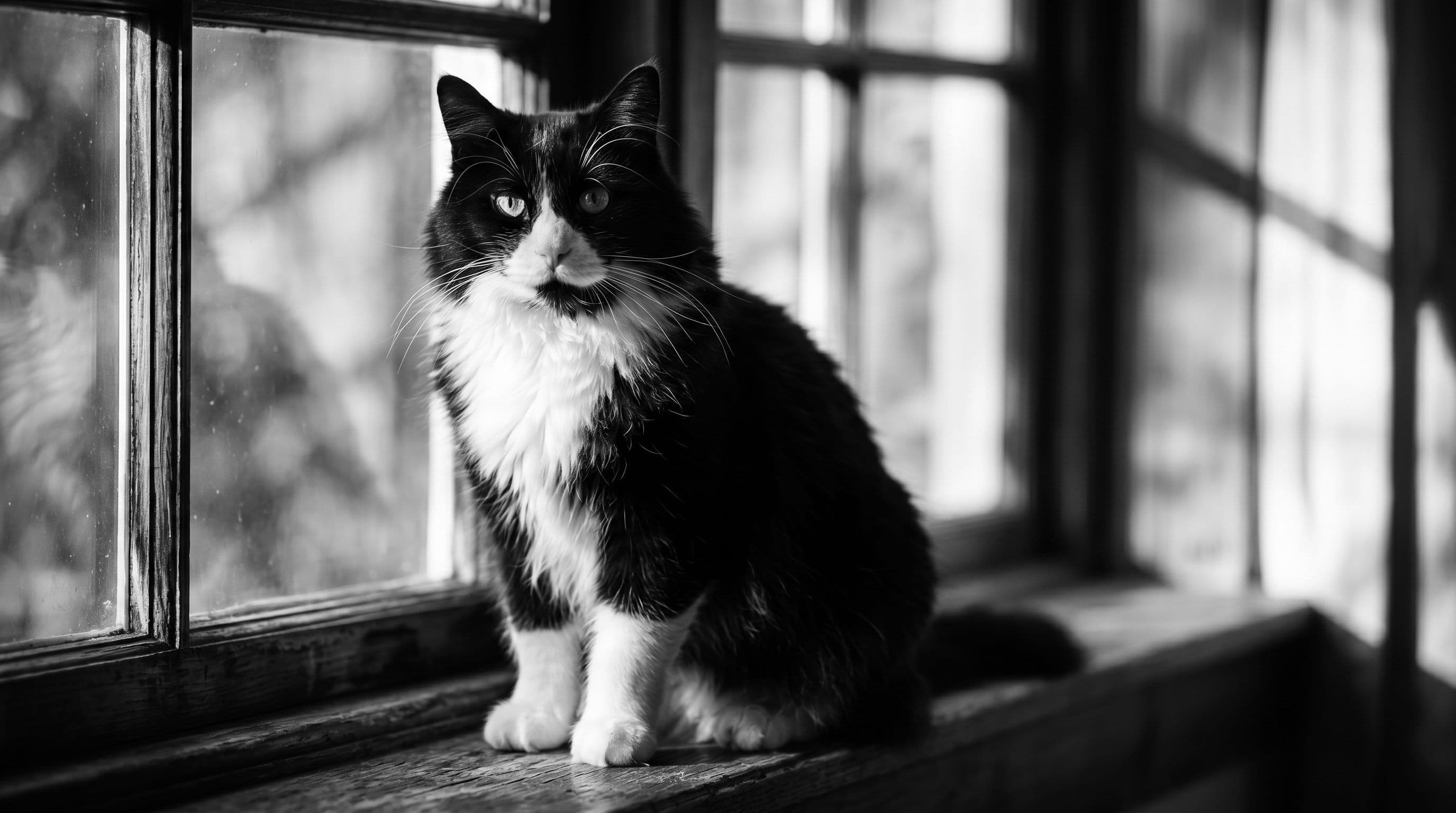
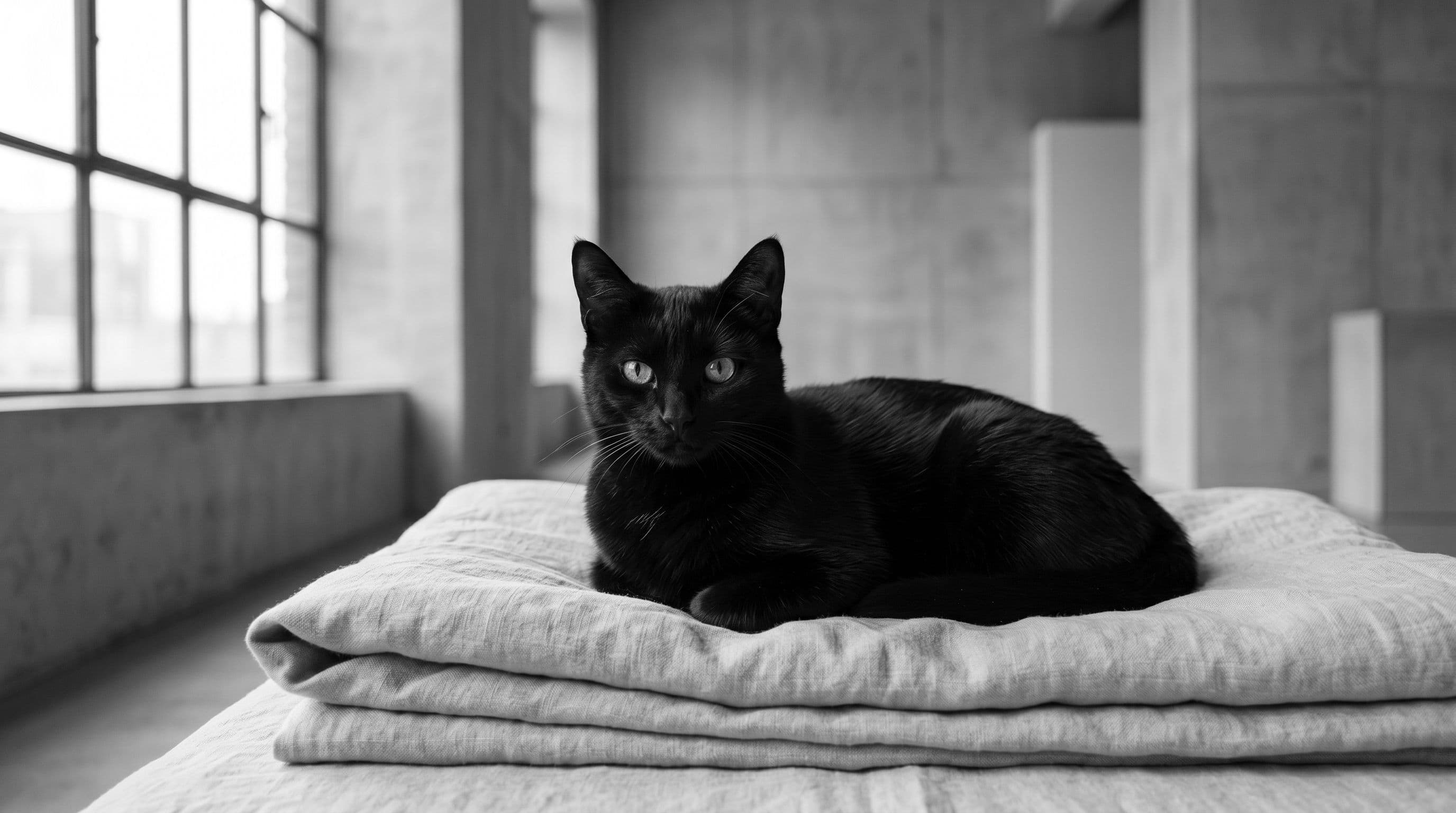
I've had one of each since 2022. Vino is 6 kg of medium-long-furred opinion who came off a biodynamic winery in northern Tasmania. Zola is black, slender, roughly 3.9 kg, reserved, and carries a small white patch on her tummy. They share the same house, the same food, the same cat tower, and the same afternoon hours in the yard.
If sex were the dominant variable, years of identical conditions should have produced some convergence. It hasn't. They remain almost perfect opposites, and the reasons are more interesting than chromosomes.
What the Research Actually Says About Coat and Temperament
The honest version of this is more qualified than most articles admit.
Stelow, Bain and Kass, writing in the Journal of Veterinary Behavior in 2016, surveyed owners of 574 single-breed cats using the Feline Behavioral Assessment and Research Questionnaire. They found some coat-colour and pattern differences in behaviour scores were statistically significant, but nearly all of those were attributable to breed rather than to coat colour itself. A small number of colour-specific associations survived independently of breed, specifically increased aggression in agouti cats and more prey interest in red cats.
So the accurate claim isn't that colour has zero measurable association with behaviour. It's that when you control for breed, almost all of the apparent effect disappears. "Tuxedo" isn't even a breed to control for. It's a pattern that appears across many different genetic backgrounds, which is why no single behavioural profile could attach to it.
What the Tuxedo Pattern Actually Is
Worth being precise here, because this is where a lot of confident nonsense lives.
A 2016 Nature Communications paper by Richard Mort, Christian Yates and colleagues at the Universities of Edinburgh and Bath showed that piebald patches arise because pigment cells move and multiply randomly as the embryo grows, not because of directed cell-to-cell signalling. The white on Vino's chest and paws isn't placed by a plan. It's where randomly dividing pigment cells didn't finish arriving.
Dr Leslie Lyons, the Gilbreath-McLorn Endowed Professor of Comparative Medicine at the University of Missouri and one of the leading feline geneticists, works on the genetics of coat traits including the variable degree of white spotting. It remains an active research area.
Note what that description contains: embryonic timing and cell movement. Nothing in it concerns the animal's temperament, and nothing in it concerns the animal's sex.
Are Male Tuxedo Cats Bigger Than Females?
Yes, on average, and this is the one real sex difference worth stating.
A 1993 study in the International Journal of Neuroscience examining body and brain weight in domestic cats found that males weighed more than females overall, confirming sexual dimorphism in body weight. Worth noting carefully: that study did not report a specific average kilogram difference, so anyone quoting you a precise gap is going beyond what it established.
In this house the gap is about 1.5 kg, with Vino at 6 and Zola at 3.9. That's one household of two cats, which is an anecdote and not a dataset. Individual variation within each sex is large, and frame, activity and diet all move the number more than sex does on its own.

What Actually Drives the Difference Between Vino and Zola
Three things, none of them sex.
Early experience. The 2011 AAFP and ISFM Feline-Friendly Handling Guidelines state that socialization and habituation to human handling, starting between 2 and 7 weeks of age, improves feline-human relationships. That window closes early and it closes hard. A kitten handled constantly in those weeks turns into a different adult than one who wasn't, regardless of sex.
Learned strategy. Cats repeat what works. Vino learned at the winery that inserting himself into human activity produced food and attention, so he still does it. Every time I walked into that barn he'd weave between my legs to trip me, then jump onto whatever I was reaching for. He does the identical thing on my desk now. That behaviour is a working strategy that never stopped paying, not a male trait.
Individual wiring. Whatever remains after history and learning. Zola is watchful and economical with her affection. Vino has never had an unexpressed thought in his life.
Vino Is Not a "Typical Male Cat"
People meet him and say it constantly. He's big, he's loud, he drools during cuddles, and he'll claim a guest's lap shortly after they sit down. The label is tidy and it's wrong.
Vino's personality was fully formed before I met him. He'd already spent a couple of years as the barn cat at the vineyard, catching mice and treating human attention as a non-negotiable entitlement, and the family there had been calling him "Messiah" long before I added it to his name. He arrived at my place aged two and a half with all of that already installed.
Then set that against how he handles the neighbour's Staffy, a dog that comes apart at the sight of a cat. Vino lies down about a metre from the fence and simply declines to acknowledge the animal exists. He doesn't flinch, doesn't run, doesn't turn his head. The dog barks itself hoarse. Vino remains still. The ignoring is the provocation, and it's the most effective thing he does.
Is that male behaviour? Zola wouldn't go near that fence. But I don't think that's because she's female. She didn't spend her formative years learning that calm indifference is a power move.
Their dynamic isn't male and female. It's extrovert and introvert. Vino loves Zola and wants to play constantly. Zola finds this exhausting and says so through hissing, though they'll also share a windowsill, smooch, and sleep close to each other without ever quite cuddling. I've met plenty of male cats who are far more Zola than Vino.

What Is the Tuxedo Cat Gender Ratio?
This question usually comes from a good instinct and a wrong premise.
People ask it because they've heard that certain coat traits track with sex, and they reasonably wonder whether tuxedo is one of them. The mechanism behind the tuxedo pattern is the white spotting described above: pigment cells migrating and dividing randomly during embryonic development, as Mort and colleagues demonstrated. That's a developmental process, and the research describing it doesn't frame it in terms of the animal's sex at all.
I'm not going to hand you a percentage split, because I don't have a source I trust for one, and a made-up number is worse than no number. What I can tell you is that the pattern shows up freely across both sexes and across many different breeds, and that in practical terms the sex of a tuxedo cat you're considering tells you approximately nothing about whether they'll suit your household.
Do Male and Female Tuxedo Cats Get Along?
This is usually the question underneath the question, because most people asking about male versus female are really deciding on a second cat.
Dr Sharon Crowell-Davis, Professor of Behavioral Medicine at the University of Georgia College of Veterinary Medicine, has documented that cats live in matrilineal colonies with individual recognition, dominance hierarchies, and cooperative behaviour. Cats aren't solitary by nature so much as selective, and the structures they form are built around related females. That's a poor fit for the folk model where you pick a male and a female and expect the pairing itself to do the work.
What matters far more is whether the house gives them room to avoid each other. The 2013 AAFP and ISFM Feline Environmental Needs Guidelines recommend that multi-cat households have as many separate resource locations, including elevated resting areas, as there are cats, positioned out of sight of one another so cats aren't forced to compete or pass through another cat's space.
Vino and Zola work as a mixed-sex pair, but not because of the mix. They work because there's enough vertical space and enough exits that Zola can decline his invitations. They used to hold a cat tower standoff, both sitting in it, each waiting for the other to give up first. I haven't seen that one in a while. My honest suspicion is that a good deal of their hissing is performative, since it escalates noticeably when people are home to watch.
Which Sex Is More Affectionate?
Neither, and the affection question has a better answer than the sex question does.
A 2019 Oregon State University study published in Current Biology found that 64.3% of cats showed a secure attachment to their caregiver, closely mirroring the rate seen in human infants. Secure attachment is the majority position for cats generally. It isn't a prize awarded to one sex.
Vino drools during cuddles, sits on my lap on the couch, sleeps on me in bed, and gets on the desk specifically to be in the way. Zola expresses affection at a fraction of the volume and roughly a tenth of the frequency. Both cats are attached. One of them is simply louder about it, and that difference was set long before either arrived here.
Should I Choose a Male or Female Tuxedo Cat?
Spend time with the specific animal instead of the category.
Fifteen minutes in a neutral room with a cat will tell you more than any sex-based checklist. Ask whoever has been fostering or housing them about history, triggers, and how the cat handles noise, handling, and strangers. Those answers predict your daily life together. "Male" and "female" don't.
If I'd chosen Vino from a description, I'd have got "confident, vocal, food-motivated adult male" and formed a picture that missed everything that makes living with him what it is. The description wouldn't have mentioned that he waits for the rooster before demanding breakfast, or that he'll walk into the house alongside anyone who happens to arrive while he's outside, or that he produces a single sustained protest meow, same tone and volume, for five seconds or more when he isn't let out on request.
None of that is male. All of it is Vino.