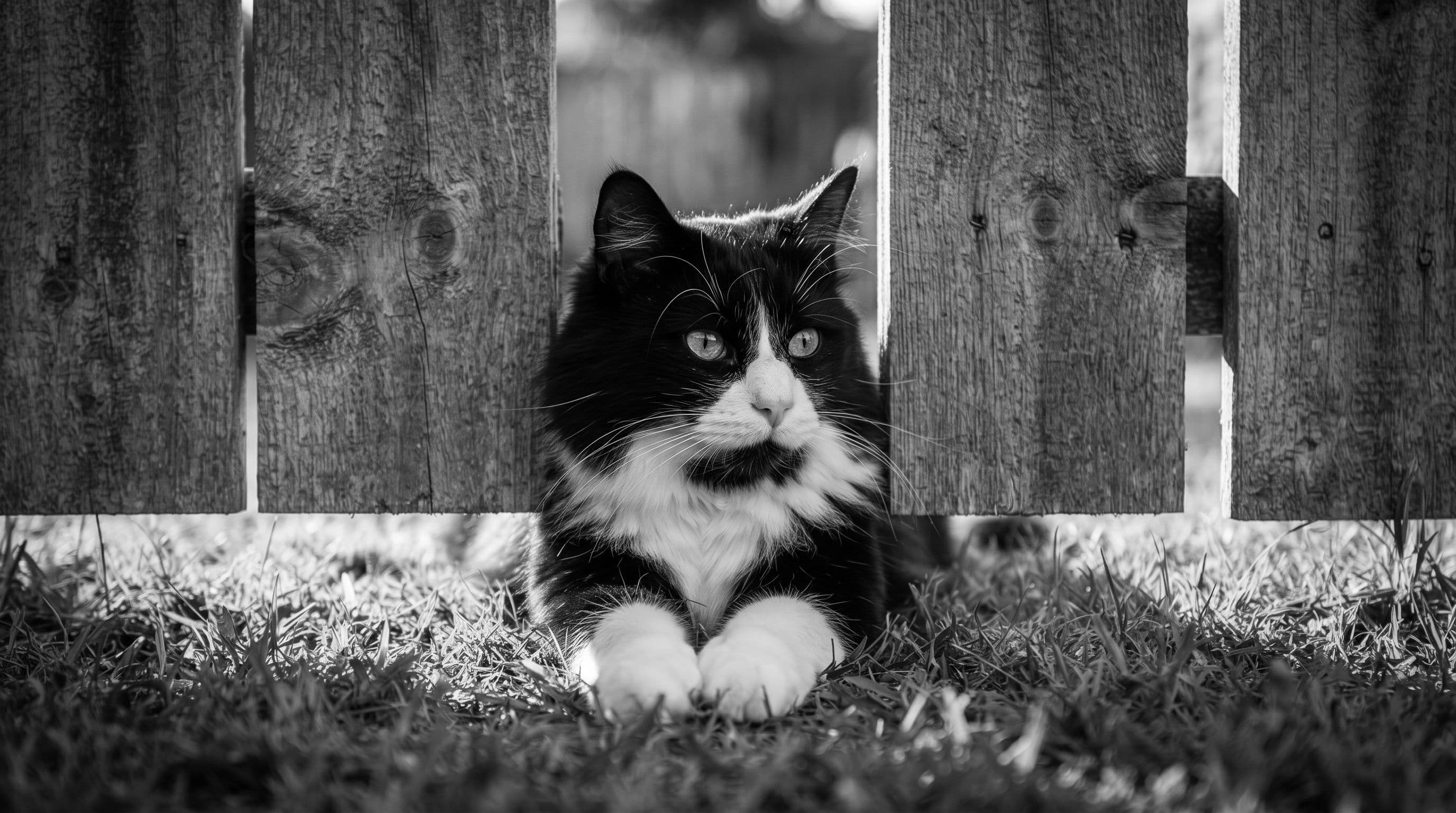
The neighbour's Staffordshire Bull Terrier was losing its mind again, barking in staccato bursts that rattled the fence palings, and Vino was doing absolutely nothing about it. He'd positioned himself roughly a metre from the boundary, belly flat on the grass, front paws crossed, green eyes fixed on a point somewhere beyond the hills of northern Tasmania. The dog was frantic. Vino was serene. I stood at the kitchen window holding a mug of tea, watching my tuxedo cat and dogs interact for probably the 200th time, and what struck me wasn't Vino's calm; it was his precision. He'd chosen that exact spot because it was close enough to be seen through the fence gap but far enough that no paw could reach him. This wasn't indifference. It was strategy.
That scene plays out several times a week in our yard, and it's shaped how I think about introducing cats to dogs more broadly. Most guides treat the topic as a simple management exercise: use baby gates, keep the dog leashed, reward calm behaviour. All of that's valid. But none of it accounts for what I've learned living with a cat whose entire approach to canine encounters is built on spatial intelligence and deliberate provocation.
Tuxedo Cat and Dogs: Why Coat Pattern Doesn't Predict Temperament
I'll say this plainly: the fact that Vino is a tuxedo has nothing to do with how he handles dogs. Tuxedo is a coat pattern, not a breed, not a personality profile. Vino's a bicolour domestic cat with medium-long fur, a white chest bib, and a black chin that forms a natural bow tie shape. His confidence around the Staffy next door comes from his history as a working mouser on a biodynamic vineyard, not from his markings.
I mention this because the internet is awash with claims that tuxedo cats are "bolder" or "more dog-friendly" than other colour patterns. I haven't found a single piece of credible veterinary literature supporting that claim, so I won't repeat it here. What I can tell you is that individual temperament, early socialisation, and the specific dog in question matter enormously. Vino's approach to the Staffy would look nothing like his approach to, say, a calm elderly Labrador Retriever. The dog's breed, energy level, and prey drive change the equation entirely.
If you're hoping your tuxedo cat will automatically befriend your dog because of some coat-pattern magic, I'd gently suggest recalibrating those expectations.
The Fence Line Protocol: What Vino's Behaviour Actually Teaches
Vino's interactions with the neighbour's Staffy aren't introductions in any formal sense. They're boundary negotiations conducted entirely on Vino's terms, and they've taught me 3 principles I now consider essential for any cat-dog pairing.

First: the cat must control the distance. Vino always chooses how close he gets to that fence. He didn't approach when the Staffy was already at the boundary; he settled into his spot first, often before the dog even noticed him. This mirrors what good introduction protocols recommend: let the cat dictate proximity. A cat who's been carried into a room with a dog has lost that control before the interaction begins.
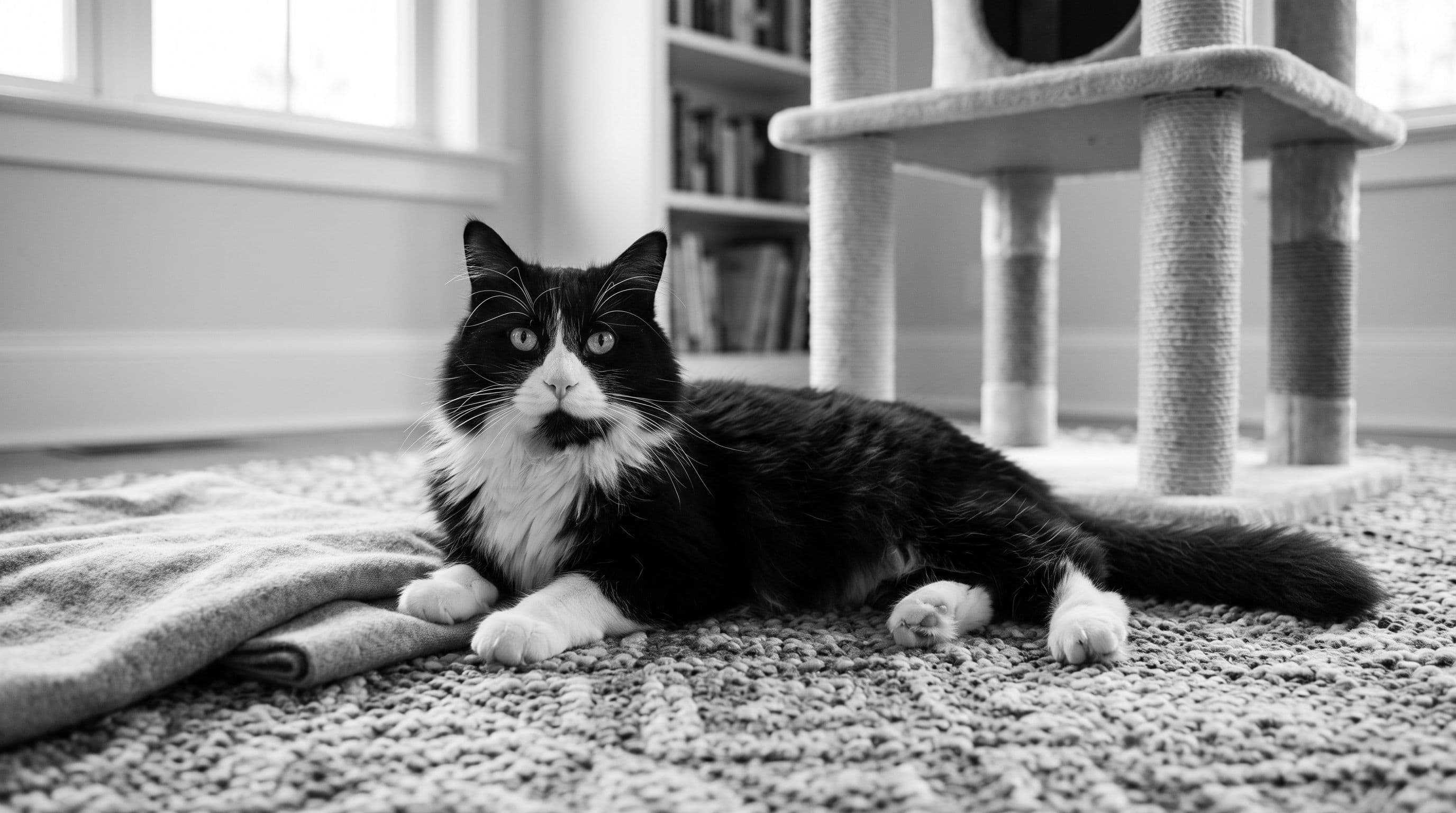
Second: elevated ground changes everything. Vino uses this principle with our rooster, who can be aggressive enough that Vino's genuinely a little intimidated. His workaround is to find a high perch near the flock where the rooster can't reach him. The same logic applies to dogs. A cat tree, a bookshelf, a tall piece of furniture: these aren't luxuries during introductions; they're escape architecture. Vino's 6 kg frame looks entirely different to a dog when it's positioned 2 metres above the floor versus flat on the ground.
Third: stillness is a tool. The Staffy went berserk precisely because Vino wouldn't react. He doesn't run, which would trigger a chase instinct. He doesn't hiss, which would escalate arousal. He lies there like a stone monument to feline composure. For anyone managing a real introduction at home, this principle translates directly: a cat who freezes or holds still is managing the situation better than a cat who bolts.
Preparing Your Home Before the First Meeting
Before any tuxedo cat meets any dog, the physical environment needs to be set up properly. I'm not talking about complicated renovations. I'm talking about the spatial planning Vino does instinctively every time he picks his spot by the fence.
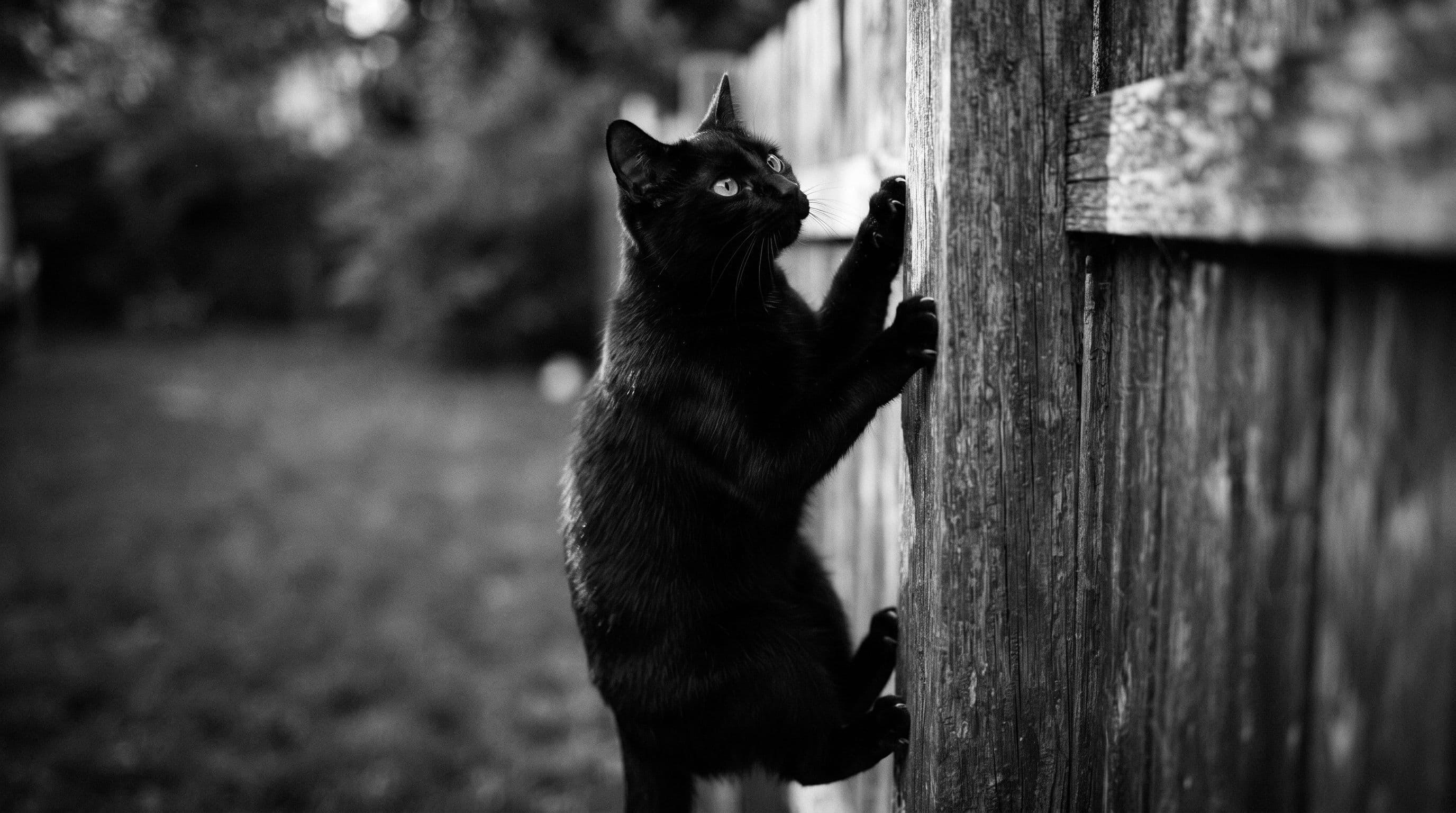
Vertical escape routes in every shared room. Cat towers, wall-mounted shelves, the top of a sturdy wardrobe. If your cat can't get above the dog's head height within 2 seconds from any point in the room, you haven't prepared enough. When Zola, our 3.9 kg black cat, first encountered the chickens in the yard, she went straight up a fence post. Cats who feel trapped behave unpredictably; cats with an exit stay calmer.

Scent swapping before visual contact. This one's boring but it works. For a full week before any face-to-face meeting, swap bedding between the cat's space and the dog's space. Let them build a scent profile of each other. Vino's medium-long fur deposits scent on everything he touches, which is essentially every surface in our house, so any visiting animal already knows he exists before they've laid eyes on him.
Separate feeding stations with physical barriers. Vino has zero food self-regulation. Give him a bowl and he'll empty it in one sitting. A dog near his food would trigger resource guarding in even the calmest cat. Feed the animals in entirely separate rooms, behind closed doors, for the first several weeks minimum.
If you're also managing multi-cat dynamics at home, the complexity multiplies. Zola's reserved temperament means she'd handle a calm dog differently than Vino would, and any introduction plan needs to account for both cats individually.
The Introduction Sequence That Actually Works
I'll lay this out as the progression I'd follow based on everything I've observed with Vino, Zola, and the various animals that orbit our household.
Days 1 through 7: scent only. No visual contact. The cat and dog live in separate areas of the house. Swap blankets, towels, or bedding daily. Feed both animals near the closed door separating them so they associate each other's scent with something positive.
Days 8 through 14: visual contact through a barrier. A baby gate works. A glass door works. The cat must have vertical escape options on their side. Sessions should last 10 to 15 minutes, twice daily. Watch the dog's body language obsessively: a stiff posture, locked gaze, or forward-leaning weight distribution means the dog isn't ready for more.
Days 15 onward: supervised shared space. The dog stays on a loose lead. The cat roams freely. Never restrain the cat. If the cat chooses to leave, let them. If the cat does what Vino does with the Staffy and simply lies down at a chosen distance, gazing past the dog with supreme disinterest, you're in excellent shape.
This timeline isn't rigid. Some pairings need 4 weeks of scent-only work. Some cats, like Vino, would probably stroll past a calm Greyhound on day 3 without breaking stride. Read both animals, not the calendar.
When It Isn't Working: Honest Signs to Recalibrate
Not every cat-dog pairing will succeed, and I think people don't hear that often enough. A tuxedo cat and dogs aren't guaranteed companions just because the internet says cats and dogs "can" get along.
Signs you need to slow down or seek professional help from a certified animal behaviourist: the cat stops eating, hides for more than 12 hours at a stretch, or begins eliminating outside the litter box. On the dog's side, any fixation behaviour, lunging, or whining that doesn't diminish over 2 weeks of controlled exposure means the dog's prey drive may be too high for safe cohabitation.
Vino's boldness is unusual. His background as a vineyard working cat in Tasmania exposed him to dogs, wildlife, machinery, and people from a young age. Zola, by contrast, would not handle a high-energy dog well. She already finds Vino's constant attempts to play with her exhausting, and she expresses those feelings through hissing. A boisterous dog would send her behind the washing machine indefinitely.
The honest answer is that you need to assess your specific cat and your specific dog. Breed tendencies in dogs matter: a Cavalier King Charles Spaniel presents a different risk profile than an American Pit Bull Terrier. And your cat's history matters more than their coat pattern.
For more on how Vino handles other animals in the household, including his complicated relationship with our rooster, the multi-species dynamics post covers the personal anecdote side of living alongside chickens and cats in detail.
> Vino's Verdict: Years of watching Vino provoke the neighbour's Staffy from a carefully chosen spot one metre from the fence have convinced me that cats who control the distance, pace, and terms of a dog interaction will almost always manage it well. The cats who struggle are the ones who never get the chance to choose. Give your tuxedo cat vertical space, time, and the freedom to walk away, and they'll often surprise you with how calmly they handle a dog.