
Zola's first night in our house, she spent 6 hours behind a washing machine in the laundry. I could see one green eye and the faint outline of a white belly patch glowing under the drum. Vino sat on the other side of the closed laundry door producing his signature protest meow: a single, sustained, unchanging note held for a solid 5 seconds, repeated at strategic intervals. He wasn't scared or curious. He was offended that a door in his house had been closed without his permission. That night was our introducing second cat experience in miniature, and it taught me the hardest part wasn't managing aggression or fear; it was managing a 6 kg tuxedo cat's conviction that every room, surface, and lap belongs exclusively to him.
Introducing a Second Cat When Your First Cat Thinks He's an Only Child Forever
What that first night revealed is something I've never seen addressed in the usual advice about multi-cat households. The guides talk about territorial aggression, scent familiarity, resource guarding. They don't talk about the cat whose primary emotional register is indignation.
Vino arrived from a small biodynamic vineyard in northern Tasmania, where he'd spent roughly 2 years as the sole barn cat: catching mice, demanding attention from winery staff, and generally behaving as though the entire property existed for his entertainment. When I brought him home in April 2022, he transferred that same energy to our house without missing a beat. He meows constantly. He gets on my desk and sits on my keyboard. He follows me through the yard demanding pats. He is, in every sense, a cat who assumes the world revolves around him.
So when my fiancée and I decided to get Zola a few months after Vino arrived, I knew we weren't just adding a second cat to a household. We were adding a second cat to a monarchy.
Zola is Vino's opposite in almost every measurable way. She's black with a small white patch on her tummy, about 3.9 kg, slender, reserved, and fundamentally uninterested in performing for an audience. If Vino is the cat who walks between your legs to trip you, Zola is the cat who watches from across the room and judges you both.

The mismatch in temperament turned out to be both our biggest challenge and, eventually, our saving grace.
How Our Introduction Differed from the Textbook Approach
Most multi-cat introduction guides I read before bringing Zola home followed the same framework: separate rooms for a week, scent swapping via blankets, feeding on opposite sides of a closed door, then supervised visual contact. It's solid advice. I followed it. But I had to adapt it significantly because these guides assume two relatively standard cats, and Vino isn't standard anything.
The scent-swapping phase, for example, lasted about 10 days in our house. I'd take a cloth, rub it on Zola's cheeks, and place it near Vino's food bowl. The guides say to watch for hissing or avoidance. Vino did neither. He sniffed the cloth once, looked at me with what I can only interpret as contempt, and then sat on it. Not next to it. On it. Claiming it. He did the same thing with Zola's blanket when I left it on the couch. He didn't reject her scent; he annexed it.
The feeding-on-opposite-sides-of-the-door phase went smoother. Vino's zero food self-regulation worked in our favour here: he'll eat anything, anywhere, regardless of what's happening on the other side of a wall. His focus on food is absolute. I put his bowl 30 centimetres from the laundry door, and he ate without pausing, even when Zola scratched at the gap underneath.
Where things got complicated was the first supervised face-to-face meeting, about 3 weeks in. I opened the laundry door with Vino on a short lead (yes, he tolerated a harness, barely). Zola stepped out slowly. Vino lunged forward; not to attack, but to sniff her with the subtlety of a freight train. Zola hissed, swatted, and retreated behind the washing machine again.

That pattern repeated for about 4 days. Vino: enthusiastic, physical, zero concept of personal space. Zola: appalled by all of it.
The breakthrough, if I can call it that, didn't come from any technique I'd read about. It came from the cat tower.
The Cat Tower Standoff and What It Actually Taught Me
We had a multi-level cat tower in the living room, and within the first week of shared space, both cats discovered they wanted the same middle platform. Neither would yield. They'd sit on separate levels, staring at each other, sometimes for 45 minutes. No hissing during these standoffs. No swatting. Just two cats locked in a battle of patience that would make a chess grandmaster weep.
I believe this is where they actually learned to coexist. Not through our careful scent-swapping protocol or the feeding schedule, but through their own stubborn, silent negotiation on a piece of carpeted plywood.
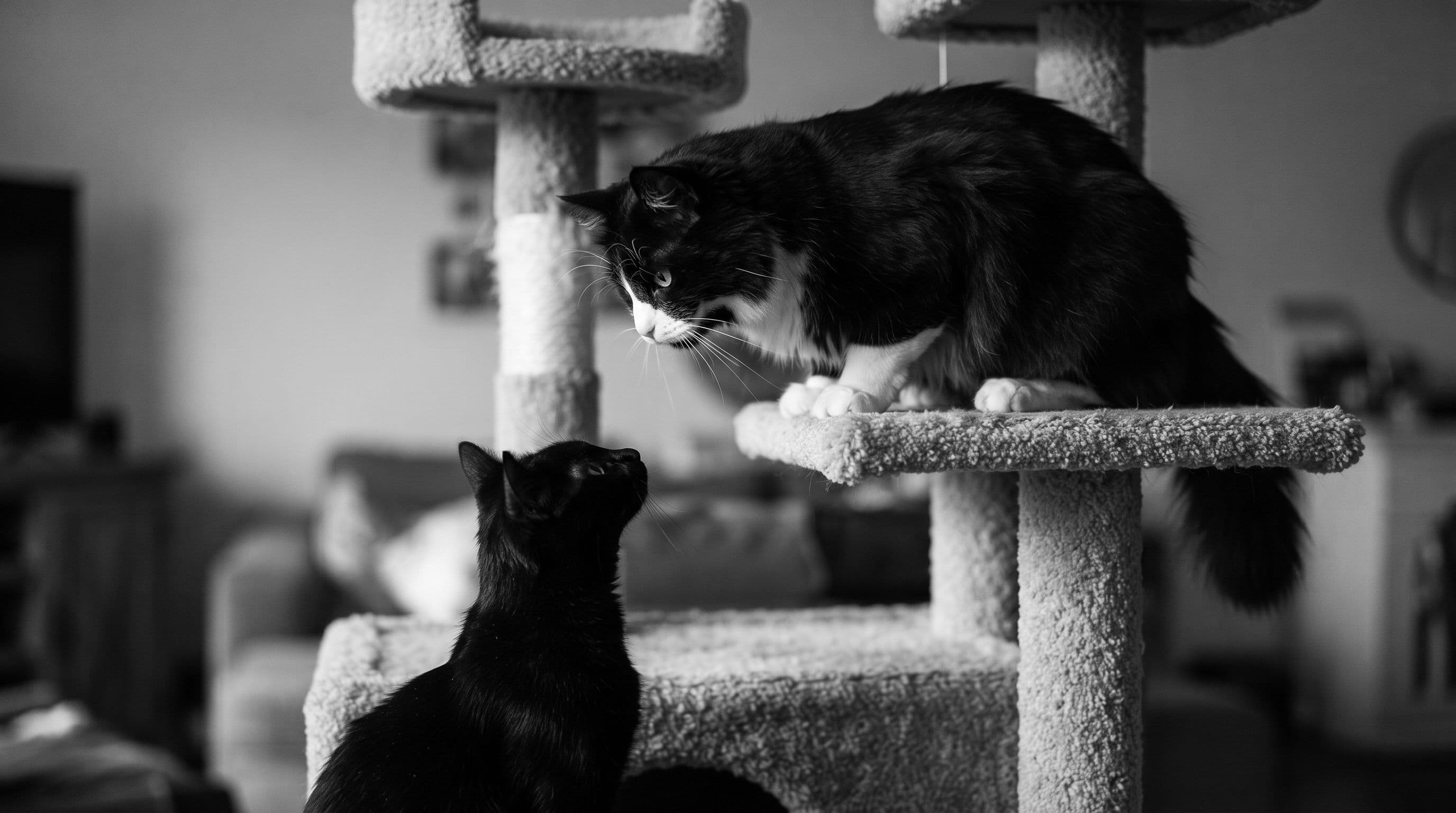
Today, Vino loves Zola and wants to play with her constantly. Zola finds this exhausting and expresses her feelings through hissing. They'll smooch each other, share a windowsill, and sleep close together, but they never actually cuddle. Their hissing dramas are, I suspect, at least partly performative: they tend to escalate when my fiancée and I are home and watching, then mysteriously subside when we leave the room.
If you're reading this because you're about to attempt introducing a second cat, here's the angle I think gets overlooked entirely. The introduction process isn't a single event with a pass/fail outcome. It's the beginning of a relationship that will keep renegotiating itself for years. Vino and Zola's dynamic at month 2 looked nothing like month 6, which looked nothing like year 2. The cat tower standoff hasn't even been observed recently. Something shifted between them that I didn't orchestrate and can't fully explain.
Practical Steps That Actually Worked in Our House
Based on roughly 3 and a half years of watching these two figure each other out, here's what I'd tell someone preparing to bring a second cat home to a resident cat with a strong personality.
Separate spaces aren't optional. Zola needed that laundry room. She spent 6 hours behind the washing machine on night one because she needed a space that didn't smell like Vino. We kept her there for over a week with her own litter box, water, and food before any visual introduction. If you're looking for more on how we manage shared spaces and territory with multiple cats, the reality is messier than any diagram suggests.
Match the timeline to the shy cat, not the bold one. Vino was ready for a face-to-face meeting on day 2. Zola wasn't ready until week 3. The introduction moved at Zola's pace, full stop. Pushing it faster would have served Vino's impatience and nobody else.

Provide vertical territory. This is the single most useful physical change we made. A second cat tower, a cleared bookshelf, a window perch: anything that lets cats occupy the same room at different heights reduces ground-level tension. Our cats worked out their hierarchy on vertical surfaces, not on the floor.
Don't intervene in every hiss. This one took me a while. Early on, I'd separate them at the first sign of tension. Over time, I learned to distinguish between a genuine warning hiss and the performative variety. Zola's genuine warning is lower, shorter, and accompanied by flattened ears. Her performative hiss is almost theatrical: ears still up, body relaxed, delivered while she's already turning away. Understanding that distinction changes everything, and I've written more about reading your cat's body language and signs of anxiety in a separate post.
Feed separately, always. Vino has zero food self-regulation. He'll eat his portion and then Zola's without hesitation. We feed them in different rooms with the door closed. This isn't a temporary introduction measure; it's permanent household policy.
Accept the relationship they build, not the one you imagined. I wanted them to cuddle. They don't. They smooch, share sunbeams, and chase each other through the yard during their 1 to 2 hours of afternoon outside time. That's their version of closeness, and it took me a while to stop measuring it against some imagined ideal.