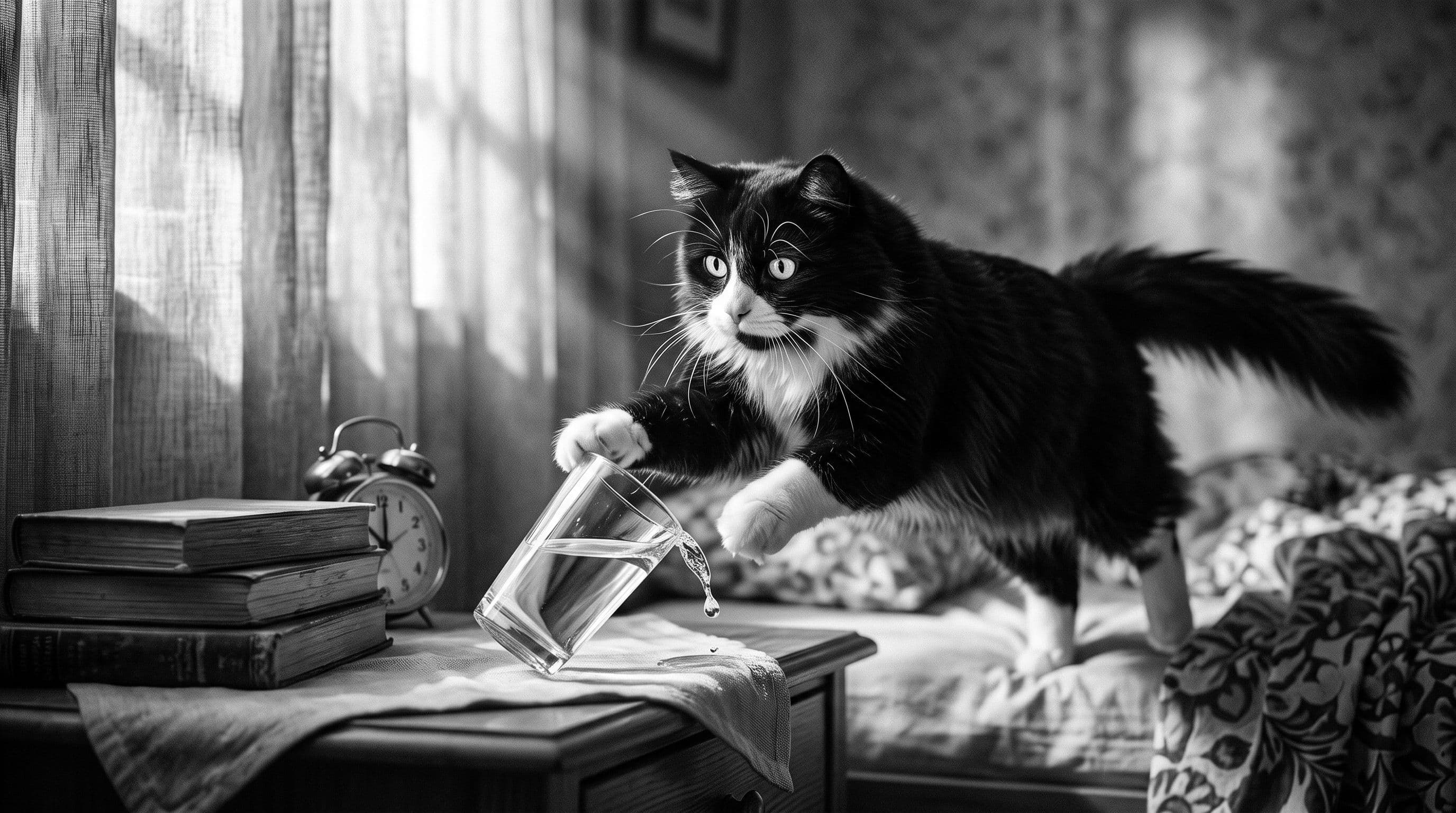
The water glass hit the floor first, then the pen vanished under the couch, and by the time I'd peeled my face off the pillow Vino was sitting on my keyboard like a 6 kg tuxedo paperweight who'd already won the argument. At the old house he'd heard the rooster and decided I was late to my duties, so he escalated: bedside table ambush, five-second protest meow, and a slow deliberate walk across every surface I needed. Years of living indoors together, and his talent for generating household chaos hasn't dulled at all. It's gotten sharper, honestly, like he's been refining his methods. Indoor cat enrichment didn't start as some enlightened lifestyle choice for me; it became a survival strategy born from sharing 90 square metres with a creature who considers a quiet morning a personal failure.
What I've learned is that most indoor cat enrichment advice online reads like a shopping list: buy this puzzle feeder, buy that electronic toy, problem solved. But the cats who live in your house aren't generic. Vino and Zola have completely different enrichment needs, different energy peaks, and different thresholds for overstimulation. So what follows isn't a one-size-fits-all checklist. It's fifteen specific strategies I actually use, tested on two cats with opposing personalities in a real household in northern Tasmania.
Structured Outdoor Access Changes Everything Indoors
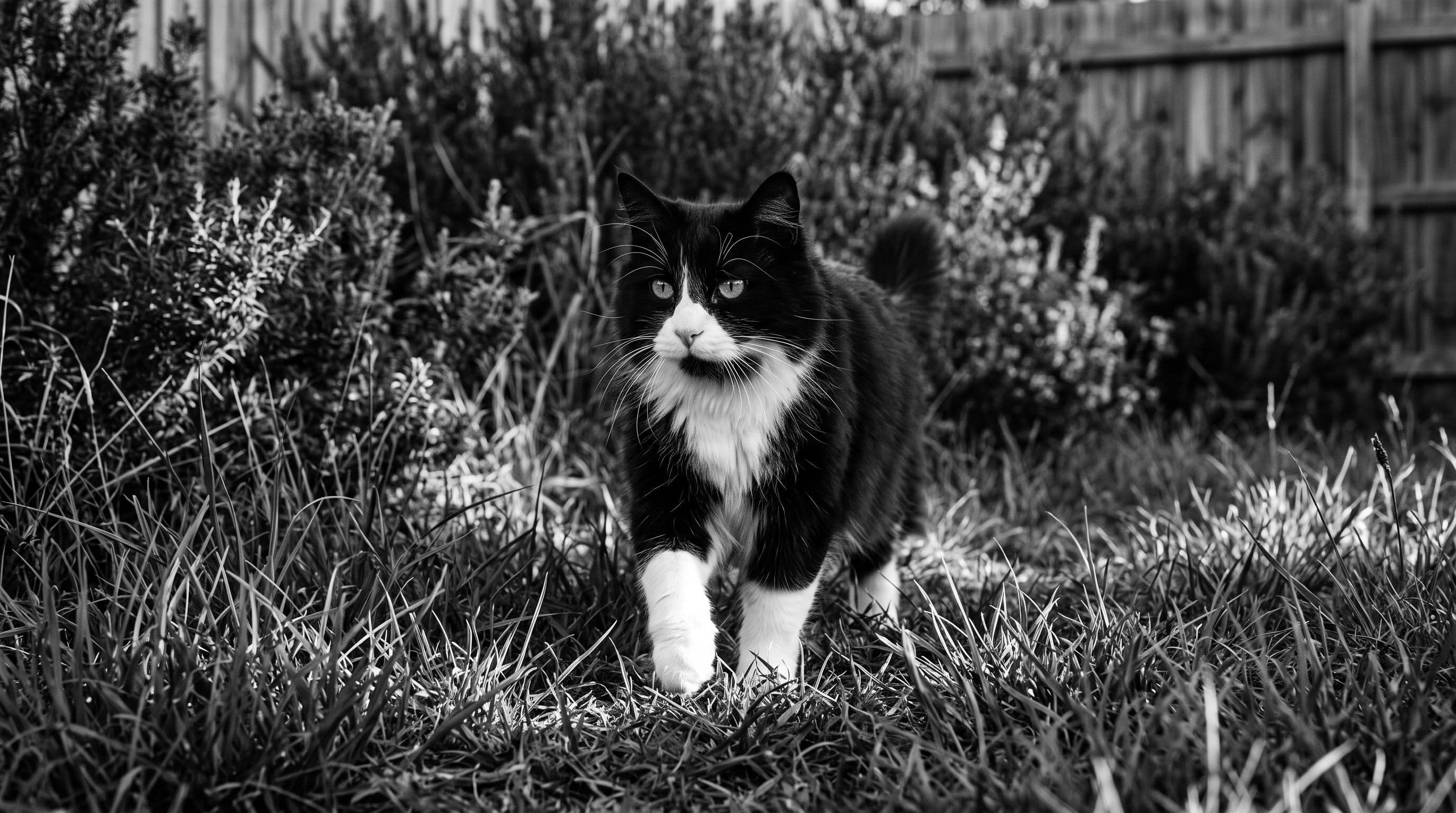
This is the contrarian bit, and I'll say it plainly: the single biggest factor in Vino's indoor contentment is that he isn't exclusively indoors. He and Zola go outside every afternoon for one to two hours before dinner, and sometimes in the mornings if there's time. I know the indoor-only position well, and I respect the reasoning behind it. The UC Davis School of Veterinary Medicine notes that indoor cats average 10 to 15 years, while cats that live outdoors average as little as 2 to 5 years, and the wildlife toll of free-roaming cats is well documented too. Those numbers haunt me. But Vino came from a working life at a biodynamic vineyard where he caught mice and roamed freely; stripping that entirely would've been its own kind of cruelty.
So we compromise. Supervised outdoor time in a fenced yard, with the understanding that at the old house Vino occasionally cleared the fence into the bush for 20 minutes, during which I age approximately three years. The result indoors is a calmer, more settled cat. The AAFP's Indoor/Outdoor Lifestyle position statement, updated in 2024, recommends that cats in urban and suburban areas be kept indoors or given only supervised or securely enclosed outdoor access, such as catios, harness walks, or fenced enclosures, because of risks including traffic, predators, disease, and human cruelty. Vino's history is outdoors, and I can't erase that, but I can meet him halfway with a setup that keeps the risks manageable and the cat content.
When he comes back inside, he's noticeably less likely to produce what I call the Sustained Grievance Meow: a single-note, unbroken vocalisation lasting five or more seconds, aimed at whichever closed door offends him most. Outdoor access doesn't eliminate it. Nothing eliminates it. But it reduces the frequency from roughly twelve occurrences per evening to about four.
Vertical Territory Prevents the Zola Standoff Problem
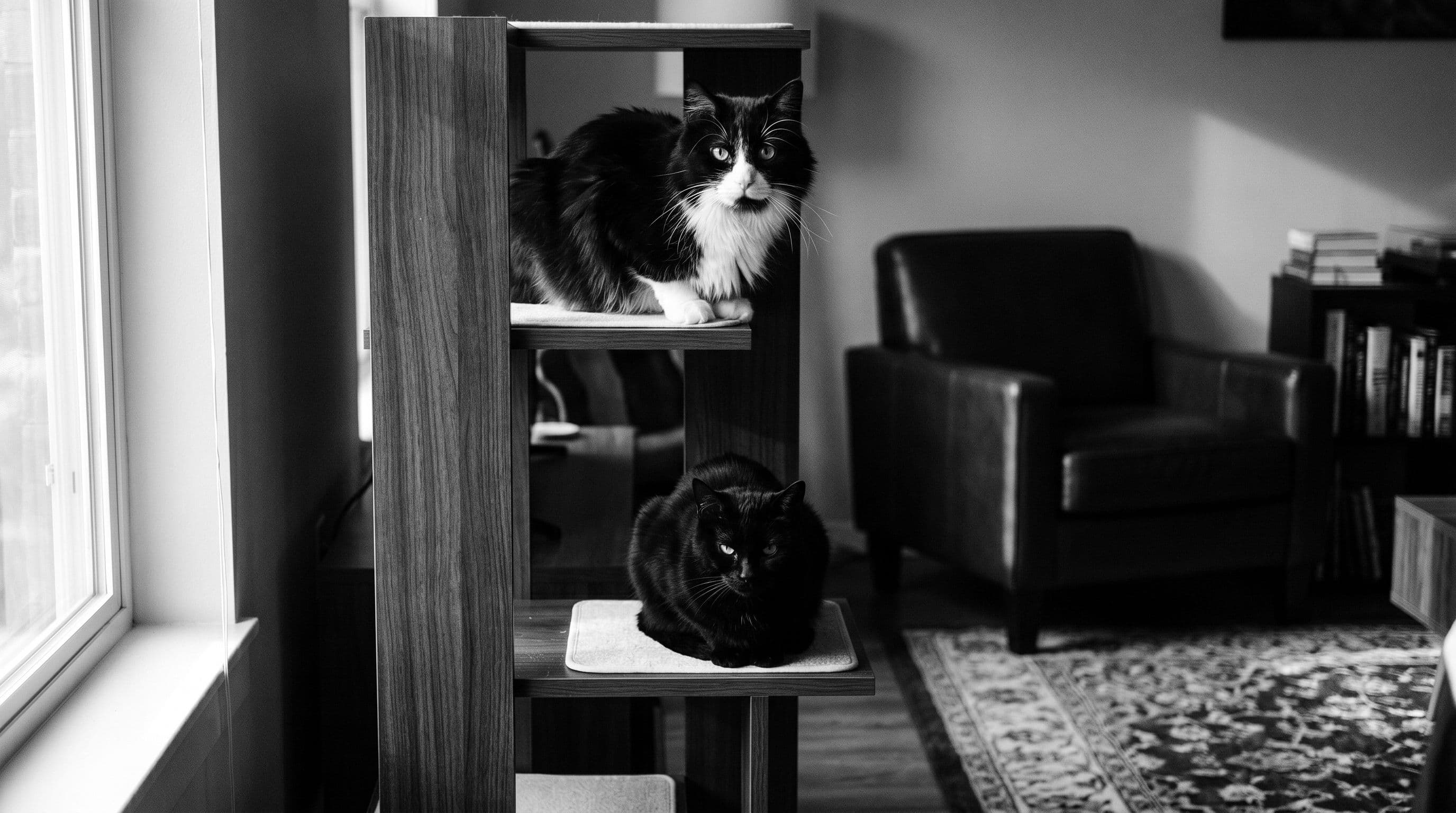
Vino and Zola used to engage in what I called the cat tower standoff: both would sit in the tower and stubbornly wait for the other to leave first. Nobody won. Nobody moved. The tension was operatic. I haven't observed this particular behaviour recently, and I credit the addition of vertical territory throughout the house.
Here's the maths. The AAFP and ISFM's Feline Environmental Needs Guidelines recommend roughly as many separate resting and resource spots as you have cats, positioned out of sight of one another, and that tracks with everything I've observed living with Vino and Zola. That means our two-cat household needs a minimum of three elevated options. We currently have six: two cat towers, two wall-mounted shelves, a cleared bookshelf section, and a windowsill in the kitchen that Vino has unilaterally claimed for smelling fresh air.
The difference this makes to indoor cat enrichment is enormous. Zola, who's naturally reserved and slender, prefers height. She'll choose the tallest shelf available and observe the household from a position of quiet authority. Vino, who loves being in the middle of everything, tends toward the lower perches and the windowsills; he wants to be near the action, not above it. Giving them separate vertical lanes means fewer hissing incidents, which I'm about 60 percent sure are performative anyway since they escalate dramatically whenever my fiancée and I are watching.
If you want to understand more about why tuxedo cats like Vino behave differently in multi-cat dynamics, I've written about that elsewhere.
Rotation Schedules Keep Toys From Becoming Invisible
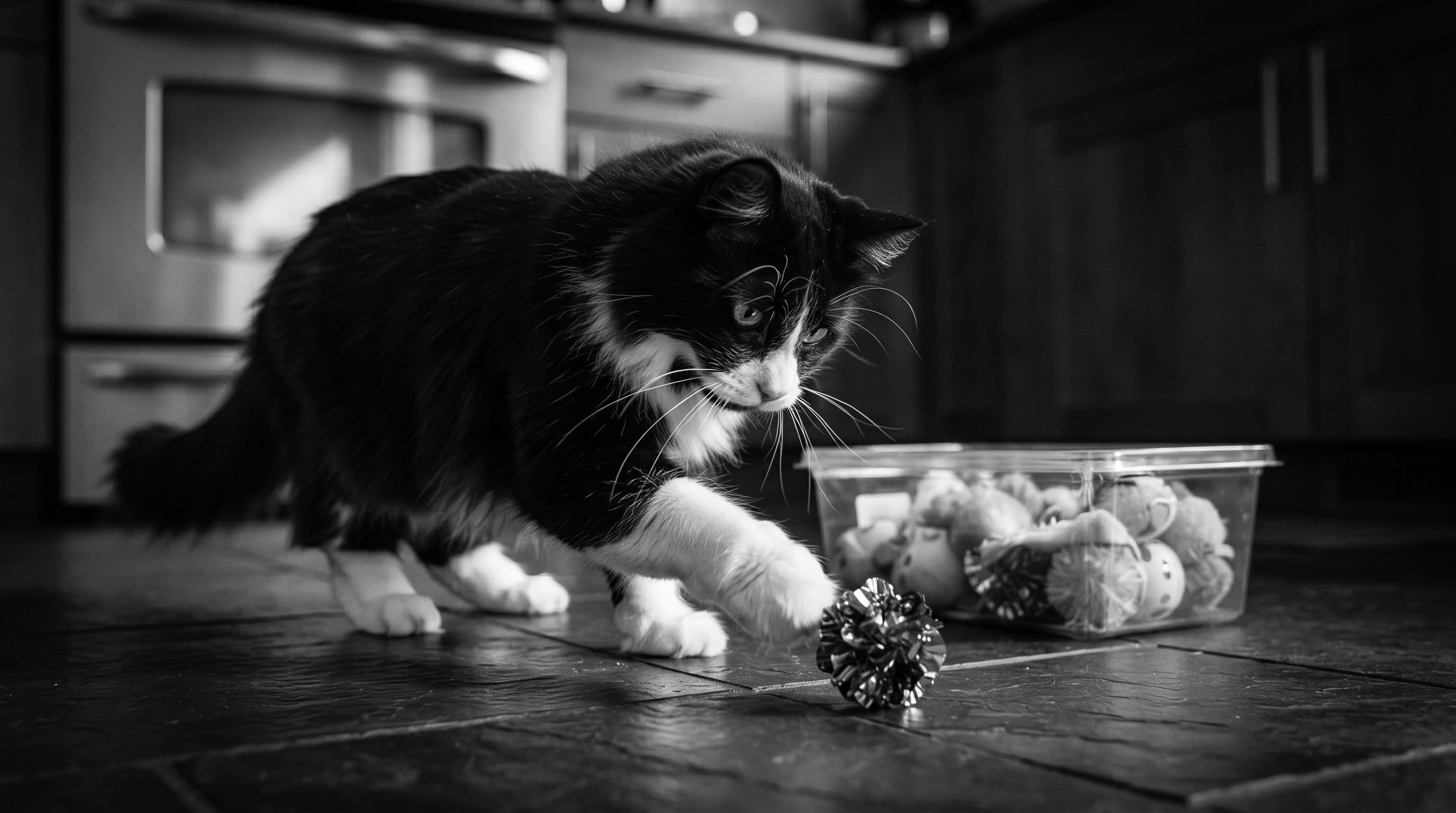
I own approximately 30 cat toys. At any given time, eight are available. The rest live in a sealed container on top of the fridge, and every Sunday I swap in a fresh batch of four while retiring four others. I didn't invent this concept. Dr Mikel Delgado, a certified applied animal behaviourist who completed her PhD in psychology at UC Berkeley and researched feline behaviour as a postdoc at the UC Davis School of Veterinary Medicine, co-wrote Total Cat Mojo and Play With Your Cat!, and her body of work on feline enrichment is part of what convinced me rotation was worth the weekly effort. Vino treats every Sunday swap like Christmas morning, pouncing on a crinkle ball he last saw three weeks ago as though it just materialized from another dimension. A static pile of mice and feathers sitting in the corner wouldn't get that reaction. Rotation does, reliably, and I'm surprised more people don't bother with it.
Vino's response to a "new" toy he hasn't seen in three weeks is indistinguishable from his response to an actually new toy: immediate pouncing, followed by the batting-under-the-couch manoeuvre, followed by loud meowing until I retrieve it. A crinkle ball he ignored completely in week two will become his obsession in week five. The rotation tricks his brain into treating familiar objects as novel, and novelty is the engine of enrichment.
Zola, for the record, doesn't care about toys. She cares about cardboard boxes. I keep three boxes of different sizes in various rooms, and she rotates herself through them on her own schedule with no input from me required.
Scent Enrichment Is Underrated and Nearly Free
This is the angle I don't see discussed enough in competing enrichment guides: scent. Cats possess an extraordinary number of olfactory receptors, far beyond what we humans carry around in our comparatively dull noses, and I've watched Vino map an entire room just by lifting his chin and sampling the air. Their world is built on smell, yet the enrichment setups I see recommended most often lean almost entirely on visual and tactile stimulation.
Three things I do regularly:
First, I bring objects inside from the yard: a handful of grass, a small branch, a feather if I find one. I place them on a towel on the floor and let both cats investigate. Vino will spend 15 minutes sniffing a single eucalyptus leaf. He gets a look on his face that I can only describe as scholarly.
Second, I rotate the location of their bedding. Cats deposit scent through the glands on their cheeks and paws, so moving a bed from the living room to the bedroom forces them to re-scent the new location, which counts as mental work.
Third, and this one is Vino-specific: I leave a worn shirt on the couch when I leave the house. He makes biscuits on it. The scent association seems to reduce his anxiety about my absence, though I'll admit the evidence for this is purely anecdotal and based on fewer claw marks on the furniture.
Grooming as Enrichment, Not Just Maintenance
Vino has medium-long fur, and he grooms himself extensively. Furballs and the occasional vomit are a fact of life in this house. But I've found that structured brushing sessions serve double duty: they manage his coat and they function as genuine indoor cat enrichment.
He loves being brushed, particularly around his chin and the chest area where his white bib meets the black coat in that natural bow-tie pattern. I use a stainless-steel deshedding comb for the body and a softer bristle brush for the face. Each session lasts about ten minutes, three times per week. During those sessions, he drools. Copiously. I've learned to keep a towel on my lap.
The enrichment value here isn't just tactile. It's social. John Bradshaw, the anthrozoologist who founded the Anthrozoology Institute at the University of Bristol and wrote Cat Sense, argues that much of how cats communicate with people is learned rather than innate. That tracks with what I've seen at home: Vino didn't always lean into the brush, but over months he's learned that grooming time means closeness, warmth, and my undivided attention. When I brush him now, I'm not just removing loose fur. I'm participating in a social ritual he's chosen to trust, one that reinforces our bond in a way neither of us had to be born knowing.
For anyone dealing with similar fur-length challenges, I've covered the realities of grooming a medium-long-haired cat in a previous post.
The 15 Strategies, Briefly
For those who want the quick list, here's everything I use:
1. Supervised outdoor yard time, one to two hours daily
2. Toy rotation on a weekly schedule, eight active out of 30
3. Six vertical resting spots across the house
4. Scent objects brought inside from the yard
5. Bedding location rotation every two weeks
6. Structured brushing sessions, three times per week
7. A kitchen windowsill kept clear for fresh-air access
8. Cardboard boxes in three sizes for Zola specifically
9. A worn clothing item left out during absences
10. Puzzle feeders at mealtimes, twice daily
11. Treat-based reward training for basic recall
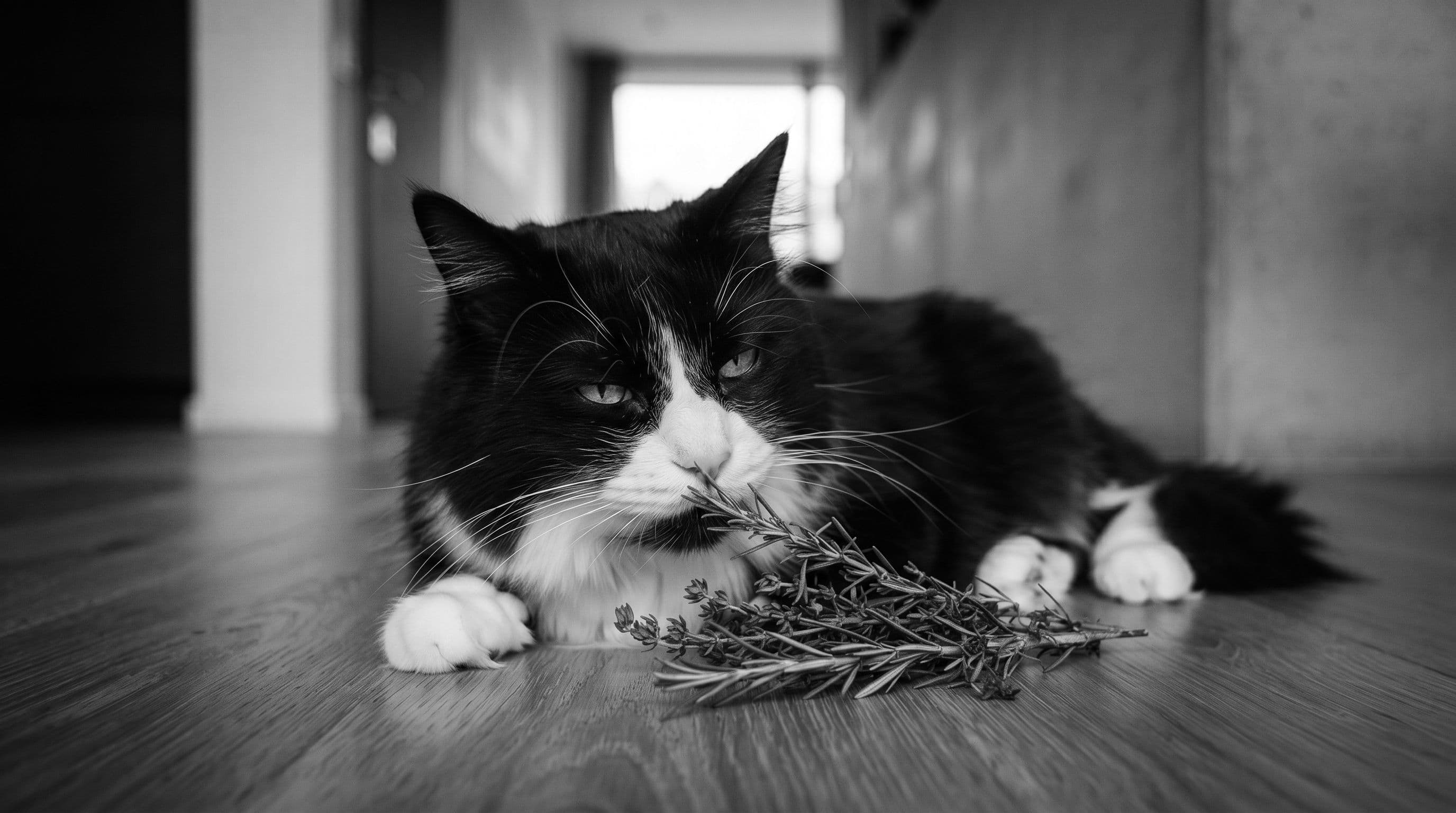
12. A bird feeder visible from the living room window; Vino chirps at wild birds for 20 minutes at a stretch
13. A wool area rug in the hallway that serves as a scratching surface and a wrestling arena
14. Designated "follow human around" time in the yard, which costs me nothing but patience
15. Chicken-adjacent sitting: at the old house Vino found elevated ground near the flock and watched them from a safe distance, well above the rooster's reach
Not every strategy will work for every cat. Zola ignores at least nine of these. But the combination keeps Vino from channelling his enrichment-starved energy into destruction, and it keeps me from losing my mind.
If you're curious about how Vino's early life at the vineyard shaped his indoor behaviour, that backstory explains a lot.
> Vino's Verdict: After years of refining this system, I can say that enrichment isn't about buying the right product or following a formula. It's about knowing your specific cat. Vino needs novelty, social interaction, and outdoor scent exposure; Zola needs solitude, height, and cardboard. The best indoor cat enrichment plan is the one that accounts for who actually lives in your house.
Frequently Asked
Rotation Beats Accumulation Every Time
Vino's toy basket sits in the corner of our living room, and at last count it held somewhere around thirty items: crinkle balls, felt mice, a couple of those springy coils, feather wands missing half their feathers, and a small plush lobster Zola once carried around for three days straight before losing all interest. The temptation with indoor cat enrichment is to keep adding. New toy, new puzzle, new thing. I fell into that pattern during Vino's first year here, convinced that if I just found the right product he'd stop batting pens off the bedside table before dawn.
He didn't stop. He won't stop. The pens are a calling.
What actually worked was rotation. Every Sunday evening I swap out roughly half the accessible toys. Whatever's been sitting on the floor all week goes into a sealed bag in the hallway cupboard; whatever's been hidden away for a fortnight comes back out. The effect on Vino is immediate and almost comical. He'll approach a crinkle ball he ignored for months like it's a completely new threat: ears forward, low crouch, one tentative paw tap, then full commitment. Zola's more reserved about it, but even she'll investigate a returning feather wand with renewed focus.
The principle behind rotation isn't complicated. Novelty matters more than volume. Five toys cycled weekly provide more indoor cat enrichment than twenty toys dumped in a pile and left to gather dust. I spend nothing extra; I just move things around. Vino's engagement with individual toys lasts longer when he hasn't seen them in a while, and the frantic "I'm bored, watch me destroy something you love" energy drops noticeably in the days after a swap.
One detail I'll add: scent matters. Before reintroducing a toy from the cupboard bag, I'll sometimes rub it between my hands or toss it near a spot where Vino's been sleeping. That thin layer of familiar scent on top of "where has this been?" seems to bridge the gap between suspicion and play. Zola, at her compact 3.9 kg, tends to prefer toys that have been near her own bedding. Different cats, different triggers, same household rotation system.
If you're finding that your indoor cat enrichment setup feels stale despite a growing collection, the answer probably isn't another purchase. It's a cupboard, a bag, and a weekly schedule. Vino would prefer I didn't share this, because a bored Vino gets to knock things off tables, and that's his favourite sport.
How Often Should I Rotate My Indoor Cat's Toys?
I rotate Vino and Zola's toys weekly, swapping roughly half the collection each Sunday. That frequency keeps things fresh without being so rapid that neither cat forms any attachment. Some weeks I'll notice Vino is still actively engaged with a particular item, so I'll leave it out longer. The goal is reading your own cat's interest level rather than following a rigid calendar. If a toy has been sitting untouched for three consecutive days in our household, it's going into the cupboard bag.
Does Indoor Cat Enrichment Require Expensive Products?
Not remotely. Vino's most reliable enrichment "toy" is a hair tie flicked across the kitchen tiles; Zola's is a piece of brown packing paper scrunched into a loose ball. The rotation system I described costs nothing. Puzzle feeders can be improvised from muffin tins and kibble. I've spent money on commercial products that both cats ignored within forty-eight hours, and I've watched Vino spend twenty minutes stalking a twist tie that fell off a bread bag. Indoor cat enrichment is about engagement and variety, not price tags.
Can Two Cats With Different Energy Levels Share the Same Enrichment Setup?
They can, but it takes observation. Vino peaks in energy around dawn and again before his late-afternoon outdoor time; Zola's bursts are shorter and more unpredictable. I run interactive wand sessions separately because Vino's intensity overwhelms Zola, and she'll simply walk away. Passive enrichment like window perches, cardboard boxes, and scattered rotation toys works well as shared infrastructure. The key is noticing which cat uses what, and when, then adjusting placement and timing accordingly. In our 90-square-metre space, that means Zola gets a quiet elevated spot near the bedroom window while Vino claims the living room floor like it's a stage.
The Morning He Decided My Keyboard Was a Bed
Early one morning, Vino's green-yellow eyes appeared at my shoulder while I was still half-asleep and typing. He didn't ask. He simply placed one white paw on the trackpad, then the other, then lowered his 6-kilogram self onto the warm keys with the satisfied sigh of a cat who has never once questioned his right to occupy any surface in this house. I now own a wireless keyboard I keep on a side table and a cat who believes the laptop is a heated bed I built specifically for him.
This is indoor cat enrichment in its rawest form: not buying the right toy, but understanding who you're actually living with. Vino inserts himself into whatever I'm doing. Always has, since the winery barn. That personality trait is durable. My job isn't to change it; my job is to channel it toward things that don't destroy my productivity or his patience.
What "Enrichment" Actually Means Here
Most advice I read treats indoor cat enrichment like a product category. Buy this, install that, enrichment achieved. I tried that. The expensive lesson came in the form of aAUD $3,200 automated laser tower that Vino watched once, yawned, and never acknowledged again. He prefers the red dot from the cheap supermarket pointer I flick across the floor while making coffee. The $3,200 tower went to my sister's more easily impressed moggy. That purchase taught me that "enrichment" is a mismatch between what a cat actually wants and what I think they should want, and the price tag only measures my own gullibility.
Vino doesn't want random stimulation. He wants insertion. He wants to be inside the action I'm already performing. When I fold laundry, he tunnels under the sheet. When I read, he parks on the open pages. When I cook, he supervises from the exact spot that blocks drawer access. His enrichment isn't a separate activity I schedule; it's the negotiation of shared space.
Two Cats, Two Completely Different Contracts
Zola, at 3.9 kg, operates on entirely different terms. She wants vertical escape routes, not insertion. She wants the high tower near the window, not my keyboard. She wants to watch birds from a distance, not supervise my cooking. Vino's enrichment revolves around me; Zola's revolves around vantage points and quiet.
I tried forcing Zola into Vino's patterns once. I placed her on the bed during my morning routine, thinking she'd enjoy the social immersion. She fled to the wardrobe and didn't emerge until dinner. Another lesson, cheaper this time: enrichment that ignores individual cat temperament is just furniture rearrangement.
The Daily Architecture That Actually Works
Our structure has become specific and repeatable, though I refuse to clock-watch it into falseness. Morning: window time for Zola, keyboard annexation for Vino. Afternoon: outdoor access, the single biggest modifier of their indoor behaviour. Evening: Vino claims my lap during reading, Zola claims the tower's top platform.
The afternoon outdoor access isn't vague wandering. I supervise. They hunt grass, stalk insects, argue with magpies. Vino returns hungrier and calmer. Zola returns with more appetite for indoor play. The indoor hours after outdoor hours are noticeably quieter, more settled. I don't need a study to observe this; I live with the before and after.
FAQ
What do I do if my cat doesn't engage with expensive toys?
I learned this with the laser tower: return what you can, regift what you can't, and watch what your cat actually does when you're not performing ownership. Vino's favourite "toy" is a crumpled receipt I dropped accidentally. His second favourite is my shoelace while I'm trying to tie it. Start with observation, not purchase.
Is supervised outdoor access necessary for indoor contentment?
I won't universalise our situation. I can say that removing Vino's outdoor time produces immediate behavioural escalation: more keyboard occupations, more dawn protests, more surface walking. Reinstating outdoor access restores equilibrium within two days. Your cat's mileage depends on your cat, your location, your capacity to supervise, and your tolerance for risk.
How do I enrich multiple cats with different needs?
I failed at this initially by assuming shared space meant shared enrichment. Zola and Vino now have parallel but separate architectures: Vino's insertion points near my activity, Zola's vertical escapes distant from it. One litter tray, two towers, one brush that both tolerate differently. The puzzle isn't finding one solution; it's not forcing one solution where two are required.