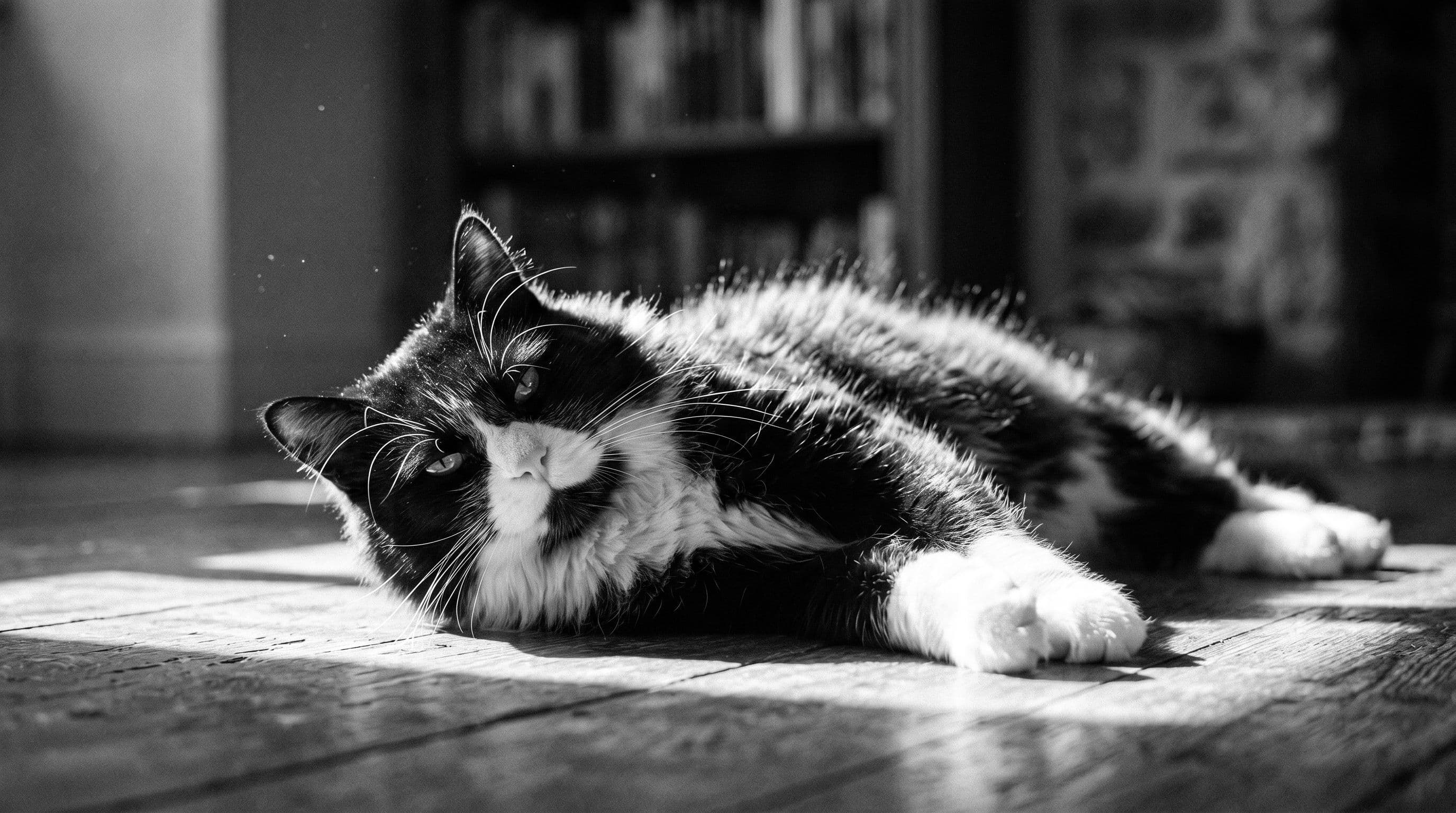
Four observations from our household complicate the standard advice you'll find on tuxedo cat grooming. Most guides treat it as a uniform task: brush the cat, clip the nails, done. But Vino's medium-long coat doesn't behave the way those guides suggest, and after years of figuring out what works, I've landed on a routine that accounts for the specific quirks of his fur type, his tolerance levels, and the reality that he drools so heavily during brushing that the brush itself needs wringing out. What follows isn't a generic guide. It's an accounting of what I've learned through trial, error, and one particularly memorable half-bath involving warm water and a cat who wanted no part of it.
Exhibit One: The Chin Brush Revelation and What It Taught Me About Tuxedo Cat Grooming
I discovered Vino's preferences backwards. For the first several months after bringing him home from the winery in northern Tasmania, I'd start every brushing session the way the internet told me to: long strokes down the back, working from head to tail, using a standard deshedding tool. Vino tolerated this. He didn't love it. He'd sit still for about 90 seconds before deciding he had somewhere more important to be, which was anywhere else.
Then one evening, I accidentally started with his chin. I was reaching across him for the remote and grazed the brush against the underside of his jaw. He froze. His eyes went half-lidded. The drooling commenced immediately. I kept going, working the brush through the longer fur around his chest and the area I've come to think of as his mane: that thick ruff where the white chest fur meets the black, right around the natural bow tie shape his markings create.
That session lasted 12 minutes. The previous record had been about 2.
The lesson was simple but specific to his coat type. Vino's medium-long fur is densest and most tangle-prone in exactly the areas he most enjoys having brushed: the chest, the chin, and the sides of his neck. Starting there doesn't just make him cooperative; it makes him borderline catatonic with pleasure. By the time I work my way to his back and sides, he's so relaxed that he'll tolerate another 8 to 10 minutes of grooming without protest. Total session time now averages around 15 minutes, three times per week.
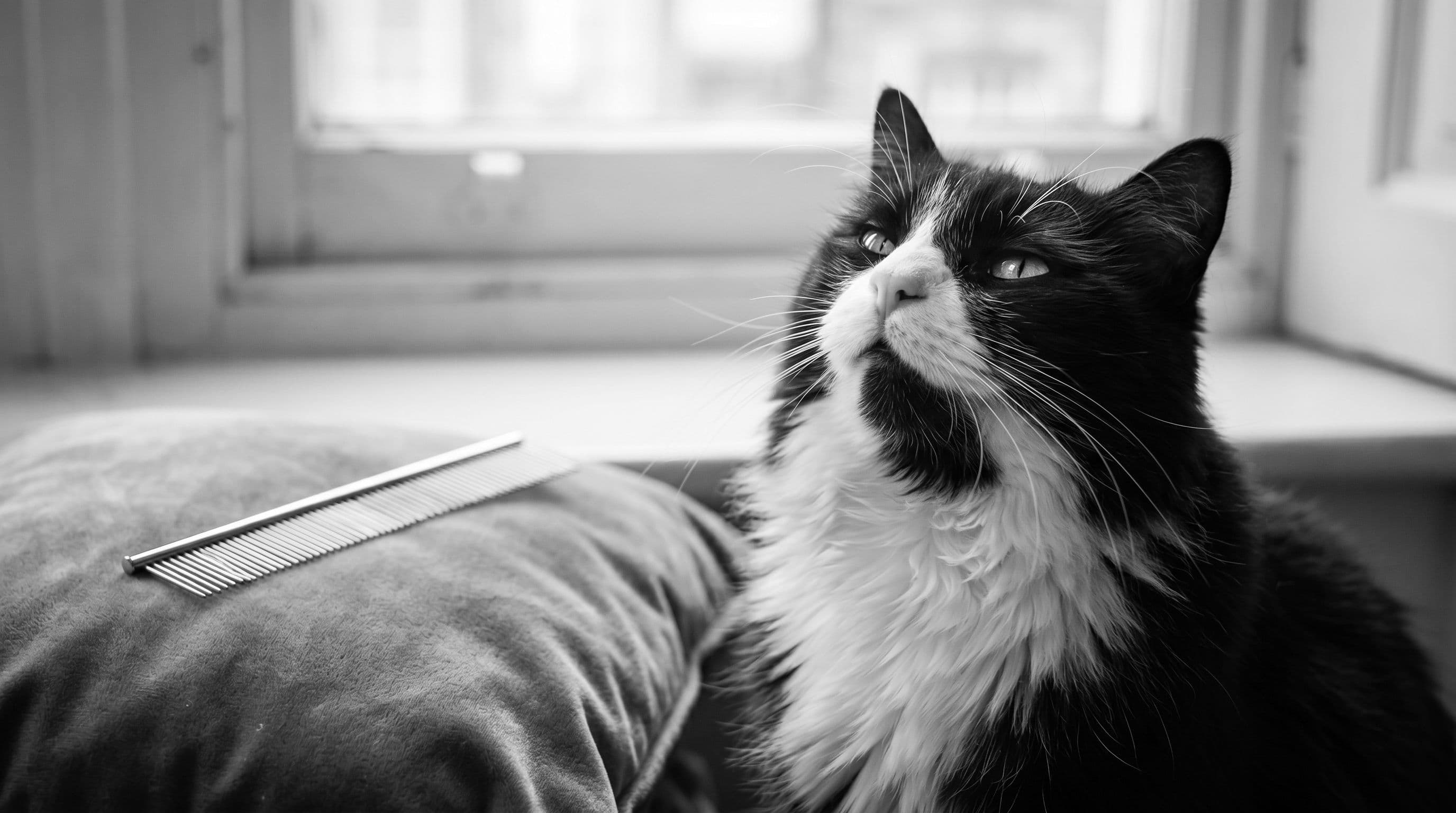
I should mention the tool change, too. I retired the deshedding tool after about six months and switched to a fine-toothed stainless-steel grooming comb (a medium-coarse grade). The deshedding tool was pulling too much undercoat and leaving his topcoat looking thin in patches. The comb works through mats without stripping, which matters when you're dealing with fur that isn't quite long enough for a Persian-style grooming routine but isn't short enough to ignore.
If you're looking for more on how Vino's personality shapes every part of his daily life, I wrote about his morning routine and the rooster situation a few weeks back.
Exhibit Two: The Half-Bath Incident, or Why Maintenance Grooming Prevents Emergencies
There's no dignified way to say this. Vino's medium-long fur on his back legs has, on more than one occasion, caught something it shouldn't have.
The first time it happened was in 2023. I noticed him scooting across the living room rug: a hand-woven wool rug that I'd prefer not to discuss in this context. Investigation revealed the problem. The longer fur around his hindquarters had trapped fecal matter, which had then dried into a cement-like consistency against his skin.
Getting it out required warm water, a shallow basin, cat-safe shampoo from Earthbath (the fragrance-free oatmeal formula, because his skin reacts to anything stronger), and approximately 7 minutes of what I can only describe as controlled chaos. Vino growled. He fought. He produced the protest meow: that single sustained note, same tone, same volume, held for 5 seconds or more. He attempted to escape no fewer than four times. My fiancée held him. I worked the fur. Nobody enjoyed themselves.
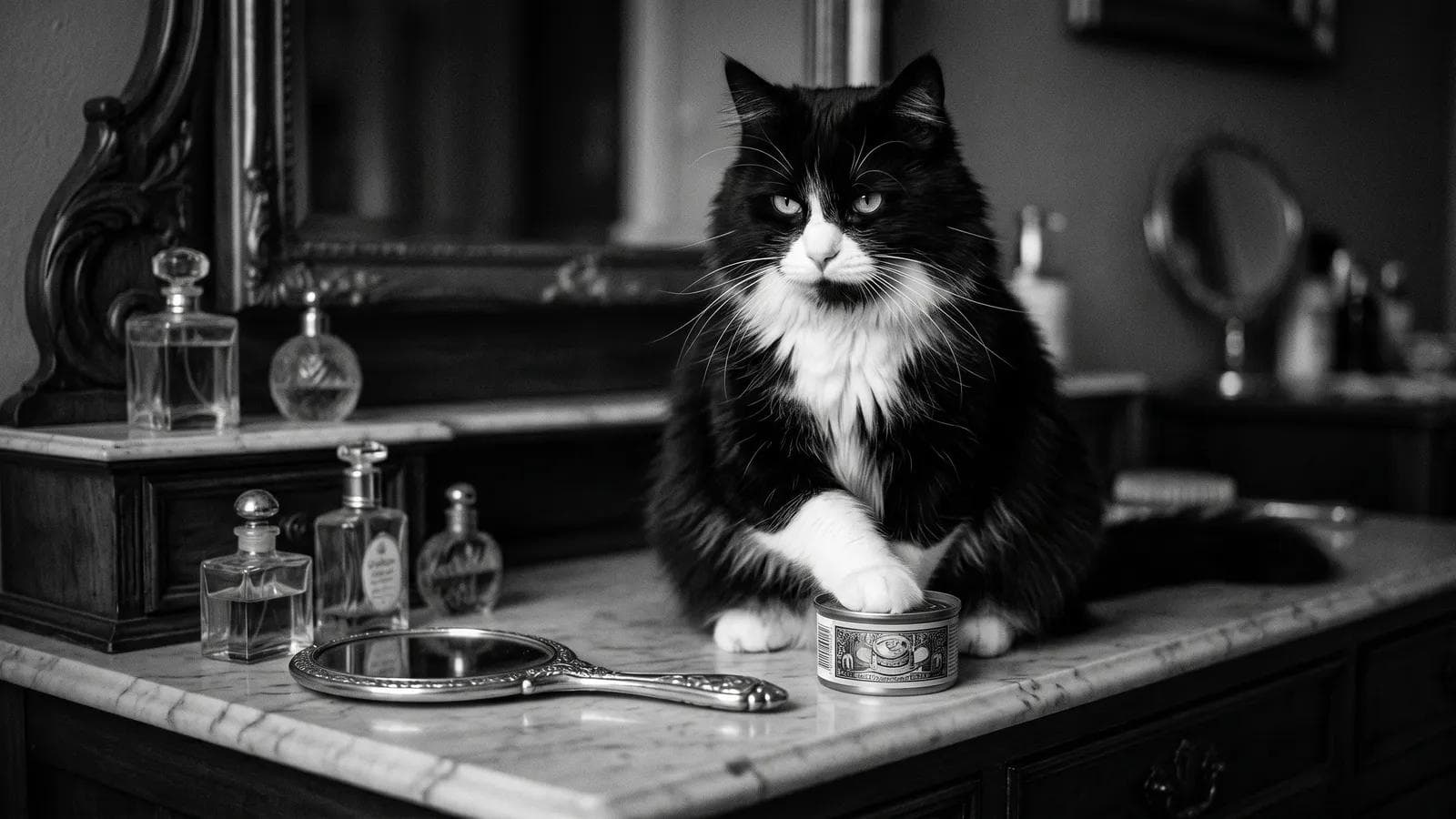
The contrast between his usual bearing and the indignity of a forced half-bath was total. This is a cat who would lie a metre from the neighbour's fence and stare at nothing in particular with the composure of a diplomat while a Staffy loses its mind on the other side. That same cat, confronted with 3 centimetres of warm water, becomes feral.
The solution I've since adopted is preventive. Every two weeks, I trim the fur around Vino's hindquarters and the backs of his legs using a pair of Scaredy Cut grooming scissors: the ones with the rounded tips designed for cats who don't sit still, which is all cats. I take off about 1.5 centimetres each time. It's not a dramatic trim; you wouldn't notice it unless you were looking. But it's reduced the half-bath incidents from roughly once every six weeks to twice in the last 18 months.
This is the angle I don't see anyone else covering. Most tuxedo cat grooming advice focuses on shedding and coat shine. Nobody talks about the sanitary trim for medium-long coats, and it's the single most impactful thing I've added to our routine.
Exhibit Three: The Seasonal Coat Change and the Week I Filled a Shopping Bag
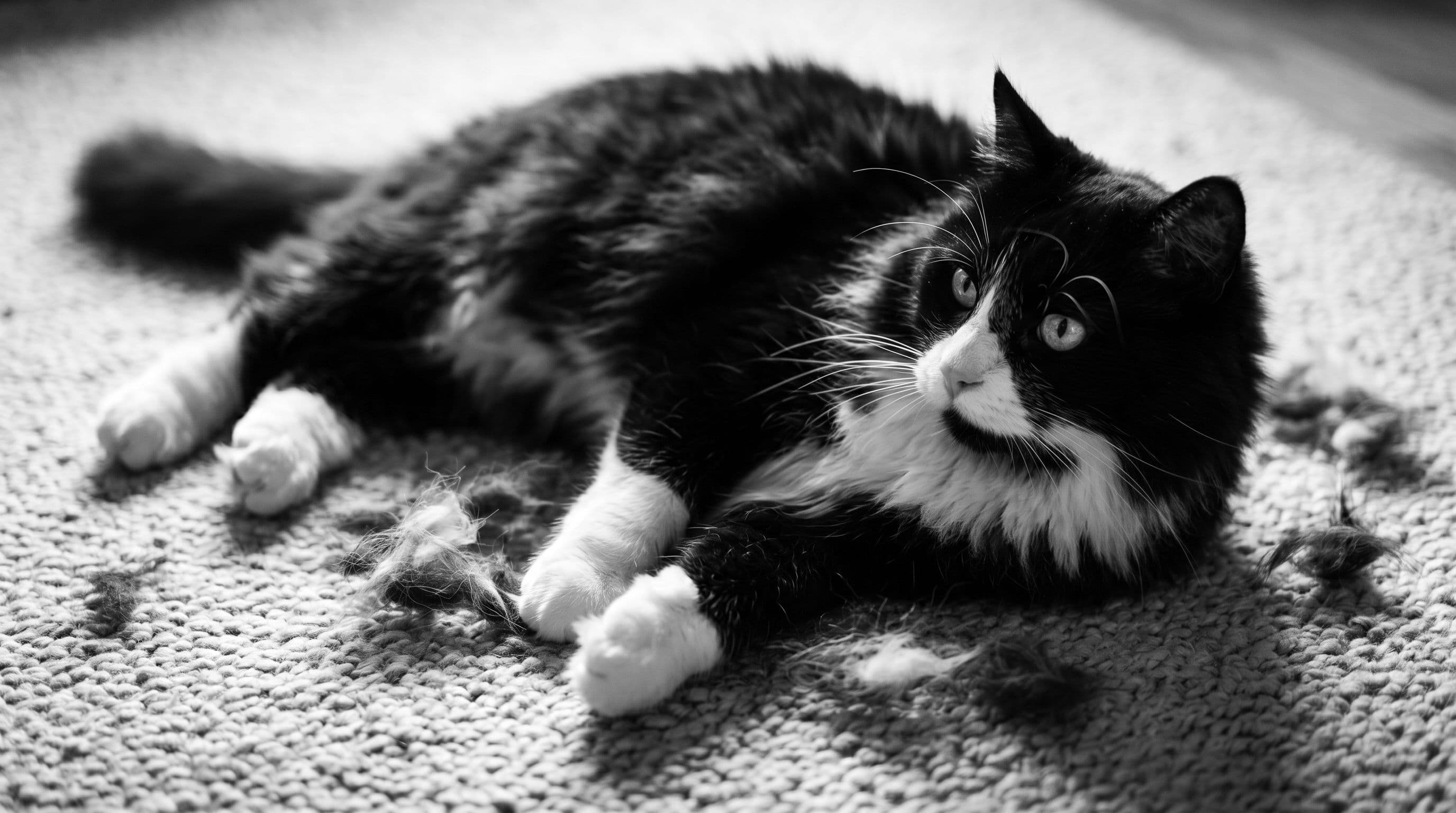
Every spring, around mid-September here in Tasmania, Vino's undercoat stages a mass exodus. I'm not exaggerating the volume. During the peak of last year's seasonal shed, I collected enough loose fur in one week to fill a reusable shopping bag. I weighed it out of morbid curiosity: 47 grams. For context, Vino weighed 6 kg at his September 2026 check-up, so he shed a little under 1% of his total body weight in fur across seven days.
During this period, I increase brushing from three sessions per week to daily. The comb handles the topcoat, but for the undercoat blowout I bring back a modified version of the deshedding approach: a soft rubber curry brush that loosens the undercoat without cutting it. Two passes with the rubber brush, then one pass with the comb. The whole thing takes about 20 minutes.
Zola, for the record, doesn't require any of this. She's a shorthair, black with a small white patch on her tummy, and her coat essentially manages itself. She sheds, of course, but it's a polite, distributed affair rather than the concentrated fur explosion Vino produces. I brush Zola once a week with the same comb, and she tolerates it with the quiet resignation she brings to most things Vino-adjacent.
The furballs are the other seasonal reality. Any longer-coated cat owner knows that shedding season turns hairball production up to an almost comical degree, and Vino tracks exactly with this. Outside of shedding season, he produces maybe one hairball every two weeks. During the September blowout, it's closer to one every three days. Regular brushing helps, but it doesn't eliminate the issue entirely. I've added a hairball-control supplement to his food during peak season, which has reduced the frequency by what I'd estimate is about 30%.
I've covered more about how Vino and Zola coexist in a separate post, if the dynamic between a high-maintenance tuxedo and a self-sufficient shorthair interests you.
What This Adds Up To
Here's what years of grooming Vino has taught me, distilled to its essentials.
First: start where the cat wants you to start, not where the guide tells you to. Vino's chin-first preference isn't arbitrary. It's the difference between a 2-minute tolerance window and a 15-minute productive session.
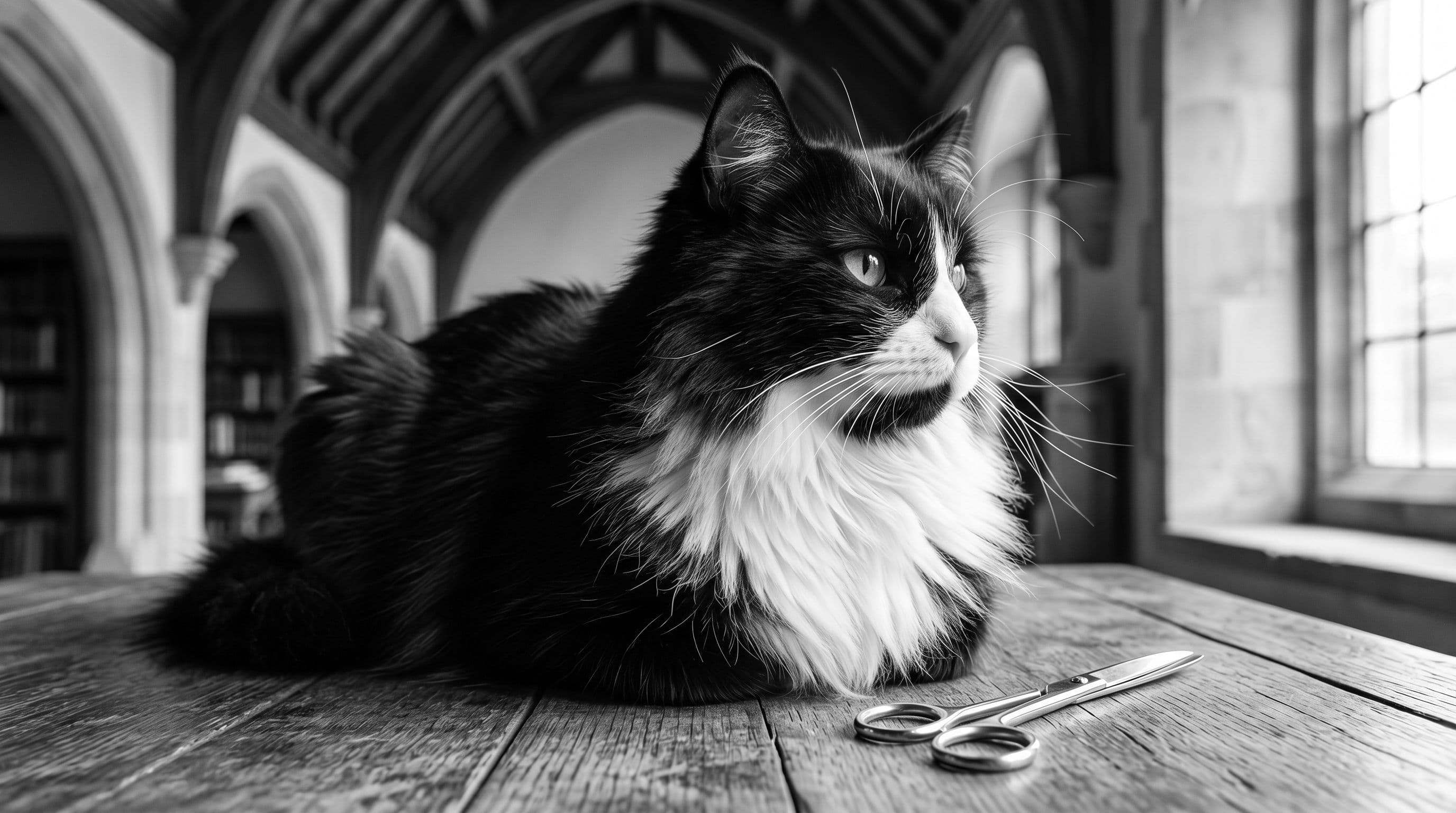
Second: the sanitary trim is not optional for medium-long coats. It's the least glamorous part of tuxedo cat grooming, and it's the one that prevents genuine misery for everyone involved.
Third: seasonal changes demand seasonal adjustments. A static routine doesn't work when your cat's undercoat decides to evacuate all at once.
Fourth: know your tools. A deshedding blade works for many cats, but Vino's coat responds better to a stainless-steel grooming comb for regular sessions and a soft rubber curry brush for shedding season. Different fur types need different approaches, and medium-long sits in an awkward middle ground that most tools aren't specifically designed for.
The through line is specificity. Generic advice produced generic results. Paying attention to what Vino actually needed, rather than what cats in general supposedly need, is what turned grooming from a chore we both dreaded into something he actively solicits. He'll bring me the comb now; he'll pick it up off the coffee table and drop it on my lap. I didn't train this. He trained me.
Frequently Asked
The Wednesday Night Mat Incident and Why Tuxedo Cat Grooming Demands Seasonal Adjustments
Last October, Vino jumped onto the bathroom counter at around 11 p.m. and I noticed a mat the size of a 20-cent coin tucked behind his left ear. I hadn't brushed him in four days; we'd been away, the routine had slipped, and his coat had seized the opportunity to rebel. That single mat took eight minutes of careful work with a de-matting comb to remove, while Vino sat on my lap drooling onto my jeans with an expression that suggested he found the whole ordeal beneath him.
[PHOTO: Vino mid-grooming session on the bathroom counter, mat comb visible beside him]
The thing about tuxedo cat grooming that no seasonal shedding chart prepared me for is how Vino's coat behaves differently depending on whether we're heading into a Tasmanian winter or coming out of one. Between March and May, the undercoat thickens noticeably along his flanks and belly. If I don't increase brushing frequency from twice weekly to every other day during that window, mats form in the exact spots he won't let me touch without protest: the armpit area, behind the ears, and the inner thighs where black fur meets white.
I've written before about understanding tuxedo cat coat patterns and what they mean for daily care, and the seasonal dimension is something I underestimated for Vino's entire first year. His spring shed, by contrast, is almost theatrical. Loose fur comes off in clouds. I switched to a stainless steel greyhound comb during those months after reading recommendations from other long-haired-cat owners, and the difference in how much undercoat it pulls compared to a standard slicker brush is genuinely remarkable.
The other seasonal factor nobody mentions: static. Tasmanian winters bring dry indoor air, and Vino's longer white chest fur generates enough static electricity during brushing that it clings to everything. A light mist from a spray bottle before each session solved that problem entirely. He wasn't thrilled the first time. By the third session he'd stopped caring.
[PHOTO: Vino's white chest bib against his black coat, natural lighting, showing winter coat density]
For anyone managing tuxedo cat grooming on a medium-long coat like Vino's, I'd recommend keeping a simple log. I track brushing dates, mat locations, and which tools I used in the Notes app on my phone. Patterns emerge quickly. Vino mats behind his left ear more than his right; I still don't know why, but I know to check there first. If you're dealing with similar quirks, our post on building a tuxedo cat care routine that actually sticks covers the broader system I've built around his preferences.
> Vino's Verdict: Years of living with this cat have taught me that tuxedo cat grooming isn't a single technique; it's a rotating set of responses to whatever his coat decides to do that week. Vino's medium-long fur has its own calendar, its own trouble spots, and its own opinions about which tools are acceptable. I just work here.
How Often Should You Brush a Tuxedo Cat?
It depends entirely on coat length. For Vino's medium-long fur, I brush every other day during seasonal transitions and twice weekly the rest of the year. Short-haired tuxedo cats can get away with once a week. The key indicator is mat formation: if you're finding small tangles between sessions, increase frequency until you aren't.
Do Tuxedo Cats Shed More Than Other Cats?
Tuxedo cats don't shed more because of their colouring. Coat pattern has no direct relationship to shedding volume. What matters is fur length, density, and breed background. Vino sheds considerably more than a short-haired tuxedo would, not because he's black and white, but because his coat is thick and medium-long with a dense undercoat inherited from whatever mix produced him at that Tasmanian winery.
What's the Best Brush for Tuxedo Cat Grooming?
I rotate three tools for Vino: a de-matting comb for tangles, a stainless steel greyhound comb for undercoat removal during heavy shedding, and a soft bristle brush for finishing and chin work. The greyhound comb made the biggest difference when I added it. No single brush handles every job on a medium-long tuxedo coat.
Related Vino Reading
- Understanding tuxedo cat coat patterns and what they mean for daily care
- Building a tuxedo cat care routine that actually sticks
The Belly Problem: Why Tuxedo Cat Grooming Below the Ribcage Requires Diplomacy
Last Thursday, Vino was sprawled across the hallway runner in what I call his "lobster pose": on his back, all four legs extended, white belly fully exposed like he's sunbathing on the Amalfi Coast. It looks like an invitation. It isn't. I've tested this theory enough times to have the scratch marks catalogued by month.
The belly fur on a tuxedo cat with Vino's coat length is a different material entirely from what grows on his back or flanks. It's finer, mats faster, and sits over skin that apparently contains every nerve ending he owns. I can brush his chin until he's a puddle of drool. I can work through the chest ruff for ten minutes straight while he purrs so loudly you can hear it from the next room. But one pass of the brush below the ribcage and he transforms into a creature from a different genus altogether.
[PHOTO: Vino in full lobster pose on the hallway runner, white belly exposed, back legs extended]
What's worked, after seasons of negotiation, is a two-tool approach. I use a fine-toothed metal comb on the belly instead of the slicker brush I rely on elsewhere. The comb lets me work through the fine undercoat in small, precise sections without dragging across the skin the way bristles do. I keep sessions on that area to about 30 seconds, always at the tail end of a longer chin-and-chest session when he's already half-asleep and chemically relaxed from his own purring.
Zola, for the record, has no belly sensitivity whatsoever. She'll let you brush her stomach, pick lint off her, practically reorganize her fur by colour. At 3.9 kg with a shorter, denser coat, her tuxedo cat grooming routine takes a third of the time Vino's does. Same breed pattern, completely different maintenance schedule. Anyone telling you there's one grooming protocol for tuxedo cats hasn't lived with two of them.
[PHOTO: Vino and Zola side by side showing the difference in coat length and texture]
The Post-Groom Cleanup Nobody Warns You About
I should mention the drool. I touched on it earlier, but tuxedo cat grooming in this household generates a cleanup radius I wasn't prepared for. When Vino hits peak brushing bliss, he produces a volume of saliva that's honestly architectural. It pools on whatever surface he's lying on, it soaks through the brush handle, and it gets flicked across nearby furniture when he shakes his head mid-session. I now keep a dedicated hand towel draped over my knee during every groom. We've learned not to leave paperwork on the coffee table on brushing nights.
The towel also catches the loose fur that the brush liberates from his chest and mane area. Vino's black fur shows on light fabric and his white fur shows on dark fabric, so he's essentially designed to be visible on every surface in the house at all times. I run a lint roller over the towel afterward and dispose of what I can only describe as a small mammal's worth of fluff.
[PHOTO: Vino's white chest bib against his black coat, natural lighting, mid-grooming session]
How Often Should You Brush a Tuxedo Cat?
Vino gets a full session three times a week: chin, chest, mane, flanks, and a cautious pass at the belly. Between those sessions, I'll do a quick chin scratch with the comb if he solicits it, which he does by headbutting the drawer where the grooming tools live. Zola gets a once-weekly brush because her coat rarely tangles. The right frequency depends entirely on coat length and density, not on the tuxedo pattern itself.
Does Tuxedo Cat Grooming Differ From Other Coat Patterns?
The pattern doesn't change the grooming needs; the coat type does. Vino's bicolour markings mean his white chest fur has a slightly different texture from the black fur on his back. The white sections are softer, finer, and mat more easily. I've found the transition zones where black meets white collect the most loose undercoat and need the most attention during brushing.
Why Does My Tuxedo Cat Drool During Brushing?
Vino drools because he's in a state of profound satisfaction, not because anything's wrong. It started the first time I brushed his chin and has been consistent across the years. Not all cats do this; Zola doesn't produce a single drop no matter how long her sessions run. If your tuxedo cat drools during grooming and only during grooming, you've probably just found the spot that sends them somewhere transcendent. Keep a towel handy.