
Nobody catalogued Vino's markings when he was working at the winery. He was a barn cat. His job was mice. The white chest and the bow-tie chin were simply how he arrived, and the family who named him Messiah presumably didn't pause to consider the genetics of it.
That consideration came later, when I got close enough, actually crouched down in the morning light looking at Vino's face, to notice that the dark stripe running from his jaw to the top of his white bib was shaped almost exactly like the narrow end of a tie. Not a full tie. Just that pointed lower section, hanging there as though he'd straightened it before heading out. The marking is not an accident. It's the predictable outcome of a specific biological sequence. But understanding why requires going back to how tuxedo cats happen in the first place.
What Actually Creates a Tuxedo Cat's Markings

The coat pattern on a tuxedo cat is controlled by the white spotting gene, technically the KIT gene, sometimes referred to as the S locus in cat genetics. It's the gene responsible for piebald patterning across a wide range of mammals. It is not unique to cats, and it is not unique to tuxedo cats. But in tuxedo cats it produces something with a particular visual consistency: high-contrast black-and-white, the white concentrated in predictable places, chest, belly, chin, paws, and the black everywhere else.
Here's what the KIT gene actually does: it doesn't place pigment. It removes it. Or rather, it limits the movement of the cells that carry it.
Cats aren't born with pigment cells already distributed through their skin. Those cells, the melanocytes, start in a cluster near the spine and migrate outward through the embryo as it develops. The white spotting gene interferes with this migration. It slows the movement, reduces the coverage, stops the cells from reaching certain areas in time. The places the melanocytes don't reach stay white.
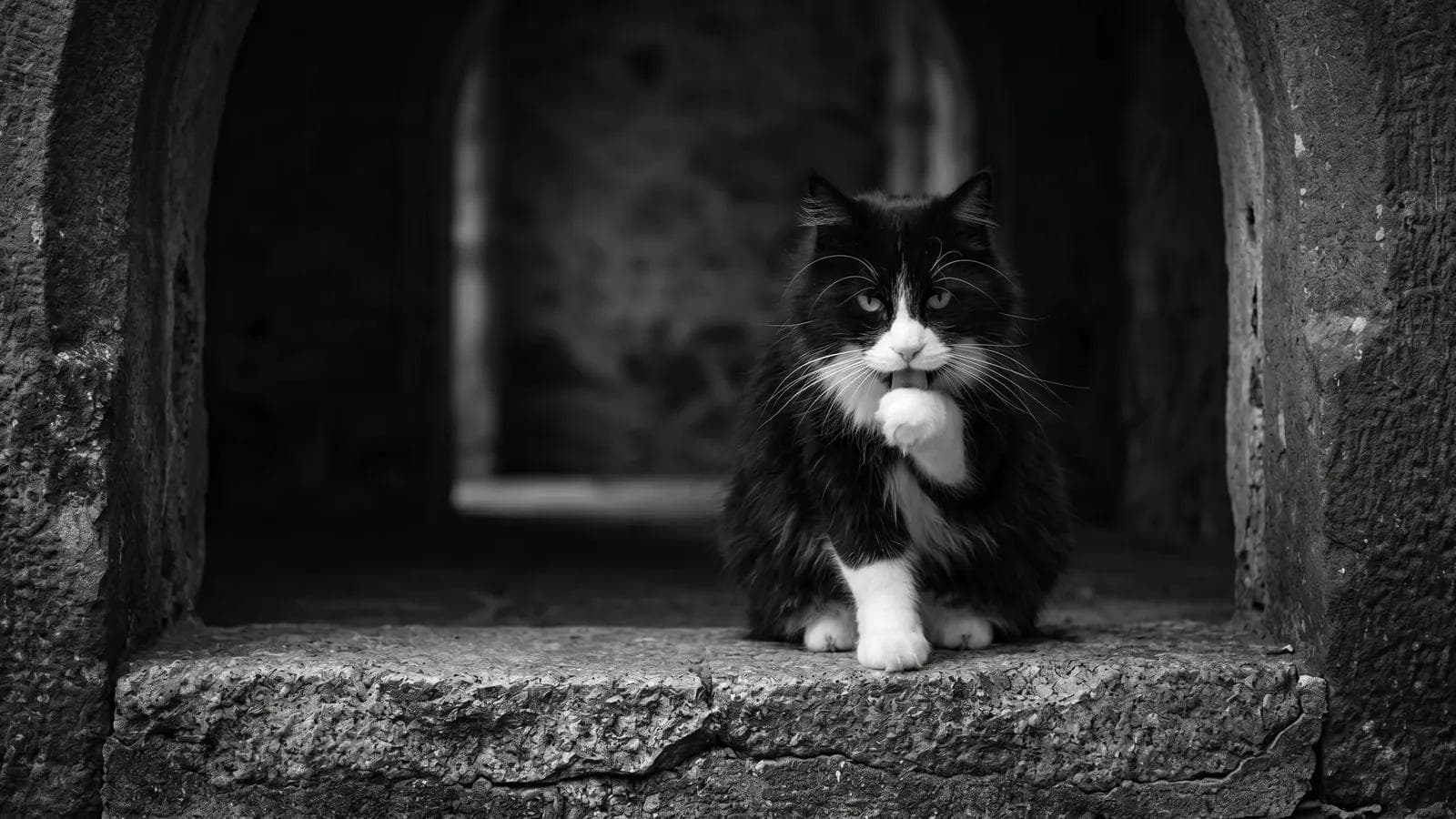
This is why tuxedo markings follow a recognisable general pattern, bib, belly, paws, chin, but never an identical one. The migration timing varies from cat to cat, litter to litter, sometimes between the same embryo's left and right sides. Vino's bib is wide and clean across his chest. His paws are white-socked but asymmetrically so: the left front paw's white extends approximately a centimetre further up the leg than the right. And that chin stripe drifts slightly left of centre when observed head-on.
This isn't a design flaw. It's a biological record: a map of where Vino's melanocytes stopped, at a specific winery, during the specific weeks he was developing inside his mother. If the migration had run slightly longer, the stripe wouldn't exist. He'd have a bib and nothing more. Instead, he has a marking that looks like evening wear he's never once been asked to justify.
Why No Two Tuxedo Cats Have the Same Markings
The allele matters. Cats can carry one copy of the white spotting variant (heterozygous) or two (homozygous). One copy produces moderate white coverage. Two copies produce more extensive white, sometimes reaching the face, sometimes creating irregular patches across the body. But even two homozygous cats from the same parents won't look the same, because those melanocyte migration dynamics are inherently variable.
Vino's markings are what breeders and geneticists would describe as "high white": the coverage extends well up his neck, the bib is broad, the paws are substantially socked. Other tuxedo cats have a coin-sized bib on an otherwise entirely black body. Same gene. Dramatically different result. The gene sets the category. The migration determines the individual.
Zola, our other resident, has none of this. She is black without interruption except for a small white patch on her tummy, the only evidence that the white spotting gene touched her at all, and it is characteristically understated. She does not advertise it. This is consistent with everything else about Zola.
Vino, by contrast, advertised his markings from the moment he could be observed. At the winery, before anyone knew about melanocyte migration or the S locus, he was already conducting himself as though the white chest and bow-tie chin were distinctions he'd earned rather than inherited. He walked into the barn, positioned himself between my legs, and did not move until he'd received the attention he considered appropriate. His markings were already fully formed. His personality was matching them.
The Marking Patterns Tuxedo Cats Actually Come In
"Tuxedo" gets used as a catch-all, but it's really one recognisable stop along a spectrum of bicolour patterns the white spotting gene can produce. The same gene that gave Vino his bib and bow tie also produces several other named markings, depending on how far the pigment cells travelled before they stopped. Knowing the terms has made it easier for me to place Vino, and any other black-and-white cat, on the actual map.
Bib and Locket
A bib is a patch of white confined to the chest, sometimes extending up toward the chin. A locket is smaller and more isolated: a coin-sized patch surrounded on all sides by dark fur, with no connection to the belly or throat. Vino's bib is the broad kind, wide across the sternum and connected cleanly to his white chin stripe. A cat with a locket instead would show a small, contained patch closed in by dark fur on every side, no bow tie possible.
Mittens and Boots
Paw markings split into two categories depending on how far up the leg the white travels. "Mittens" describes white confined to the paw itself, stopping at or just above the toes. "Boots," sometimes called socks, climb further, wrapping the lower leg. Vino wears boots, not mittens: his front paw markings extend roughly a centimetre past the joint, higher on the left leg than the right. A cat with true mittens would show white that stops abruptly at the foot, with no climb up the leg at all.
Cap-and-Saddle
This pattern inverts the usual ratio. Instead of a mostly black cat with white extremities, cap-and-saddle cats are mostly white, with colour confined to a cap on the head and a saddle-shaped patch across the back. It's the same gene expressing at a much higher level: more melanocyte migration failure, more white overall. Vino is nowhere near this end of the range. His black covers the overwhelming majority of his body, with white doing the accenting rather than the other way round.
Magpie
Named for the bird's scattered black-on-white plumage, the magpie pattern describes irregular, patchy distribution rather than the clean, symmetrical lines a classic tuxedo shows. Patches appear off-centre, sometimes asymmetrical between left and right, without the tidy bib-and-chin geometry. Vino's markings lean tidy by comparison. His bib has a slightly irregular edge under close inspection, but the overall geometry, chin to chest to paws, reads as coordinated rather than scattered.
Van Pattern
At the far end of the white-spotting spectrum sits the van pattern, named after the Turkish Van: colour restricted almost entirely to the tail and a patch or two on the head, with the rest of the body left white. It's the same gene Vino carries, expressed at close to maximum. A van-patterned cat and a classic tuxedo like Vino share a genetic cause and almost nothing else visually.
Where Vino Actually Sits
Line them up and Vino sits comfortably in the classic, moderate range: a broad bib, boots rather than mittens, black still doing most of the work across his body. Not cap-and-saddle, not van, not magpie. Just the specific, mid-spectrum combination that happens to look, from certain angles, like something he put on this morning.
What Vino's Specific Markings Say, Examined Carefully

Since we began paying the kind of attention that builds a publication, certain details have become apparent.
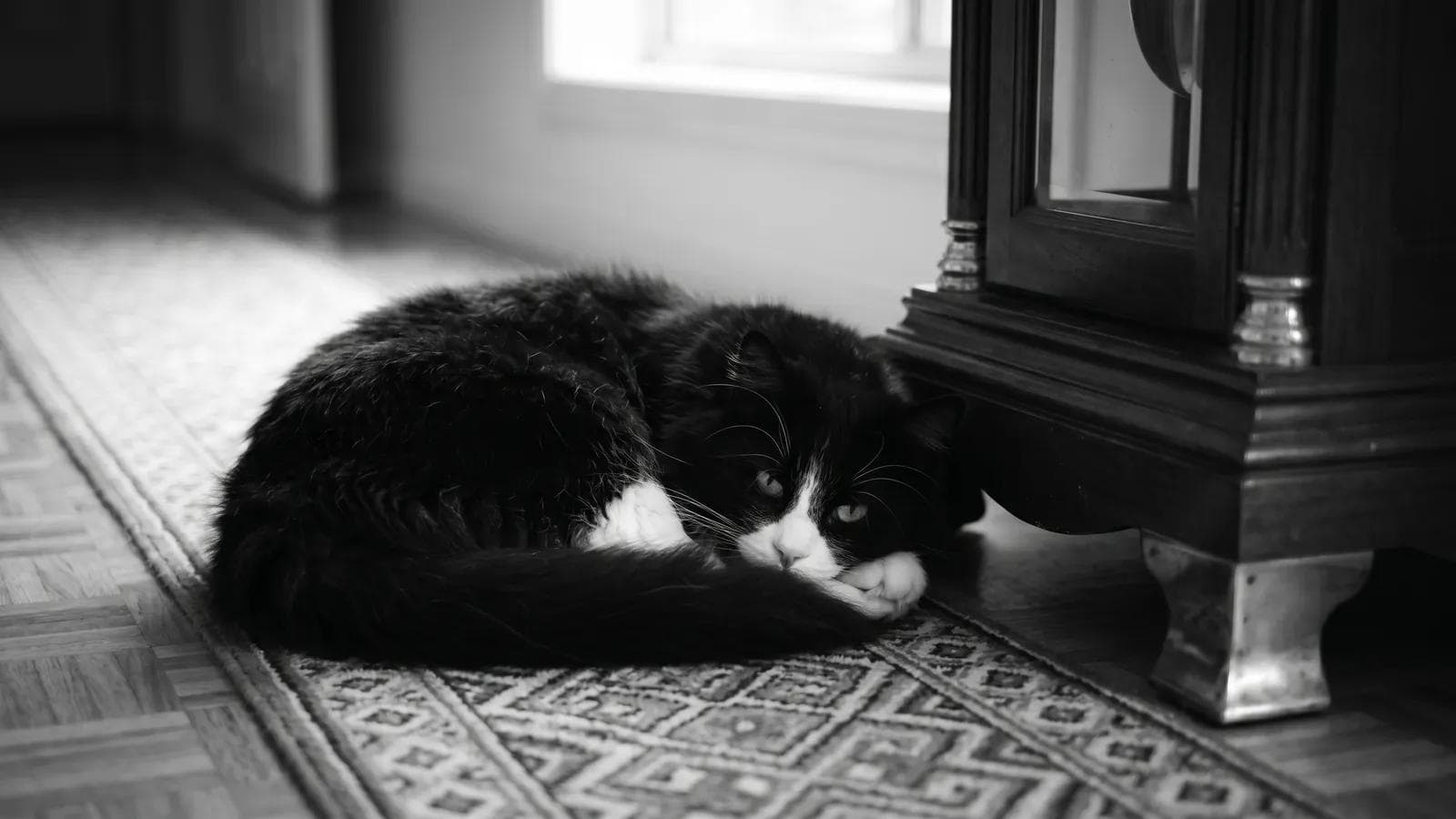
The bib isn't symmetrical. The right edge is slightly more irregular than the left, a subtle waviness where the melanocytes ran out of runway at slightly different points across the chest. The chin stripe, on close inspection, is not a single clean line but a narrowing wedge: wider at the jaw, tapering to a point exactly at the top of the bib, where it creates the bow tie effect. The white on his front paws doesn't end at the same height on both legs.
None of this is perceivable at a glance. It requires the kind of observation that is either clinical or affectionate, and in Vino's case has tended to be both.
What the markings don't tell you is what happened later. He used those white paws to take up a position one metre from the fence line and lie there in perfect stillness while the neighbour's Staffy lost all composure on the other side. He walked through the new house in the first week with the methodical pace of a property inspector, those green-gold eyes scanning each room in turn, no hiding, no anxiety, just assessment. He spent two and a half years in a barn, using that marked body to do a working job on a winery property, before I took him home and he immediately began conducting himself as though the arrangements had always been this way.
The markings were fixed before he was born. They're a record of a biological process in a specific cat during a specific gestation. The personality: the systematic property inspection, the Staffy calculation, the insertion into whatever I was reaching for. That arrived separately, and it has never once wavered.
Frequently Asked Questions
What gives tuxedo cats their black-and-white markings?
Tuxedo cat markings are controlled by the white spotting gene (KIT gene, or S locus). This gene limits the migration of melanocytes, the pigment-producing cells, through the embryo during development. Areas the cells don't reach stay white. The white typically concentrates on the chest, belly, paws, and chin, while the rest of the coat remains black.
Why do tuxedo cats all look different from each other?
The white spotting gene sets the general pattern, white on the underside and extremities, but the exact coverage depends on the timing of melanocyte migration, which varies between individual cats. One copy of the variant produces moderate white coverage; two copies produce more extensive white. But even cats with identical genetics won't have identical markings, because the migration process is variable by nature.
What's the bow tie on a tuxedo cat?
The bow tie effect is produced when the white spotting gene slows melanocyte migration before the cells fully reach the chin, leaving a strip of white running from the jaw to the chest bib. In cats where the migration stopped at a particular point, this creates a narrow wedge of white that resembles the lower section of a tie, an effect that, in Vino's case, tapers to a near-perfect point at the top of the bib. It's the most reliably remarked-upon feature of his appearance and the one he makes the least effort to explain.
Is the tuxedo pattern hereditary?
Yes. The KIT gene is heritable. Tuxedo cats with one copy of the white spotting variant will produce some tuxedo offspring; those with two copies produce more extensive patterning, though expression varies. Tuxedo cats can produce non-tuxedo kittens and vice versa, depending on what alleles both parents carry.
Do tuxedo markings change as a cat ages?
The basic pattern is set at birth and doesn't change significantly with age. Minor variations in shade or the appearance of white hairs in dark areas can occur in older cats, but the fundamental geography of the markings, bib width, paw coverage, chin stripe presence, remains consistent across a cat's life.
The markings were set before Vino arrived. Before the winery, before the barn, before any of the behaviour that makes documenting him worth doing. What the melanocytes left behind is just the exterior. The rest: the systematic property inspection, the Staffy operations, the desk insertion. That arrived independently and with considerably more intention.