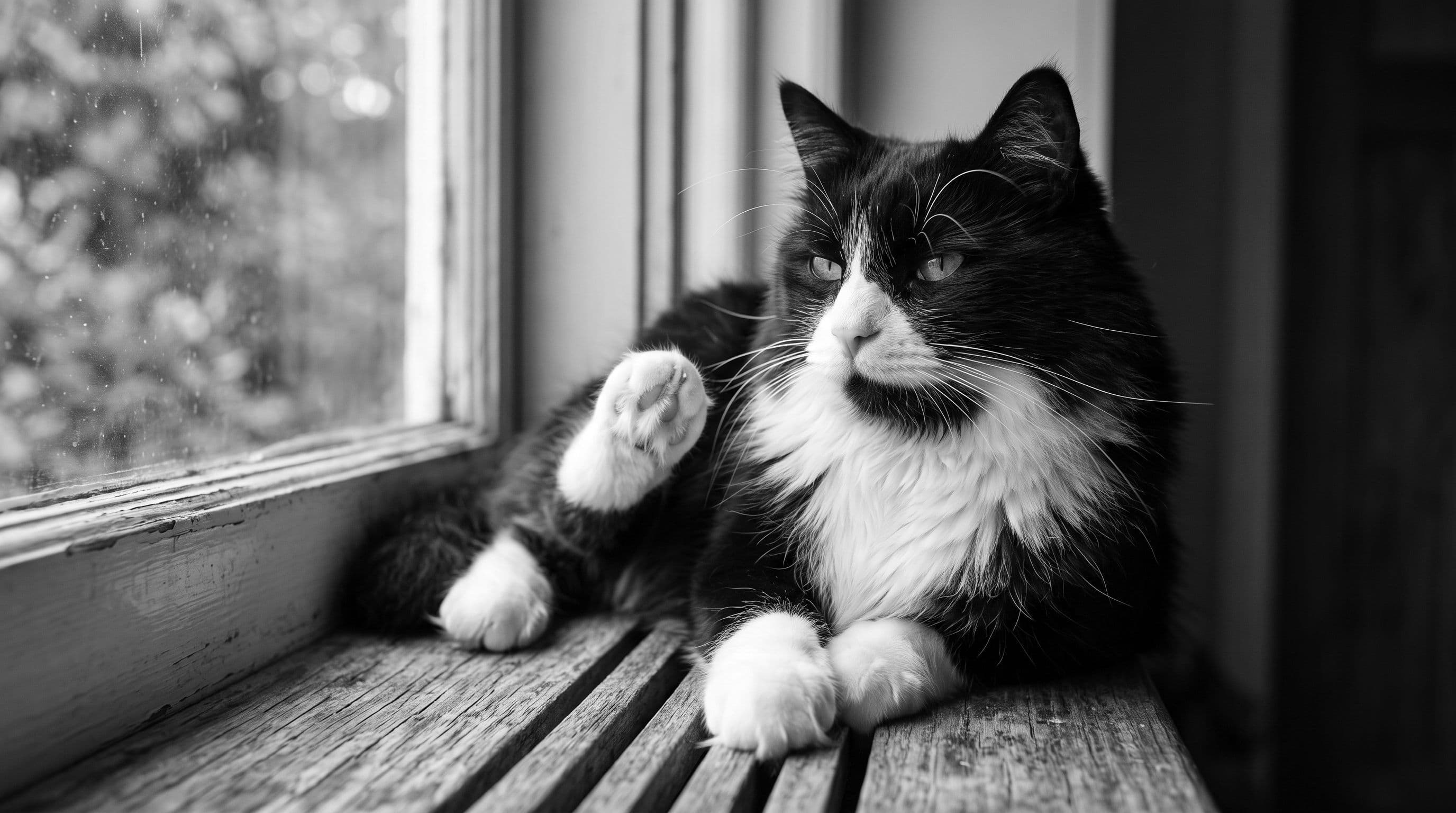
Vino had stationed himself on the kitchen windowsill last Thursday morning, his standard post for monitoring the neighbour's Staffy through the fence slats. The rooster had already announced dawn; Vino had waited his customary beat, then leaped onto my bedside table for his opening negotiation. Now, with breakfast secured, he'd shifted to phase two of the daily programme: passive-aggressive surveillance. Tuxedo cat patterns aren't static designs stamped onto fur, I was reminded, as the light angled through the Tasmanian oak at a slant I hadn't seen before. Individual guard hairs, dark filaments creeping upward from his black chin into the white chest, created a soft gradient I'd somehow missed through four years of photographs. He caught me staring. The protest meow arrived on schedule, sustained for five seconds, flat in tone, unmistakably a grievance.
What Variable White Spotting Actually Looks Like
That kitchen windowsill moment illustrates something fundamental about tuxedo cat patterns that breed guides rarely capture. The white spotting gene doesn't produce a uniform result. It expresses across a continuous range, which is why two cats both called "tuxedo" can look almost unrelated. Vino's distribution, white chest extending to belly, white paws, black chin with that natural bow-tie shape against the white, represents what most people picture when they hear the term. But I've seen photographs from his vineyard days that show him dustier, his white markings less crisp, suggesting the pattern clarified as he moved from working barn cat to indoor-outdoor household resident.
The genetics here aren't about colour itself but about where pigment cells fail to reach during embryonic development. A 2016 Nature Communications paper by Richard Mort, Christian Yates and colleagues at the Universities of Edinburgh and Bath demonstrated that piebald patches arise from random movement and multiplication of pigment cells, not from directed cell-to-cell signalling. This randomness explains why symmetrical tuxedo patterns like Vino's feel almost miraculous: the same stochastic process that produces a cat with one white leg and three black ones can, through sheer probability, land on something approaching evening wear.
Dr Leslie Lyons, the Gilbreath-McLorn Endowed Professor of Comparative Medicine at the University of Missouri, has spent years documenting how this variable expressivity plays out across individual cats. Her work on coat trait genetics includes tracking how the same genetic mechanism produces everything from a small white locket on the throat to the near-total white coverage seen in some Turkish Van patterns. Vino sits comfortably in the middle of this distribution: not minimal, not maximal, but distinctly patterned enough that strangers regularly comment on his "outfit."
How Vino's Pattern Differs From the Standard Cases
Most tuxedo cat descriptions focus on the ideal: crisp boundaries, symmetrical white "shirt front," matching white "spats" on the paws. Vino approximates this but deviates in telling ways. His black chin doesn't stop cleanly at the jawline; it extends downward in a shape that changes slightly depending on how he's holding his head. The white on his left front paw creeps slightly higher than the right. These aren't flaws; they're the signature of a biological process that doesn't aim for perfection.
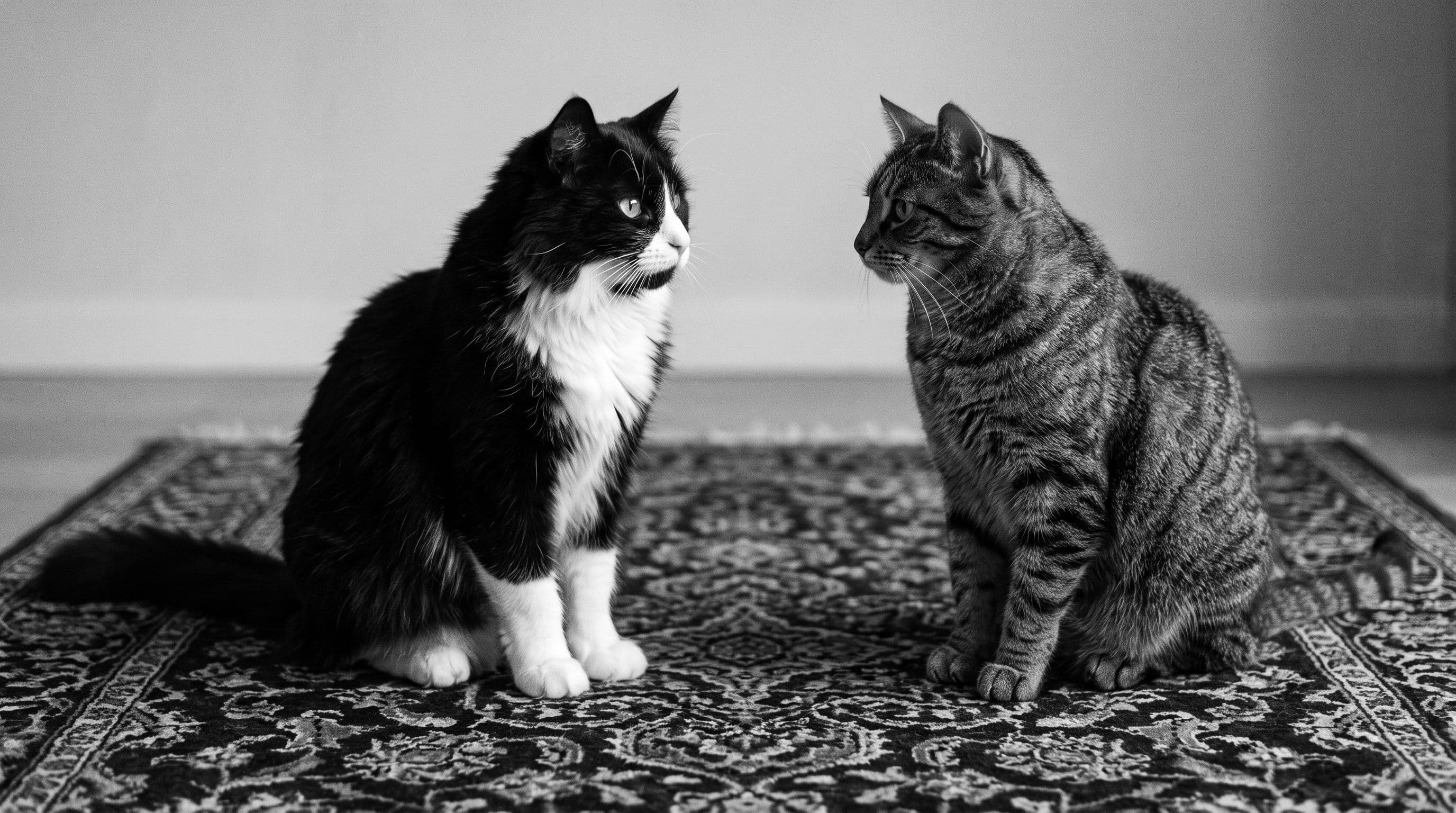
For contrast, consider the tuxedo Maine Coon I encountered at a TICA Household Pet show in Melbourne three years before Vino came home. That cat, I never got his name, but he was roughly 8 kg of collected indifference, displayed what handlers call "mitted" patterning: white restricted to precise gauntlets on all four paws, a white muzzle, and a chest bib that stopped exactly at the sternum. The boundaries were knife-sharp. Against this standard, Vino looks almost impressionistic. Yet both cats qualified for the same show category, judged on condition and health in the Household Pet division, not against a breed standard.
The International Cat Association currently recognizes 73 cat breeds, but tuxedo patterning appears across dozens of them and in non-pedigree populations at similar rates. What varies isn't the pattern's presence but its interpretation. A British Shorthair with Vino's distribution might be faulted in breed competition. A random-bred cat from the same neighbourhood would be admired for identical markings. The pattern hasn't changed; only the frame around it has.
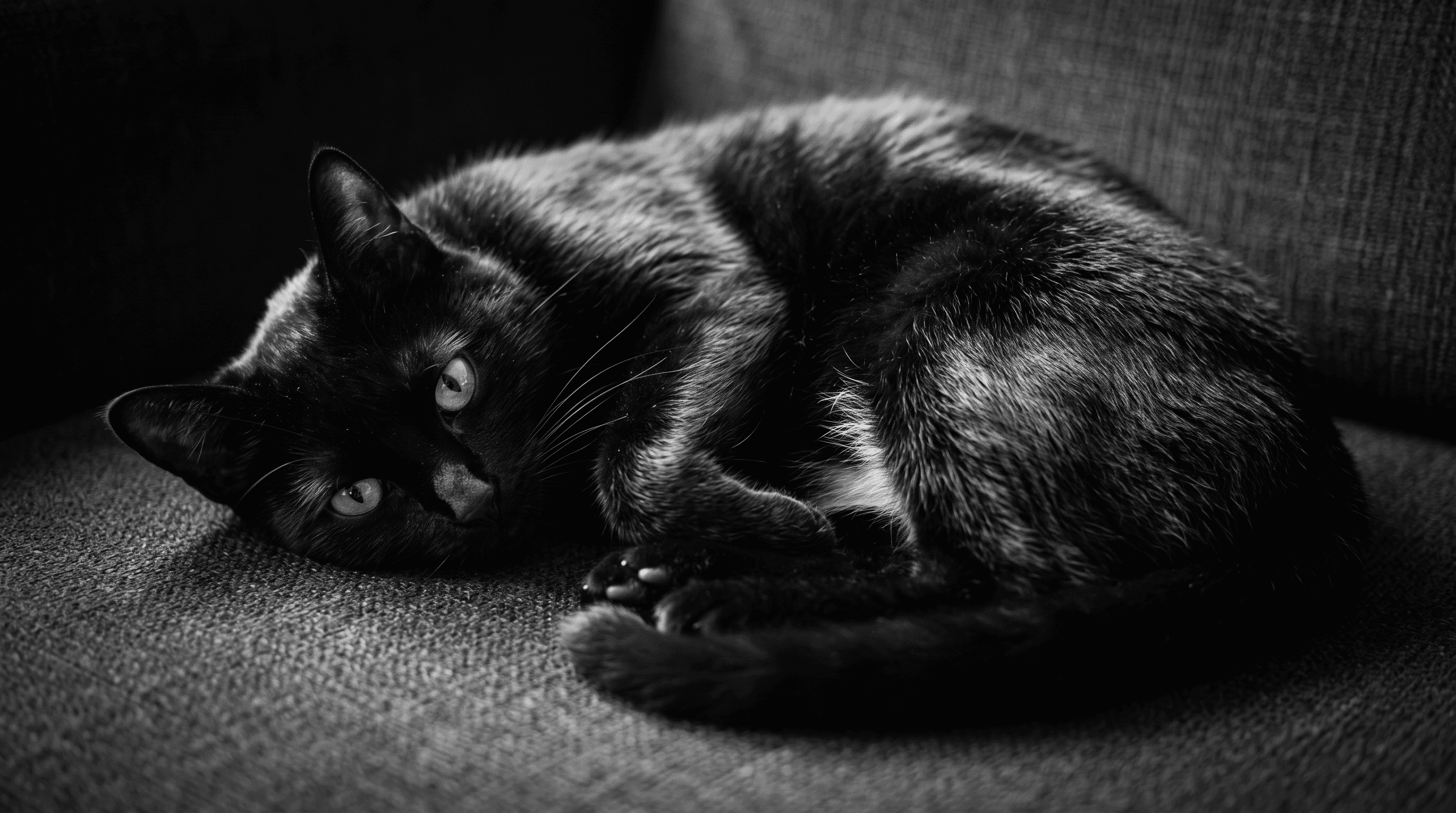
Zola offers a useful counterpoint here. At about 3.9 kg, she's more compact than Vino's 5.4 kg frame, and her black coat holds just one white marking: a small patch on her abdomen that the terminology calls a "locket," making her technically bicolour but not tuxedo. Sharing space with both animals has recalibrated how I see coat patterns. Where does tuxedo end and bicolour begin? The line is administrative, not biological.
What to Actually Look For in Pattern Variation
If you're trying to understand or describe a tuxedo cat's specific pattern, I've developed a habit from photographing Vino that might transfer. Start with the boundaries: not whether they're crisp, but where they fall. Does the white reach the shoulders? Does it wrap around the legs or stop at the ankle? Vino's chest white extends far enough back that it disappears when he sits, making him appear solid black from behind, a common source of double-takes from visitors who've only seen him face-on.
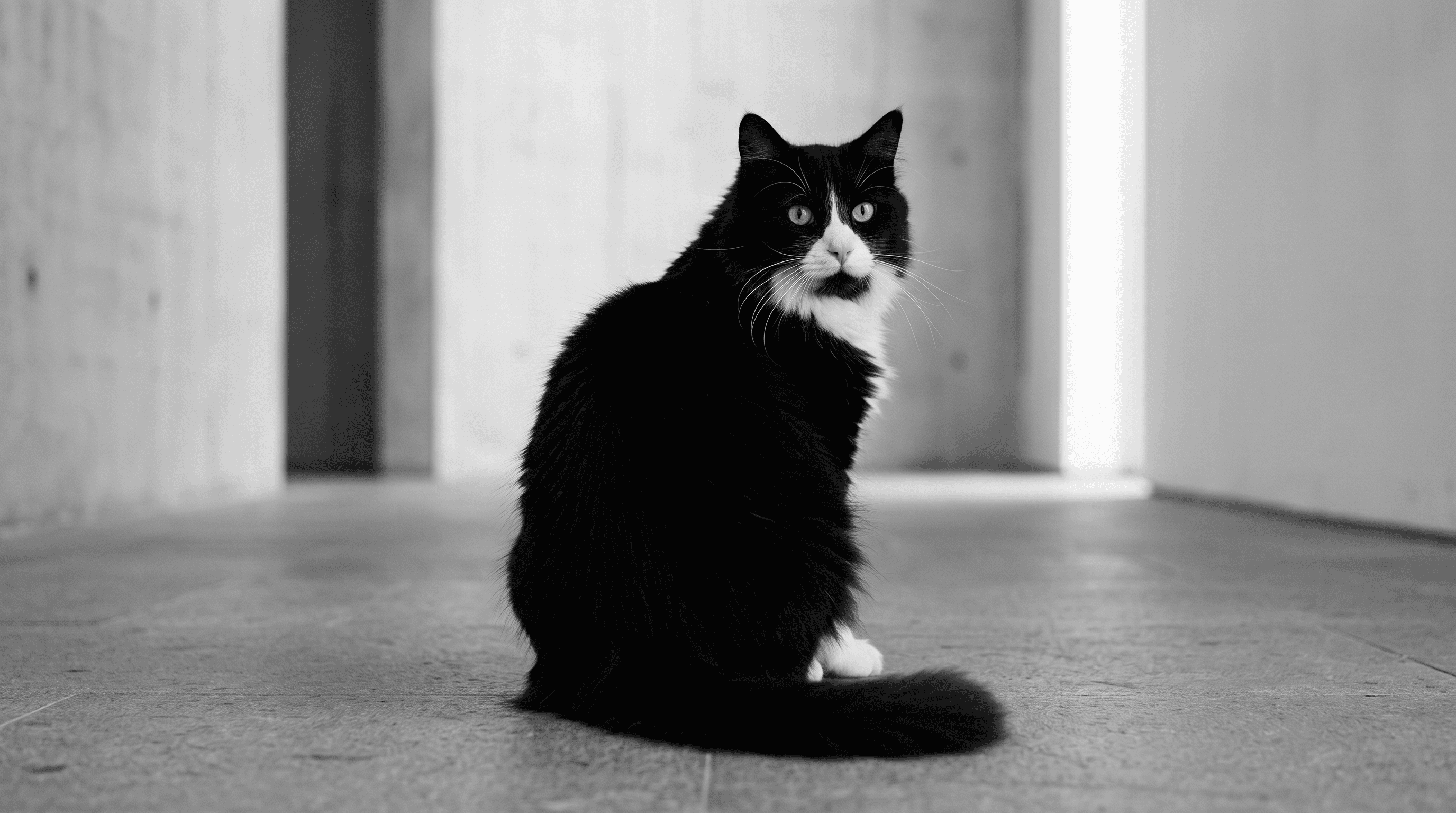
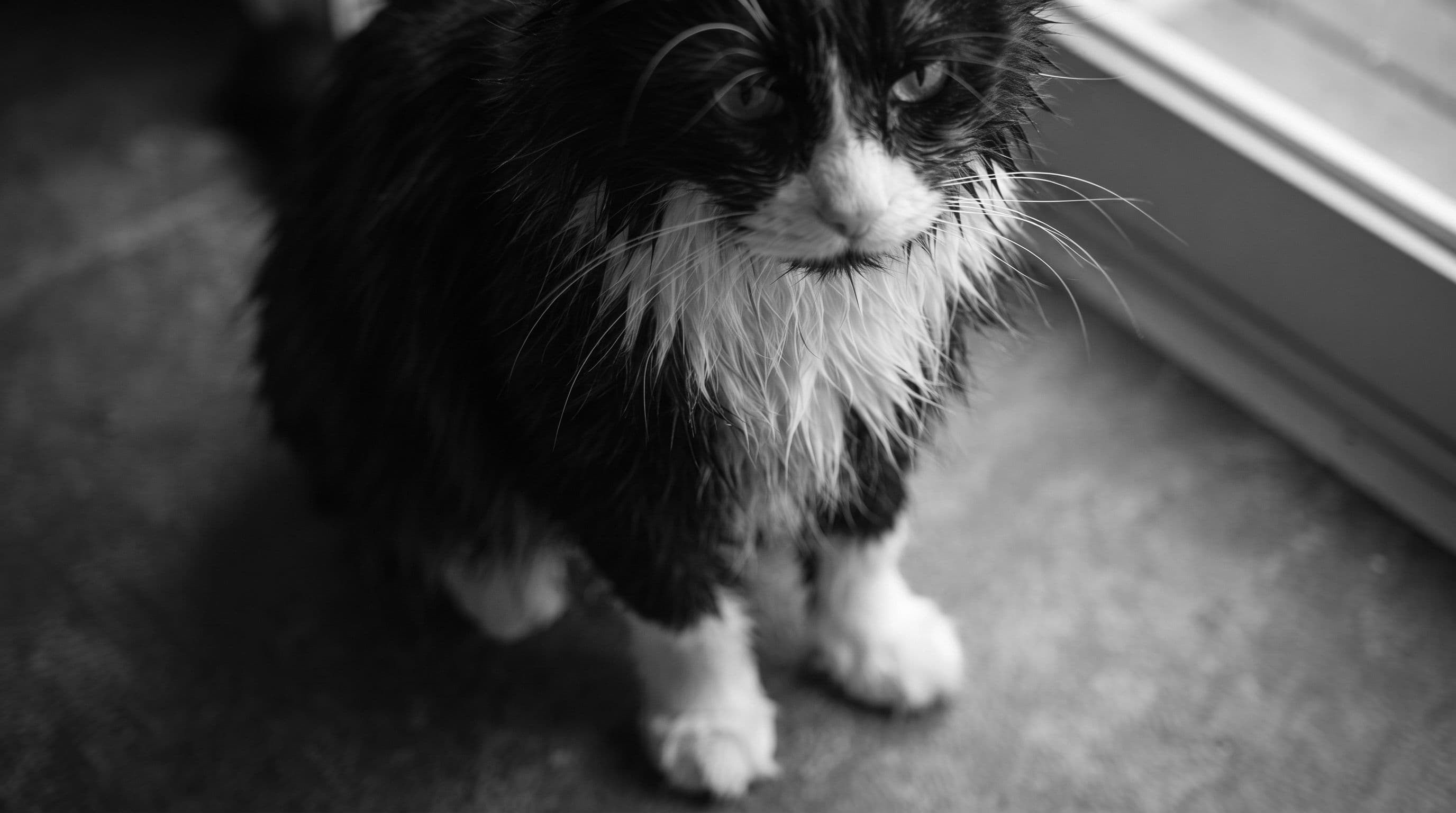
Next, observe how the pattern behaves in motion. Vino's medium-long fur complicates his appearance considerably. When he grooms his chest, the white fluffs outward, expanding his apparent "shirt front." When he's been outside in damp Tasmanian weather, the black darkens and the white dulls, reducing contrast. His pattern isn't static; it's a performance that changes with grooming, lighting, and humidity.
For practical purposes, if you're selecting a tuxedo kitten or describing one for adoption, I'd suggest ignoring the perfection standard entirely. Look instead for health markers that actually matter: clear eyes, clean ears, a coat without patches of thinning fur. The pattern will settle into whatever random distribution the embryonic pigment cells achieved. Vino's slight asymmetries, that higher white on the left paw, the blurred chin boundary, have never affected his ability to catch mice, demand attention, or systematically destroy my sleep schedule.