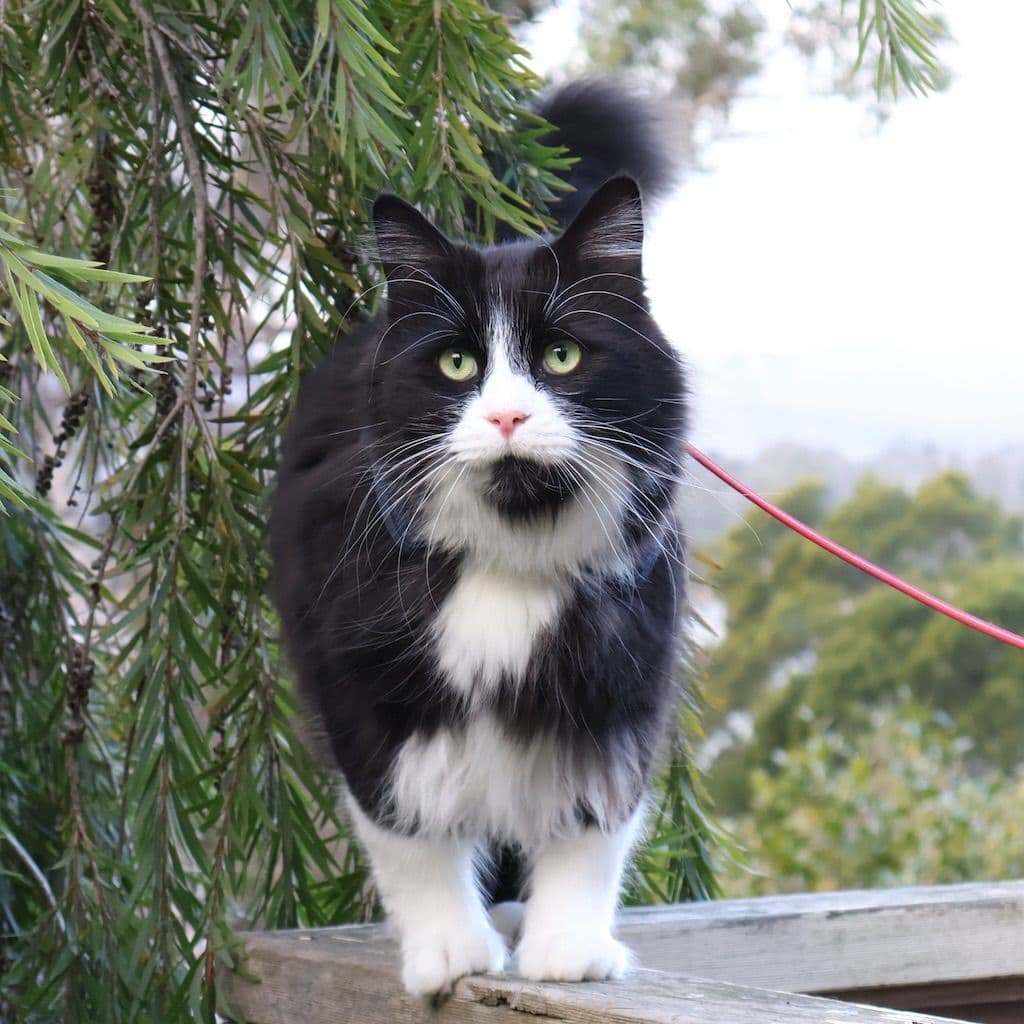
I've owned cats my whole life, but I'd never thought particularly hard about tuxedo cats until Vino walked into it. He was a barn cat at a winery where I worked: black and white, medium-long hair, greenish eyes that suggested he had strong opinions about most things. His original owner had died. He needed somewhere to go. I brought him home, named him Viniferous after the winery, and then spent three years learning exactly what a tuxedo cat actually is.
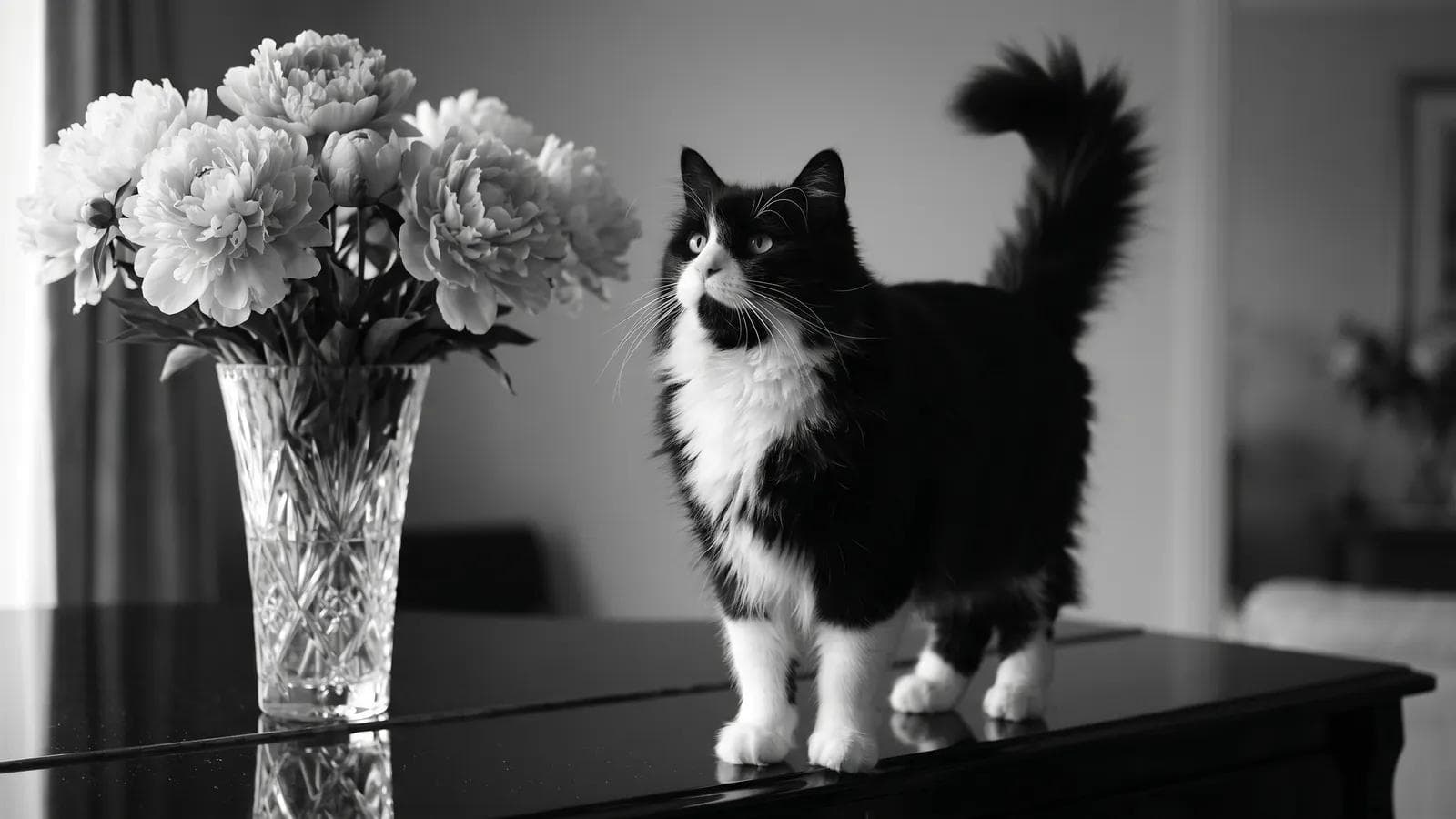
The short version: it's a coat pattern. That's it. Not a breed, not a lineage, not a certification from any cat fanciers' association. A tuxedo cat is any cat, any breed or mix, with a dark base coat and white patches concentrated on the chest, paws, and often the chin. The pattern mimics a dinner jacket, hence the name, and Vino wears the full look: white bib, socked white paws, a chin stripe that sits where a bow tie would go.
Are tuxedo cats a breed?
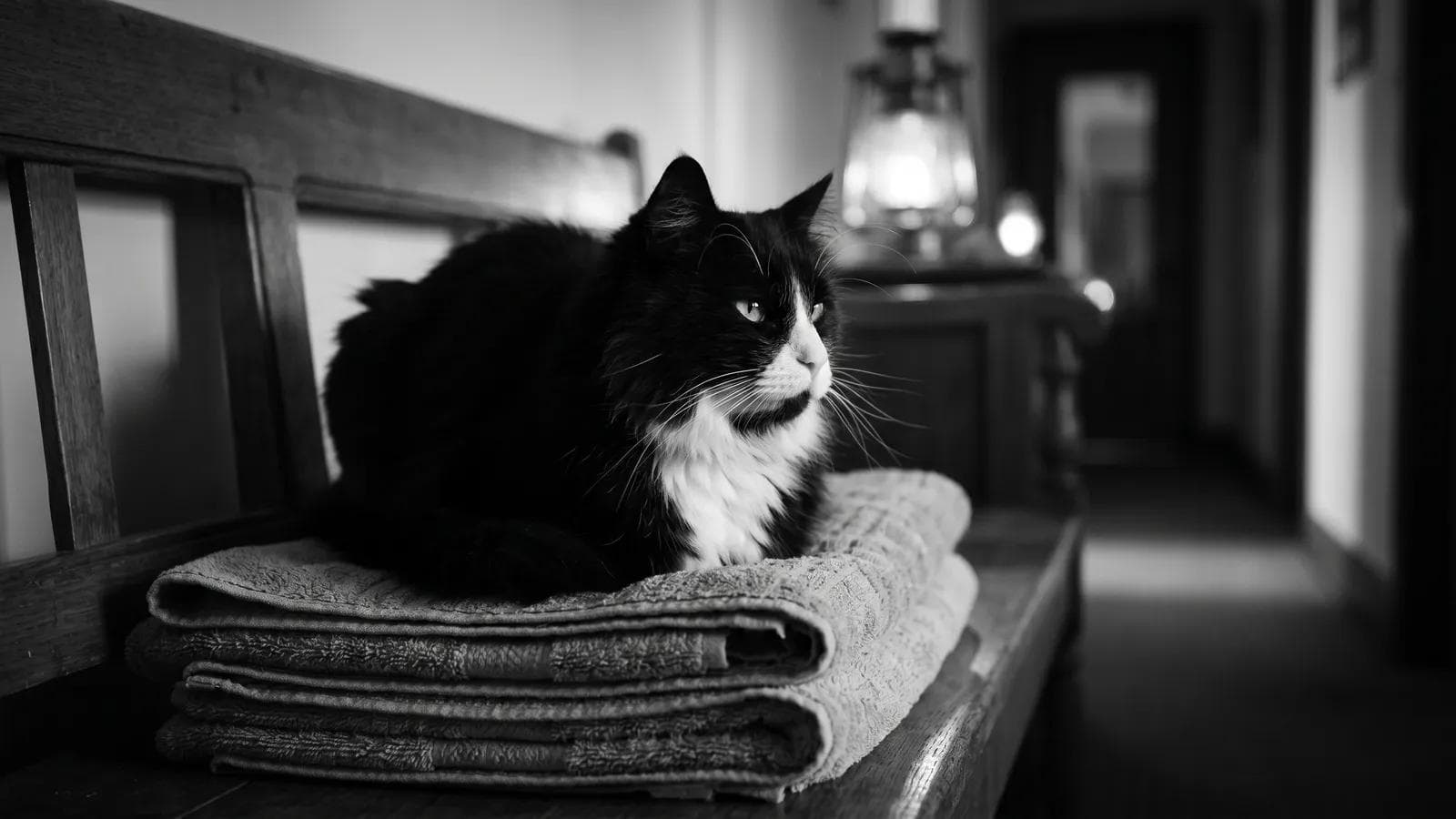
People assume tuxedo cats are a breed because they're so visually consistent. Two tuxedo cats from completely different backgrounds look like they went to the same tailor. But the consistency is genetic, not genealogical. A single dominant gene affecting white spotting is responsible for the pattern. One parent carrying it is enough to produce a tuxedo kitten. No pedigree required.
Vino is a case in point. He came from a working barn. I have no idea what his ancestry is. His tuxedo markings are as sharp as any pedigree Maine Coon's. The gene doesn't care about lineage.
This matters practically because it means tuxedo cats vary enormously in size, coat length, body type, and personality. What they share is a visual signature, not a breed standard. Vino is medium-long-haired, compact enough to be agile but solid enough that he commands a room. Another tuxedo might be enormous and fluffy, another sleek and short-haired.
The winery where I found him had other cats, all working mousers. Some were tabby, some were tortoiseshell, one was pure black. Vino stood out not because he was better at catching mice (he was efficient), but because he looked like he was wearing a formal suit to do farm work. The contrast was absurd and immediately memorable.
Do tuxedo cats have a distinct personality?
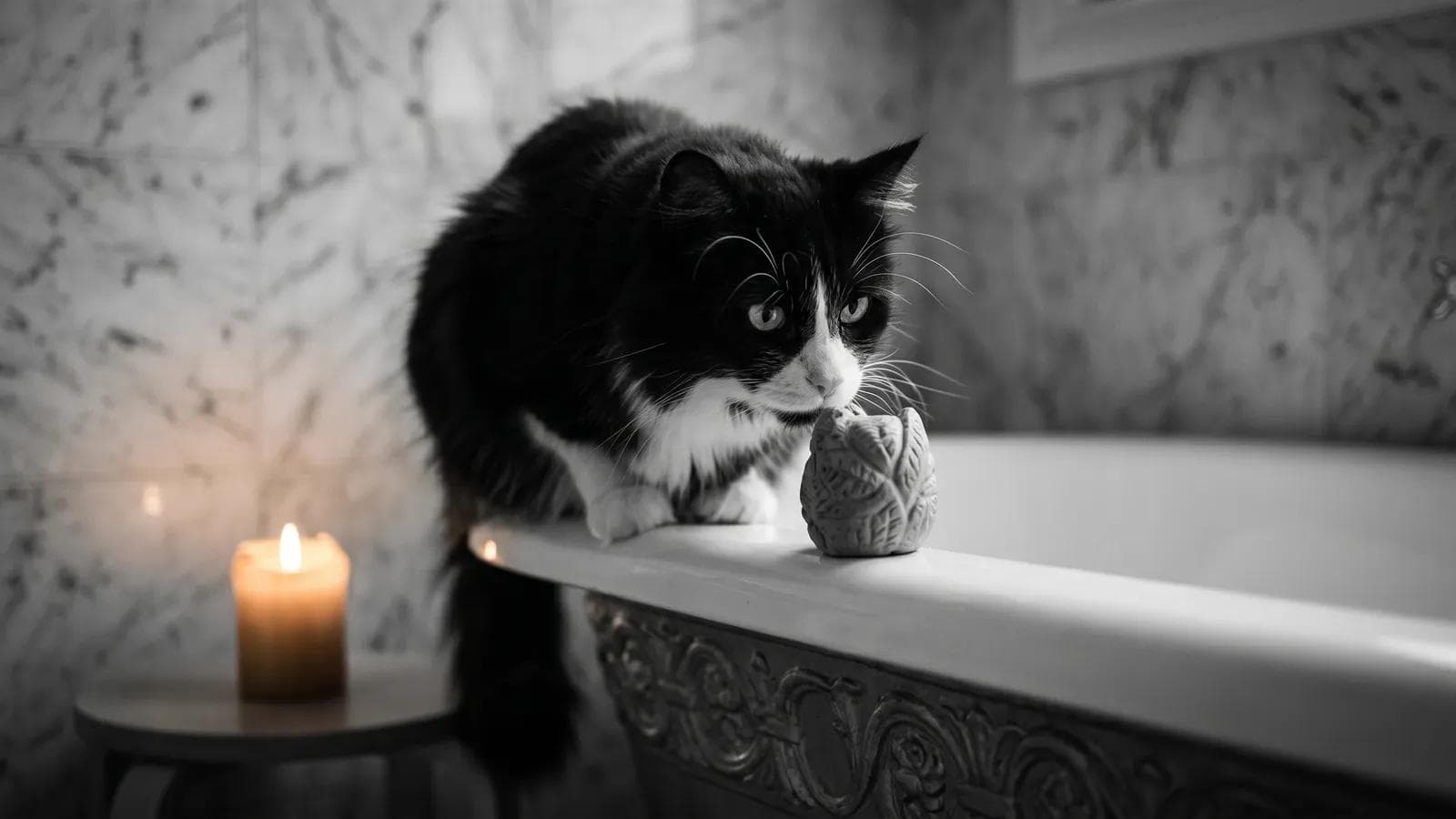
There's no scientific proof that tuxedo cats have a distinct personality. The coat pattern isn't linked to temperament in any documented way.
That said: every tuxedo cat owner I've talked to describes something similar. Opinionated. Socially confident. Not exactly aloof, but deliberate. They engage on their own terms. Vino meets guests at the front gate and escorts them to the house. This is not trained behaviour. He decided this was the correct protocol and implemented it. He greets new people with a meow and a headbutt, sizes them up, and either approves them or doesn't.
The first time he did this gate-greeting routine, I assumed it was coincidence. A guest arrived while Vino was already outside. But it kept happening. Now I watch for it. Someone pulls into the driveway, and Vino appears from wherever he was napping or hunting. He walks alongside them to the front door, meowing commentary the entire way. If they stop to pet him, he allows it briefly, then continues the escort mission.
He also has Zola, our other cat, whom he publicly ignores and privately adores. They share a can at every mealtime. She pretends not to notice him. He knows. At night, they sleep within touching distance but never actually touching. In the morning, they're in separate rooms as if they'd spent the night avoiding each other.
And then there's the Staffy next door. Vino's approach to this dog is masterful passive aggression. He'll lie down roughly a metre from the fence line and stare into the middle distance, pretending the Staffy doesn't exist. The dog loses its mind. Vino does not react. The performance can go on for twenty minutes. When he's satisfied with the level of frustration he's generated, he gets up and walks away without acknowledgment.
What you make of all that, whether it's personality or just one specific cat, I'll leave to you. But Vino doesn't feel accidental.
What does the tuxedo pattern actually look like?
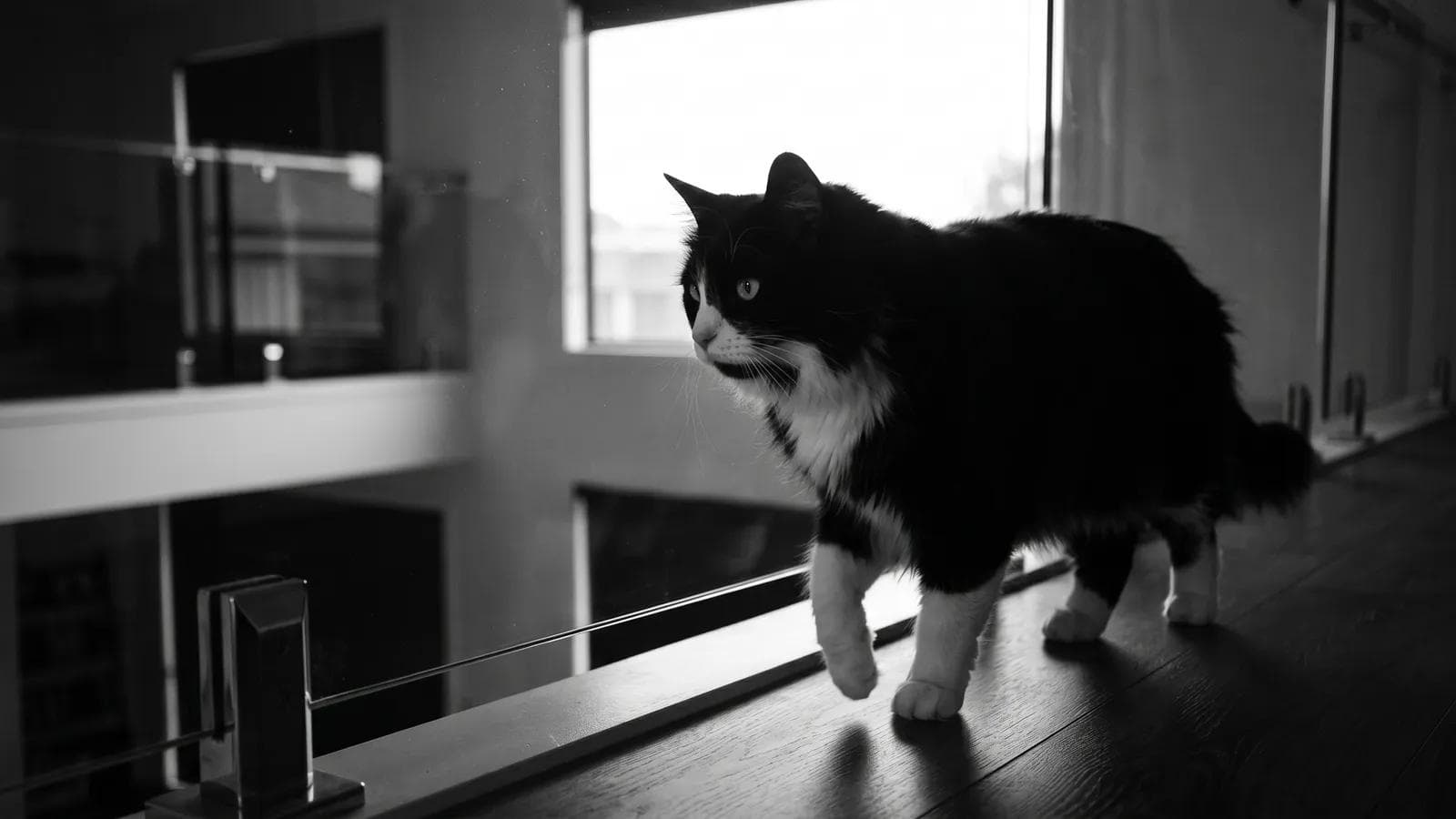
The core requirement is a dark base coat, almost always black, with white concentrated in specific locations: the chest, the belly to varying degrees, the paws, and often the chin. Beyond that, the pattern varies significantly.
Vino's markings happen to be particularly clean. The white bib sits high on his chest and extends down his belly in a neat line. The white socks extend well up each paw, creating the impression that he's wearing formal gloves and spats. The chin stripe starts white and meets the black above it at a precise angle that frames his face like a bow tie.
His eyes are green with a slight yellow cast, which gives them a quality that reads as evaluative in most lighting conditions. When he's deciding whether to approve a new person, those eyes do most of the work.
The medium-long fur adds to the formal effect. Short-haired tuxedo cats can look sleek and streamlined. Vino looks substantial, like he's wearing a winter formal coat. When he sits upright with his white chest prominent and his tail wrapped around his paws, the resemblance to a Victorian gentleman is unavoidable.
Not all tuxedo cats wear the pattern as tidily as Vino does. Some have white that bleeds up onto their faces, creating a masked effect. Others have white bellies that extend too far up the sides, or white paws that stop at the toes instead of extending up the legs. The gene creates the general pattern, but the specific distribution is individual.
Where do tuxedo cats come from historically?
Tuxedo cats show up across recorded history because the bicolour gene is ancient and widespread. Ancient Egyptian tomb art depicts cats with black-and-white markings. Medieval European folklore tied them to luck, though which kind shifted by region and era. Japanese maneki-neko statues are often black-and-white. Sailors prized them as ship cats, possibly because they were easy to spot on deck.
In more recent history, they became cultural fixtures: Felix the Cat, Sylvester the Puddy Tat, Socks at the White House during the Clinton administration. The Cat in the Hat, though he's clearly wearing an actual hat, reads as a tuxedo cat to most children.
They keep appearing in popular culture because the look is memorable and the personality, whatever you want to call it, tends to be distinctive. A tuxedo cat in a story doesn't need much introduction. The visual does half the character work.
How do you live with a tuxedo cat day to day?
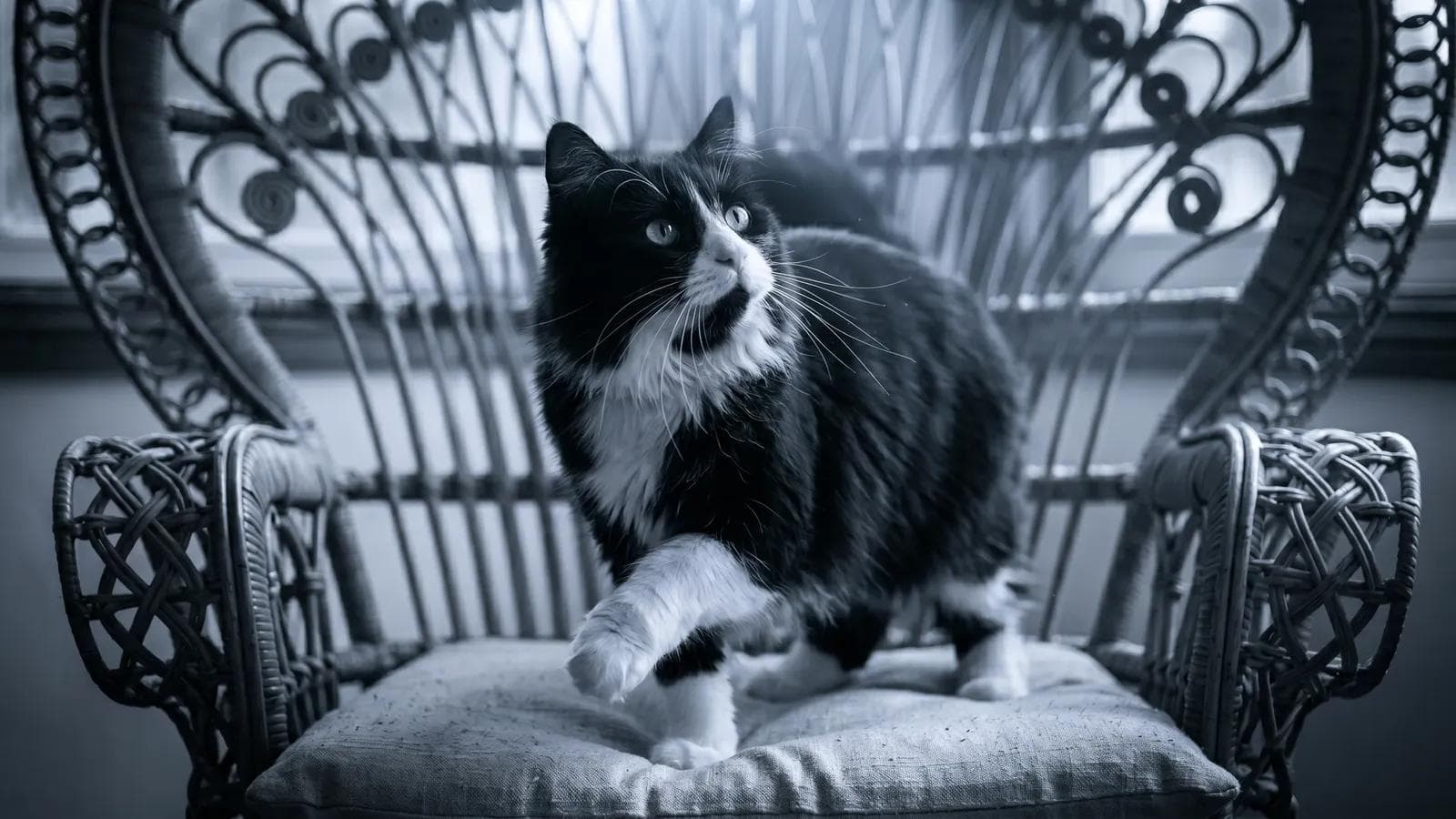
Vino's routine provides a practical example. At first light, Vino lands on my bedside table and begins his breakfast request. He doesn't crow first: he waits for the rooster as though that's the proper protocol. But he doesn't wait long.
Breakfast is shared with Zola in a performance of mutual indifference that fools no one. They eat from opposite ends of the same plate, never making eye contact, never acknowledging each other's presence. If one finishes first, they'll sit nearby and wait for the other to finish before both leave together.
Outside time runs most afternoons for an hour or two. Vino wanders the yard, sits majestically on fence posts, chirps at wild birds, and follows me around demanding constant attention and commentary. He's exactly the same as he was in the winery barn: cannot be ignored, will not be ignored, inserts himself into whatever you're trying to accomplish.
When something hasn't gone his way, most commonly the door not being opened fast enough, he produces what I call the protest meow. It's a single sustained note, same tone, same volume, for five seconds or more. Not a question, not a request. A statement of grievance that hangs in the air until acknowledged.
He drools during cuddles, which guests discover when he settles on their lap and relaxes fully. The contrast between his formal appearance and the undignified reality of cat ownership becomes clear quickly. He's also medium-long-haired, which means he grooms himself for considerable stretches of each day and produces regular furballs.
But he's also the most specific cat I've ever owned. Other cats I've had were cats. Vino is a person who happens to be a cat, and he operates accordingly. He has opinions, routines, preferences, and a sense of protocol that he enforces consistently.
Why do people get confused about tuxedo cats?
The confusion stems from how visually consistent the pattern is across different genetic backgrounds. When you see tuxedo cats from completely different sources (shelter cats, pedigreed cats, barn cats, urban cats), they look like they come from the same programme. The white bib, the white paws, the formal symmetry: it's remarkably standard.
This visual consistency makes people assume there must be a tuxedo cat breed somewhere, with standards and lineages and breeding programmes. But that's backwards. The consistency comes from a single gene that expresses the same way regardless of what other genes are present.
Vino could be part Maine Coon, part barn cat, part whatever else was wandering northern Tasmania before he came home. His tuxedo pattern would look identical if he were a purebred British Shorthair. The gene creates the uniform, not the breeding.
What should you know before getting a tuxedo cat?
First: you're not getting a breed, you're getting a coat pattern. The personality, size, grooming needs, and health considerations depend entirely on the actual breed or mix underneath the pattern. A tuxedo Maine Coon will be enormous and need daily brushing. A tuxedo American Shorthair will be compact and low-maintenance. The white markings tell you nothing about what you're signing up for.
Second: the anecdotal personality reports are just that: anecdotal. Vino is social, vocal, and insistent on being involved in everything. Another tuxedo cat might be reserved, quiet, and prefer to observe from a distance. The pattern doesn't determine temperament.
Third: if you're specifically seeking a tuxedo cat, shelters and rescues are your best bet. The pattern appears regularly in mixed-breed populations, and you're more likely to find one there than through a breeder focusing on a specific breed that happens to sometimes produce tuxedo markings.
That said: if you want a cat like Vino (opinionated, present, socially confident), getting a tuxedo cat might improve your odds. The reports from tuxedo households are remarkably consistent, even if the science doesn't back up the pattern.
If you're wondering how long a cat like this lives, or whether the Staffy situation was typical behaviour, both questions have their own posts. Start with tuxedo cat lifespan if you want to know what "barn cat" actually means for longevity.
For more on how Vino behaves day to day, the post on tuxedo cat personality traits covers his relationship with the neighbour's dog in detail.
What did you think tuxedo cats were before you found out the truth? I assumed there was a breed somewhere with formal standards. Drop your answer in the comments.
Related reading: Tuxedo Cats: Everything You Need to Know.
Frequently Asked
What I've Learned Living with a Tuxedo Cat
The thing about tuxedo cats is that people project onto them. Because they look formal, they assume some dignity underneath. Three years with Vino has cured me of this. He drools when he purrs, gets knots under his arms that I have to brush out while he tries to bite the brush, and once fell off a couch chasing a treat so hard he knocked a canine loose. The tuxedo pattern is not a personality. It is a colour scheme that happens to look good in photographs while the animal wearing it commits various indignities.
What I have learned is that tuxedo cats draw the eye in a way other patterns don't. At the winery, Vino moved between my legs in the barn while I tried to reach for equipment: trip, block, demand attention. The other cats did variations of this. But Vino was the one I remembered, the one who inserted himself into my field of vision until taking him home felt inevitable. The pattern creates a visual anchor. The behaviour does the rest.
There is no genetic link between the white-spotting gene and temperament. I say this because I have read the assumption repeatedly: tuxedo cats are smarter, more vocal, more mischievous. Vino is certainly vocal. He meows constantly, a running commentary on his grievances and desires. But I have lived with talkative tabbies too. The pattern did not ordain this. What the pattern ordains is that when he stands in a doorway complaining about his dinner delay, he looks like a maître d' lodging a formal complaint about the service. The comedy is that the cat underneath is simply demanding, not dignified. The tuxedo makes it feel like theatre.
I have also learned that the pattern fades into information. After a while I do not see "tuxedo cat" when I look at Vino. I see Vino: the specific shape of his bow-tie chin stripe, the exact placement of the white on his paws, the way his medium-long coat fluffs out in cold weather until he looks slightly undignified. The generic becomes particular. This is what happens with any cat you live with closely. The breed or pattern becomes irrelevant to your daily experience. What matters is whether he is currently standing on your keyboard, which he is, because that is what he does in whatever house we happen to be living in. The winery barn, the rural place with the chickens, the current suburban house with its sunroom: different settings, same insertion of self into my tasks.
If you are considering a tuxedo cat because of how they look, you will get what you expect visually and nothing you expect behaviourally. They are cats. Some are reserved, some are pests, some are both depending on the hour. The tuxedo does not predict which.
Why does my tuxedo cat meow so much?
Observed behaviour: Vino meows constantly, a running commentary that follows me through the house.
The mechanism: Excessive vocalisation in cats typically indicates a learned reinforcement loop. The cat discovers that meowing produces human attention, food access, or environmental change, and escalates frequency accordingly. Some individual cats have lower thresholds for initiating vocal communication.
Vino's specific trigger: He wants something. Usually food, sometimes outside time, occasionally just acknowledgment that I am in the room and he is also in the room and this fact requires vocal registration. The meowing increased not at all when we moved house and he lost his unsupervised yard access. He simply applied the same commentary to the new windows, the new doors, the new sunroom. The behaviour predates and outlives any specific setting.
Are tuxedo cats smarter than other cats?
Observed behaviour: Vino learns quickly and inserts himself strategically into whatever I am doing.
The mechanism: Feline cognitive research consistently finds no correlation between coat pattern and intelligence. Individual variation within any population far exceeds between-pattern differences. What owners interpret as "smart" is often high observational learning capacity combined with boldness in acting on observations.
Vino's specific trigger: He was a working barn cat for approximately two years before I took him home. That environment rewarded initiative: noticing where humans went, predicting when food appeared, inserting himself into activity to secure resources. The behaviour transferred intact to domestic life. A less confident cat from the same litter might have learned identical skills and never deployed them so aggressively. The pattern is not the cause. The individual history is.
Do tuxedo cats have different personalities?
Observed behaviour: Vino presents as confident, persistent, and socially demanding. Zola, the black cat he lives with, presents as initially reserved then surprisingly chaotic once comfortable.
The mechanism: Coat colour genetics in cats do not link to behavioural genetics. The "tuxedo cat personality" as described online consolidates observer bias: people who choose cats for formal appearance may unconsciously reinforce bold, attention-seeking behaviour with immediate response, creating a self-fulfilling stereotype.
Vino's specific trigger: He was bold when I met him. I responded to that boldness because it was charming. He became bolder because it worked. His tuxedo pattern meant I photographed him more often, talked about him more, generally reinforced his centrality to household attention. Whether a tabby or solid black cat from the same barn would have received identical reinforcement is unknowable. What is knowable is that the pattern created initial visual interest, and the individual sustained it. One does not function without the other, but they are not the same thing.
Vino's Verdict
Photographed on the new sunroom tiles, September 2026.
He lies in the sunbeam, medium-long coat absorbing heat, white chest rising and falling. The tuxedo pattern looks immaculate from a distance. Close inspection reveals a small food stain on the white bib, a knot forming under his left arm, and the faint pink line on his top lip where the remaining canines sit slightly wrong since the extractions. He is not pristine. He is present. That, I have learned, is what the tuxedo really signifies: not elegance, but visibility. You will see this cat. He has arranged it so.