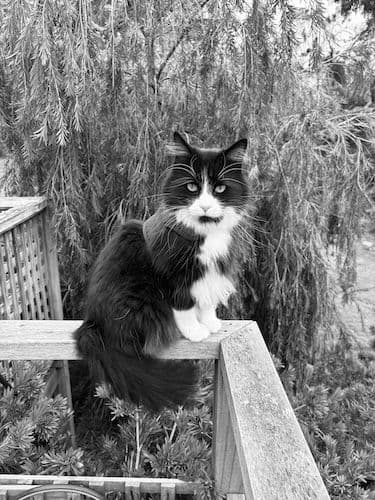
The answer is no. Tuxedo cats are not a breed. The black-and-white coat pattern that makes them instantly recognisable is produced by a gene, not by selective breeding. Vino, who came home with me from a winery barn in northern Tasmania without a pedigree in sight, is as much a tuxedo cat as any show-quality British Shorthair wearing the same markings. The pattern defines the category. The paperwork does not.
This is the complete guide to tuxedo cats: what they are, where they came from, how the genetics actually work, what living with one reliably produces, and how to care for one properly. Vino, known in full as Viniferous "The Mischievous" Messiah, is the primary source. Years of continuous observation has provided ample material.
What Makes a Tuxedo Cat
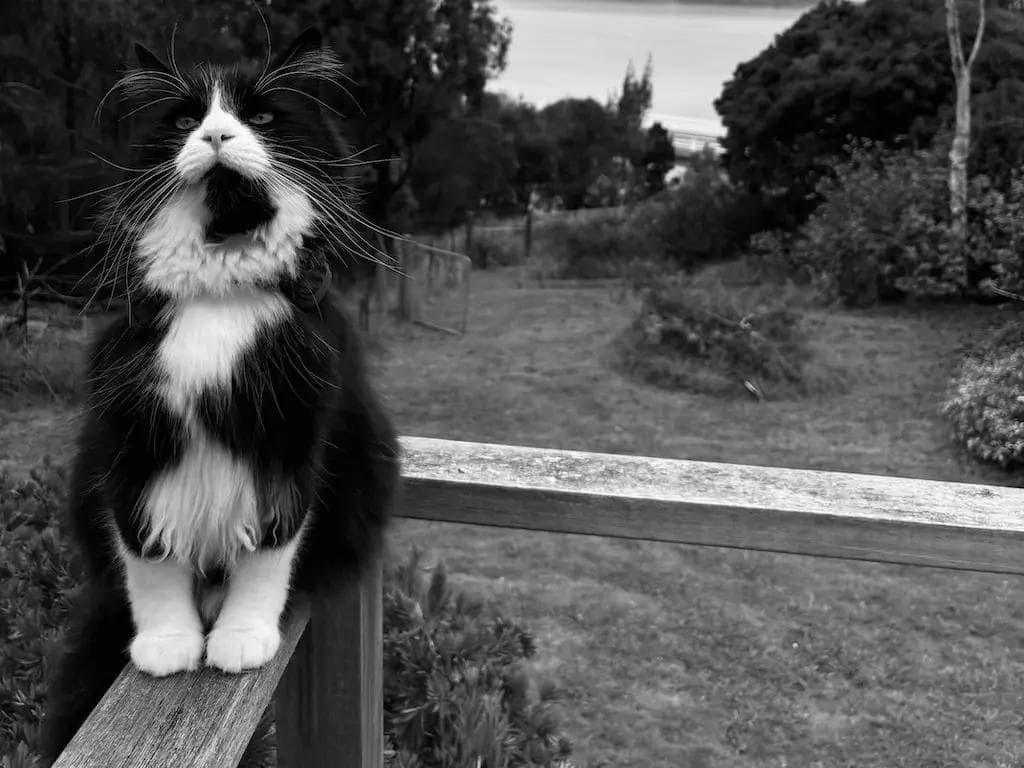
A tuxedo cat is any domestic cat with a predominantly dark base coat and white markings concentrated on the chest, belly, and paws. The pattern's resemblance to formal evening wear is not coincidental as a name, though the cats themselves seem entirely indifferent to the association.
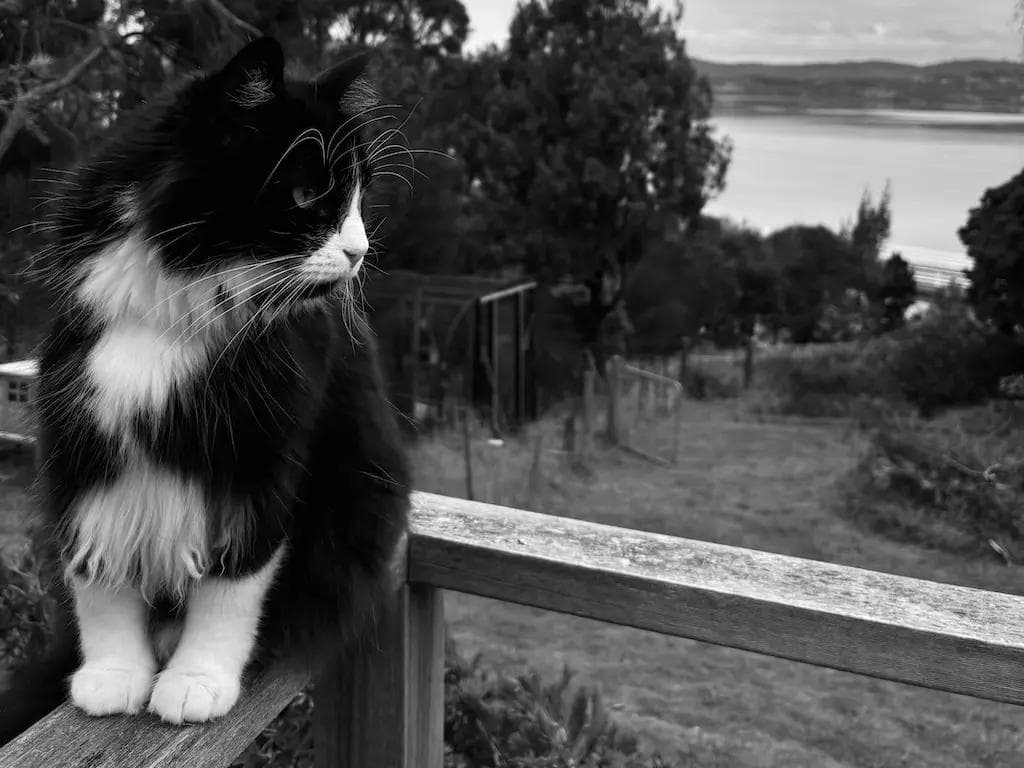
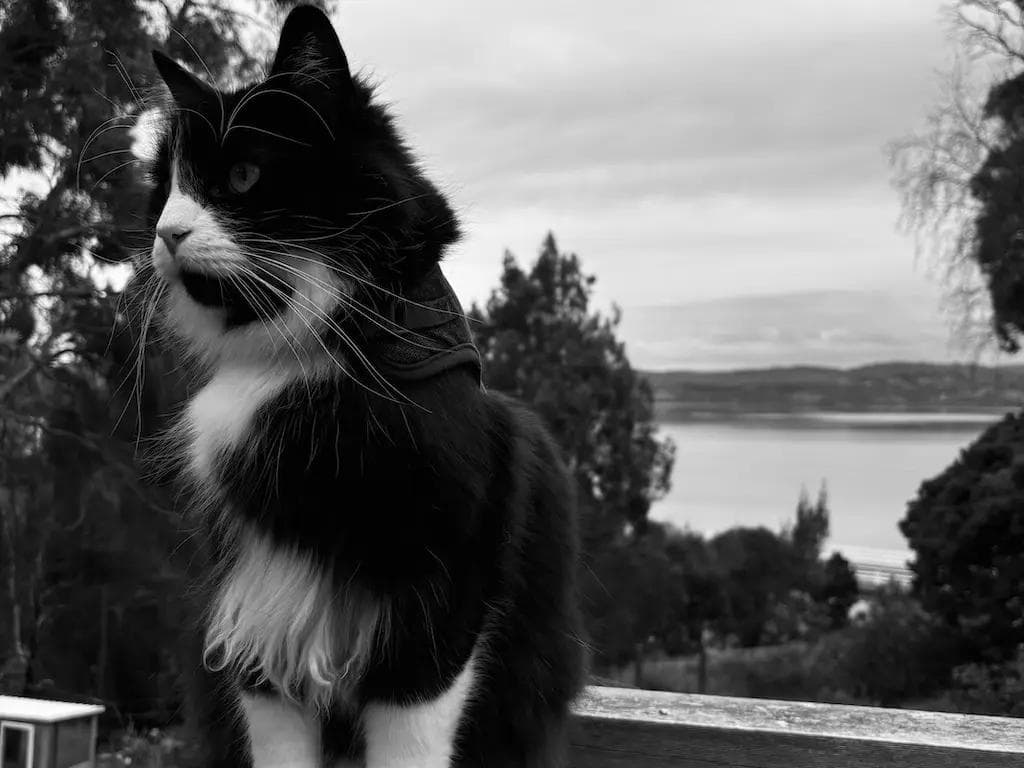
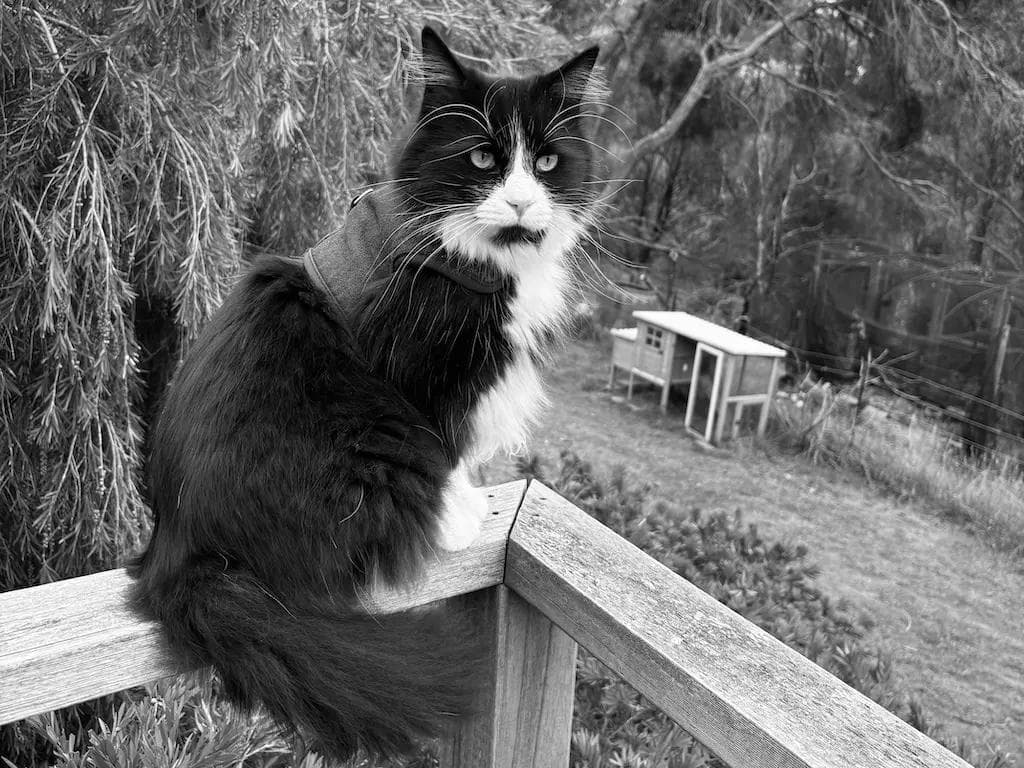
The classic tuxedo presents as follows: white bib on the chest, white socked paws, and often a chin stripe or drop that creates a bow-tie silhouette against the white. Vino has all of it. His black chin extends downward to a point, meeting the white chest in a shape that, once noticed, is impossible to unsee. I've been asked, on more than one occasion, whether it's natural. It is.
The pattern is not breed-specific. It appears in domestic shorthairs, longhairs, Maine Coons, British Shorthairs, Norwegian Forest Cats, and every mixed-breed cat that carries the relevant gene. Two tuxedo cats from opposite ends of the earth, from different bloodlines, different barn cats, different pedigrees: they look like they share a tailor. They don't. What they share is a gene.
Coat length varies widely within the category. Vino is medium-long: noticeably more than a shorthair, nothing like a Persian. His coat requires daily attention. Build varies equally. Vino is compact and solid. Other tuxedo cats range from lean and slight to the full Maine Coon scale. The tuxedo pattern makes no promises about size, structure, or temperament, though the last point is where observation starts to complicate the official position.
A History That Predates the Breed System Entirely
Tuxedo cats were already famous before anyone thought to formalise cat breeds at all, which says something about the pattern's staying power.
Egyptian tomb paintings depict bicolour cats alongside their human companions. Medieval European folklore associated black-and-white cats with fortune and luck, a reputation the pattern has never quite shaken. The Japanese maneki-neko, the beckoning good-luck cat that became a global icon, is most commonly rendered in black and white. Sailors kept tuxedo cats as ship companions for centuries, with a rationale that was half practical pest management and half something closer to superstition.
The modern cultural canon is well established: Felix the Cat appeared in silent films from the 1920s onward, becoming the first globally recognised cartoon cat. Sylvester the Cat entered Looney Tunes in 1945 and has been scheming unsuccessfully ever since. Mr. Mistoffelees in Cats holds the distinction of being the musical's most dramatically useful character. Socks served as the White House cat through the Clinton administration, greeting world leaders with the composed disinterest that the pattern apparently confers. Tuxedo Stan stood as a candidate in the 2012 Halifax municipal election on an animal welfare platform, polling better than several actual politicians before his death in 2013.
Vino's own origin story places him at a biodynamic winery in northern Tasmania, living in the barn of a property that had been built and operated by an elderly couple for roughly four decades. The founder had passed away approximately two weeks before I began working there. Vino had been his. The cat who kept Vino company in that barn was 22 years old. This is worth remembering when outdoor-cat lifespan statistics enter the conversation.
The Genetics: One Gene, Many Outcomes
The tuxedo pattern is produced by the white spotting gene, designated S (dominant) against s (recessive). During development, the S gene interrupts the migration of melanocytes, the cells responsible for pigmentation, across the embryo. Melanocytes begin in the central dorsal region and migrate outward. Where migration is blocked or incomplete, white appears. The areas furthest from origin, which is to say the chest, belly, and paws, are the last to receive pigmentation and the most likely to end up white.
The gene expresses across a spectrum. Low expression, roughly grades 1 through 4 on the standard scale, produces the tuxedo pattern: approximately 25% white, concentrated on the underside. This is Vino's position in the range, a grade 3 or 4 by the markings: cleanly defined, high-contrast, unmistakable. Higher expression, grades 5 and up, produces harlequin or van patterns where white coverage increases dramatically and the dark areas become the accent rather than the base.
The S gene is dominant, meaning one copy from one parent is sufficient to produce a tuxedo kitten, even from two non-tuxedo parents. This is partly why the pattern appears so consistently across shelter populations. The gene doesn't require two cooperating parents; it needs only one carrier.
Vino's parentage is unknown. His barn origin accounts for the documentation gap. His coat is what it is, and it is impeccable.
Physical Characteristics of the Tuxedo Cat
The tuxedo pattern imposes no particular build, size, or coat length on the cats that carry it. What it does impose is a level of visual specificity that makes identification immediate. Within that visual specificity, the variation is considerable.
Coat length
Coat length ranges from the flat, close shorthair of a standard domestic, through the medium-long of a Vino, to the dramatic extension of a Maine Coon or Norwegian Forest Cat wearing the same markings. Vino's coat is the middle register: clearly longer than a shorthair, requiring daily brushing, catching things it shouldn't on occasion. The occasions when it has caught things it shouldn't have resulted in what is internally documented as the half-bath procedure: warm water, patience, and a cat who considers the entire enterprise beneath him. Vino growls throughout. He fights. He attempts to escape. The contrast between his usual bearing and the reality of being held over a sink is considerable, and I no longer feel embarrassed to admit that a small, specific, dignified cat won that argument at least twice.
Eye colour
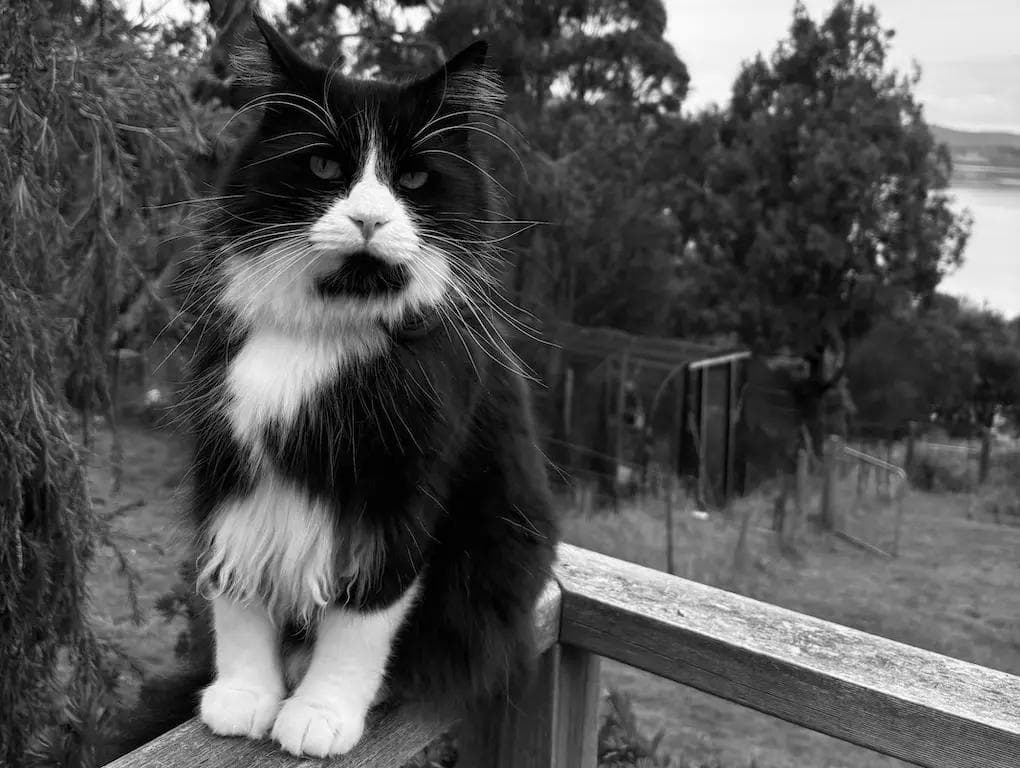
Eye colour in tuxedo cats most commonly presents as gold, green, or blue, with variation common. Vino's eyes are green with a slight yellow hue. They are expressive in a way that I've learned to read with some precision: the specific arrangement of ears, eyes, and tail that indicates a formal grievance is distinct from the arrangement that indicates he simply wants someone to be sitting down.
Markings
Markings within the tuxedo category vary. Not every tuxedo cat has socked paws; not every one has a chin stripe. Vino has both. His chin mark, the black drop that terminates in a point against the white chest, creates the bow-tie silhouette that has been photographed with moderate frequency and that he appears to consider his due.
Personality: The Anecdotal Case for Social Confidence
There is no peer-reviewed literature establishing a causal link between the tuxedo coat pattern and any specific behavioural profile. The gene controls pigmentation, not temperament. The official position is that personality varies by individual, not by marking.
The official position is correct and also somewhat beside the point, because the pattern of reports from tuxedo cat owners is consistent enough to warrant observation: social, present, opinionated, deliberate. Engaged on their own terms, with their terms made clear. Not aloof, exactly, but not frantic for approval either. A particular calibration of confidence.
Vino arrived in a winery barn and immediately inserted himself into the work being done there. Every time I entered to retrieve something, Vino would walk between my legs in an attempt to trip me, then jump onto whatever I was reaching for, then produce sustained meowing until the situation was resolved through pats. This behaviour was not a settling-in phase. It was an introduction to permanent operating procedure. It continues today in the yard, on the desk, in the kitchen, and anywhere else someone appears to be doing something without him.
When visitors arrive at the property while Vino is outside, he walks in with them. Not trained. Not coaxed. He is simply already out there, and the incoming human is entering his domain, and it follows naturally that he should accompany them to the house. I've stopped trying to explain this to guests.
The neighbour's Staffy has lived next door for some time and has not, in that time, come to terms with Vino's existence. Vino lies down approximately a metre from the fence. He does not look at the dog. He does not acknowledge the dog. He stares into the middle distance with the expression of a cat who had never heard of a Staffy and was not about to start. The dog loses its mind. Vino continues not to react. He didn't jump the fence. He doesn't need to. The ignoring is the provocation, and he has understood this since the beginning.
Zola, our other cat, is black, slender, and in possession of a small white tummy patch. She is the direct temperamental opposite of Vino in most respects: reserved, laid back, disinclined to insert herself into other people's business. Vino loves her without restraint. He wants to play with her constantly. She finds this exhausting and communicates as much through hissing, the frequency and intensity of which correlates noticeably with how many people are watching. My working theory is that the hissing is at least partly performed for an audience, given that the same two cats will share a windowsill, sleep within reach of each other, and eat from the same bowl with a composure that suggests the drama is, if not entirely theatre, at least occasionally scheduled.
The rooster was a different matter. Vino is generally relaxed around our four chickens. The rooster commands more respect. Vino's workaround is tactical: he identifies elevated ground near the flock and positions himself there. From height, he can observe the situation with dignity intact, and the rooster cannot easily reach him. It is not cowardice. It is applied geometry.
Health and Lifespan
Tuxedo cats have no breed-specific health concerns because they are not a breed. The coat pattern contributes nothing to pedigree-linked genetic conditions. What they face is the standard set of domestic cat risks, which are significant enough without adding further categories.
Obesity is the most common weight problem indoor cats face: the Association for Pet Obesity Prevention's 2022 survey found 61% of cats in the US were overweight or obese. Vino's diet is high-protein, AAFCO-approved, and kept to 200-250 calories per day split across two meals. His outdoor access on harness contributes to maintaining reasonable activity levels. The calorie ceiling is not negotiable; he would not reach the same conclusion unprompted.
Dental health deteriorates silently in most cats and requires active monitoring. Twice-yearly vet checks catch what daily observation misses. Kidney health is tied directly to hydration. Vino uses a water fountain rather than a bowl, and the difference in his water intake was immediate and measurable. A static bowl is a thing a cat tolerates; a fountain, apparently, is a thing a cat drinks from.
Flea and tick prevention is non-negotiable for any cat with outdoor access. Vino receives it on schedule. FIV and other viral risks are reduced substantially for cats who are not in regular unsupervised contact with unknown cats. Vino's outdoor time is managed; unsupervised bush excursions happen but are not the norm.
Indoor lifespan for well-cared-for cats runs to 12-18 years reliably, and significantly beyond with good fortune and attentive care. The cat Vino shared the winery barn with was 22 years old. The outdoor cat statistics, which circulate with some frequency and paint a grim picture, describe averages across populations that include genuinely feral cats surviving without veterinary care. They are not a sentence. They are a data set, and data sets have outliers.
Caring for a Tuxedo Cat
Diet
High-protein food with a named protein source as the first listed ingredient. Two meals per day. Water via fountain, not bowl, for cats who will drink more from a moving source. Fish treats kept within 10% of daily caloric intake. The 200-250 calorie range applies to a compact adult male of Vino's size and activity level; individual requirements vary and a vet's guidance is the appropriate source.
Grooming
Daily brushing for medium-to-long-coated tuxedo cats. The slicker brush handles it efficiently: head, back, belly, done in five minutes. Vino loves the process, particularly when the brush reaches his chin and chest. He goes boneless during chin brushing in a way that makes the rest of his carefully maintained dignity seem somewhat provisional. Baths are reserved for when they are genuinely necessary; they are not enjoyable for any party involved and should not be conducted alone if avoidable.
Enrichment
Puzzle feeders expose an interesting characteristic in Vino's case. He solves them quickly. He then loses interest entirely. My interpretation is that the challenge is the point, not the food; once the problem is solved, the feeder becomes furniture. Rotation matters. Feather wands produce the only kind of urgency Vino displays that isn't primarily theatrical, and evening play sessions are among the more reliable features of our routine. Rotating toys prevent the boredom that makes a creative cat genuinely destructive.
Outdoor access
Harness training took Vino approximately one week to accept. I don't know if that's fast or slow as these things go. It's just how long it took him. He bolts for the door when the harness comes out. One to two hours of supervised outdoor time per afternoon has been the consistent routine, with occasional morning sessions when logistics permit. He climbs, chirps at birds, conducts his Staffy patrol, and sits looking majestic for significant portions of the time. A lot of his outdoor time is simply this.
Vet schedule
Twice yearly is what the AAHA and AAFP guidelines describe as commonly recommended for cats of any lifestyle, and that's the frequency I lean toward for a cat with outdoor access and other animals in the household. Once a year is a defensible minimum for a fully indoor adult cat with no health concerns. Once every two years is how cats develop problems that could have been caught earlier.
Tuxedo Cats in Culture
The pattern's cultural recurrence is not accidental. There is something about the black-and-white contrast, the dinner-jacket silhouette, the inherent formality of the markings, that reads as character rather than mere appearance. The cultural canon keeps returning to it.
Felix the Cat came first, in the 1920s, a silent-film character whose black-and-white design was partly practical given the era's technology and partly just correct. Sylvester entered Looney Tunes in 1945 and has spent the intervening decades as the most persistent and least successful predator in animation history. Mr. Mistoffelees in Cats is the show's magical operator, the one who actually gets things done, which seems tonally appropriate. Socks at the White House was photographed with the same compositional seriousness as the humans who passed through the same doors. Tuxedo Stan ran a genuinely considered municipal campaign in Halifax and is survived by the animal welfare changes he catalysed.
Vino hasn't stood for office. His constituency management across the property, the lane, and the neighbour's nervous system is, however, ongoing and largely effective.
Adopting a Tuxedo Cat
Shelter populations contain tuxedo cats consistently. The S gene is widespread, appears across mixed-breed litters without requiring two cooperating parents, and results in a coat pattern that appears in most regions at a steady rate. If someone is looking for a tuxedo cat specifically, a shelter is the most direct and practical route.
What that person is actually adopting, when they take a tuxedo cat home, is an individual. The coat pattern is a starting point. Vino's markings were visible at the barn before anyone knew his personality, before the behaviour in the barn had made itself fully apparent. The coat was there. Everything else revealed itself over time, and continues to.
Vino settled into our home in approximately one week. One week of investigation, calibration, and assessment. Then he moved in fully and began running things. I did not choose the timeline. The settling-in was complete when Vino determined it was complete, and the standard has not changed since.
This is a reasonable preview of what adopting a tuxedo cat with significant personality involves. The protocol is set by the cat. We adjust. The outcome, years on and counting, has been worth every adjustment.
Frequently Asked Questions
What are tuxedo cats?
Tuxedo cats are domestic cats with a dark base coat, typically black, and white markings on the chest, belly, and paws. The pattern resembles formal evening wear, which accounts for the name. Tuxedo is a coat pattern, not a breed; it appears across dozens of breeds and all mixed-breed cats that carry the relevant gene.
Are tuxedo cats their own breed?
No. There is no tuxedo breed standard, no tuxedo breed registry, and no selective breeding programme for the pattern. The white spotting gene produces the markings independently of breed. A Maine Coon, a British Shorthair, and a winery barn cat from northern Tasmania can all be tuxedo cats simultaneously.
How long do tuxedo cats live?
Indoor tuxedo cats with good veterinary care live 12-18 years routinely, and beyond that with good fortune. The barn cat Vino shared his original home with was 22 years old. Outdoor cat lifespan statistics describe populations with limited veterinary access; they are not a ceiling for well-cared-for cats with managed outdoor access.
What is the tuxedo cat personality like?
The pattern is not genetically linked to behaviour, which the scientific literature is correct to note. The anecdotal record, however, is consistent: tuxedo cat owners describe social confidence, deliberate engagement, and a tendency to have opinions about the household's operations. Vino has met every new arrival at the gate, conducted a sustained campaign against the neighbour's Staffy purely through strategic ignoring, and maintained a working relationship with four chickens and a rooster through applied elevation strategy. This is the data available from our household.
Do tuxedo cats shed a lot?
Shedding depends on coat length, not pattern. Short-haired tuxedo cats shed at the normal rate for short-haired cats. Vino's medium-long coat sheds daily at a manageable rate with consistent brushing. Daily brushing with a slicker brush takes five minutes and is, for Vino, a high point of the day that he would not describe as shedding management and I would.
What do tuxedo cats eat?
High-protein food with a named protein source as the first listed ingredient. Standard adult cat nutritional guidelines apply. Vino's specific intake is 200-250 calories per day split across two meals, with water via fountain rather than bowl. Treats kept within 10% of daily intake. Tuxedo cats have no specific dietary requirements distinct from other cats.
Are tuxedo cats good with other animals?
Individual variation applies. Vino coexists with Zola through a relationship that involves shared meals, proximity, performative hissing for audiences, and an affection that neither party would characterise as effusive. He has reached an operational accommodation with four chickens and uses geometry to manage the rooster. The Staffy next door at that house was a different category of situation, and both parties had developed stable positions on it.
Are tuxedo cats rare?
No. The S gene is dominant and widespread in domestic cat populations. They are not rare. They are, however, frequently striking, which may account for the impression.
Related reading: What is a Tuxedo Cat?.