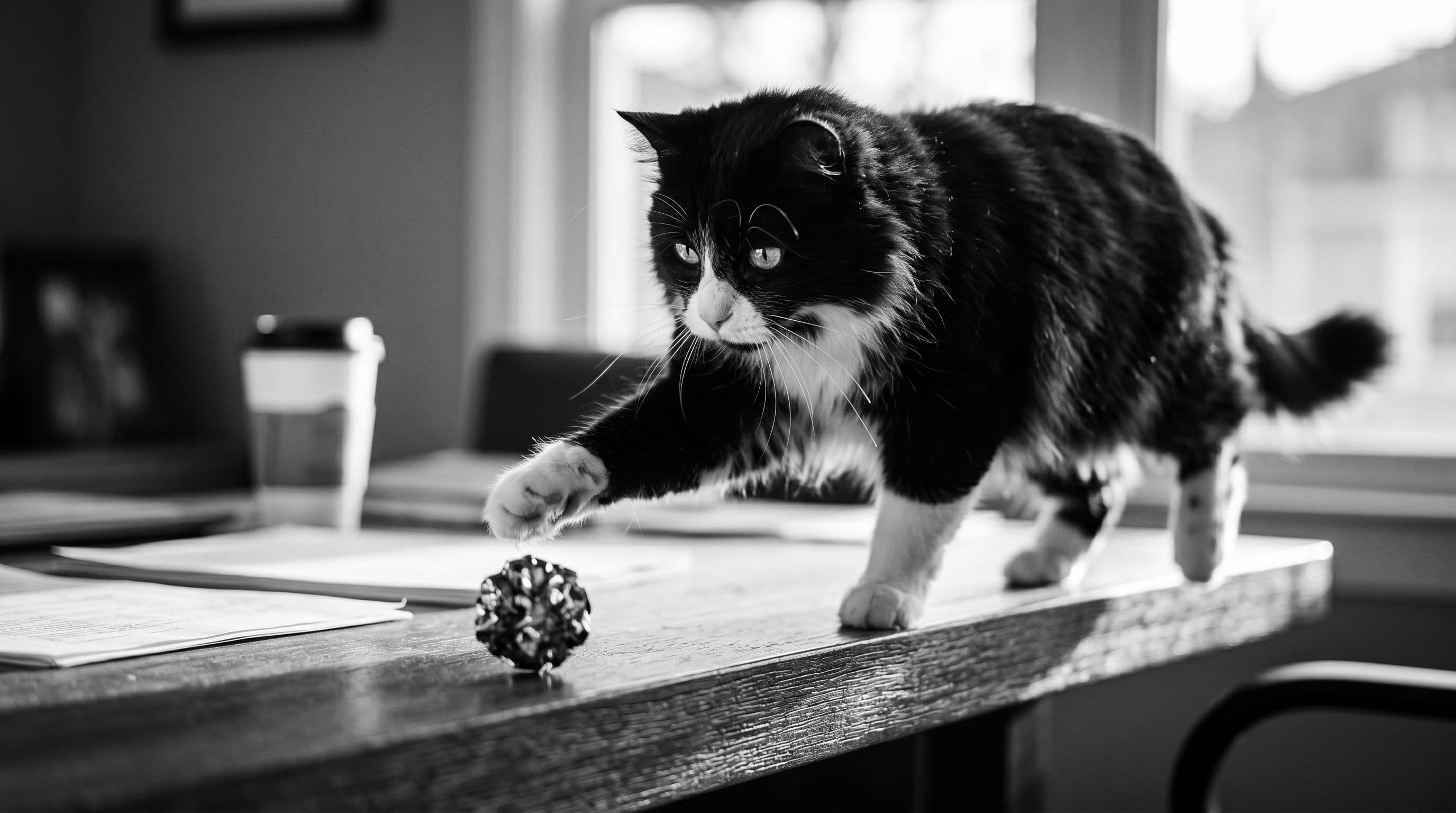
Last Tuesday afternoon, Vino was stationed on the desk beside my keyboard, methodically batting a crinkle ball off the edge and onto the floor, then meowing at me until I picked it up. We repeated this cycle 14 times before I started counting and another 9 times after. That's 23 retrievals in roughly 40 minutes, which tells you everything you need to know about tuxedo cat play behavior: it's relentless, it's inventive, and it's conducted entirely on the cat's terms. I didn't sit down at that desk to play fetch. I sat down to answer emails. Vino had other plans, and Vino's plans won.
Why Tuxedo Cat Play Behavior Deserves Its Own Conversation
Most articles about tuxedo cats recycle the same five facts: they're not a breed, they have bicolour coats, they're "friendly." That's fine as far as it goes, but it doesn't go anywhere near far enough when it comes to play. Tuxedo cats are domestic shorthairs, domestic longhairs, Maine Coons, British Shorthairs, Turkish Angoras, and a dozen other breeds wearing the same coat pattern. What I've noticed living with Vino for years is that his play style isn't random. It's structured, persistent, and weirdly strategic.
John Bradshaw, the anthrozoologist who founded the Anthrozoology Institute at the University of Bristol and wrote Cat Sense, argues that much of how cats communicate with people is learned rather than innate. The bicolour pattern that produces the tuxedo look turns up across many different breeds, and coat colour on its own is a poor predictor of a cat's temperament. In other words, the science says a tuxedo's personality isn't determined by being a tuxedo. But here's where I'll push back slightly: the owners I've spoken to through this blog, combined with my own household evidence, suggest that bicolour cats who land in the tuxedo pattern tend to share a particular intensity around play that goes beyond what I've observed in solid-coloured cats. It isn't that they play more; it's that they play with more agenda. Vino doesn't chase a toy the way Zola does. Zola will swat something once, maybe twice, then walk away with the air of someone who's just remembered a prior engagement. Vino approaches play like a second job.
If you've read my earlier post on understanding your tuxedo cat's personality, you'll recognise this pattern. The same stubbornness that makes Vino follow me around the yard meowing until I pay attention is the stubbornness that fuels his play sessions.
The Five Play Modes I've Catalogued in My Living Room
Over the past two years, I've kept informal notes on how Vino plays. Not because I'm running a research lab, but because the patterns became impossible to ignore. His play falls into five consistent modes:
Fetch (cat-initiated). This is the crinkle ball situation from my desk. Vino bats an object off a surface, waits for a human to retrieve it, and repeats. He'll do this 20 to 30 times in a session. It isn't trained. He invented it.
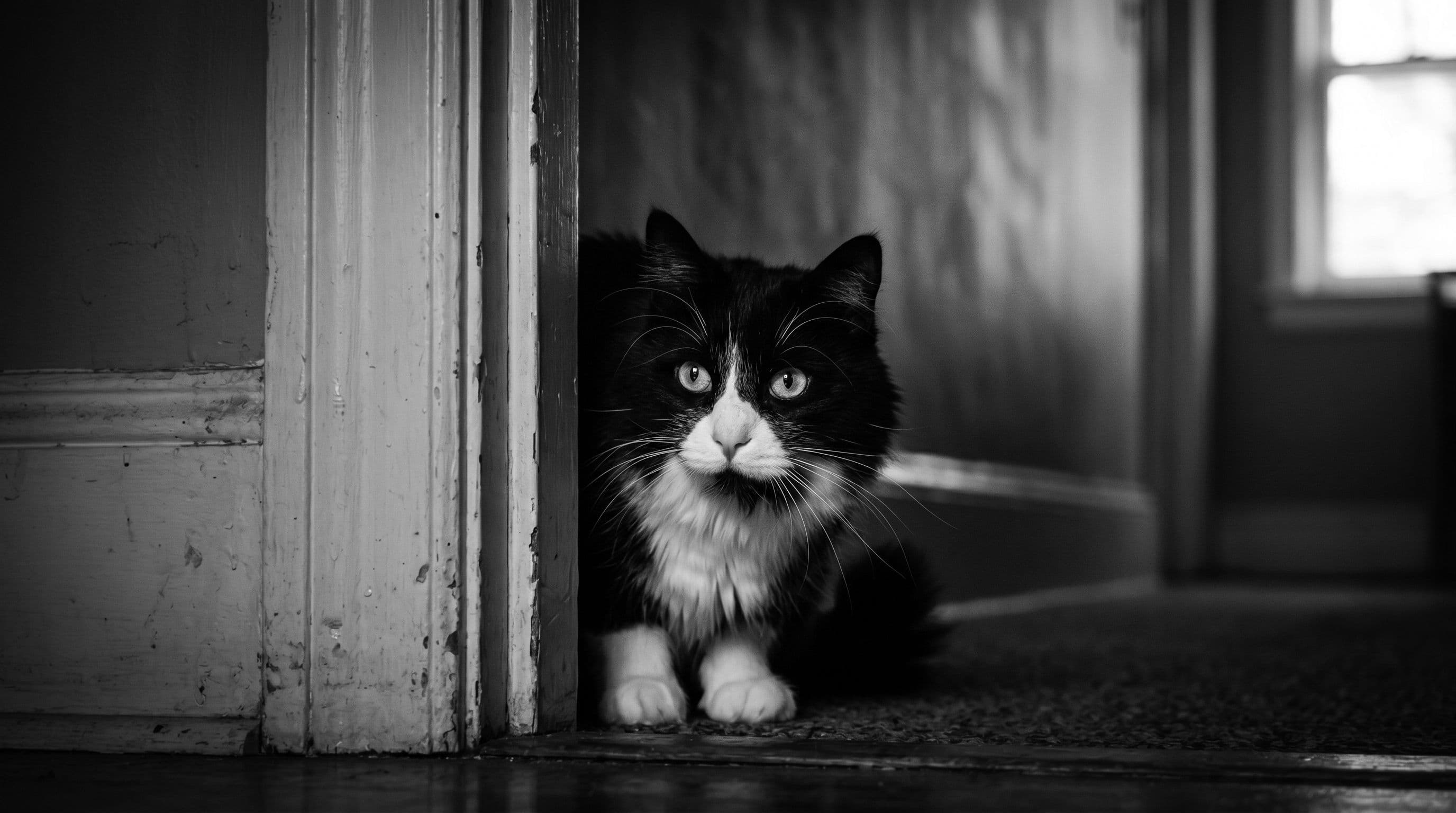
Ambush hunting. Vino will position himself behind a doorframe or beneath a chair and wait for Zola to walk past. The pounce is theatrical. The success rate is low because Zola has learned to check corners. But Vino commits to the crouch for 3 to 5 minutes at a stretch, which is a long time for a cat who can't sit still for 30 seconds under any other circumstance.
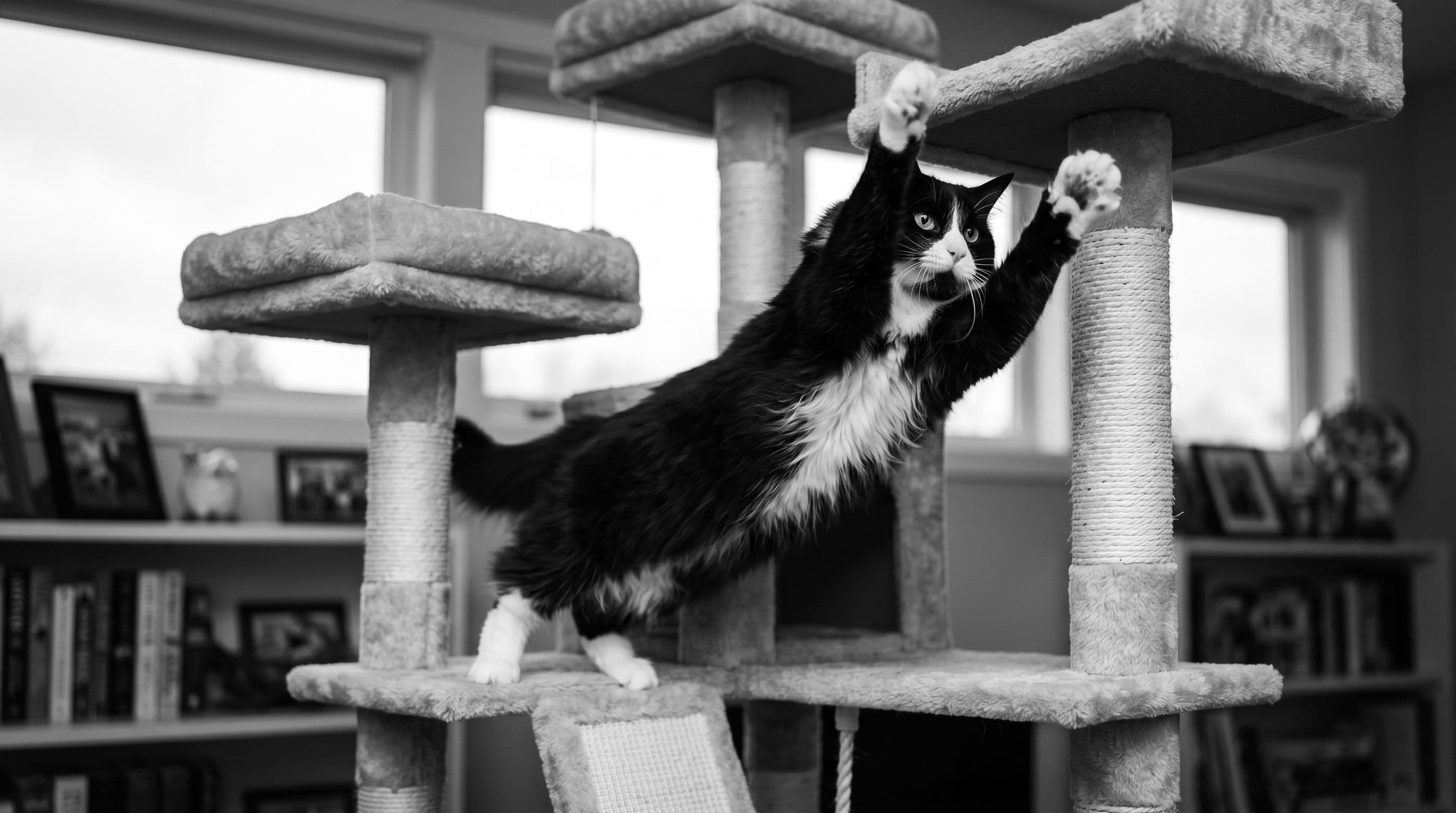
Vertical sprinting. The cat tower in our lounge gets a full vertical charge at least twice a day. Vino launches from the floor, scales all three tiers in under two seconds, and then sits at the top looking smug. This is performance, not exercise. He wants you to have seen it.
Solo object manipulation. Hair ties (stolen), pen caps (stolen), and small soft toys get carried around the house in his mouth, deposited in specific locations, and revisited later. He has a rotation. Currently, a small felt mouse lives under the couch and a knotted piece of rope lives beside his water bowl. These positions haven't changed in about six weeks.
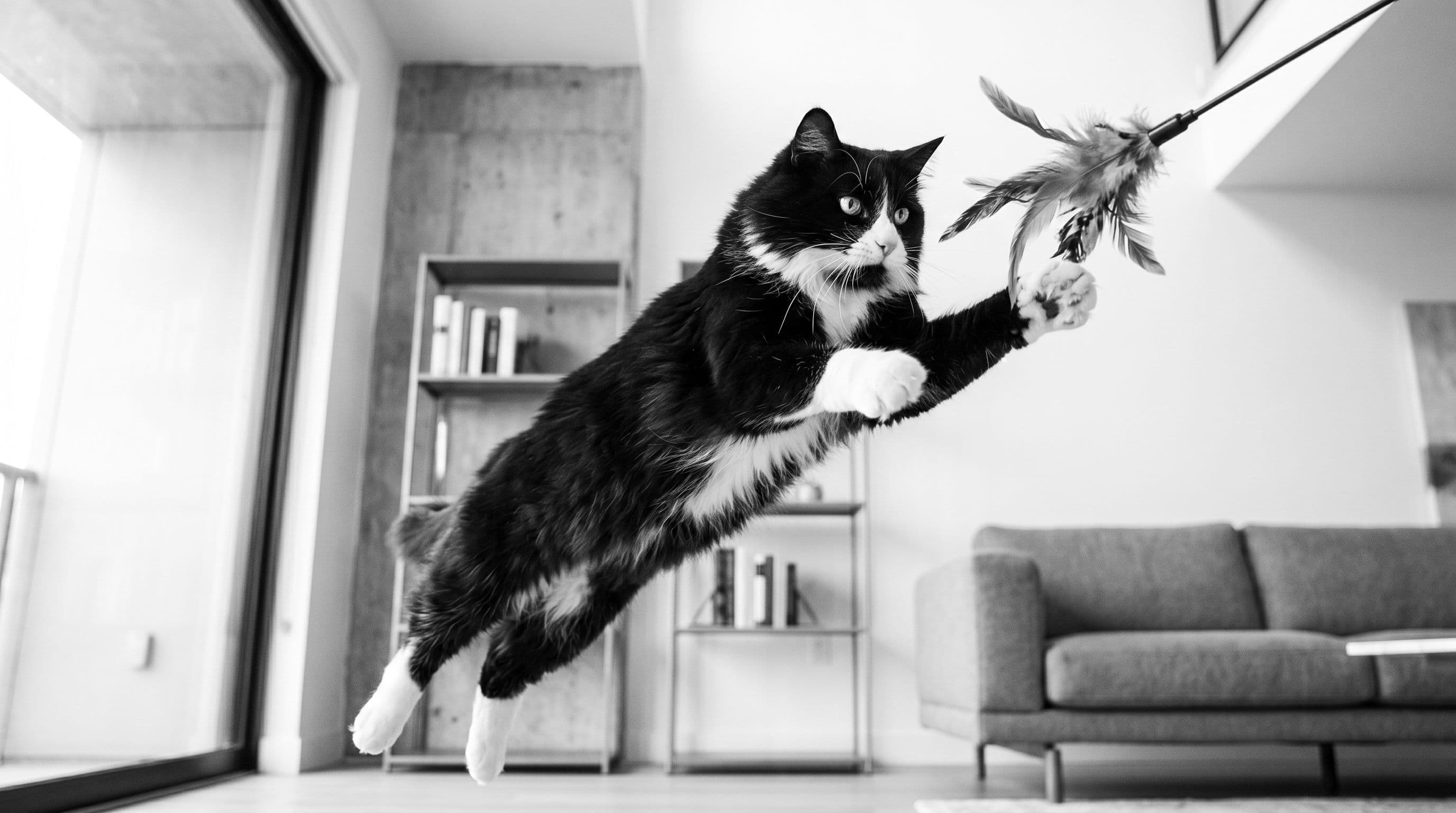
Interactive wand sessions. This is the only mode that requires my active participation from the start. A feathered wand toy gets roughly 15 minutes of airtime before Vino loses interest or, more accurately, before he catches the feather end and refuses to release it. Average session length based on my notes: 12 minutes.
What Vino's Play Tells Us About Enrichment Needs
Dr. Mikel Delgado, a certified applied animal behaviourist who completed her PhD in psychology at UC Berkeley and researched feline behaviour as a postdoc at the UC Davis School of Veterinary Medicine, co-wrote Total Cat Mojo and Play With Your Cat!, and both books shaped how I think about Vino's daily routine. I've seen the proof in my own living room: when Vino doesn't get his evening stalk-chase-pounce-catch sequence, he redirects that energy into ambushing my ankles or obsessively grooming his belly until the fur thins. Indoor cats need opportunities to run those predatory sequences to completion, and without them, the fallout shows up as aggression, compulsive grooming, or both.
Vino gets 1 to 2 hours of outdoor time most afternoons, which helps enormously. He'll chirp at wild birds from beneath the apple tree, stalk insects through the grass, and occasionally chase Zola across the yard at speeds that suggest neither of them is fully domesticated. But the outdoor time doesn't eliminate his need for indoor play. It supplements it. On days when rain keeps both cats inside, Vino's play demands increase by what I'd conservatively estimate at 40 percent. The crinkle ball comes out. The ambush positions get occupied. The protest meow intensifies if nobody engages.
From my own experience, multiple short play sessions throughout the day work better than one long one. I've found that three sessions of 10 to 15 minutes suit Vino far better than a single 30-minute marathon. By minute 20 of a continuous session, he's not playing anymore; he's just lying on his side holding a toy in his mouth and daring me to try to take it back.
Any cat owner who's watched a bored feline ignore a perfectly good toy knows the value of rotation. I do this imperfectly. Vino has about 8 toys in active circulation and another dozen in a basket he can't open but knows the location of. Every few weeks I swap some in and some out. The response is immediate: a "new" toy that's actually three months old gets treated like a revelation. Dr Mikel Delgado, a certified applied animal behaviourist who completed her PhD in psychology at UC Berkeley and researched feline behaviour as a postdoc at the UC Davis School of Veterinary Medicine, co-wrote Total Cat Mojo and Play With Your Cat!, and I think of her work every time Vino loses his mind over a crinkle ball he last saw in February.
How Zola's Play Style Reveals the Contrast
You can't understand Vino's play without understanding Zola's, because the difference is the point. Zola is a black domestic shorthair, slender and reserved, and her approach to play is the opposite of Vino's in almost every measurable way.
Where Vino initiates 90 percent of his play interactions, Zola initiates maybe 20 percent of hers. Where Vino plays loudly, narrating his hunts with chirps and trills, Zola is silent. Where Vino fetches, Zola watches. Her preferred play mode is what I'd call "selective precision": she'll ignore a toy for 45 minutes, then execute a single perfect leap to catch it mid-air, land, and walk away as though the whole thing was beneath her.
The dynamic between them during play is fascinating and, I suspect, at least partly performative. Vino will crouch and wiggle before pouncing on Zola. Zola will hiss. Vino will pounce anyway. Zola will hiss again, bat him once, and then they'll chase each other through the hallway. If you've read my piece on how tuxedo cats interact with other pets, you'll know their relationship runs on a mix of genuine affection and theatrical conflict. The hissing escalates when my fiancée and I are watching and mysteriously de-escalates when they think they're alone. I've caught them sharing the windowsill in perfect silence more times than I can count.
What I've taken from this: multi-cat households need play options that serve different temperaments. Vino needs intensity and repetition. Zola needs the freedom to opt in or out. A single feathered wand toy works for both, but only if I let Zola engage at her own pace instead of trying to match Vino's energy.
The Toys That Actually Work (and the Ones That Don't)
I've spent more money on cat toys than I'm comfortable admitting, so here's the honest breakdown.
What holds Vino's attention: Crinkle balls (the noise is essential; silent balls get ignored). Feathered wand toys with an erratic flight pattern. Small felt mice that are light enough to carry. Knotted rope segments. A simple laser pointer, used sparingly and always followed by a physical toy so the session ends with a catch.
What doesn't work: Anything battery-operated that moves on its own. I've tried three different automated motion toys, and Vino watches them like someone watching bad television: mildly interested for 60 seconds, then fully disengaged. He wants a play partner, not a gadget. Electronic toys remove the social element, which for him is the entire point.
What works for Zola but not Vino: A crinkly tunnel. Zola will sit inside it for 20 minutes. Vino tried to enter it once, got his medium-long fur snagged on the wire frame, and hasn't gone near it since.
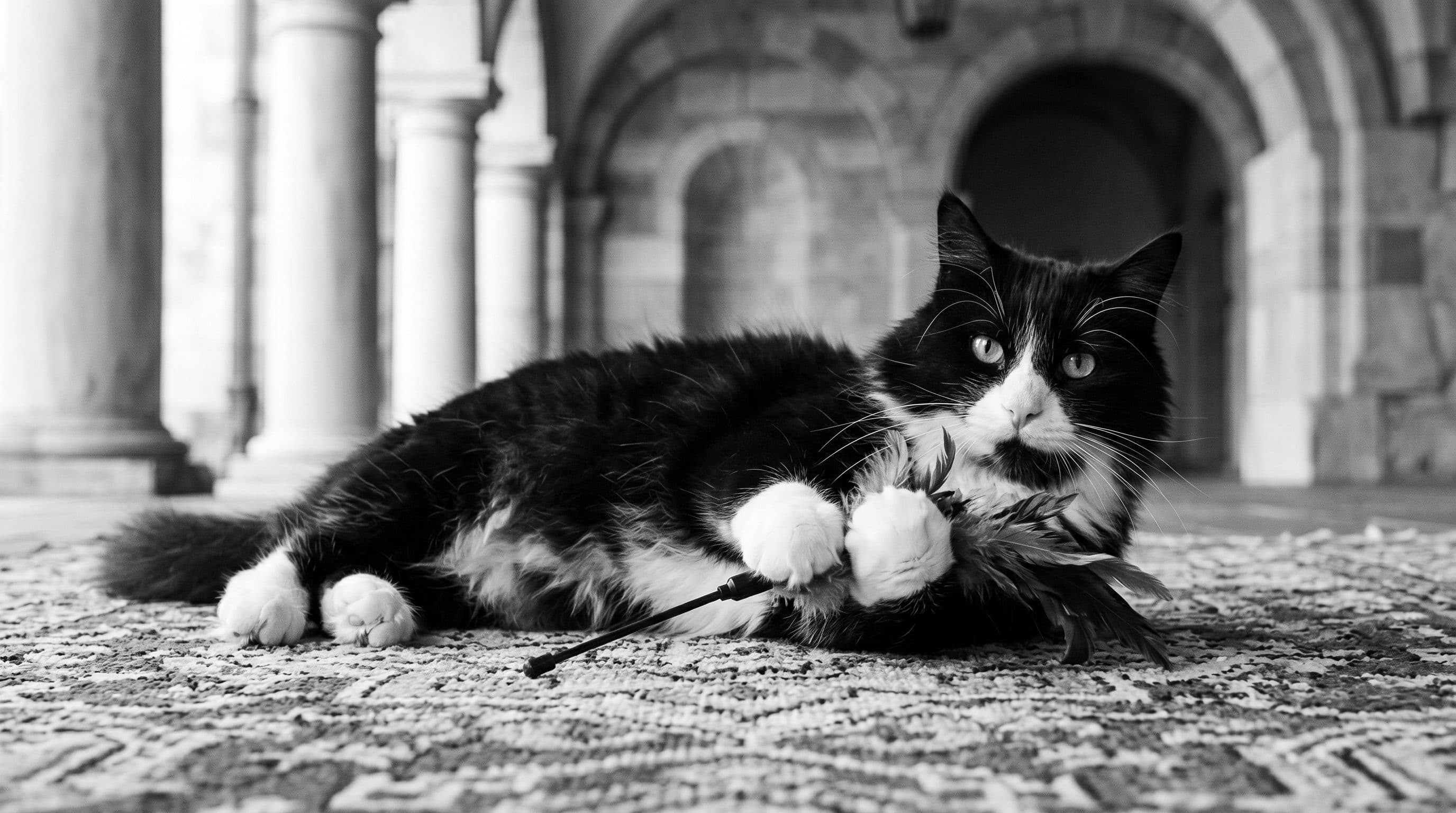
I should note that Vino's relationship with a stainless-steel deshedding comb also falls into play territory. He loves being brushed so much, particularly around his chin and the white mane area of his chest, that he'll roll and paw at the comb like it's a toy. Grooming sessions become play sessions become grooming sessions. The line is blurry.
Tuxedo Cat Play Behavior Across Life Stages
Vino came to me from a biodynamic vineyard in northern Tasmania, where he'd spent a couple of years as a working mouser. He was already an adult when I brought him home, so I missed the kitten play phase entirely. What I can tell you is that his play style hasn't noticeably diminished from when he arrived at about two and a half. The intensity is the same. The duration is the same. The long fetch session happened in 2026, not in his first year here.
John Bradshaw, the anthrozoologist who founded the Anthrozoology Institute at the University of Bristol and wrote Cat Sense, argues that much of how cats communicate with people is learned rather than innate. That idea lands differently when you live with a cat who's perfected the art of screaming for second breakfast. Vino is, to put it diplomatically, not underfed. He's always eating or asking for more food. A cat who's genuinely hungry hunts; a cat who's had breakfast plays. His play is pure surplus energy channelled through the predatory motor pattern his brain can't switch off, and the vocabulary he's built around mealtimes tells me he's learned exactly which sounds get results.
For owners of older tuxedo cats who seem to be losing interest in play, reduced play in cats past about six is often linked to undiagnosed joint discomfort rather than genuine disinterest, something owners frequently miss entirely. Vino's nowhere near that stage yet, but owners of older cats describe the same pattern again and again: a senior who ignores the favourite feather wand will often perk right up for ground-level toys that don't demand a leap, re-engaged completely by shorter, lower-impact sessions along the floor. If your senior cat's been ducking out of playtime, it's worth checking with your vet for joint pain before you chalk it up to boredom. Dr Mikel Delgado, a certified applied animal behaviourist who completed her PhD in psychology at UC Berkeley and researched feline behaviour as a postdoc at the UC Davis School of Veterinary Medicine, co-wrote Total Cat Mojo and Play With Your Cat!, and I've found her writing helpful when thinking through exactly this kind of age-appropriate play adjustment. The instinct to play doesn't vanish with age; sometimes the body just needs the game to meet it halfway.
> Vino's Verdict: Years in, Vino hasn't slowed down. His play is loud, persistent, socially motivated, and entirely on his schedule. If your tuxedo cat is demanding play at inconvenient moments, that's not a behaviour problem; that's the whole cat. The best thing I've done is stop resisting it and start treating his fetch obsession as the genuine enrichment session it is.
Frequently Asked
When Play Becomes a Two-Cat Production
Vino doesn't limit his tuxedo cat play behavior to humans. Zola, our black female cat at about 3.9 kg, is his preferred sparring partner, and the dynamic between them tells you something about how play escalates in a multi-cat household. Vino will spot Zola sleeping on the couch, drop into a low crouch behind the coffee table, and launch himself at her like he's been planning the ambush for hours. He probably has. Zola's response is a hiss, a swat, and then a full sprint down the hallway with Vino thundering behind her at 6 kg of enthusiastic momentum.
Here's the thing I find fascinating: she comes back. Every single time. She'll hiss, she'll retreat, she'll sit on the cat tower looking personally offended. Then twenty minutes later she's back on the couch and Vino's back behind the coffee table. They run this sequence multiple times a day.
<!-- Photo placeholder: Vino mid-crouch behind the coffee table, eyes locked on Zola -->
Their afternoon outdoor sessions amplify this. During those one to two hours before dinner, Vino will chase Zola across the yard, break off to chirp at a wild bird, then circle back and pick up the chase exactly where he left it. His play isn't scattershot; it's sequential. He rotates through targets and activities like he's working through a checklist. The chirping at birds, the fence sitting to torment the neighbour's Staffy with practiced indifference, the loud meowing at me while I'm trying to check on the chickens: all of it slots into a pattern that repeats with minor variations every single day.
What strikes me most about Vino's tuxedo cat play behavior is how little of it looks like stereotypical "cat play" from the outside. He doesn't pounce on feather wands and lose interest. He engineers situations. The crinkle ball fetch game from my desk isn't random batting; it's a trained loop he's imposed on me. The Zola ambushes aren't impulse attacks; they're rituals with a known structure both cats understand. Even his habit of walking between my legs in the yard, the same move he pulled in that winery barn in northern Tasmania when I first met him, functions as a kind of play. He trips me, I react, he meows, I give him attention. He's been running that particular play script for years and hasn't changed a single beat.
<!-- Photo placeholder: Vino and Zola sharing the windowsill during a temporary ceasefire -->
Do Tuxedo Cats Need More Playtime Than Other Cats?
In my household, the answer is an unqualified yes. Vino needs engagement the way other cats need sleep. If he doesn't get his outdoor time, his protest meow fills the house: one sustained note, same tone, same volume, held for five seconds or longer, repeated until someone opens the door. That's not a request. That's a grievance filing.
Does Coat Pattern Influence How Cats Play?
I can only speak to what I see at home. Vino, a tuxedo, plays with structured intensity and visible strategy. Zola, solid black with just a small white patch on her tummy, plays when invited and mostly on her own terms. Two cats, same household, same routines, wildly different approaches. The coat didn't cause the personality, but living with both of them side by side makes the contrast impossible to ignore.
Why Does My Tuxedo Cat Keep Bringing Me Toys?
Because you've been trained. Vino doesn't bring me crinkle balls because he wants to play fetch. He brings them because he's learned that dropping a toy and meowing produces a human response. I pick it up, I toss it, he bats it off the desk again. The toy is a tool; the real game is controlling my attention. If your tuxedo cat is doing the same thing, congratulations: you're not the player. You're the equipment.