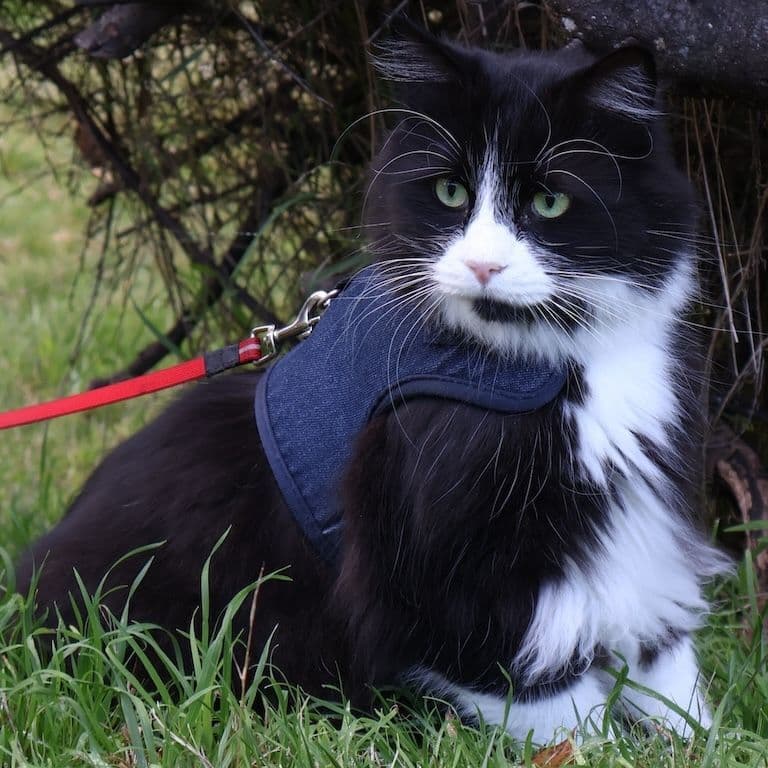
Vino learned to walk on a harness in a week. He knows the difference between my "we're going for a walk" jacket and my "I'm leaving without him" jacket, and his reaction to each is completely different. He remembers where I put his treats even after months. He's trained me to give him a specific number of pats before I get up from the couch, because if I don't, he complains loudly and I've learned it's easier to comply.
Whether that's intelligence or something else is a genuinely interesting question.
What cat intelligence actually means
. The cerebral cortex, responsible for cognition and memory, is proportionally large in cats. They demonstrate object permanence (they know a toy is still there when it's hidden), problem-solving, and the ability to read human cues. Vino responds to his name, reads my body language accurately, and has different vocalisations for different requests: food meow, play meow, lap meow, grievance meow. These are distinct and consistent.
The complicating factor is that cat intelligence is hard to measure objectively, because cats have no motivation to perform for humans on demand. Vino can open drawers. He does it when he wants something in a drawer. He won't do it for an audience. This is either stubbornness or a reasonable position on the irrelevance of human approval. Hard to say which.
The tuxedo question specifically
There's no peer-reviewed evidence that tuxedo cats are smarter than other cats. The coat pattern isn't linked to brain development. Vino's cleverness (and he is clever) comes from his background, his upbringing, and whatever personality he arrived with, not from being black-and-white.
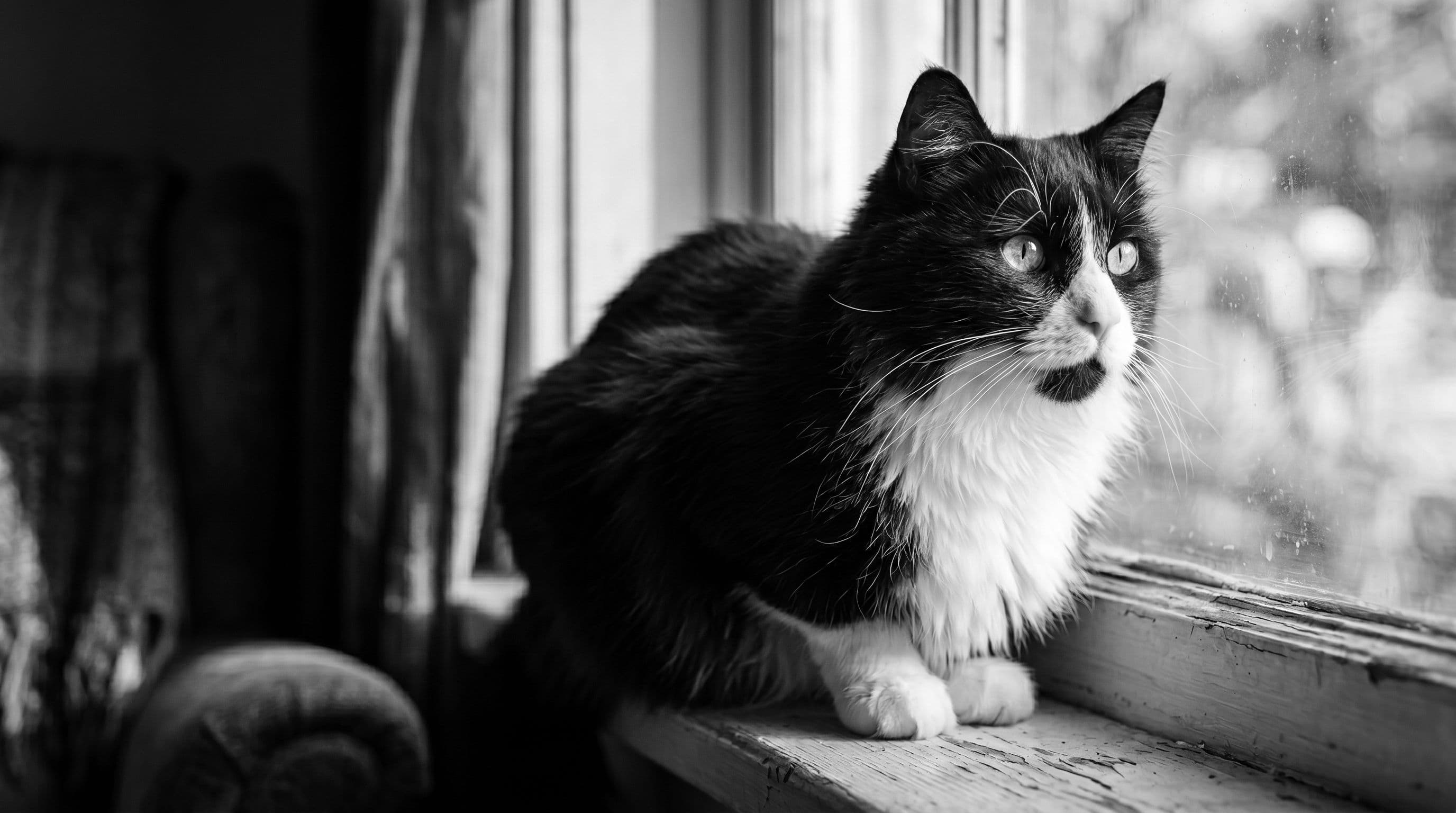
What does seem true, anecdotally and consistently across tuxedo cat owners, is that tuxedo cats tend to be socially intelligent. They read rooms well. Vino doesn't perform for people who aren't interested. He sits near them at a respectful distance and waits. With people who are interested, he's completely present: headbutt, meow, lap immediately. He calibrates this accurately every time.
He also calibrates the Staffy situation. At the old house he would go over the fence and snoop around next door. Timothy only ever caught him there a couple of times. Whether that's intelligence or mischief is possibly the wrong distinction.
Vino as a test case
He came from a barn at two and a half years old. Barn cats run their own territory, knowing their environment, tracking resources, managing threats. That's a cognitively demanding existence. When he arrived here, he adapted fast. The harness took a week. New people he assesses in thirty seconds. When we moved house, he took seven days to fully settle, then picked up exactly where he left off.
The puzzle feeder I bought him he cracked in minutes. He's since showed diminishing interest in it, which I choose to interpret as boredom rather than cognitive limitation.
He's taught himself the rooster's schedule. At the old house he waited until he heard the rooster before starting his morning demands, not because I trained him to, but because he figured out that the rooster signals the household is waking up, and that demanding breakfast before that confirmation is inefficient. That's pattern recognition applied to a practical problem.
How to keep a tuxedo cat mentally sharp
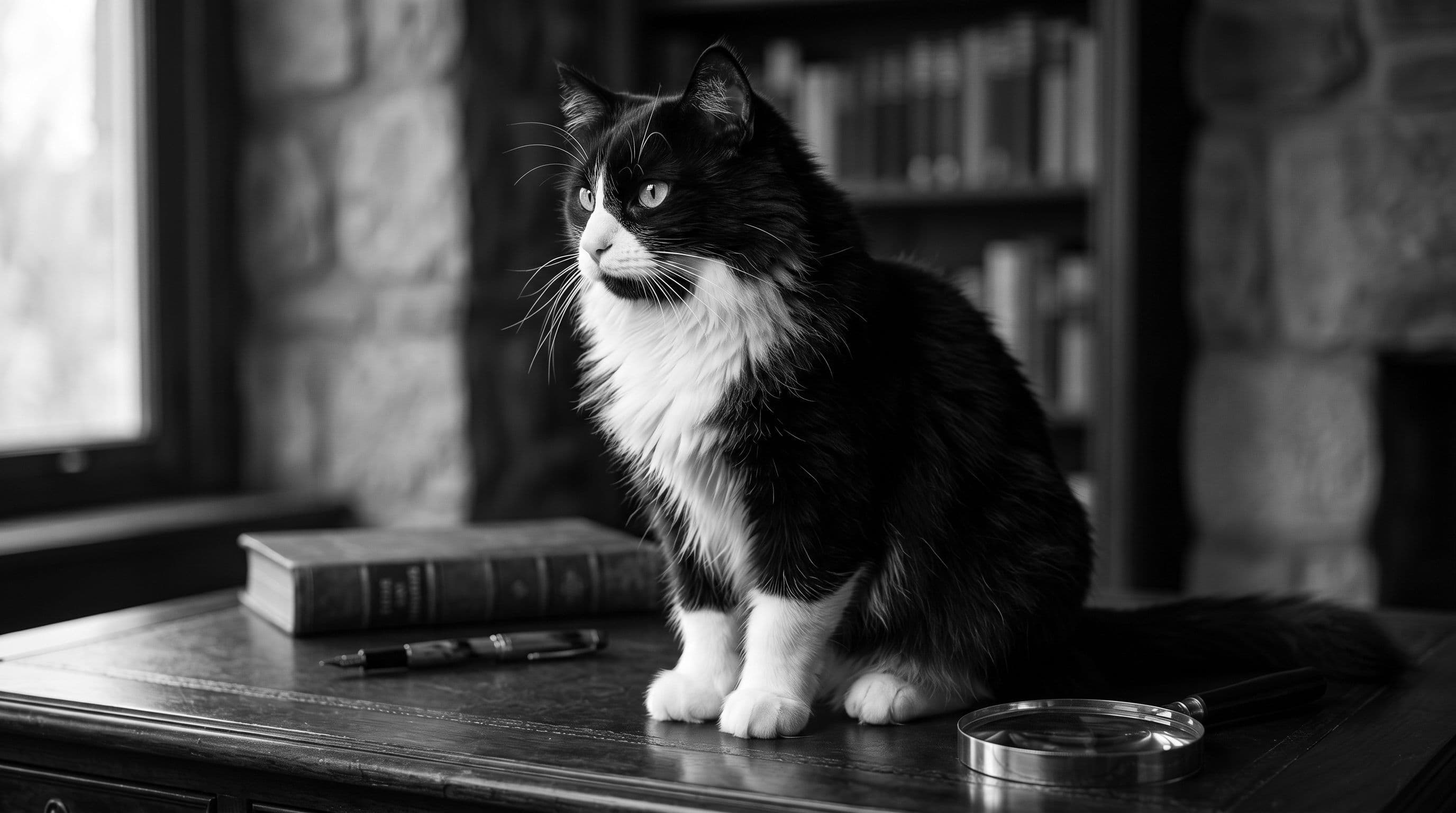
The standard advice applies: rotate toys, use puzzle feeders, interactive play sessions, keep the environment varied. What I'd add from experience is that social engagement matters a lot for cats like Vino. His most engaged periods are when there are people around, things happening, new things to investigate. Purely environmental enrichment isn't enough. He needs the social dimension.
Harness walks have been significant for this. Outdoor environments offer real sensory variety (smells, sounds, different textures underfoot) that no indoor enrichment fully replicates. Vino is visibly sharper after a walk than on days he doesn't get one. If you're not already doing this, the harness training process is worth reading through. Vino took to it in under a week.
Training also works well. He knows his name, responds to a few commands, and learned leash manners quickly, partly because he came from a barn and is used to moving through space with purpose, partly because he's motivated by the outcomes (outside = good, so cooperating with the harness = outside).
The honest answer
Are tuxedo cats intelligent? Vino is, yes. The coat is not why.
What tuxedo cats do seem to have, and this might be selection bias from living with one, is a quality of attention. They're present in a way that reads as intelligence because it's responsive and calibrated. Vino isn't just reacting. He's watching, processing, deciding.
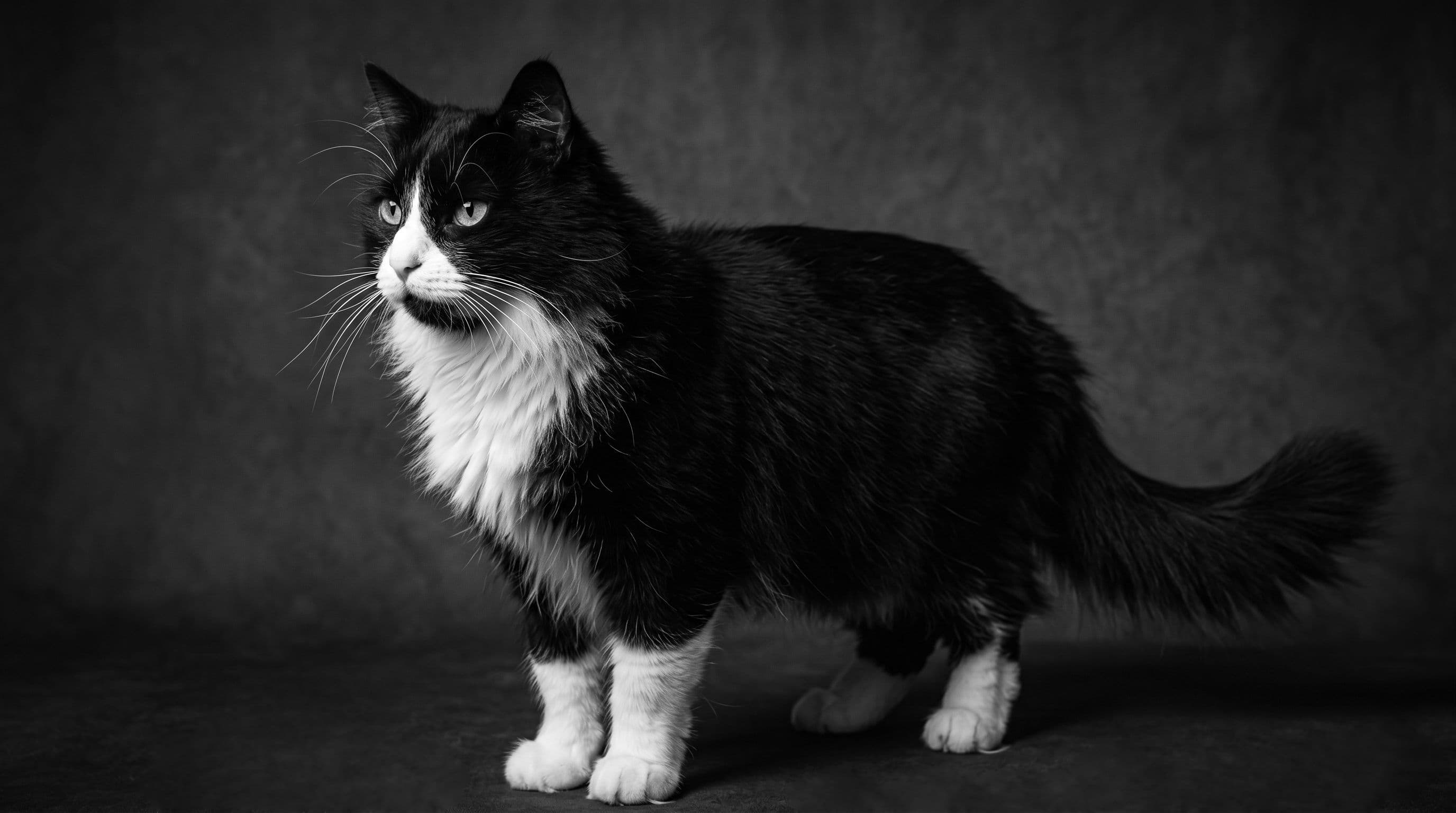
Whether that's the tuxedo pattern, the individual cat, or the kind of owners tuxedo cats tend to attract, I genuinely don't know.
Reading the Room Before Anyone Else Does
Cognition is easiest to spot in the moments Vino wasn't told what to do. If someone arrives at the property while he's outside, he doesn't wait to be let in later. He falls in step and walks through the door with them, like he'd been expecting the visit all along. Nobody taught him this. He worked it out: doors open for people, and if he's standing next to a person when the door opens, the door is open for him too. It's a small piece of logic, but it's genuinely logic, not habit.
The complaint system runs on the same kind of precision. When something hasn't gone his way, most commonly being told he can't go back outside, Vino doesn't scatter a handful of ordinary meows and give up. He produces one sustained meow, same pitch, same volume, held for five seconds or longer. It isn't a request. It's closer to a formal objection, filed once and left on the record. I've never managed to talk him out of one once it starts. The only thing that ends it is getting what he wanted, which is presumably the point.
The harness is probably the clearest single case study. He didn't just tolerate the gear the way plenty of cats eventually do. He connected it to an outcome within days: harness goes on, the door opens to somewhere better than the hallway. Once that connection was made, he stopped fighting the process almost entirely, because fighting the process was delaying the outcome he wanted. That's not obedience. Obedience doesn't require understanding why. What Vino did looks more like a cost-benefit calculation he ran on his own, arrived at, and has acted on consistently since.
None of this proves Vino is smarter than any other cat wearing a different coat. What it demonstrates is that he pays close, continuous attention to cause and effect in his own environment and adjusts his behaviour accordingly: arriving with visitors, timing his breakfast demands to the rooster, holding a grievance meow at a volume calculated to be impossible to ignore rather than easy to tune out. That's not charm. It's applied observation, and he applies it constantly.
It's tempting to write this off as routine, the kind of pattern-matching any animal picks up over years in one place. But routine explains repetition. It doesn't explain adaptation, and Vino adapts faster than repetition alone would predict. Watch him work out a new visitor, a rearranged room, or a broken routine, and the behaviour changes within the same day, not gradually over a week. Whatever's happening under that black-and-white coat, it isn't simple habit.
Frequently Asked
Does your cat do something that makes you genuinely question whether they're smarter than you? Vino's pat-count enforcement is mine. Drop it in the comments.
Are Tuxedo Cats Smart? A Household Investigation
I live with a cat who learned to walk on a harness in a week. He knows the difference between my "we're going for a walk" jacket and my "I'm leaving without him" jacket, and his reaction to each is completely different. He remembers where I put his treats even after months. He's trained me to give him a specific number of pats before I get up from the couch, because if I don't, he complains loudly and I've learned it's easier to comply.
Whether that's intelligence or something else is a genuinely interesting question.
What cat intelligence actually means
The cerebral cortex, responsible for cognition and memory, is proportionally large in cats. They demonstrate object permanence (they know a toy is still there when it's hidden), problem-solving, and the ability to read human cues. Vino responds to his name, reads my body language accurately, and has different vocalisations for different requests: food meow, play meow, lap meow, grievance meow. These are distinct and consistent.
The complicating factor is that cat intelligence is hard to measure objectively, because cats have no motivation to perform for humans on demand. Vino can open drawers. He does it when he wants something in a drawer. He won't do it for an audience. This is either stubbornness or a reasonable position on the irrelevance of human approval. Hard to say which.
The tuxedo question specifically
There's no peer-reviewed evidence that tuxedo cats are smarter than other cats. The coat pattern isn't linked to brain development. Vino's cleverness (and he is clever) comes from his background, his upbringing, and whatever personality he arrived with, not from being black-and-white.
What does seem true, anecdotally and consistently across tuxedo cat owners, is that tuxedo cats tend to be socially intelligent. They read rooms well. Vino doesn't perform for people who aren't interested. He sits near them at a respectful distance and waits. With people who are interested, he's completely present: headbutt, drool, the full program.
What Vino's recent dental surgery revealed about his problem-solving
Vino had sixteen teeth extracted around late August 2026 after an immune condition was spotted at his annual check-up. The surgery was already booked; he simply accelerated it by knocking his top left canine loose while jumping off a couch. That's Vino: the same cat who once walked between my legs in a winery barn to trip me up, still inserting himself into situations and forcing outcomes.
What struck me during recovery was how quickly he adapted to a reconfigured mouth. Within days he was eating dry biscuits again, despite missing most of his top teeth. His breath improved dramatically. His drooling reduced. But the real tell was smaller: he figured out that his lip now catches on the empty gum space, and he has developed a constant mouth-licking habit to manage it. Not charming, but observably adaptive. He's solving a new physical problem with a new physical behaviour, and he's doing it without instruction or demonstration.
This is the same cat who, at the rural house, used to jump the fence into the bush and then meow constantly so I'd know where he was. A cat who narrates his own whereabouts has a particular kind of sense; not obedience, but strategic communication. He wanted to explore, he knew I'd worry, and he found a way to have both.
Zola, by contrast, is the cat who will wind Vino up until he tries to play, then hiss at him for trying. She's become more mischievous since our August 2026 move, raiding bikkie bags and tearing around at dawn. She's smart too, but her intelligence runs toward manipulation and timing. Vino's runs toward systems and workarounds: how to get what he wants within the constraints given.
Vino's Verdict
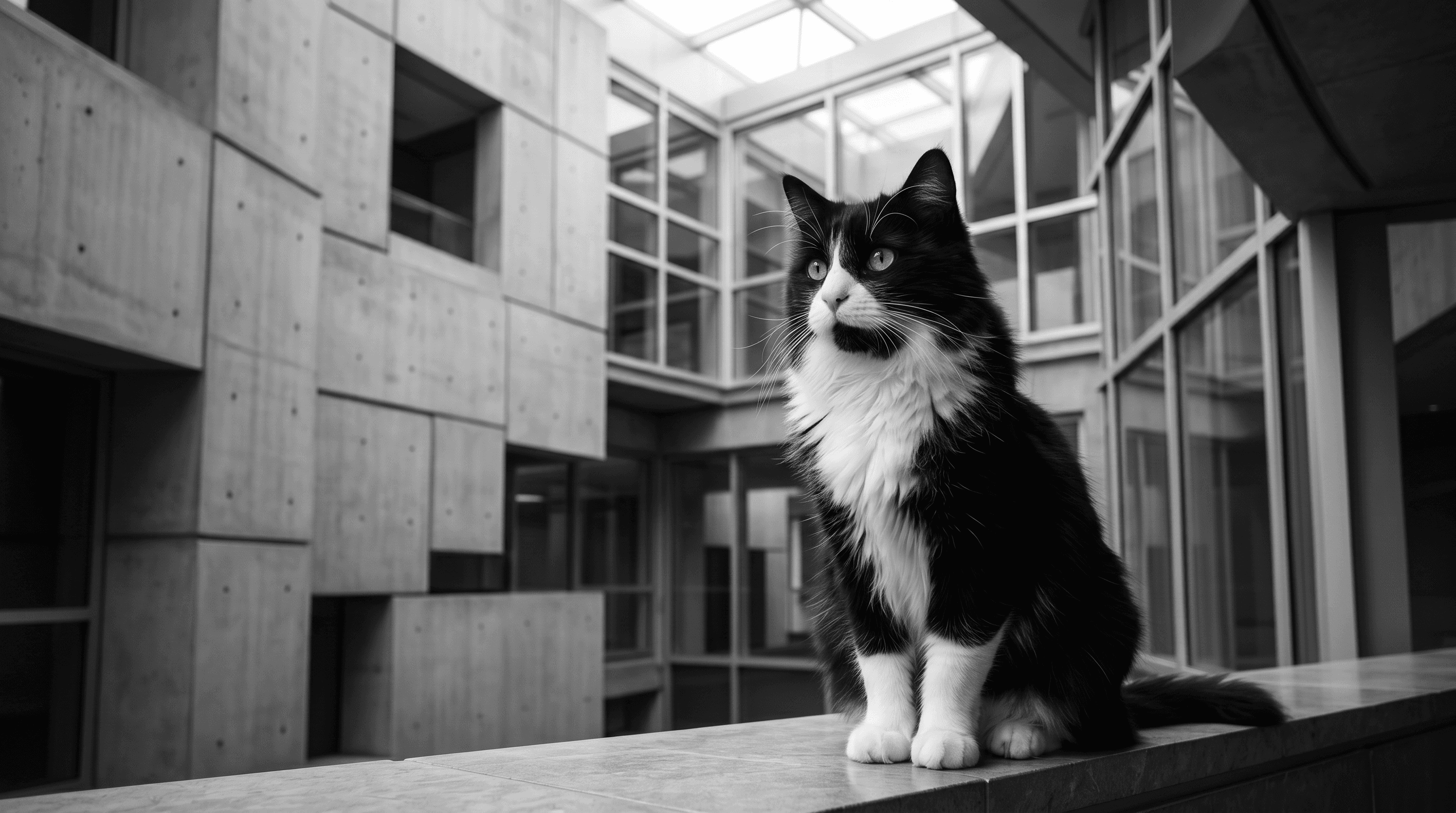
Photographed September 2026, sunroom
Vino's position on the intelligence question is best captured by his desk behaviour. I work on the computer; he stands on the keyboard, sits on the keyboard, flops across the keyboard, and spreads himself over as much of the desk as he can occupy. He is not confused about what the keyboard does. He has simply concluded that what I am doing is less important than what he wants, and he has found the most efficient way to make that point. I have never successfully outlasted him.
FAQ: Are Tuxedo Cats Smart?
Do tuxedo cats have different brains than other cats?
No. The black-and-white coat pattern is just pigment distribution; it doesn't reach the brain. Vino's particular cleverness comes from his background, two years working a winery barn, catching mice, inserting himself into human business, and his individual personality, not his markings. I've had cats my whole life, and he's the only one who trained me to a specific pat count before I can stand up.
Why does my tuxedo cat seem smarter than my other cats?
Social intelligence reads as general intelligence because it's what humans notice. Tuxedo cats, in my observation and that of other owners, tend to be exceptionally good at reading rooms and selecting their moments. Vino ignores guests until they've settled, then claims a lap. He doesn't waste effort on people who aren't receptive. That selectivity looks like discernment, and discernment is easy to mistake for brilliance.
Can you make a cat smarter?
You can make a cat more responsive, which is different. Vino is easy to train because he's motivated by food, attention, and the fundamental project of inserting himself into whatever I'm doing. The harness took a week because walks meant bushland exploration, which he wanted. He ignores commands that don't serve him. Intelligence in cats is largely about whether you've found the currency they actually value, and whether they've decided you're worth the transaction.