
The morning I found Vino over the fence in the neighbour's yard at our old house, with no obvious hurry about coming back down, I accepted that hoping he'd simply stop jumping the fence wasn't a strategy. He'd been disappearing into the bush behind our property in northern Tasmania for months during his afternoon outside time, sometimes for 20 minutes, sometimes longer. My fiancée spotted him once trotting back from the direction of Rowella Road like he'd just finished running errands. I needed to stop cat jumping fence escapes before he met something less tolerant than the neighbour's Staffy.
What made this project different from anything I'd read online was Vino's specific athletic profile. He's a medium-long-haired tuxedo at roughly 6 kg, and he doesn't look like an athlete, but before he came home he was a working mouser at a biodynamic vineyard. That background gave him a vertical leap and a comfort with rough terrain that most indoor cats don't have. Generic advice about "making your fence taller" missed the point entirely; height alone wasn't the issue. Leverage was.
What You'll Need Before You Start
The foundation of any cat containment fence is understanding how your cat actually gets over it. Vino doesn't scramble. He leaps to the top rail, pauses, then pushes off the other side. That pause is the vulnerability: if the top of the fence denies him a stable platform, he can't complete the second phase.
Here's the gear list I worked with:
- Angled brackets (L-shaped steel or aluminium, roughly 45 degrees) sized to bolt onto the top of a standard 1.8-metre timber paling fence
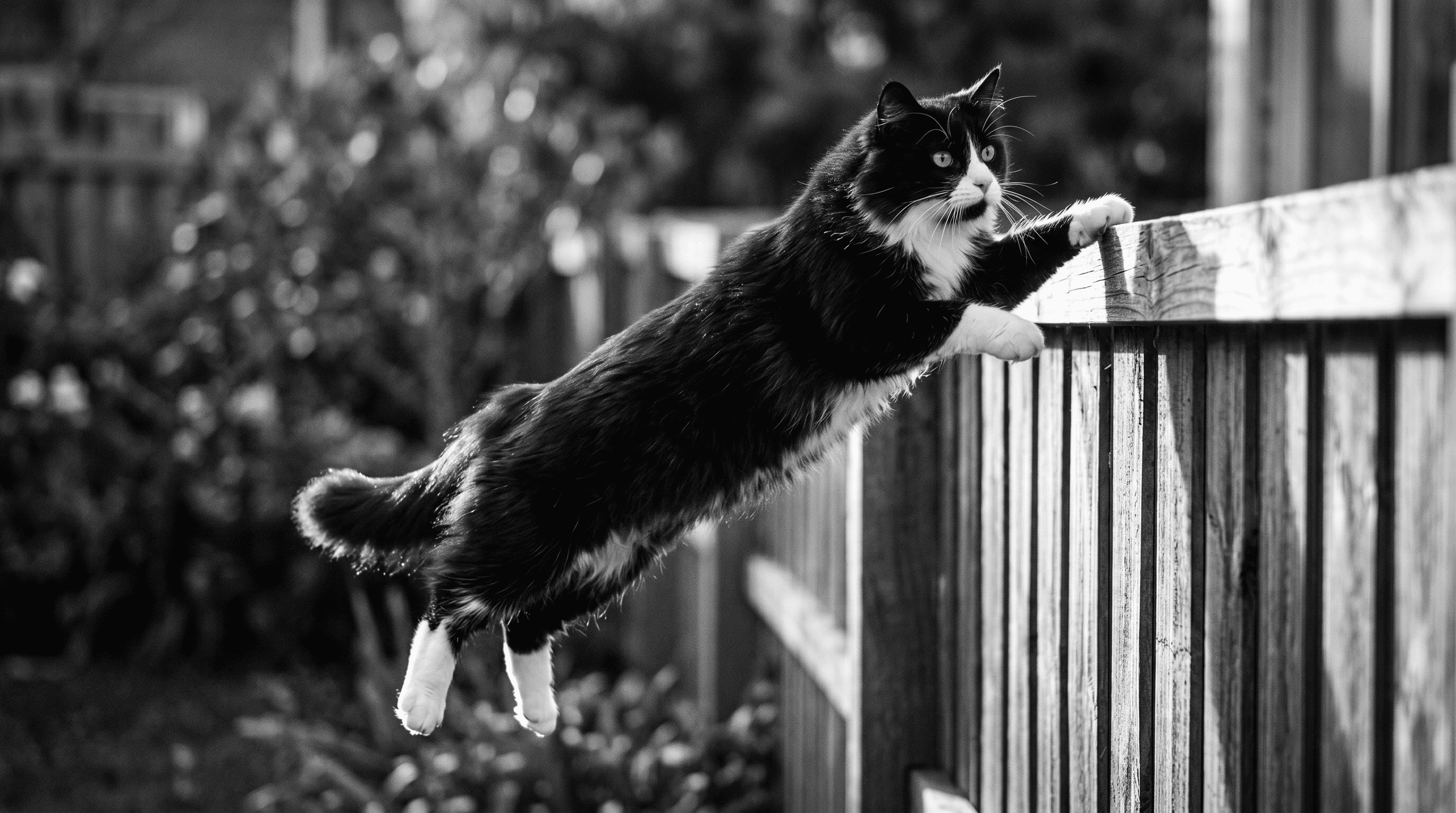
- Polyethylene mesh netting with small enough apertures that a cat can't push through: I used 30-millimetre square mesh
- Cable ties, stainless steel screws, and a cordless drill
- A spirit level, because nothing looks worse than a wobbly fence topper
- Patience: the install took me about 6 hours across two weekends
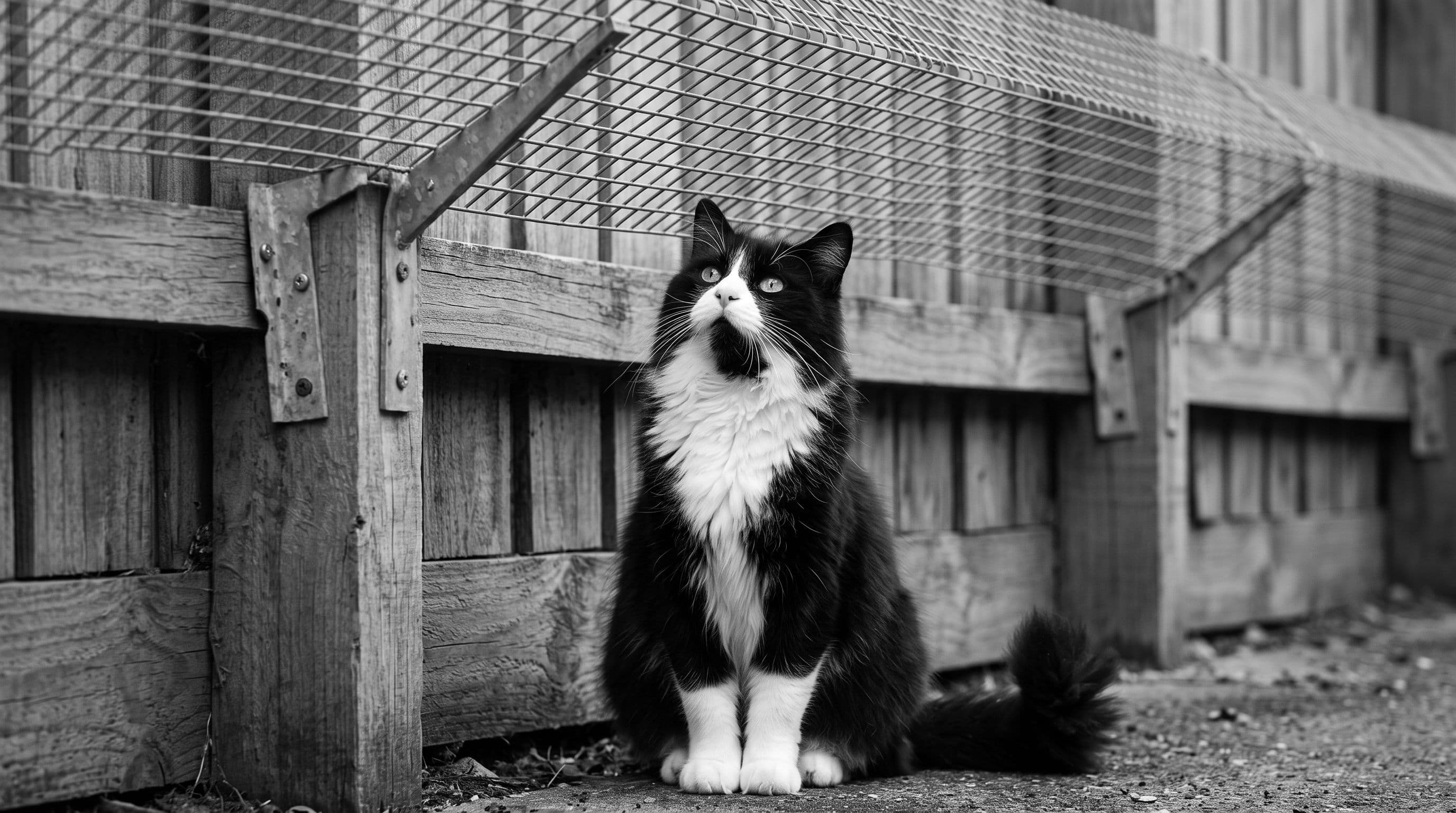
I didn't need to replace my existing fence. The timber palings around our yard in the Tamar Valley were solid enough; they just needed the angled overhang added to the inside face. The overhang points inward at 45 degrees, so when Vino leaps to the top, the mesh curves back toward him and he can't get purchase to go over. Zola, who's lighter and more cautious, never attempted the fence in the first place. She watched the entire installation from the back step with visible disinterest.
How I Installed a Cat-Proof Fence Overhang to Stop Cat Jumping Fence Escapes in 7 Steps
1. Survey the full perimeter on foot. I walked every metre of our fence line and marked the sections where Vino had been seen jumping. Three spots were obvious: the rear boundary near the chicken run, the side fence closest to the Staffy's yard, and a low section near our water tank where the ground rises and effectively shortens the fence by 30 centimetres. I also marked two spots where branches from a neighbouring Eucalyptus overhung our side, giving him a bypass route.
2. Trim any overhanging vegetation first. Those Eucalyptus branches were Vino's escalator. I cut back everything within 1.5 metres of the fence line, which took about 90 minutes with a pole saw. If you skip this step, you're building a containment system with a cat-sized loophole.
3. Bolt the angled brackets to the inside face of the fence at 2-metre intervals. I pre-drilled pilot holes to avoid splitting the palings. Each bracket sits flush against the top rail and extends inward at 45 degrees. This is the step where having a second pair of hands matters: my fiancée held each bracket level while I drove the screws. Vino supervised from the kitchen window, meowing his sustained five-second protest note roughly every 8 minutes.
4. Run the mesh netting along the brackets and secure it with cable ties every 20 centimetres. The mesh needs to be taut enough that a cat's weight won't collapse it, but flexible enough that if he does manage to get partway up, it bows inward and dumps him back into the yard. I pulled each section firm by hand and zip-tied as I went.
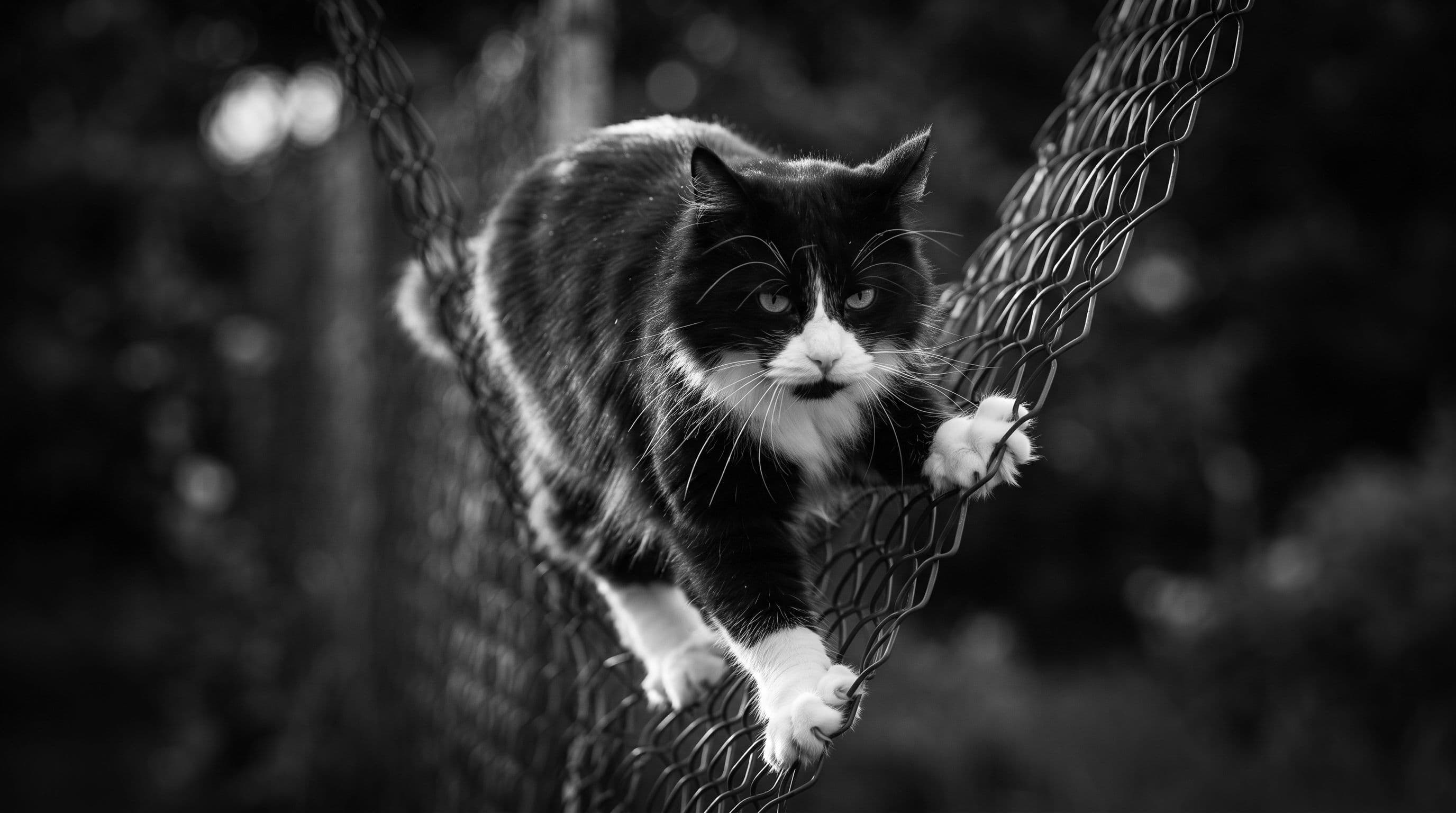
5. Reinforce the low section near the water tank with an additional strip of mesh running vertically. That 30-centimetre height deficit was too significant to ignore. I added a vertical mesh panel from the ground up to the top of the fence before attaching the angled overhang. This section alone probably would've stopped 80 percent of Vino's exits, since he favoured it as his primary launch point.
6. Test the system before trusting it. I let Vino out for a supervised 15-minute session the afternoon I finished. He walked straight to his usual spot near the water tank, looked up, assessed the mesh, and sat down. Then he walked to the rear boundary, repeated the assessment, and sat down again. On day two he made one genuine attempt near the chicken run: he leapt, hit the angled mesh, slid back down, and landed on all four white paws looking personally offended.
7. Check every connection point after the first week. Wind, rain, and a determined 6 kg cat test your cable ties. I found two that had loosened near the Eucalyptus corner after 5 days and replaced them with fresh ones. Monthly checks became part of my routine after that.
What Goes Wrong: Failure Modes I Observed and Fixed
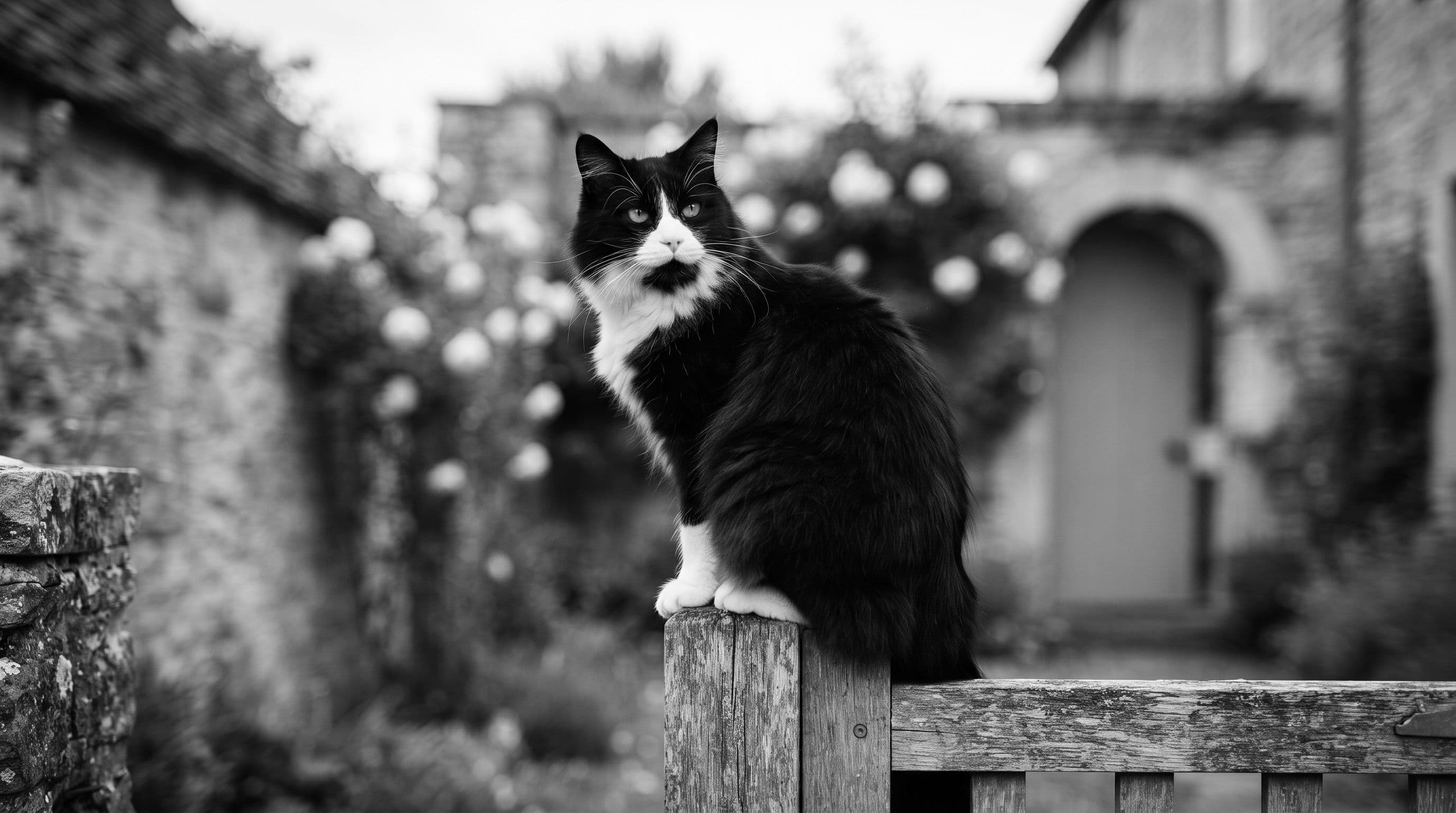
The first problem was the gate. I'd secured every centimetre of fence and completely forgotten about the pedestrian gate between the yard and the driveway. It's shorter than the fence by about 15 centimetres. Vino found this on day three. He didn't even need the full leap; he hopped onto the gate top, perched there, and looked back at me with the expression of someone who's just found a loophole in a contract. I added a mesh panel above the gate that same evening.
The second failure was what I'll call the furniture assist. We had an old wooden bench seat positioned about a metre from the side fence, near where I'd written about Vino's standoffs with the Staffy. That bench gave him a raised launch platform that effectively cut the fence height by half a metre. He didn't use it to escape, but I caught him sitting on it and eyeing the mesh with what I can only describe as engineering interest. I moved the bench to the centre of the yard. Anything within jumping distance of the fence: bins, garden furniture, stacked firewood: needs to be relocated. I ended up clearing a 1.2-metre buffer zone along the entire perimeter.
The third problem was psychological. Zola, who'd never attempted the fence, suddenly became interested in the mesh itself. She didn't want to escape; she wanted to scratch it. The polyethylene mesh was apparently the ideal texture for her claws. This loosened two sections over the first month. I redirected her by placing a sisal scratching post near her favourite stretch of fence, and the behaviour stopped within a week.
The most subtle failure was complacency. After three weeks without an escape, I stopped doing the weekly checks. A month later, I noticed Vino sitting suspiciously close to the rear boundary, and when I inspected, I found a section of mesh that had come loose from its bottom cable tie after rain and wind. He hadn't exploited it yet, but he was clearly aware of it. Monthly inspections went into my calendar with a recurring reminder. If you want to stop cat jumping fence breaches for good, maintenance isn't optional; it's the whole second half of the project.
If you've been working on your cat's overall outdoor enrichment routine, containment fencing is the structural backbone that makes everything else possible.