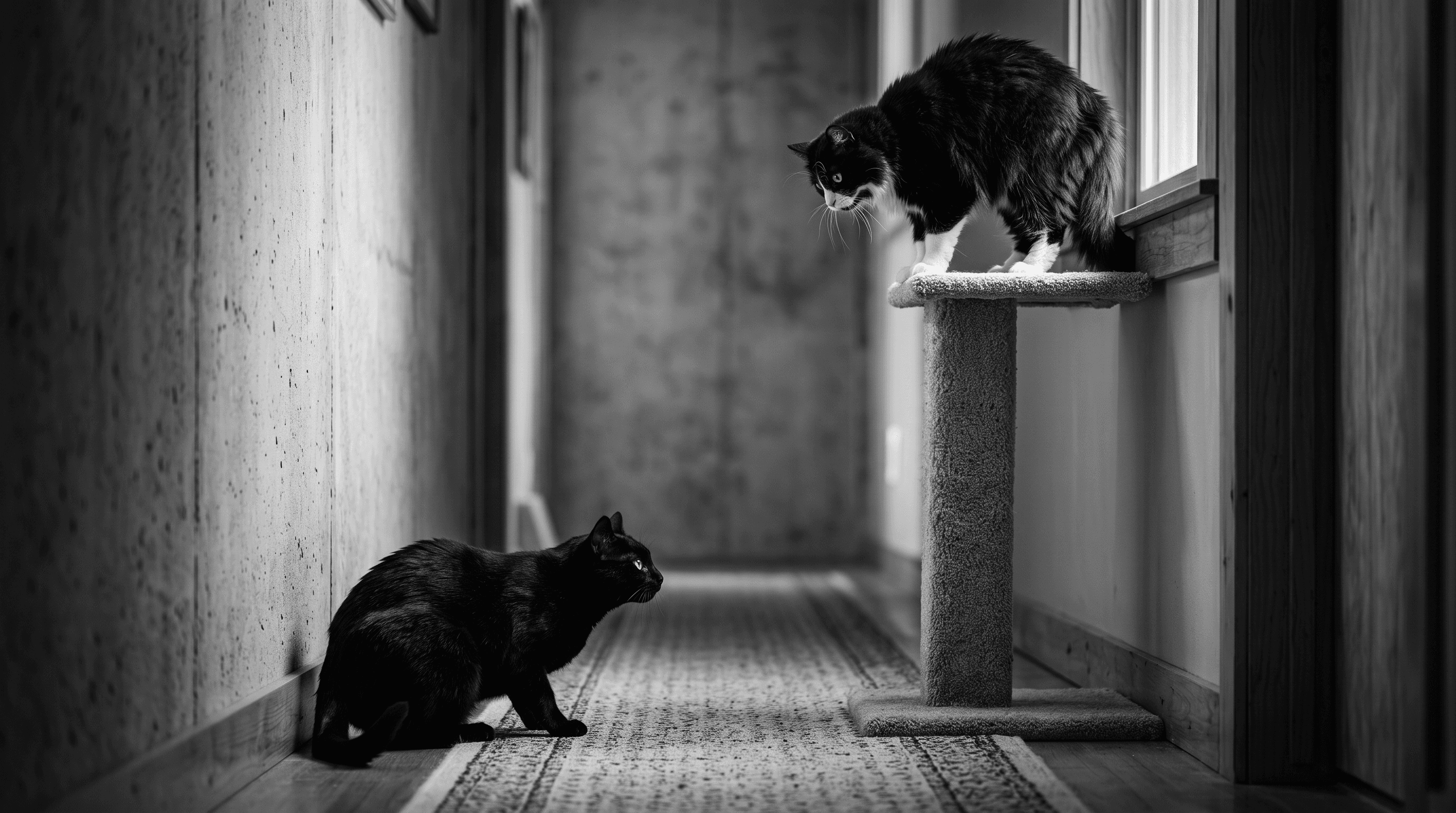
Vino was mid-growl on top of the cat tower, spine arched, tail fat as a bottle brush, and Zola was crouched on the hallway runner 3 metres away, ears pinned flat. My fiancée looked at me from the couch and said, flatly, "Your cats hate each other." That was late in 2022, a few months after Zola arrived in June. Four observations from this household complicate the standard advice about two cats not getting along, and they've shaped everything I believe about multi-cat tension: that most of it is architectural, some of it is theatre, and almost none of it requires the interventions the internet wants to sell you.
Exhibit One: The Cat Tower Standoff and Why Two Cats Not Getting Along Is Often a Space Problem
For weeks after Zola settled in, she and Vino ran a silent siege over the cat tower. It's a tall structure with three platforms and a cubby at the base. Vino, at about 6 kg of dense tuxedo confidence, would claim the top platform. Zola, at roughly 3.9 kg and built like a greyhound someone accidentally covered in black fur, would take the middle shelf. Neither would leave.
They'd sit there for an hour or more. No hissing. No swatting. Just two cats refusing to blink first. It looked absurd, and it was: two animals with the entire house available to them, locked in a staring contest over 90 centimetres of carpeted plywood.
The 2013 AAFP and ISFM Feline Environmental Needs Guidelines, authored by Ellis, Rodan, Carney and colleagues in the Journal of Feline Medicine and Surgery, spell this out with clinical precision: in multi-cat households, there should be as many separate resource locations as there are cats, positioned out of sight of one another so cats aren't forced to compete or pass through another cat's space. That includes elevated resting areas.
I'd read that guideline and nodded along, then done absolutely nothing about it. Vino and Zola had one tower, one primary feeding station, and one preferred sunny window. Every resource was singular. Of course they were gridlocked.
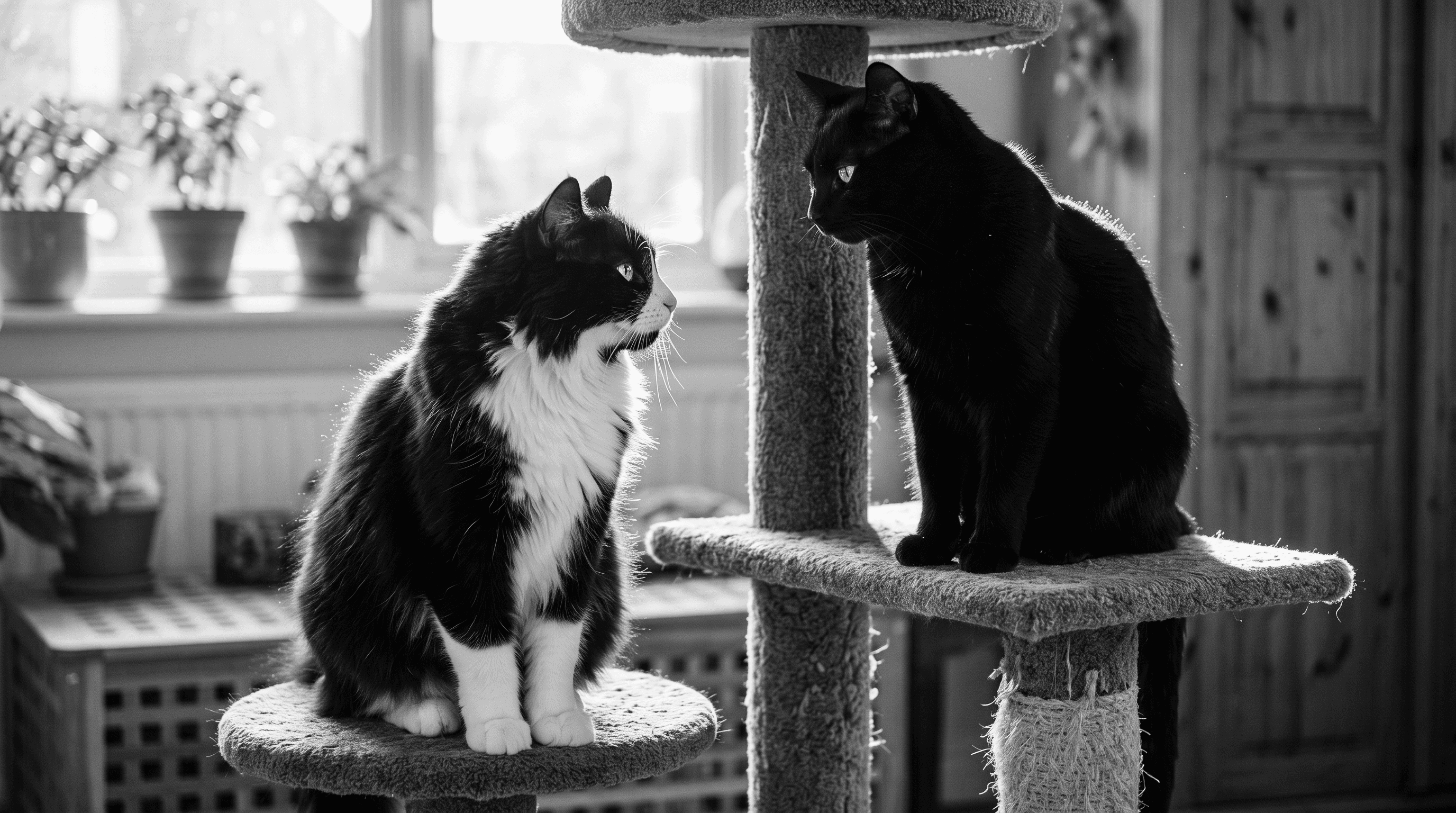
The fix took a Saturday afternoon. I added a second elevated resting shelf near the kitchen window where Zola already liked to sit, and I moved her food bowl to the opposite end of the hallway from Vino's. Two shelves, two feeding spots, two territories that didn't overlap. The tower standoff disappeared within a week. I haven't seen it since.
Exhibit Two: The Performative Hiss
Here's the part that none of the standard multi-cat advice prepared me for: Vino and Zola's conflicts are, to a significant degree, theatrical.
Vino loves Zola. He wants to play with her constantly. He'll barrel toward her at full speed, slide across the floorboards, and tag her flank with a paw. Zola does not love this. She hisses. She growls. She delivers a swat that connects about 40% of the time. It looks like war.
But my fiancée and I started noticing a pattern. The hissing escalated dramatically when we were in the room. When I'd come home and check the camera footage from the afternoon, the two of them would be sharing a windowsill, noses 15 centimetres apart, watching rosellas in the eucalyptus like a retired couple birdwatching from a porch. Then I'd walk in the door, and within 10 minutes: hissing, growling, a chase down the hallway.
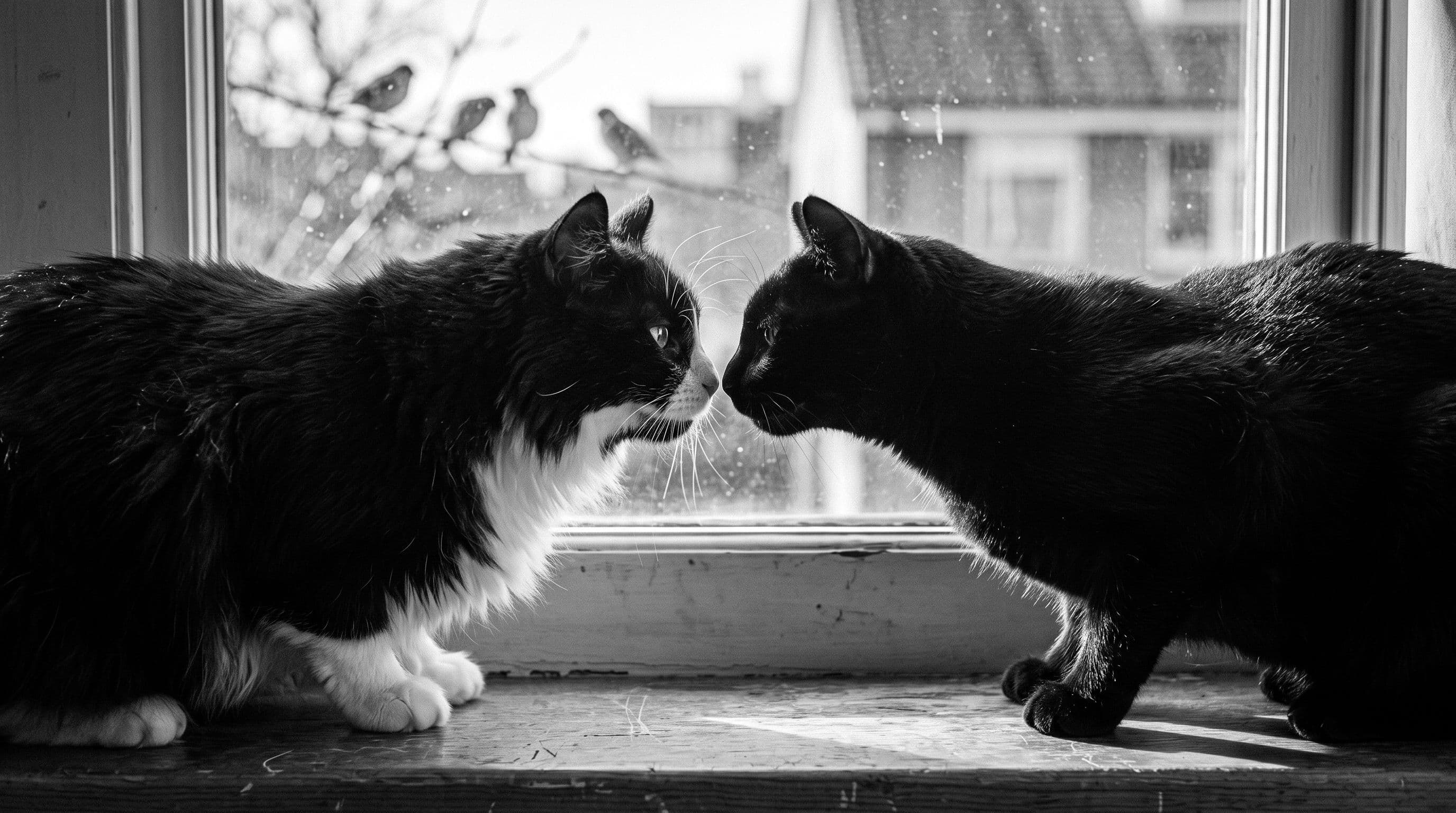
They smooch each other. They sleep within a paw's reach. They share the warm patch of sun by the glass door every afternoon before their 1 to 2 hours of outside time. But they won't cuddle. And when we're watching, the drama spikes.
I don't have a clinical explanation for this. Susanne Schotz's Meowsic project at Lund University analysed 780 meows from 40 cats and found that meow melody varies with context; cats modulate their vocalisations based on what they're trying to communicate and to whom. It's not a stretch to think hissing carries the same contextual flexibility. Zola's hiss when Vino ambushes her at full gallop sounds genuinely different from her hiss when he saunters past while I'm holding a treat bag. The first is sharp and explosive. The second is almost perfunctory, like a commuter honking at a yellow light.
If you're living with two cats not getting along, it's worth asking a blunt question: are they actually fighting, or are they performing conflict because you're the audience? I wasted weeks worrying about aggression that turned out to be closer to sibling bickering with an element of attention-seeking layered on top.
Exhibit Three: The Rooster Principle
Vino's relationship with our rooster taught me something I should have applied to the Zola situation much sooner.

We have 4 chickens and 1 rooster in the yard. The rooster was aggressive. He puffs up, he charges, and he's got spurs that mean business. Vino, despite being a former vineyard mouser who spent 2 years catching rodents in northern Tasmania before I brought him home in April 2022, is a little intimidated by this bird.
His solution is elegant: he finds elevated ground. A fence post. The top of the coop. A garden wall. Anywhere the rooster can't easily reach. From there, Vino sits among the flock peacefully, watching the chickens scratch around below. He doesn't flee the yard. He doesn't fight. He simply changes the geometry of the encounter so the rooster's aggression becomes irrelevant.
This is exactly what I needed to do inside the house for Zola. She didn't need Vino to stop being Vino; that was never going to happen. She needed escape routes and elevated territory that let her opt out of his energy without leaving the room entirely. Once I gave her that second shelf and rearranged the feeding spots, she had her version of Vino's fence post. The dynamics shifted not because either cat changed personality, but because the environment stopped forcing them into the same square metre.
If you've been reading about tuxedo cat play behaviour or thinking through introducing a second cat, this is the thread that connects it all: environment dictates behaviour more than temperament does.
What This Adds Up To
Three years of living with Vino and Zola have convinced me that the phrase "two cats not getting along" is almost always a misdiagnosis. It frames the problem as relational: these two animals don't like each other. But in most cases I've observed, the problem is spatial. These two animals don't have enough separate territory to coexist comfortably.
Vino hasn't become less boisterous. He still charges at Zola. He still meows at her from across the room when she's trying to sleep. He still gets in her way as a matter of principle, the same way he gets in mine when I'm at the desk or walking through the yard. That's Viniferous "The Mischievous" Messiah. He doesn't edit himself.
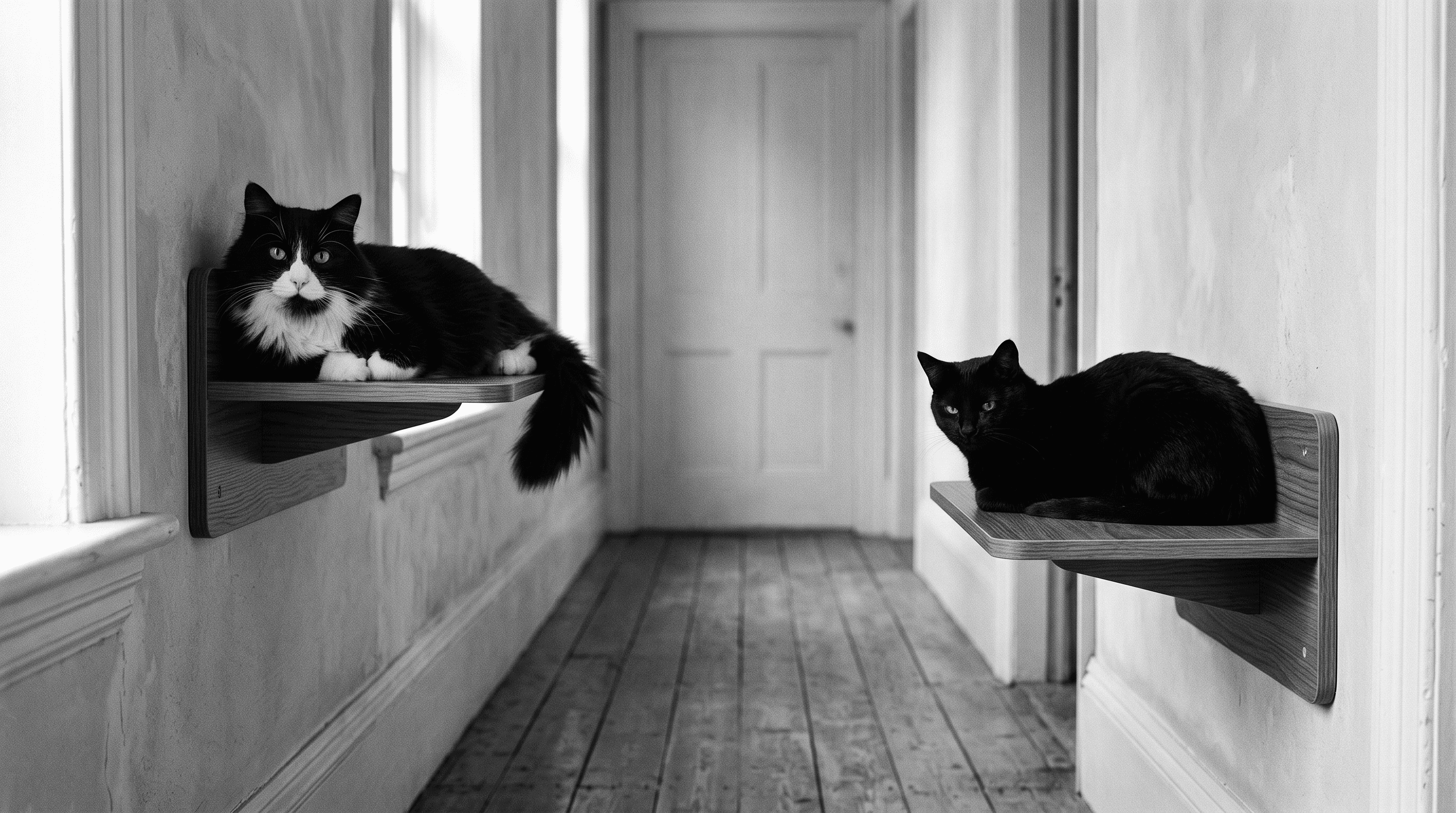
But Zola has options now. She can retreat upward, eat in peace, and claim a sunlit patch that isn't contested. And the result isn't harmony exactly; it's détente. They coexist. They share space on their own terms. They perform their little hissing operas for our benefit, and then the camera catches them nose-to-nose at the window 20 minutes later.
The fix wasn't a personality transplant. It was a shelf, a relocated food bowl, and the willingness to accept that "getting along" doesn't mean cuddling. It means choosing to stay in the same room.