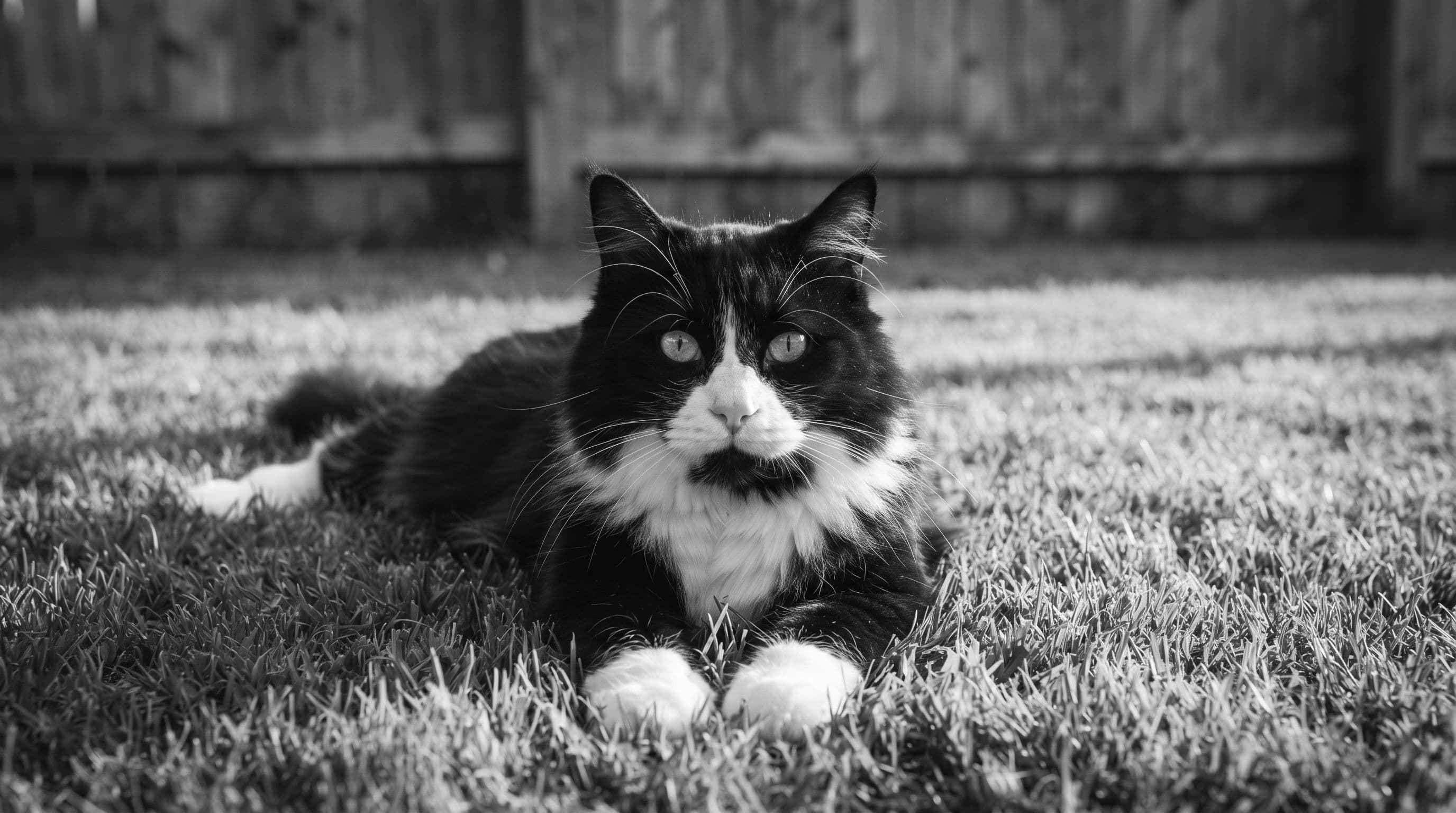
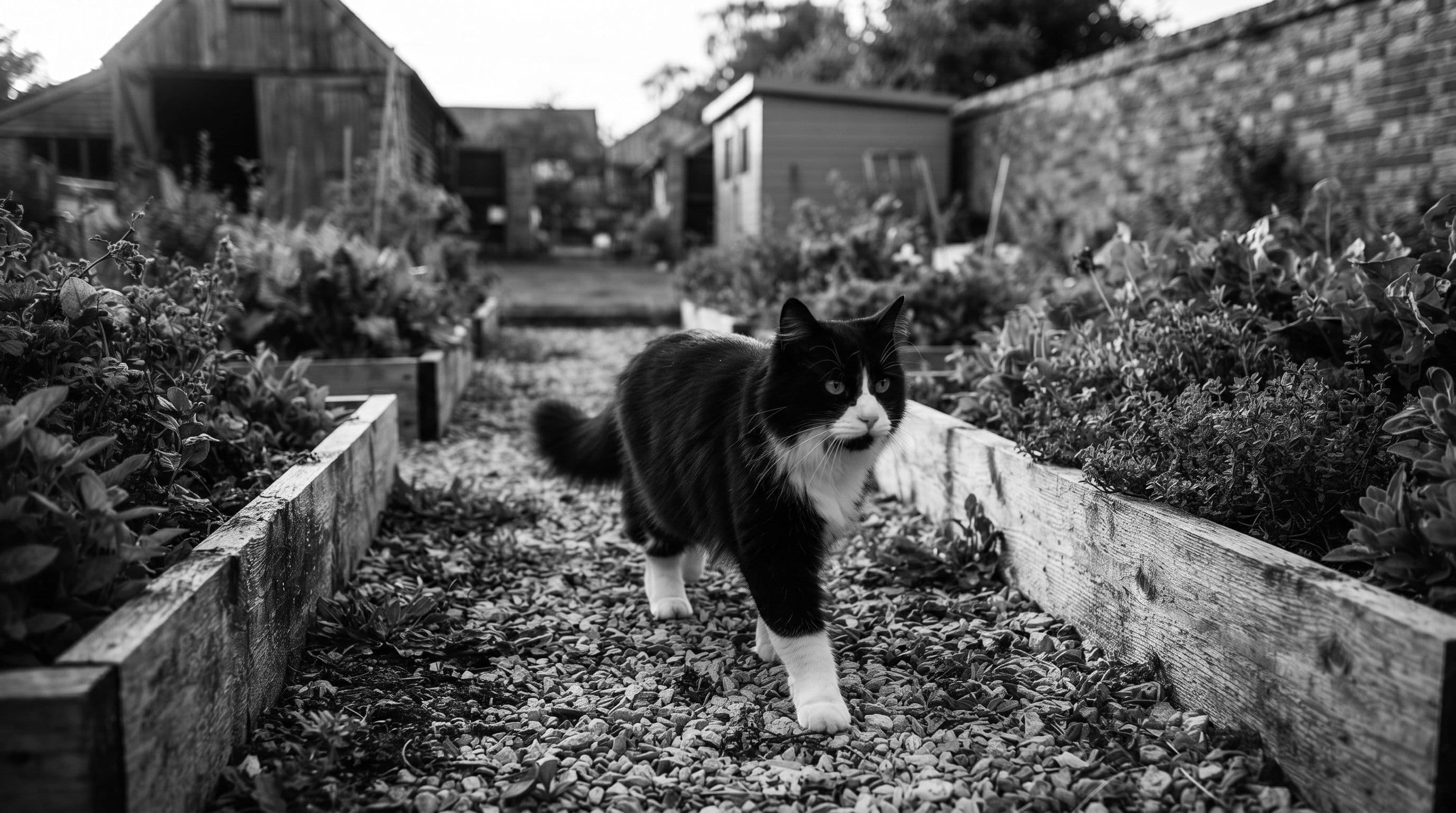
The neighbour's Staffy was already barking when I stepped out the back door, but Vino couldn't have cared less. He was belly-flat in the grass about a metre from our boundary fence, white chest pressed into the lawn, green eyes locked on some invisible middle distance with the serene detachment of a creature who's never once had to worry about rent. A 30-kilogram dog raged two fence palings away. Vino didn't flinch. Didn't blink. Didn't even twitch a whisker. I stood on the porch holding a lukewarm cup of tea, watching this tuxedo cat treat mortal peril like ambient noise, and the question hit me fresh the way it does every single time someone emails or leaves a comment: should tuxedo cats go outside at all? I've spent years working out the answer with my own two cats, and what I've landed on isn't a simple yes or no.
Should Tuxedo Cats Go Outside? What the Fence Scene Tells Us
That moment with Vino and the Staffy captures the tension at the heart of this topic. On one hand, Vino is clearly in his element outdoors. He's confident, engaged, mentally stimulated. He chirps at wild currawongs in the trees. He follows me around the yard demanding pats with the same insistence he showed in that Tasmanian winery barn years ago. His body language outside is looser and more relaxed than it ever is when he's spent a full day indoors pacing by the kitchen window.
On the other hand, there's a large, agitated dog one metre away. There are cars on the road beyond our property. There are snakes in northern Tasmania during the warmer months, and Vino has, on occasion, jumped the fence and disappeared into the surrounding bush for stretches that turn my stomach.
The coat colour itself doesn't change the calculus here. Tuxedo cats aren't a distinct breed; they're bicolour cats found across domestic shorthairs, Maine Coons, British Shorthairs, Turkish Angoras, and plenty of other breeds. Vino's black-and-white markings don't make him more or less suited to outdoor life than any other cat. What matters is temperament, environment, and how you manage the risks.
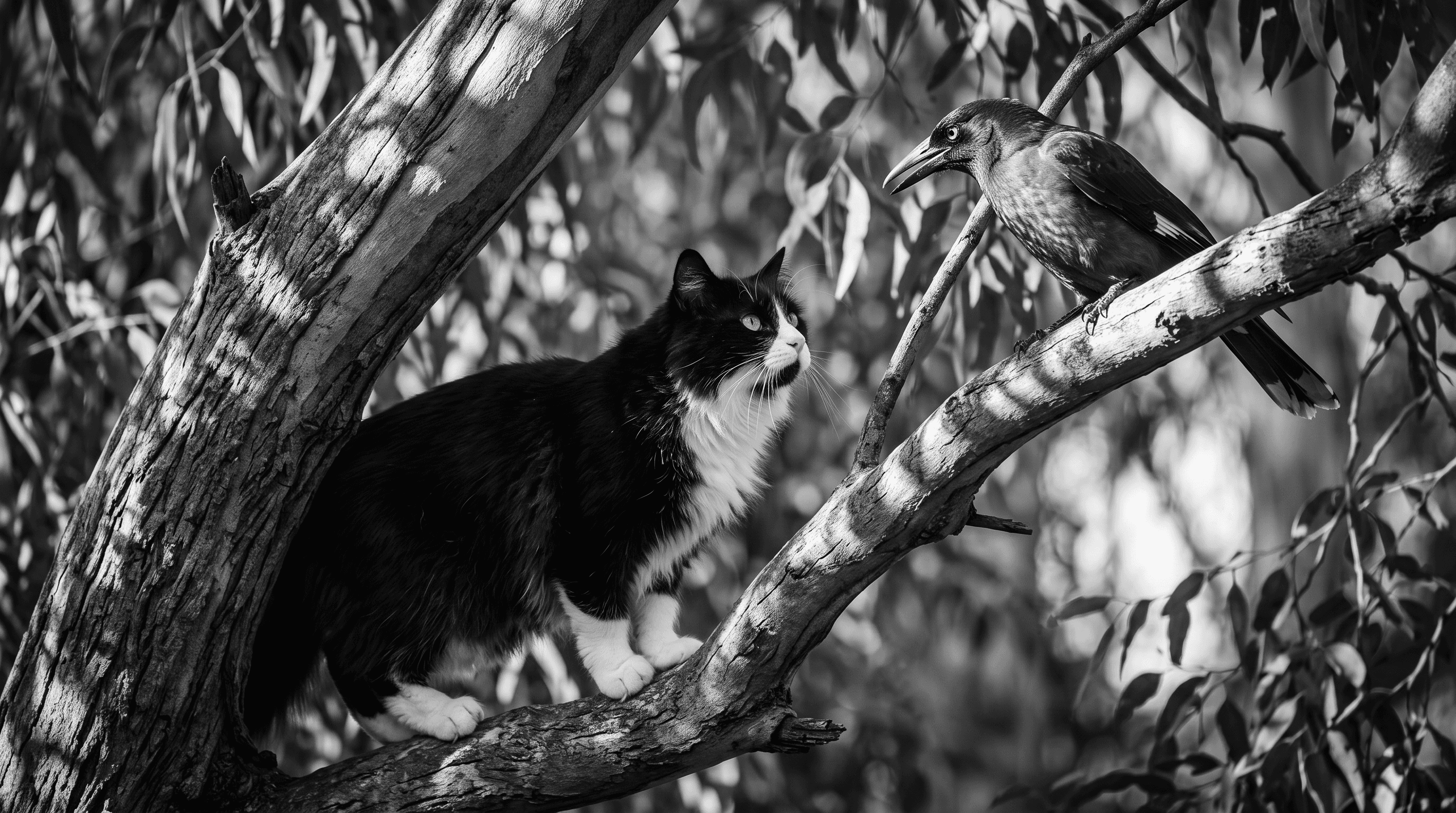
I've watched Vino stalk a moth through the living room with the intensity of an apex predator, so I don't doubt for a second that our pet cats are doing real damage out there, and I don't think most cat owners fully appreciate how much hunting their pets actually do. I've seen Vino proudly deposit a lizard on the doormat like he's presenting a Michelin-starred dish, and I'd wager most owners share my instinct to shrug it off as harmless fun. But the numbers tell a different story. A 2020 study by Legge, Woinarski, Dickman and colleagues, published in the CSIRO journal Wildlife Research, estimated that Australia's roughly 3.8 million pet cats collectively kill approximately 390 million native animals a year, averaging 186 animals per roaming pet cat. That's not feral cats. That's pets.
I don't share those numbers to shame anyone. I share them because they shaped how I think about Vino's outdoor access.
How Vino's Routine Differs from the Average Indoor-Outdoor Setup
Most people I talk to about this topic fall into one of two camps: full indoor cat, or cat flap with 24-hour freedom. I don't do either. Vino and Zola go outside every afternoon before dinner for 1 to 2 hours, and sometimes in the mornings before breakfast if I've got the time. They're supervised, or at least monitored. I know where they are. I can see the fence line. When it's time to come in, they come in.
This isn't the norm. Indoor cats average 10 to 15 years, while cats that live outdoors can average as little as 2 to 5 years. That gap alone should settle the debate for most people, but the real conversation isn't a binary of inside versus outside. It's about what happens inside. A cat with zero outdoor access but a well-structured indoor environment can thrive, and I've watched Vino prove this daily with his window perches, his rotating puzzle feeders, and the elaborate cardboard fortress he's colonized in the living room. A cat with unlimited outdoor access but no supervision faces shortened life expectancy, disease exposure, and the risk of simply not coming home. Environmental enrichment matters more than the question of which side of the door your cat sits on.
The AAFP's Indoor/Outdoor Lifestyle position statement, updated in 2024, recommends that cats in urban and suburban areas be kept indoors or given only supervised or securely enclosed outdoor access. Controlled is the operative word. That means catios, harness walks, fenced enclosures, or supervised yard time.
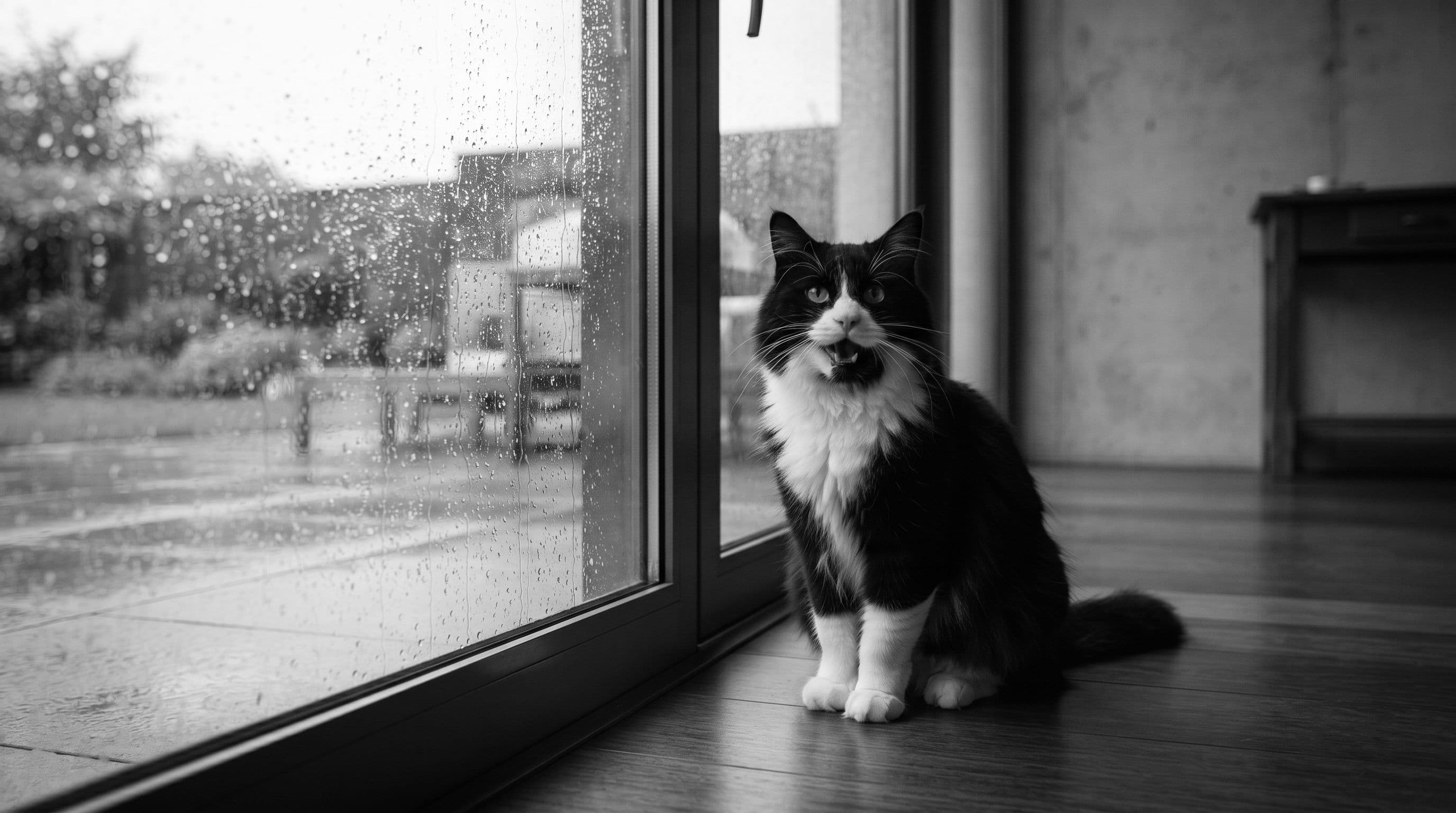
I've written before about understanding tuxedo cat behaviour and personality and what makes Vino tick. His temperament is bold, curious, and relentlessly social. Full indoor confinement would make him miserable; I know because on rainy days when he can't go out, he produces a sustained protest meow that lasts 5 seconds or longer and repeats it at intervals that suggest he's studied psychological warfare. He doesn't want to be inside all day. But he also doesn't need to be outside all night.
Zola is the opposite. She's content to lie in a sun patch by the window for hours. When she does go out, she stays close, rarely ventures past the garden beds, and comes in the moment anything startles her. Two cats in the same household, same outdoor access, completely different engagement with it.
Practical Steps for Safe Outdoor Access
If you're weighing whether to let your tuxedo cat outside, here's what's worked for me over the years with Vino and Zola.
Set a schedule and stick to it. Cats are creatures of routine. Vino knows that outdoor time comes in the afternoon before dinner. He starts sitting by the door and meowing in the early afternoon, like clockwork. The predictability means he isn't anxious about whether he'll get out; he knows he will. It also means I'm always present and alert during that window.
Assess your specific risks. My property is semi-rural in Tasmania. The threats I worry about are snakes, the neighbour's dog, road traffic, and Vino's habit of jumping fences. Your risk profile might be completely different. If you're in a dense urban area, traffic and other cats are probably your primary concerns. If you're rural, predators and distance become bigger factors. The AAFP's Indoor/Outdoor Lifestyle position statement, updated in 2024, recommends that cats in urban and suburban areas be kept indoors or given only supervised or securely enclosed outdoor access, such as catios, harness walks, or fenced enclosures, because of risks including traffic, predators, disease, and human cruelty. That recommendation lines up with what I've seen firsthand: you need to know your own property's dangers before you let a cat roam unsupervised.
Create vertical escape routes. Vino's strategy with the rooster was instructive. We've got 4 chickens and 1 rooster, and the rooster can be aggressive. Vino handles this by finding elevated ground: fence posts, the top of the chicken coop, garden walls. Cats feel safer with vertical options, and it's saved Vino from a few rooster confrontations. I've added a couple of sturdy wooden platforms near the fence line for exactly this purpose.
Invest in indoor enrichment for the hours they're inside. This is where a lot of people fall short. If your cat's indoor environment is bare, of course they'll be desperate to get out. Vino and Zola have a multi-level cat tower, rotating toys, window perches, and a stainless-steel puzzle feeder that slows down Vino's eating. I've also covered the basics of keeping tuxedo cats' coats healthy since Vino's medium-long fur needs regular brushing, and outdoor time means more debris, more tangles, and the occasional situation involving his back legs that I won't describe in detail here.
Microchip and collar. This isn't optional. Even supervised cats can bolt. Vino is microchipped and wears a breakaway collar with our contact details. International Cat Care's position statement on microchipping describes a permanent microchip conforming to the ISO 11784/11785 standard as the safest and most permanent method of cat identification, enabling reunification through routine scanning by vets and shelters. I sleep better knowing that if Vino ever slipped past me, a single scan would bring him home.
Know your cat's body language. Vino chirps at birds, which is harmless and entertaining. But when his tail drops low, his ears flatten, and he goes completely silent, something has seized his focus so tightly that I need to intervene. Learning the difference between curious and locked-on has prevented at least 3 fence-jumping incidents that I know of.
> Vino's Verdict: Vino gets 1 to 2 hours of supervised outdoor time daily, and it's the highlight of his routine. He's calmer, more satisfied, and less likely to wage his one-cat meowing campaign against the back door. My experience says structured outdoor access, not unlimited roaming, is the sweet spot for a confident, curious tuxedo cat.
Frequently Asked
Why "Should Tuxedo Cats Go Outside" Depends on Your Specific Yard
I'll say this plainly: the answer I've landed on after years with Vino and Zola is supervised outdoor access in a secured space, not free roaming. That's the short version. The long version involves a lot of fence modifications, a couple of genuinely awful evenings spent shaking a treat bag in the dark, and one incident where Vino somehow ended up on the neighbour's roof looking thoroughly pleased with himself.
The thing people miss when they ask whether tuxedo cats should go outside is that "outside" isn't one thing. Our backyard in northern Tasmania, with its cat-proof roller bars along the fence line, is a different proposition entirely from an unfenced suburban lot backing onto a main road. Vino at 6 kg is a confident cat; at the rural house he handled the yard with the calm authority of someone who owned the place. Zola at 3.9 kg is warier, sticks closer to the back door, and bolts inside the moment a currawong lands on the fence post. Same household, same yard, two completely different outdoor experiences.
[PHOTO: Vino belly-flat in the grass near the boundary fence, green eyes focused, white chest pressed into the lawn]
Contained Outdoor Access: What Actually Works at Our Place
After Vino's fence-jumping phase, the household invested in roller bars along the top of every fence panel. These are spinning PVC tubes that prevent cats from getting purchase when they try to climb over. They're not foolproof; I once watched Vino study one for a full thirty seconds like he was solving an engineering problem. But they've kept both cats inside the boundary for over a year now, and that single change turned "should tuxedo cats go outside" from a source of constant anxiety into something I can actually manage.
I also keep outdoor time to specific windows: morning and late afternoon, when the snake risk drops and I'm physically present in the yard. Vino gets roughly ninety minutes outside on a good day. If I need to go inside, both cats come in. No exceptions. Zola cooperates immediately. Vino requires bribery, usually in the form of freeze-dried chicken treats, administered with what I'll generously call dignity.
[PHOTO: Roller bars installed along the top of the wooden boundary fence, garden visible behind]
The point isn't that every household needs roller bars and a structured schedule. The point is that the question "should tuxedo cats go outside" only becomes answerable once you've honestly assessed your specific setup: fence height, nearby hazards, local wildlife, your cat's individual temperament, and whether you're actually willing to supervise. Vino's coat colour has nothing to do with any of it. His personality, his weight, his athleticism, and our particular backyard: those are the variables that matter.
[PHOTO: Zola sitting near the back door on the patio, looking cautiously toward the garden]
Should Tuxedo Cats Go Outside if They've Always Been Indoor Cats?
Transitioning an indoor-only tuxedo cat to outdoor access takes patience and a harness. Seriously. I started Vino with a harness and lead in the backyard before the roller bars went up, and he spent the first three sessions just lying flat on the concrete like I'd personally insulted him. By session five he was walking the perimeter. The key was letting him set the pace and not dragging him around like a reluctant dog. Zola took even longer to adjust; she preferred sitting on my lap on the porch for weeks before she'd touch grass.
If your cat has spent years indoors and you're considering outdoor access, start small. A secured patio, a catio, or supervised leash time in the yard. Don't just open the front door and hope for the best.
Are Tuxedo Cats More Likely to Roam Than Other Cats?
No. There's nothing about bicolour coat genetics that influences roaming behaviour. Vino roams because he's bold and curious. Zola stays close because she's cautious. I've watched them both in the same yard on the same afternoon, and the difference comes down to individual temperament, not markings. Any confident, high-energy cat will test boundaries if given the chance.
Does Outdoor Access Change a Tuxedo Cat's Behaviour Indoors?
In our household, absolutely. On days Vino gets his full outdoor time, he's calmer in the evening. Less pacing by the kitchen window, less knocking items off the bathroom shelf at 2 a.m., less of what I'd describe as "targeted harassment of household objects." Zola shows a subtler shift: she sleeps more deeply and grooms less obsessively after an outdoor session. The mental stimulation seems to take the edge off for both of them.
Is a Catio Worth It for Tuxedo Cats Who Can't Free-Roam?
A catio or enclosed outdoor run is the safest compromise I know of. We considered one before settling on the roller-bar fence setup, and I'd still recommend it for anyone whose yard can't be fully secured. Even a small enclosure gives a cat access to fresh air, bird sounds, and sunlight without the risks of traffic, dogs, or wildlife. Vino would probably find it too confining for his tastes, but Zola would thrive in one.
The Morning Vino Chose the Wrong Puddle
Early one morning, Vino abandoned my lap for the bathroom floor. Not the heated bed I'd bought him. Not the sun patch by the bedroom window. The bathroom floor, specifically the tile beside the shower, where condensation had gathered overnight into a shallow puddle no wider than his white chest patch. He lapped at it twice, looked at me with his green-yellow eyes, then flopped his entire 6 kg directly into the water. His black chin and natural bow tie soaked through in seconds. I sat on the edge of the tub with my coffee going cold, watching my tuxedo cat turn a minor plumbing issue into a spa morning, and I thought: this is the same creature who once faced down a Staffy without blinking, who has jumped fences into snake country, who treats the world like a personal amusement park. Should tuxedo cats go outside? Vino's answer is obviously yes. Mine is more complicated.
The Expensive Lesson I Learned About Free Range
I used to let Vino come and go through a cat door. That ended when I found him three properties over at dusk, perched on a stranger's rainwater tank, his white paws filthy, one ear slightly back, watching me approach with the calm patience of someone who knew exactly how much panic he'd caused. No injury, no incident, just a $180 vet bill the next morning for a full check and a lecture about tick prevention I still remember. The cat door got sealed that weekend. Freedom isn't free when your cat has no risk assessment and you have no sleep.
Should Tuxedo Cats Go Outside? Three Questions Answered
Does coat colour affect outdoor safety?
No. Vino's black-and-white pattern doesn't change his visibility to predators, his heat tolerance, or his traffic sense. What matters is the individual cat: Vino's confidence borders on recklessness, which makes him simultaneously excellent company in the yard and completely untrustworthy off-leash. Zola, at 3.9 kg and considerably more sensible, would make different choices with the same coat.
Can you train a tuxedo cat for supervised outdoor time?
Partially. Vino responds to his name, to the rattle of the bikkie bag, and to the specific tone I use when I'm genuinely furious. He does not respond to "come here" when a currawong is visible. I treat yard time as joint activity, not independent play. He patrols; I follow. He chirps at birds; I maintain exit awareness. The harness lives in the drawer, rejected after one session of dramatic collapse-and-drag performance art.
What's the real alternative if indoor life seems cruel?
Enrichment, not acreage. Vino's indoor contentment improved dramatically when I stopped thinking about space and started thinking about engagement. Cardboard boxes rotated weekly. Windowsills cleared for patrol duty. The evening treat negotiation, which follows the same script every night: he sits by the cabinet, I pretend not to notice, he escalates to pawing my knee, I capitulate. Structure matters more than square footage.
The Fence Scene Revisited
I still think about that morning with the Staffy. Vino's serenity wasn't bravery; it was category error. The dog existed in the same perceptual bin as the lawnmower, the postman, the vacuum cleaner I haven't used in months. Threats he understands get a different response. Once, a snake in the long grass near the clothesline: he backed up instantly, ears flat, tail puffed, retreated to the porch and watched from safety. That memory is why I don't trust his judgment. He knows real danger when he sees it. He simply doesn't see most danger at all.