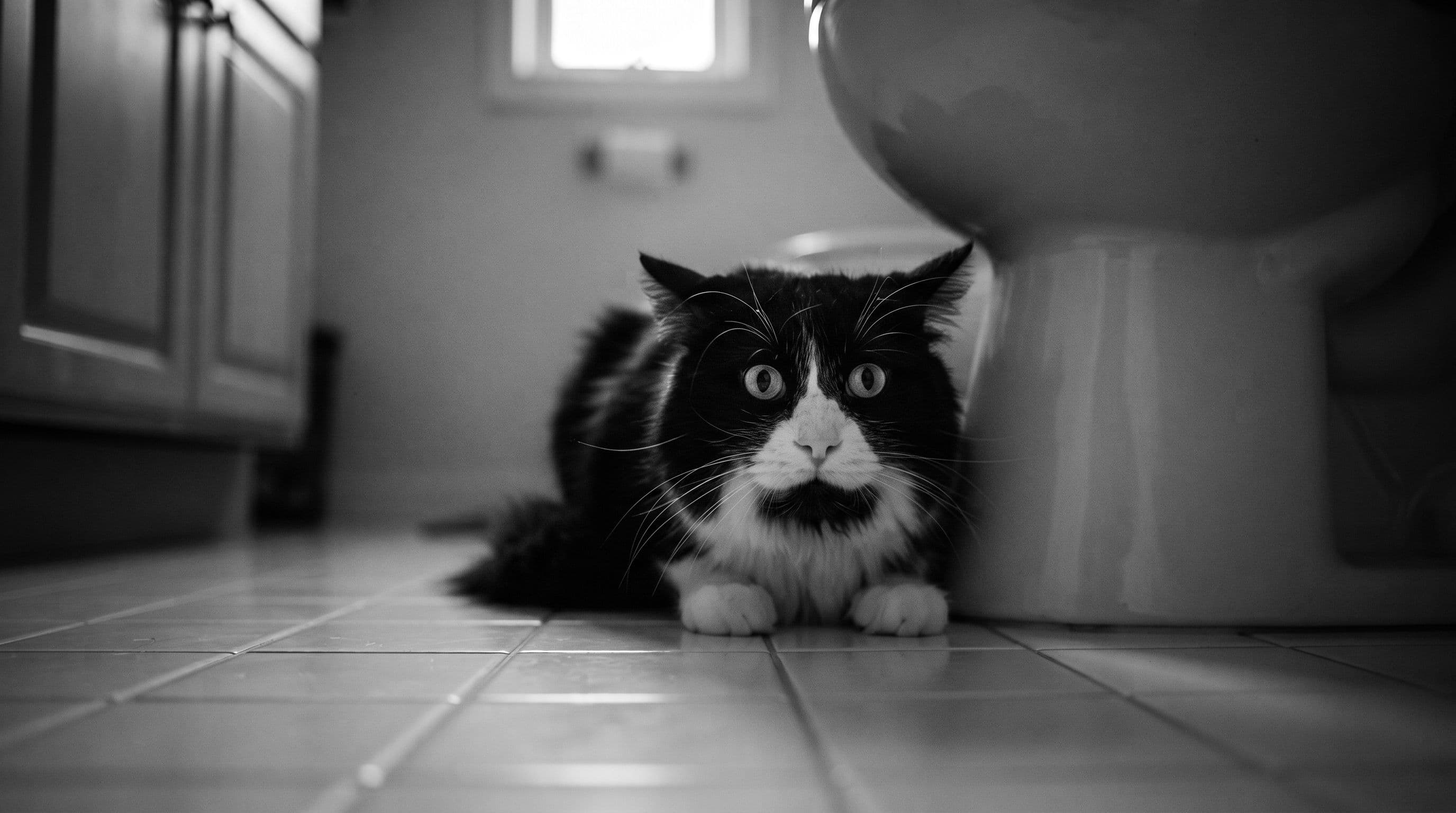
His untouched breakfast sat on the bathroom floor, and Vino sat behind the toilet, pressed flat against the tile like he was trying to dissolve into it. Green eyes tracked something invisible along the baseboard. No chirp, no yowl, no narration of his own magnificence. Years of sharing a bathroom with a tuxedo cat who provides running commentary on every moth, dust mote, and plumbing sound will recalibrate your hearing, so when dawn passed without a single noise from him, the silence landed on me like a physical weight. I stood in the doorway holding that rejected bowl, and the whole house felt pressurised, a dense quiet that settles over the valley right before a storm front pushes through. Something was off, not because of what he was doing but because of everything he wasn't. I've read plenty of articles ranking the signs of an anxious cat: hiding, hissing, appetite loss, all accurate enough in isolation. But those bullet points assume you already know what normal looks like for your specific cat, and normal is a moving target. Vino's baseline is chaos. Zola's baseline is monastic calm. The identical stress response registers completely differently in each of them, and I'd have missed it in both if I'd been working off a generic checklist. Three observations from our household complicate the standard answers, and I want to lay them out as evidence.
Exhibit One: When Anxiety Sounds Like Nothing
Three months ago, we had a plumber out to replace a section of pipe under the kitchen. The work took about 90 minutes. During that time, Vino did something I've only seen him do twice in the years he's lived with us: he went completely silent.
For context, Vino's vocal output on an average day is relentless. He meows when he wants food (always). He meows when he wants to go outside (frequently). He produces what I call the protest meow: a single, sustained note, identical in pitch and volume, lasting five seconds or more, deployed whenever his wishes haven't been fulfilled quickly enough. The cat is, to put it plainly, loud.
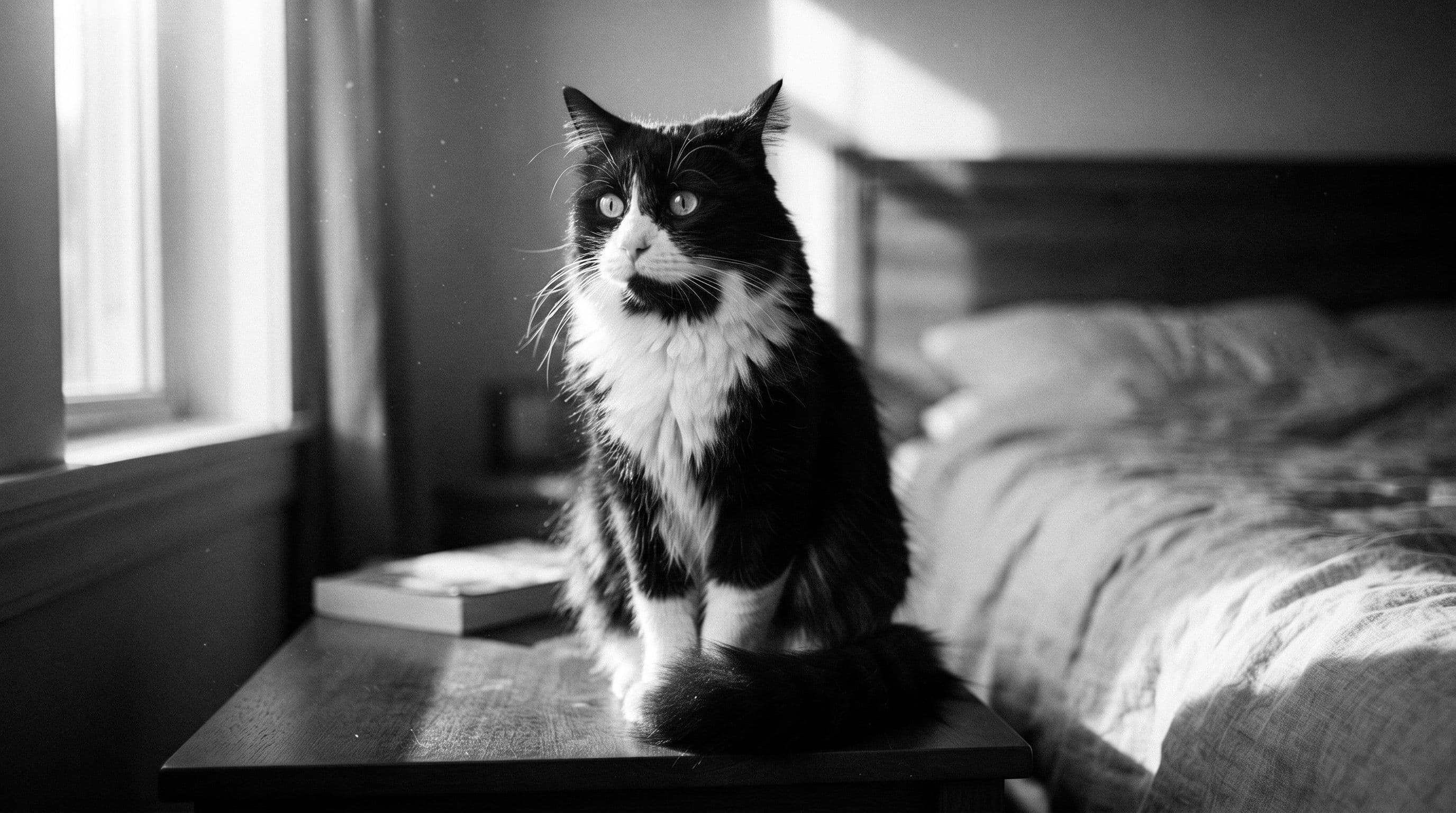
So when a stranger with a pipe wrench appeared in the kitchen, and Vino retreated to the bedroom without a sound, that silence carried information. He wasn't hiding under the bed, which is the classic anxiety image most people picture. He was sitting on the bedside table, his usual morning post, looking composed. But his ears were rotating like satellite dishes, his pupils were fully dilated despite the room being well-lit, and his tail was wrapped tightly around his body. I've noticed this pattern enough times now to trust it: cats experiencing moderate stress don't always bolt the way you'd expect. They'll freeze in place, holding a superficially calm posture while broadcasting micro-signals if you know where to look. Ear rotation, pupil dilation, tail tucking. Reading your own cat's stress signals isn't something that comes from a textbook. I've learned Vino's particular dialect of discomfort by living alongside it for years, not by reading a manual. The ASPCA recommends consulting a Certified Applied Animal Behaviorist or a board-certified veterinary behaviorist to help design a desensitization and counterconditioning plan for pets with separation anxiety and other anxiety-related conditions, and I think that advice speaks to something broader: professional guidance matters, but so does the daily literacy you build with your own animal over time. That morning with the plumber, every signal lined up. He looked relaxed to anyone who didn't know him. To me he was shouting.
Zola, by contrast, was asleep on the couch roughly 2 metres from the plumber. She didn't stir. This isn't because Zola's braver; it's because her baseline temperament is different. She's a black domestic shorthair with the emotional bandwidth of a river stone. What registers as a five-alarm event for Vino barely interrupts her nap cycle.
The lesson here is that feline anxiety isn't a universal expression. It's a deviation from that individual cat's norm. If your cat is normally quiet, silence won't tell you much. If your cat is Vino, silence tells you everything.
Exhibit Two: The Grooming That Crossed a Line
Over-grooming is the anxiety sign I treat with the most respect, because it's built to hide in plain sight. Vino grooms extensively under normal circumstances; he's a medium-long-haired cat who takes pride in maintenance, and the brushing sessions focused on his chest and chin (his favourite areas; he'll drool through the entire process) are a fixture of the routine. A cat grooming is the most normal sight in the world. That's precisely the problem.
The condition to know about is psychogenic alopecia: over-grooming driven by stress, persistent enough that the fur thins. What the case reports keep showing is how small the triggers can be: a change in the household's afternoon routine, an outdoor session that drifts later than usual, a schedule shifted by three-quarters of an hour. Forty-five minutes. For some cats, that's enough.
Cats, in my experience living with Vino, anchor their sense of security to predictable routines. Even small schedule disruptions, ones a dog or a human wouldn't register, can trigger a stress response in a cat. I've watched Vino lose his composure over a shifted feeding time or a rearranged piece of furniture, his tail puffing up like a bottle brush at the smallest change. A cat that reactive to small changes is exactly the kind of cat this sign is written for, which is why his grooming gets watched, not just admired.
The distinction that matters, and none of the competitor articles I've seen address it, is grooming-as-comfort versus grooming-as-compulsion. Comfort grooming moves around the body and finishes. Compulsive grooming keeps returning to the same spot, session after session, and because the behaviour itself looks routine, the first hard evidence is usually physical: fur thinning where the tongue keeps landing. In a medium-long coat like Vino's, a patch could take a week or two of over-grooming to even show through, which is a long head start for whatever is driving it.
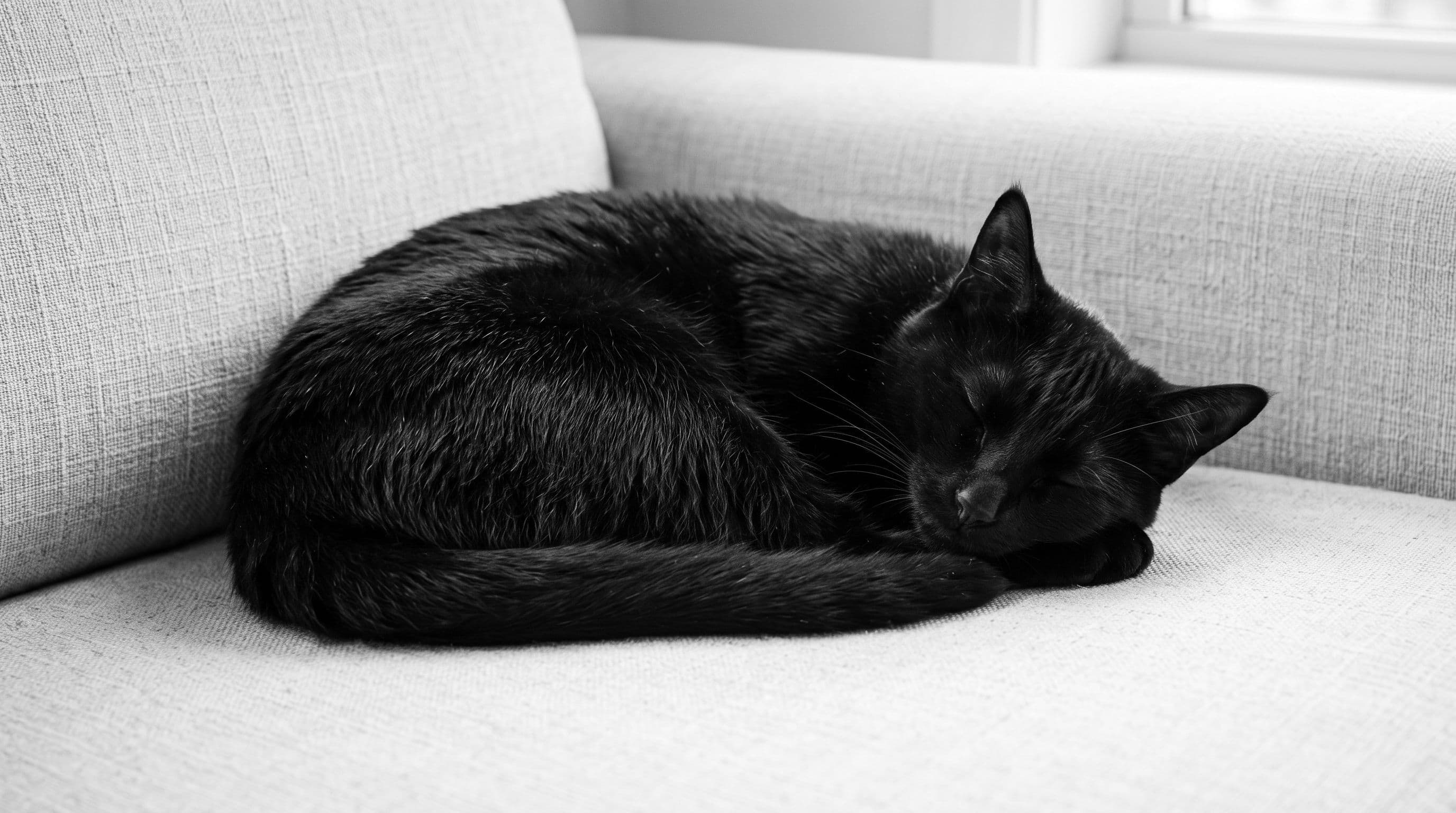
So the metric I watch is grooming duration, not just grooming frequency. If Vino ever works the same spot for longer than feels ordinary, and keeps returning to it within the same hour, that's the pattern that sends me looking closer, and to the vet if it persists. I keep a loose mental count, and I've shared this timing framework in my post on understanding your tuxedo cat's daily habits; it's a specific metric that actually helps when you're trying to spot trouble early.
Exhibit Three: Appetite as a Smoke Signal
This past January, we introduced a new self-cleaning litter box to the laundry room. Within a few days, Vino's appetite changed. For a cat who treats every meal as non-negotiable, that's not a subtle signal.
He wasn't refusing food outright. He was eating less at each sitting, leaving about a third of his portion, then walking away. He'd return to the bowl later, sniff it, and leave again. His water consumption stayed normal, which is notable because Vino drinks a lot of water on any given day.
The culprit was the litter box's cycling mechanism. It activates roughly 7 minutes after a cat exits, and the motor produces a low hum followed by a brief whirring sound. The laundry room shares a wall with the kitchen, where the cats eat. Vino had connected the sound of the new device with mealtime proximity, and it was putting him off his food.
I want to be specific about what I didn't see during this period: no hiding, no silence, no over-grooming. Vino was still meowing at full volume, still sitting on my lap in the evenings, still antagonising the neighbour's Staffy from his usual position about a metre from the fence. The only visible sign was a subtle change in eating patterns that I might have chalked up to warm weather or a finicky mood if I hadn't been weighing him semi-regularly.
The 2021 AAHA/AAFP Feline Life Stage Guidelines recommend at minimum annual wellness exams for healthy adult cats, with exams every 6 months recommended once a cat is around 7 years old, and body weight and condition assessed at every visit. I'd taken that guidance to heart by weighing Vino at home, and that habit is the only reason I caught the appetite change early. We moved the feeding station to the opposite side of the kitchen, putting more distance and a cabinet between the bowls and the shared wall. Within a week, Vino was back to cleaning his plate with his usual enthusiasm.
This is the angle I think gets overlooked: appetite changes as the sole indicator of feline stress, with no accompanying behavioural flags. Most guides list appetite alongside hiding, aggression, and litter box avoidance as if they'll all show up together. Sometimes they don't. Sometimes the only sign is a cat eating noticeably less, and if you aren't tracking portions or weight, you'll miss it entirely. I covered this monitoring approach in more detail in my post on keeping your indoor cat healthy and happy, which includes the weighing routine I use.
What This Adds Up To
The common thread across all three exhibits isn't a specific behaviour. It's the gap between what a cat is doing and what that cat normally does. Vino's anxiety didn't look like the textbook version in any of these cases. It looked like a loud cat going quiet. It looked like a food-obsessed cat leaving food in his bowl. And the sign I respect most, compulsive over-grooming, is the one built to look like nothing at all.
I've come to believe that the way cats communicate with us isn't hardwired but learned over time, shaped by the particular household they live in and the humans they're stuck with. That insight has changed how I read Vino's behavior. He doesn't pace or whine or chew furniture when something's off. He makes tiny adjustments to his patterns, signals he's developed specifically for me, and if I'm not paying close attention, I'll miss them entirely. It's a private language built on repetition and trust, and it only works if I bother to stay fluent in it.
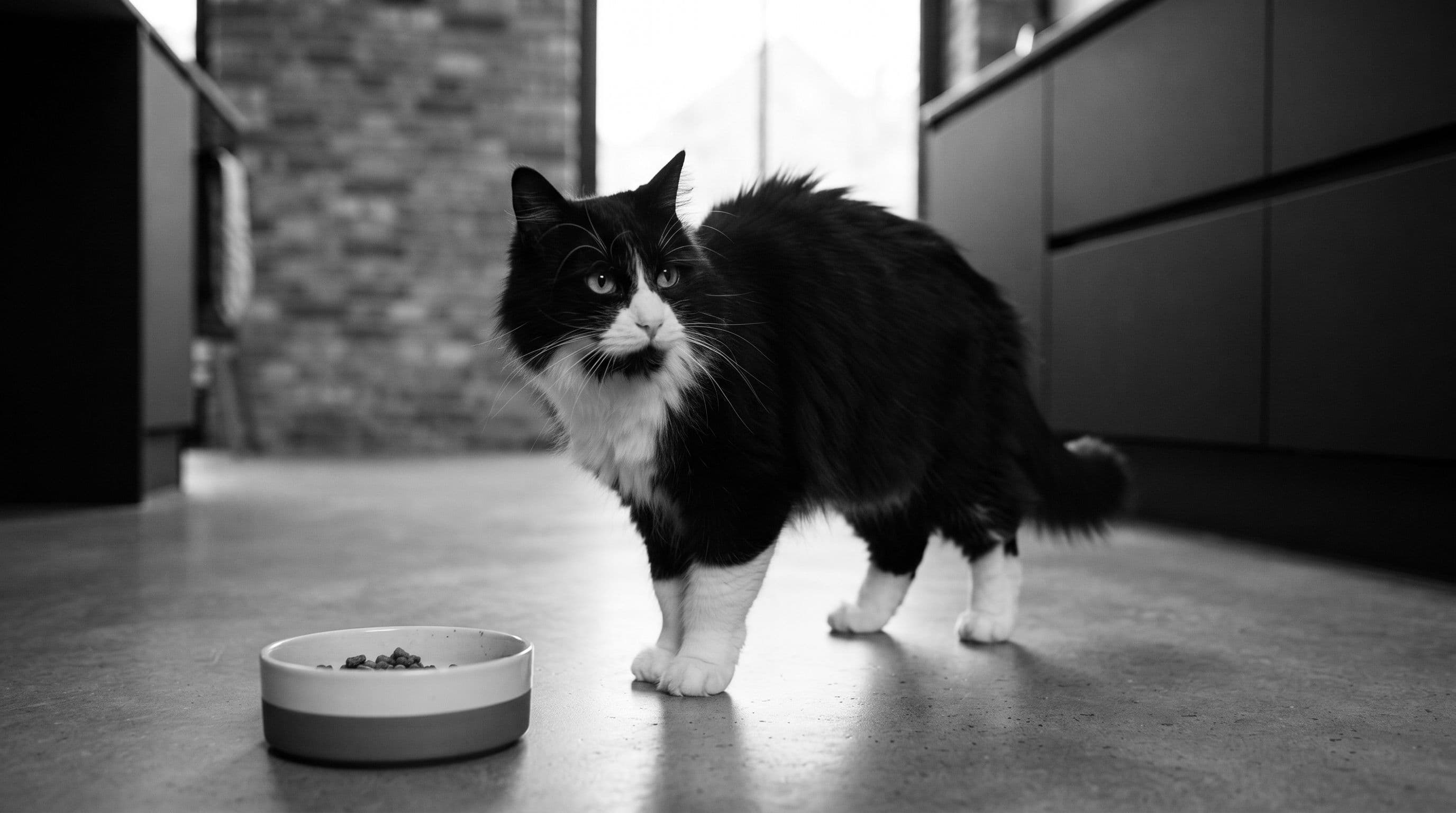
The practical takeaway is this: before you can read the signs of an anxious cat, you need to establish what "normal" looks like for yours. Track meal portions for two weeks. Note vocalisation patterns. Pay attention to grooming duration and location. Build a baseline. Then watch for departures.
Frequently Asked
Related Vino Reading
- Understanding your tuxedo cat's daily habits: what daily life with a tuxedo cat actually involves.
- Tracking your tuxedo cat's weight: the weighing habit that gives me Vino's baseline.
If you want more of these observations from life with Vino and Zola, I share them weekly. Follow Vino's Tuxedo Tales on Instagram at @vinostuxedotales, or sign up for the email list so nothing slips past you the way a subtle appetite change almost slipped past me.
The $3,200 Morning That Taught Me What Vino's Silence Costs
One morning in March, Vino missed window patrol. He always claims the east-facing sill before the coffee machine finishes its cycle, white paws arranged just so, one green eye on the sparrows and one on me to confirm I'm watching him watch them. That morning the sill stayed empty. I found him in the laundry instead, wedged behind the dryer with only his black ears visible, and those ears were flattened so hard they looked like they'd been ironed. The crooked milk mustache of fur on his upper lip, usually so prominent when he yawns or yells for breakfast, was pressed against the wall where I couldn't see it.
I'd already spent $3,200 that month on Zola's unexpected dental work. The budget was screaming. Yet there I stood calculating whether a silent Vino constituted an emergency or just a mood, and I made the wrong call. I told myself he'd emerge when hungry. I told myself I'd check after my first meeting. I told myself a lot of things that morning, and every one of them cost me three more hours of his distress before I finally loaded him into the carrier he'd normally fight like a demon to avoid, and he didn't fight at all. That was the moment I understood: the absence of his usual resistance was itself the alarm bell I'd been waiting for.
The vet found nothing physically wrong. Vino's sixteen teeth were fine, his weight held steady at 6 kg, his top left canine still hanging loose in that way that makes him look permanently mid-grin. The diagnosis was stress, likely from construction noise two streets over that I'd stopped noticing days ago. His body had been shouting at me through silence, through compliance, through the missing mustache at the window. I just hadn't learned the frequency yet.
What Vino's Verdict Teaches About Anxious Cat Signs
| Standard Checklist | Vino's Actual Signal | What I Almost Missed |
|:---|:---|:---|
| Hiding | Hiding in new spots, not his usual bolt-holes | Behind the dryer, never used before |
| Appetite loss | Ignoring ritual foods, not all food | Untouched breakfast, but ate treats later |
| Reduced activity | Skipping established routines | The pre-coffee window patrol, abandoned |
| Vocal changes | Silence replacing specific sounds | No protest meow when moved from sill |
Vino's Verdict: The construction noise was audible to him for eleven days before I noticed. He rated it "unacceptable" on day one and "catastrophic" by day twelve. My lag time: eleven days. His forgiveness: immediate, expressed via drooling on my keyboard by that evening.
Three Household Observations That Complicate the Generic Lists
First: Vino's anxiety inverts his hierarchy of needs. A calm Vino demands food above all else. An anxious Vino will reject a quarter-sachet of his usual meal while accepting an identical flavour from my hand in a different room. The food isn't the variable. The context is.
Second: Zola's 3.9 kg frame carries stress oppositely. Where Vino compresses himself into smaller spaces, Zola expands, occupying doorways and hallways she normally avoids, making herself unavoidable. Same household stressor, same hour, two bodies performing entirely different emergencies.
Third: The return to normal isn't linear. Vino resumed window patrol on day three post-construction, but his protest meow didn't return to full volume for nine days. I kept checking his weight, his teeth, his loose canine, looking for physical explanation when the behavioural recovery simply needed longer than I'd budgeted for.
Frequently Asked Questions
What is the most overlooked sign of an anxious cat?
The disappearance of a specific, named routine. Not "less active" but "the pre-coffee window patrol, abandoned." Not "quieter" but "protest meow absent when physically moved." Generic lists train owners to look for broad categories. Your cat's anxiety is more precise than that, and the precision is what you'll miss if you're scanning for generalities.
How do I tell anxiety from illness when the symptoms overlap?
I can't. That's the honest answer. The $3,200 Zola dental taught me that physical and behavioural symptoms interleave in ways I can't separate at home. Vino's silent compliance behind the dryer looked behavioural but I couldn't rule out obstruction, toxin, neurological event. My mistake was waiting three hours to let a professional make that distinction. The carrier he didn't fight was the sign I should have trusted immediately.
Why does one cat in the same household show anxiety differently from another?
Vino compresses; Zola expands. Vino goes silent; Zola becomes underfoot. They've shared the same spaces, same food, same humans, same construction noise, same two cat towers, same single litter tray. Their stress responses are not environmental copies. They're individual architectures built on individual baselines. Vino's chaos-normal makes his silence visible. Zola's calm-normal makes her obstruction visible. You have to know which cat you're looking at before you can read what they're showing you.