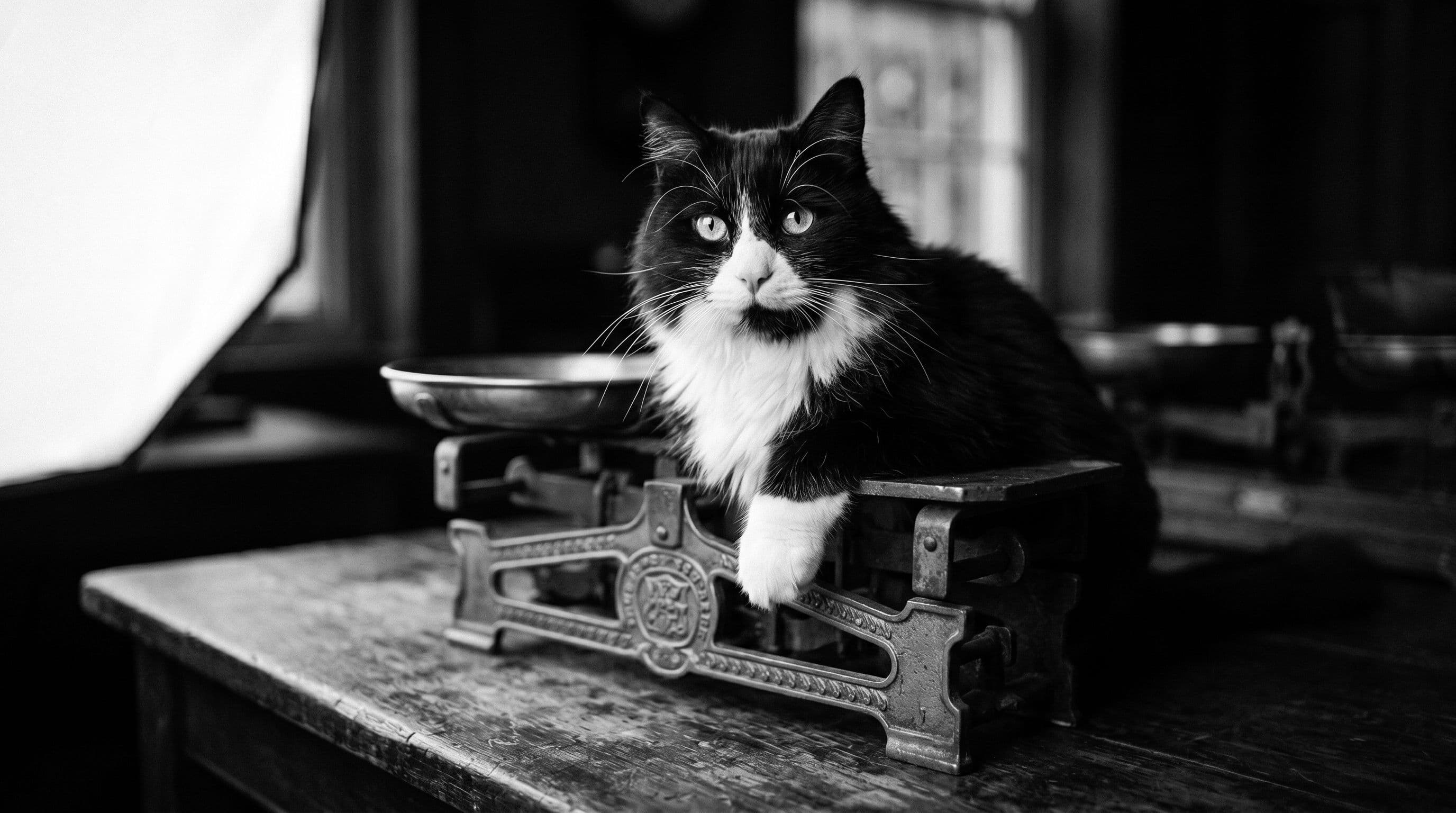
There isn't a healthy tuxedo cat weight, and any chart that gives you one is answering a different question than the one you asked.
"Tuxedo" is a coat pattern, not a breed. Bicolour markings turn up across domestic shorthairs, domestic medium-hairs, and plenty of pedigree lines, and those cats have wildly different frames underneath. Searching for a tuxedo cat weight and landing on a single figure is like asking how tall someone with brown hair is. The pattern isn't load-bearing information.
Vino is a medium-long-haired bicolour domestic cat I brought home from a small biodynamic winery in northern Tasmania in April 2022. He weighs 6 kg. Whether that number is useful to you depends entirely on what you do with it, and mostly it shouldn't be.
What Vino's Weight Has Actually Done
His whole history is one gentle drift, which is less dramatic than most articles on this topic would like.
He arrived at about 5.4 kg aged two and a half, lean and muscular from working life at the vineyard catching mice. Domestic comfort took him up to roughly 5.8 kg. His portions are measured rather than left out, which is the only weight management he has ever needed. No crash diet, no dramatic intervention, no crisis.
That 400 g sounds trivial. On a cat his size it's about 7% of his body mass, which on an 80 kg human would be a bit under 6 kg. You'd notice that in yourself.
The slow approach wasn't caution for its own sake. The AAHA weight management guidelines recommend a target weight loss rate of 0.5 to 2% of body weight per week in cats, because faster loss raises the risk of hepatic lipidosis. Clark and Hoenig, in the Journal of Feline Medicine and Surgery in 2021, make the same point from the other direction: hepatic lipidosis risk rises specifically when an obese cat undergoes rapid or severe caloric restriction, not from carrying excess weight alone. Taking the weight off fast is its own hazard. Boring and gradual is the medically correct speed.
Why the Coat Hides the Cat
This is the part I'd want to know if I were living with a medium-long-haired cat for the first time.
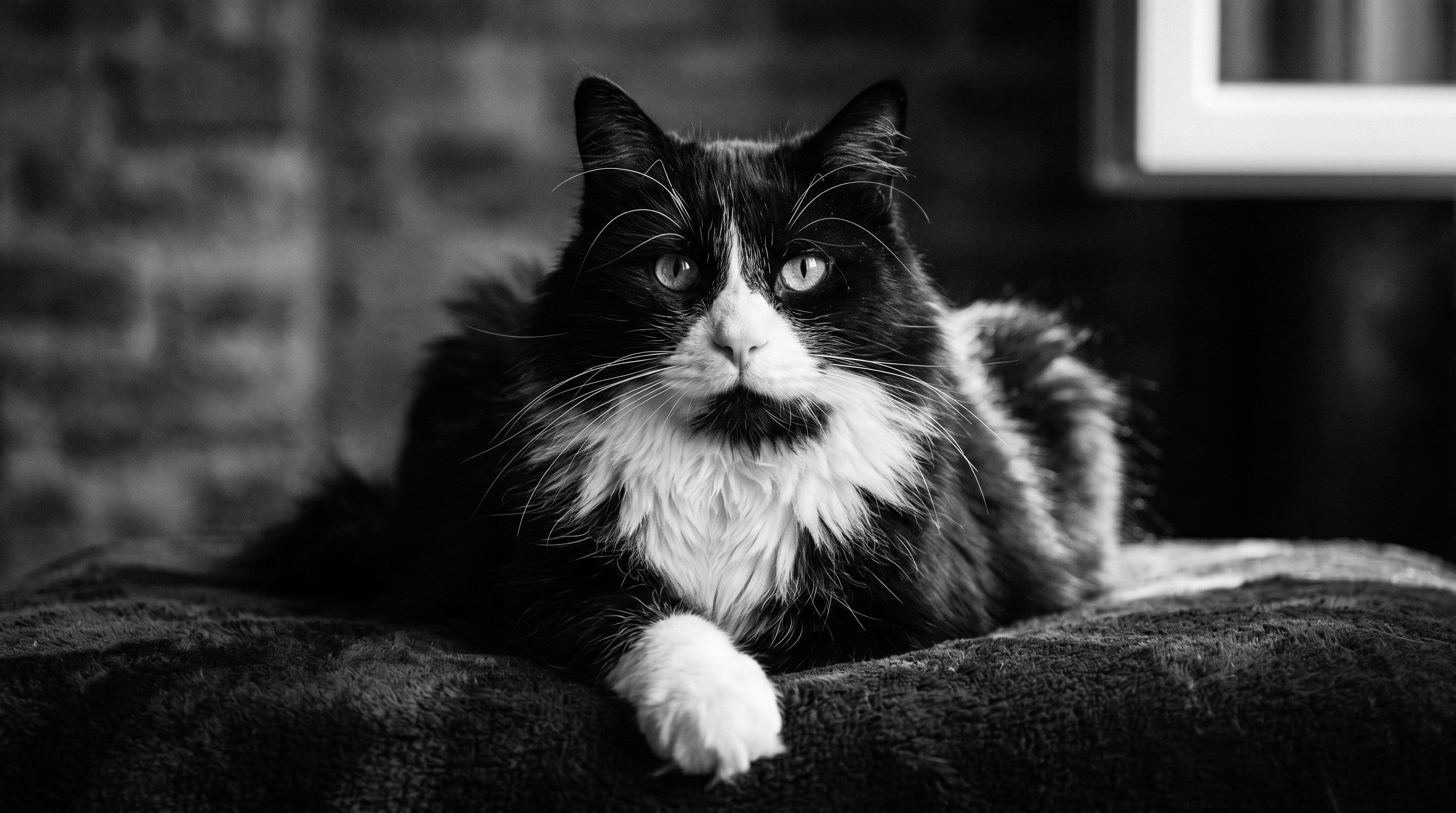
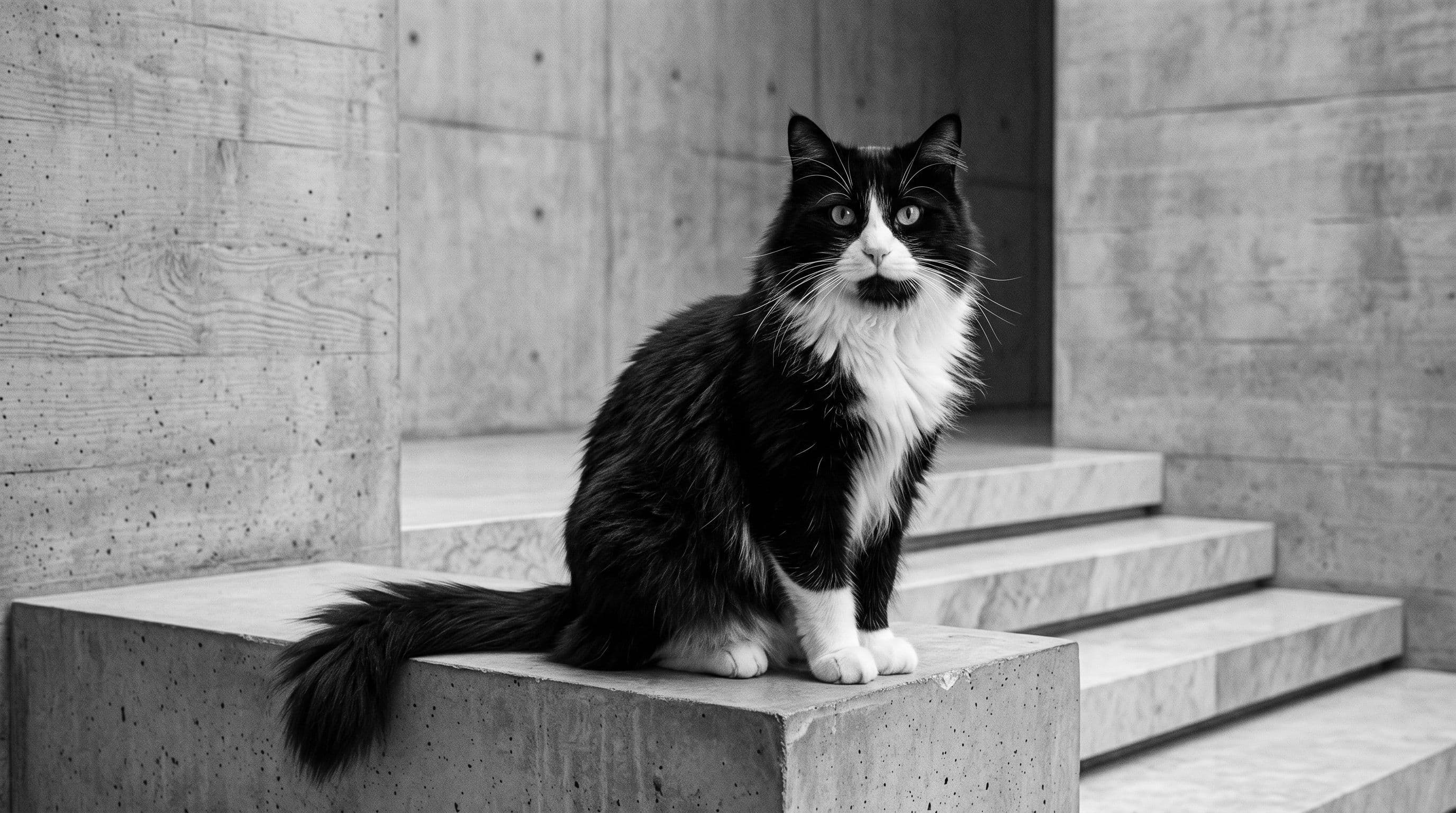
Vino's fur adds real visual bulk. His chest and mane puff outward where the white meets the black in that natural bow tie, and the longer fur on his back legs suggests thicker haunches than he actually has. Freshly brushed, he reads as a much bigger cat. He looks approximately the same across the room whether he has put on half a kilo or taken it off, which is precisely the problem.
This isn't just my poor eyesight. A 2010 study by Courcier and colleagues, looking at feline obesity in a first-opinion veterinary practice in Glasgow, found that owners were more likely to misjudge their cat's body condition score when the cat was long-haired. The coat is doing the hiding, and it does it to everyone.
The fix is hands, not eyes. Run your palms flat along the cat's sides and feel for ribs without pressing hard. On a cat in good condition you should find them easily through a thin layer of fat. Then look from above for a visible waist behind the ribs. That takes about ten seconds and tells you more than the scale does on its own.
The Multi-Cat Arithmetic Nobody Mentions
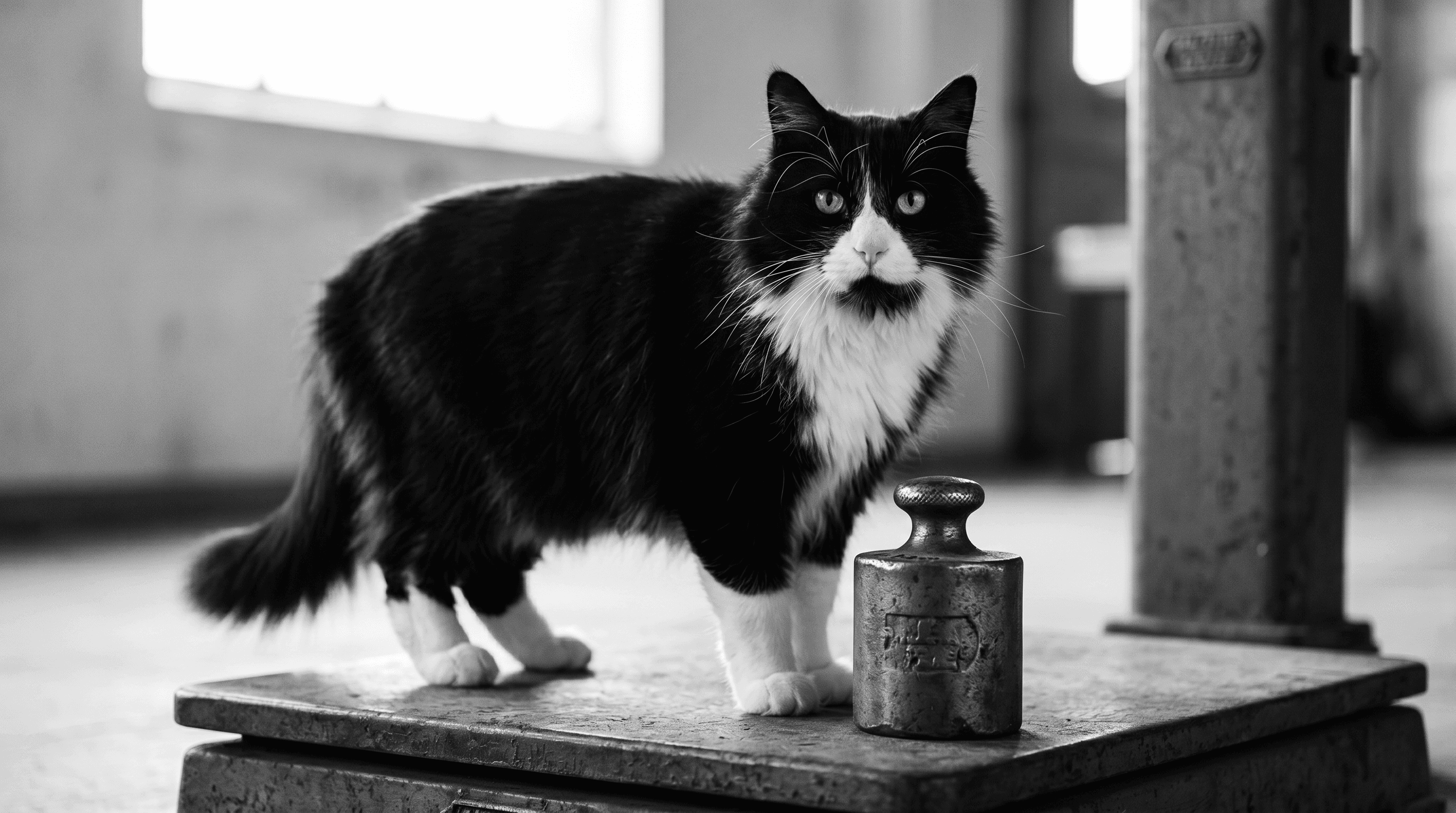
Vino has zero food self-regulation. Give him a bowl of biscuits and he will eat every one in a single sitting, every time, and then present himself for more. Any portion control here is done by the humans, because he contributes nothing to the effort.
Zola is the opposite animal. She's black, slender, about 3.9 kg, and she eats what she needs and walks away from the rest. In a single-cat house that would be unremarkable. In this one it's a structural problem, because a cat who walks away from a half-finished bowl is leaving it for a cat who has never once walked away from anything.
Left unmanaged that arithmetic only runs one direction: he trends up, she trends down, and neither of them is on the diet you think they're on. Dr Sharon Crowell-Davis, Professor of Behavioral Medicine at the University of Georgia, has documented that cats live in matrilineal colonies with individual recognition, dominance hierarchies, and cooperative behaviour. Feeding is where that hierarchy becomes visible in your kitchen.
If you have a confident eater and a grazer under one roof, the scale is eventually going to tell you something about their relationship rather than their metabolism. Separate the bowls, or accept that you're feeding one cat twice.
Separating them properly means more distance than most people assume. The 2013 AAFP and ISFM Feline Environmental Needs Guidelines recommend that multi-cat households have as many separate resource locations as there are cats, positioned out of sight of one another so cats aren't forced to compete or pass through another cat's space. Two bowls at opposite ends of the same kitchen doesn't satisfy that. Two bowls in different rooms does.
The practical version here is that the grazer needs somewhere the vacuum can't loiter. Zola will leave food if she's being watched, and Vino has considerably more patience for waiting than she has for being waited on.
What Weight Actually Costs
Weight matters more than the aesthetics of it, and this is the part worth being blunt about.
The Association for Pet Obesity Prevention's 2022 survey found that 61% of cats in the United States were classified as overweight or obese by veterinary professionals. That's a clear majority of the pet cat population.
The consequences are well documented. Clark and Hoenig report that obese cats are two to four times more likely to develop diabetes mellitus than cats of ideal body condition, and are at markedly higher risk of orthopedic disease, with an odds ratio of 4.9 for that association.
The joint half of that has a nasty companion finding. A 2011 study by Slingerland and colleagues radiographed 100 client-owned cats aged six and over and found 61% had osteoarthritis in at least one joint, yet only 13 of those 100 owners had noticed any lameness. Cats don't limp in a way owners reliably recognise. They just stop making the jump, and it reads as ageing rather than pain.
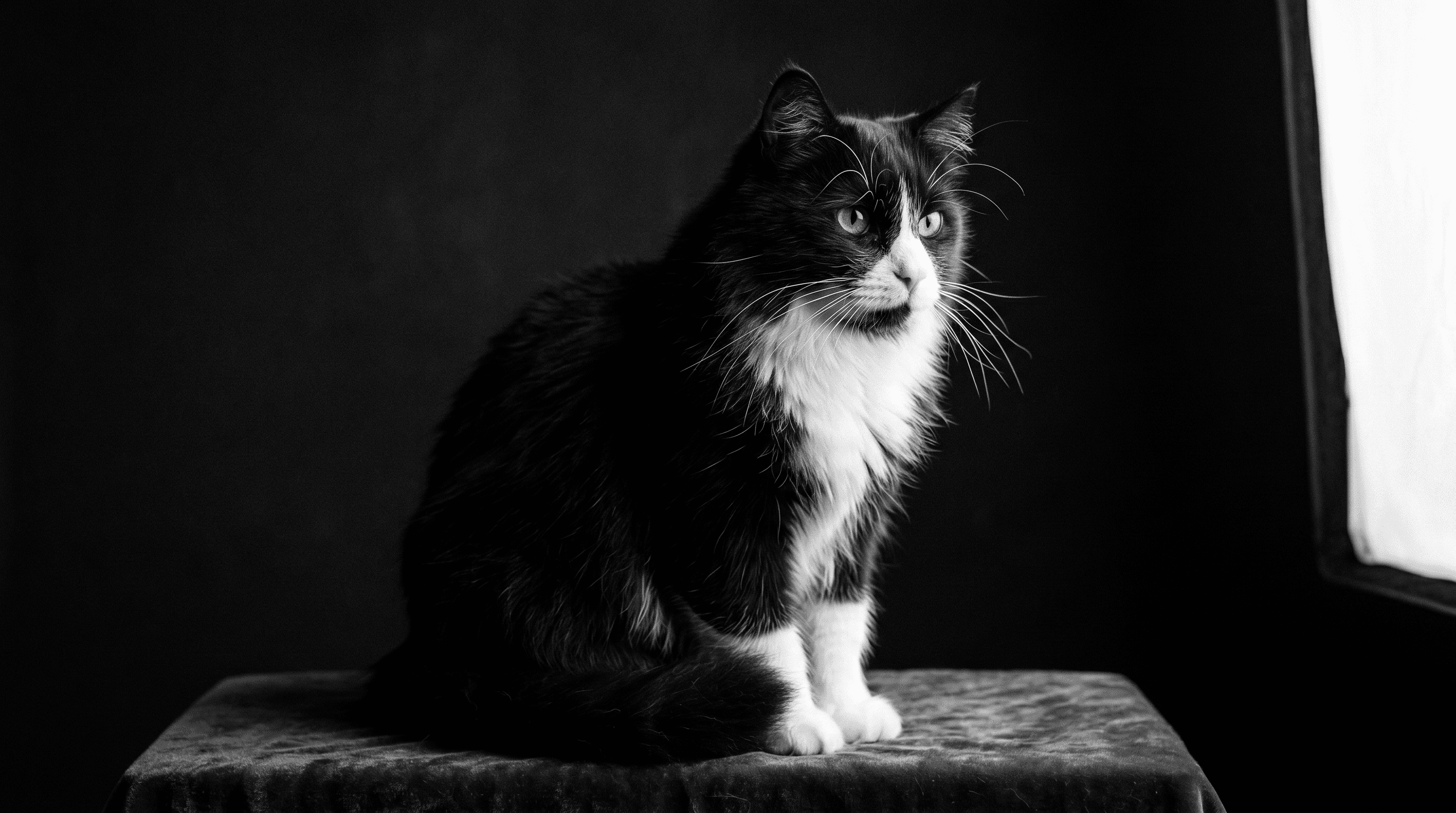
Vino is on the desk, the cat tower, and the windowsills constantly, and he's around six years old now. The day that stops looking effortless is a thing I want to catch as a symptom.
How Much Should a Cat Like Vino Eat?
Portion size is where the weight conversation actually gets decided, and there's a usable reference point.
The WSAVA Global Nutrition Committee's calorie chart for a healthy adult cat in ideal body condition gives roughly 200 to 250 kilocalories a day for a cat weighing 3 to 4 kilograms, with needs rising as body weight increases. Note the weight band carefully, because it's easy to grab that number and apply it to a cat well outside the range it describes. Vino, 6 kg at his September 2026 check-up, sits above that band, so the figure is a starting point for the maths and not his allowance.
That's also why the calorie count on the packet matters more than the volume in the scoop. Two foods filling the same cup can differ substantially in energy density, and the cat notices the difference long before you do.
How Often Should I Weigh My Tuxedo Cat?
Monthly is enough for a cat who's stable. Weekly is worth doing if you're actively managing a change.
Consistency beats frequency by a wide margin. Same time of day, same surface, same point relative to a meal. A hard floor rather than carpet, because a soft surface will hand you a reading that's meaningfully off and you'll spend a week wondering what happened.
The 2021 AAHA/AAFP Feline Life Stage Guidelines recommend at minimum annual wellness exams for healthy adult cats, with exams every six months once a cat is around seven years old, and body weight and condition assessed at every visit. That last clause is the valuable one, because it builds a trend line, and a trend is the only thing that makes a single number mean anything.
Does Coat Length Affect How You Judge Tuxedo Cat Weight?
Yes, and more than most owners expect, which is the Courcier finding above in practice.
At his 5.8 kg peak Vino honestly didn't look overweight to me, and I see him every day. The rib check settled it: I had to press harder than I should have needed to before I found them. Visual assessment on a medium-long coat is close to worthless. Hands and a consistent scale are the whole toolkit.
The bicolour pattern adds a second small distortion on top of the coat length. High-contrast markings create contour lines that don't follow the actual shape of the animal underneath, so the eye reads a silhouette that isn't quite there.
Is 6 Kilograms a Healthy Tuxedo Cat Weight?
It depends on the frame carrying it. Six kilograms is comfortable for a large-framed domestic cat and too much for a small-framed one, and no chart can tell you which you have.
Vino weighed 6 kg at his September 2026 check-up, and arrived in April 2022 at about 5.4 kg. A bigger-boned bicolour cat could be in excellent condition at 6.5 kg. The scale reading is only meaningful next to a body condition assessment, and if you're uncertain about yours, that assessment is a reasonable thing to ask a vet to walk you through once so you know what you're feeling for afterwards.
Weight alone is a number. Weight plus condition plus a trend line is information.