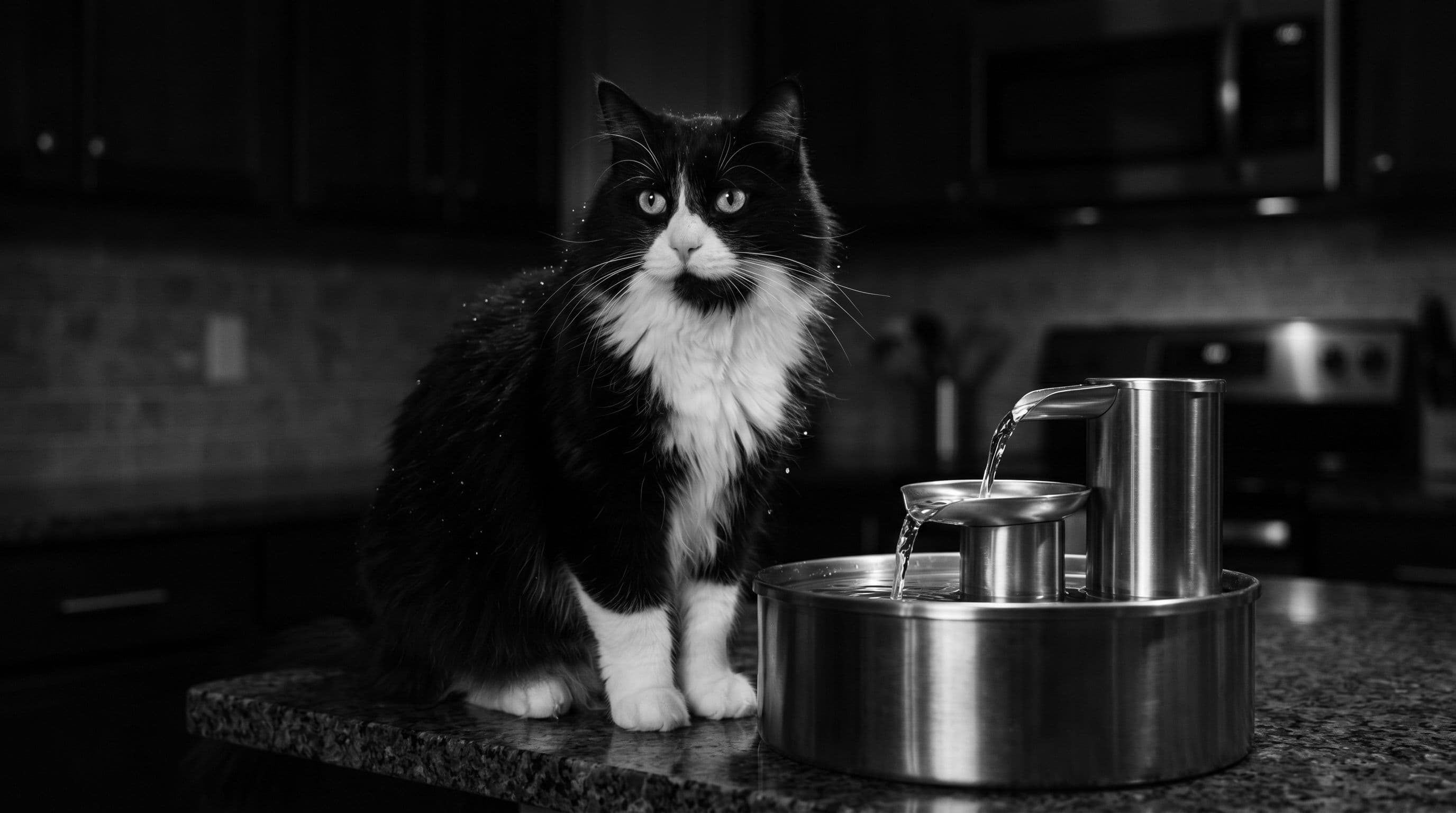
Late one night, I watched Vino drink water for the fourth time in two hours. He sat at his stainless-steel fountain in the kitchen, lapping steadily, his black chin dipping low enough that the white bib underneath caught a few droplets. Zola was asleep on the couch. My fiancée was asleep in bed. I was standing in the doorway in my socks, counting how many seconds he drank for, because that's who I am now: a man in his thirties timing his cat's water intake and wondering whether tuxedo cat health problems include excessive thirst or whether Vino is just, as usual, doing everything at maximum volume and frequency.
Why Tuxedo Cat Health Problems Don't Get Their Own Textbook
Here's the thing that took me longer than it should've to understand: "tuxedo" isn't a breed. It's a coat pattern. Vino's bicolour markings, that almost-perfect split of black and white with the natural bow tie shape at his chin, don't come with a breed-specific health profile the way a Scottish Fold's cartilage issues or a Maine Coon's predisposition to hypertrophic cardiomyopathy (HCM) do. No veterinary genetics panel lists "tuxedo" as a breed, because it isn't one, and Vino's vet has never once treated his coat pattern as a diagnostic category. That's because tuxedo cats can be domestic shorthairs, domestic medium-hairs (Vino's category, with that medium-long fur he spends half his waking life grooming), British Shorthairs, Maine Coons, or any number of other breeds and mixes.
So when I talk about health concerns I watch for with Vino, I'm not talking about some special tuxedo syndrome. I'm talking about common feline health issues filtered through the specific realities of living with this particular 6 kg cat who came from a biodynamic vineyard in northern Tasmania in April 2022. The coat pattern doesn't determine the risk. But the individual cat, his habits, his genetics, his environment, and my willingness to stand in the kitchen at midnight watching him drink: those determine what I catch early and what I miss.
That said, there are a few interesting data points about black-and-white cats specifically. The tuxedo pattern comes from the white-spotting gene in the KIT gene family, which stops pigment cells from migrating across parts of the coat during development. A 2016 Nature Communications paper by Richard Mort, Christian Yates, and colleagues at the Universities of Edinburgh and Bath showed that piebald patches arise because pigment cells move and multiply randomly as the embryo grows, not because of directed cell-to-cell signalling. Dr Leslie Lyons, the Gilbreath-McLorn Endowed Professor of Comparative Medicine at the University of Missouri and one of the leading feline geneticists, continues to work on the genetics of coat traits including the variable degree of white spotting. The white-spotting gene is incompletely dominant, so one copy gives a typical bicolour tuxedo, two copies give a mostly-white or van-patterned cat, and the exact placement of white varies even between littermates. All of which tells me that pigmentation genetics aren't a simple on-off switch; they're tangled up with how cells migrate and proliferate during embryonic development, and those same biological pathways don't exist in isolation from the rest of the body. None of this means Vino's tuxedo pattern makes him sick. It means I don't dismiss it as irrelevant, either.
What I Actually Monitor: Vino vs. the Statistical Average
The 2021 AAHA/AAFP Feline Life Stage Guidelines recommend at minimum annual wellness exams for healthy adult cats, with exams every 6 months recommended once a cat is around 7 years old, and body weight and condition assessed at every visit. Vino was born around late 2019, so he is right at that 7-year mark rather than comfortably inside the annual window, and I'd rather have a solid baseline waiting for him. Here's why that matters, and how his profile compares to what vets typically flag.
Water intake. The scene that opened this post isn't unusual. Vino drinks noticeably more water than Zola does. A healthy cat of his weight should consume roughly 200 to 250 millilitres per day; I've measured Vino's intake across a 72-hour stretch (yes, I know), and he's consistently around 280 to 310 millilitres. The working theory in this house is that Vino just drinks a lot because he's Vino, and he does everything with intensity; a renal panel and urinalysis are the definitive way to rule out the alternatives, and they're on the list for his next checkup conversation. But I keep tracking it, because increased thirst (polydipsia) is one of the earliest detectable signs of chronic kidney disease (CKD), and CKD is common enough in older cats that I don't want to be caught off guard. I'd rather have three years of baseline data that show "Vino has always been a heavy drinker" than discover a spike with nothing to compare it to.
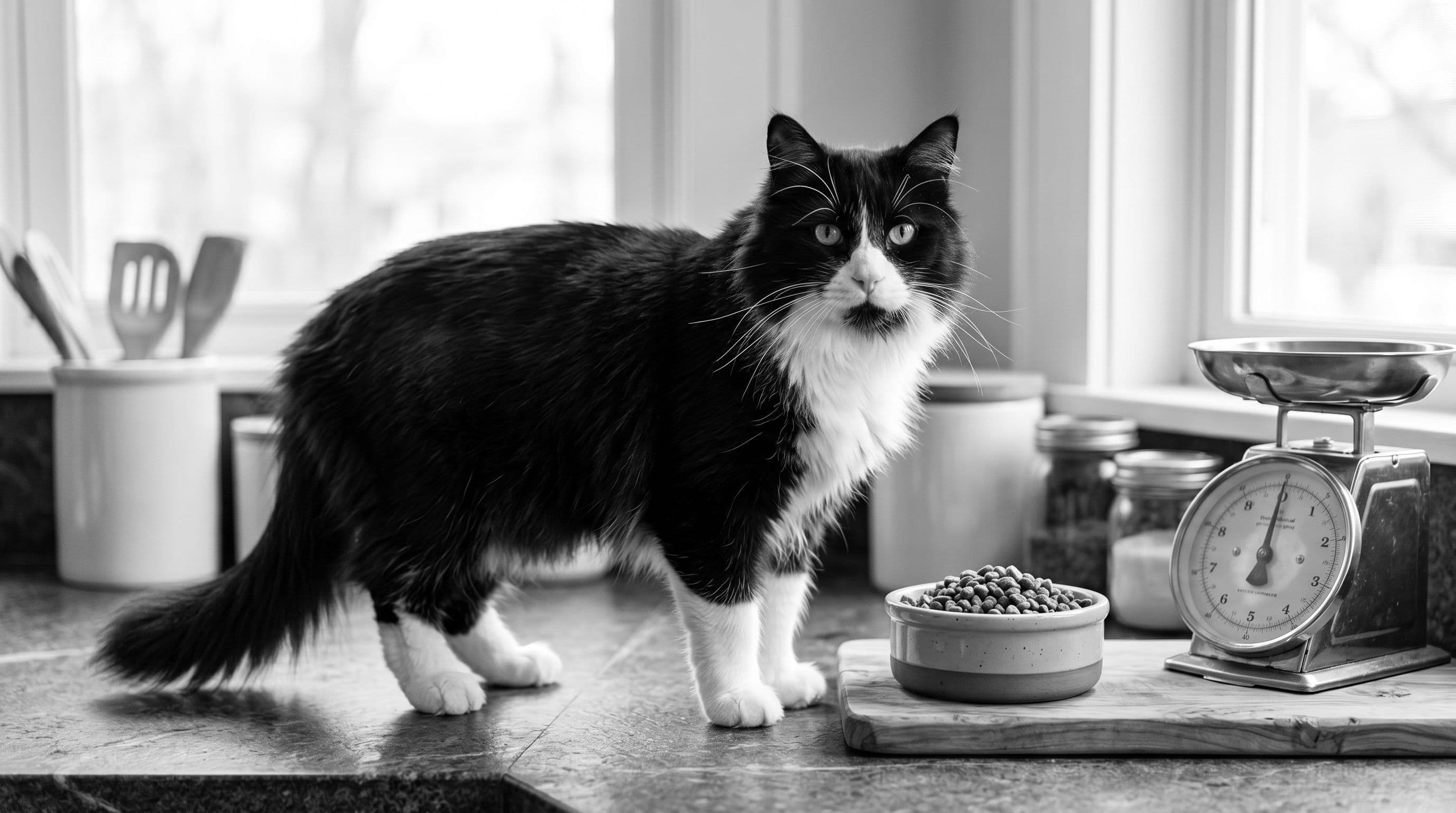
Weight management. Vino is always eating or asking for more food. I'm not exaggerating. At 6 kg, weighed in September 2026, he's a normal, healthy shape for a medium-long-haired domestic cat of his frame, but he'd happily be 8 kilograms if I let him. Obesity in cats is a genuine epidemic: the Association for Pet Obesity Prevention found in their 2022 survey that roughly 61 percent of cats in the United States were classified as overweight or obese. Zola self-regulates. She eats what she needs and walks away. Vino treats every meal like it's his last and every closed cupboard like a personal insult. Portion control is non-negotiable in this household, and I weigh his food with a kitchen scale twice daily. It takes eight seconds, and it's how we caught his one slow creep: a drift up to about 5.8 that reversed with a small portion cut.
Hairballs and vomiting. Vino's medium-long fur means regular grooming sessions, both his own and mine. He loves being brushed, particularly around his chin and chest area, and I use a stainless-steel deshedding comb on him three to four times a week. Despite this, hairballs happen. The occasional vomit is a fact of life with this cat. But I track frequency. One hairball every two to three weeks doesn't alarm me; a sudden jump to twice a week would send us to the vet, because the Cornell Feline Health Center lists vomiting as a common sign of inflammatory bowel disease in cats, with diet often part of the picture, and I'd rather rule out something more serious early. The distinction between "normal for Vino" and "something's changed" only exists because I've paid attention long enough to know the difference.
Dental health. This one doesn't get enough attention. Dental disease is strikingly common in cats, with most showing some sign of it within their first few years. It's the one I treat as a when, not an if, and the household protocol reflects that: regular gum-line checks at home, and a dental assessment as part of his checkups. His drooling, which is prodigious during cuddle sessions, hasn't changed in character or volume, so it stays filed under "quirk" instead of "symptom." But I notice it every time. I notice everything now.
Practical Steps: What You Should Actually Do
If you've got a tuxedo cat, or any domestic cat whose breed history is unknown or mixed, here's what years of mild obsession have taught me.
Establish baselines early. Don't wait for symptoms. Get bloodwork done when your cat is healthy, young, and boring. Ask your vet for a complete blood count (CBC), chemistry panel, and urinalysis. Then do it again in 12 months. The value isn't in any single result; it's in the trend line. A creatinine number on its own is just a number; the same number sitting above years of stable readings is a signal you can actually act on.
Track daily habits with actual numbers. I don't mean vaguely noticing that your cat seems thirstier. I mean measuring water consumption for a few days, noting the number and consistency of litter box deposits (our Litter-Robot makes this easier since it cycles after each use and I can see exactly what's there), and keeping a rough log of vomiting or hairball events. Your future vet visit self will thank your current self.
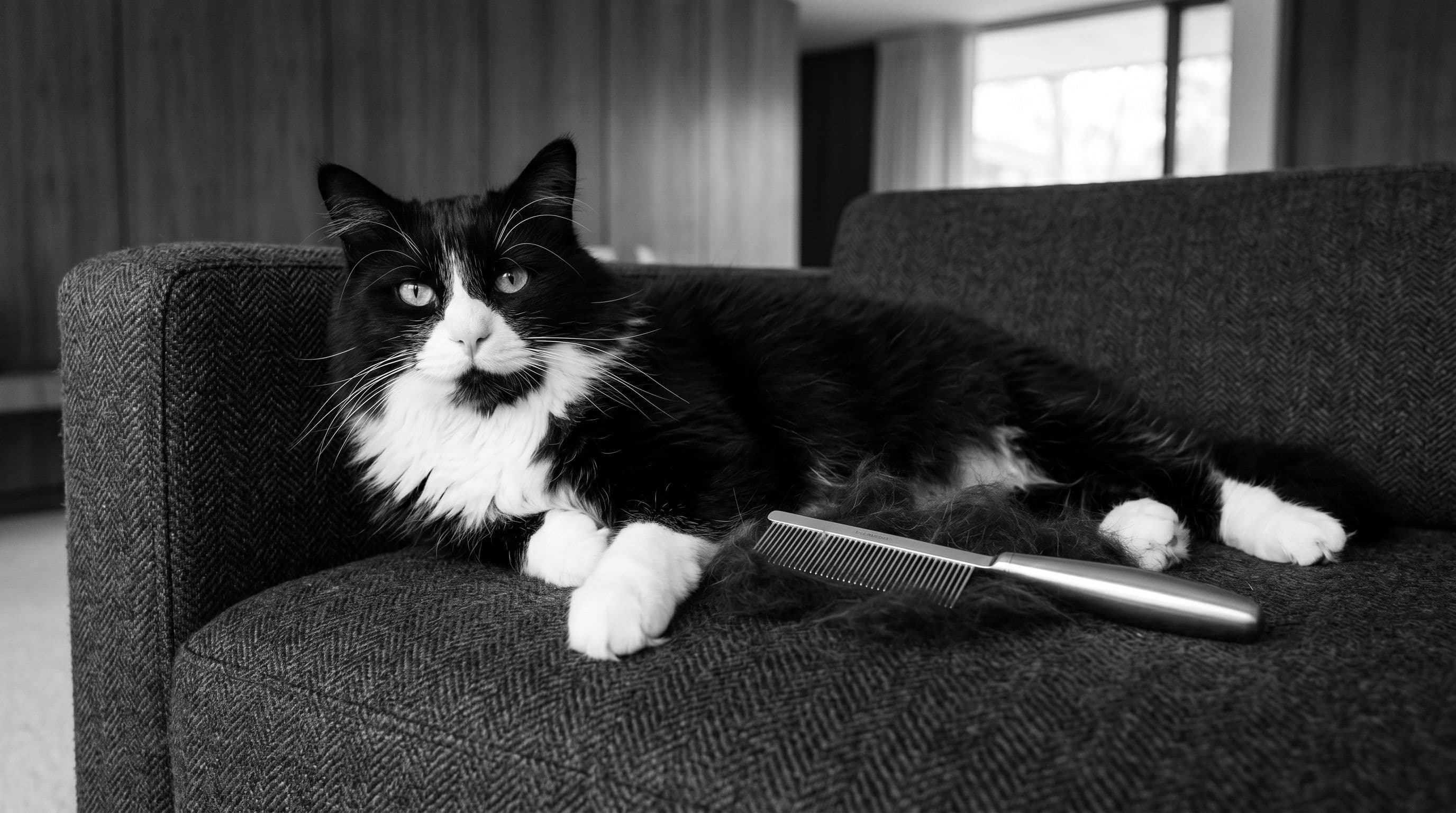
Learn your cat's specific body, not the breed average. Run your hands over your cat weekly. I know where every bump and ridge on Vino's frame sits. I know the shape of his lymph nodes under his jaw (they're small, symmetrical, and unremarkable). I know his belly is soft and he doesn't flinch when I palpate it gently. If any of that changes, I'll feel it before I see it.
Don't skip dental checks. Open your cat's mouth. I realise this sounds like advice from someone who's never tried to open a cat's mouth, but Vino tolerates it because we've done it since he arrived. Lift the lip, look at the gum line. Pink is good. Red, swollen, or bleeding isn't. A line of tartar along the back molars means it's time to talk to your vet, not next year.
Know your cat's weight to the decimal. Weigh monthly at minimum. A loss of 0.3 kilograms in a 6 kg cat represents 5 percent of his body weight. In a human, that's equivalent to an 80-kilogram person dropping more than 4 kilograms without trying. You'd notice that in yourself. Notice it in your cat.
Frequently Asked
Are Tuxedo Cats More Prone to Specific Diseases?
No. Tuxedo coat patterning is a pigmentation trait, not a breed classification, so it doesn't carry breed-linked genetic predispositions. A tuxedo domestic shorthair and a solid grey domestic shorthair of similar lineage share the same baseline risk profile. The conditions to watch for depend on the individual cat's breed mix, genetics, weight, diet, and environment. Vino's medium-hair mixed heritage means I monitor for the general domestic cat concerns: dental disease, obesity, urinary tract issues, and kidney function as he ages.
How Often Should I Take My Tuxedo Cat to the Vet?
The 2021 AAHA/AAFP Feline Life Stage Guidelines recommend at minimum annual wellness exams for healthy adult cats, with exams every 6 months recommended once a cat is around 7 years old, and body weight and condition assessed at every visit. Vino goes for a full checkup on that schedule, plus any additional visits prompted by something specific. Kittens and senior cats need more frequent monitoring. Don't wait for obvious symptoms; cats hide discomfort with remarkable skill.
Can a Tuxedo Cat's Coat Pattern Indicate Health Issues?
The coat pattern itself doesn't signal health problems. However, changes in coat quality across any cat, including tuxedo cats, can point to underlying issues. If Vino's white patches started yellowing, or his black fur became dull and brittle, I'd consider nutritional deficiencies, thyroid dysfunction, or skin conditions. The bicolour pattern simply makes some changes easier to spot: staining shows on white fur, and thinning shows on black. That contrast is one small observational advantage.