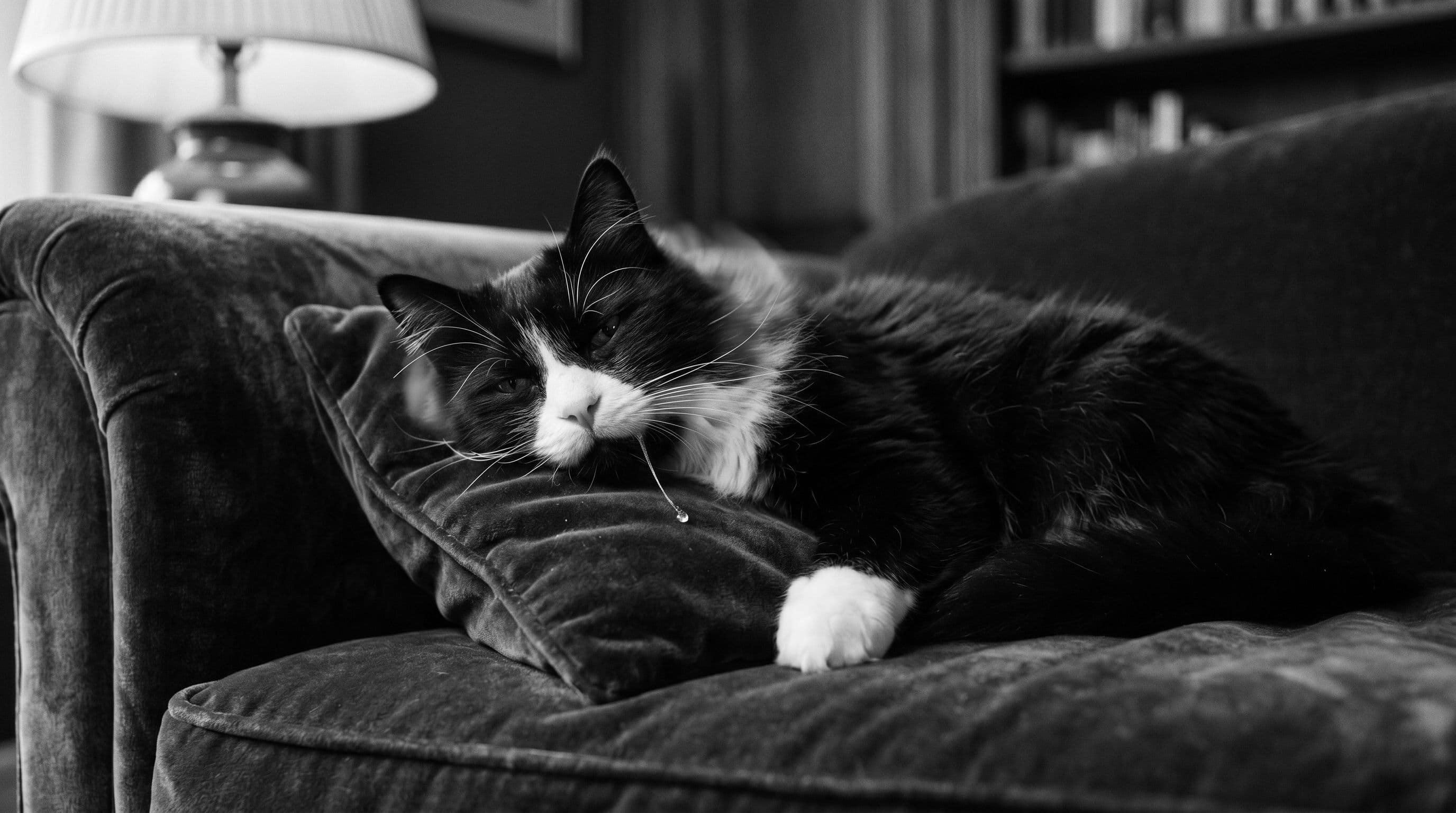
The first time Vino drooled on me, I thought something was genuinely wrong with him. Do tuxedo cats drool more than other cats? That was the panicked question I typed into Google at midnight in 2022, with a medium-long-furred tuxedo cat purring on my lap and a warm, wet spot spreading across my jeans. He'd been home from the winery in northern Tasmania for maybe a week, and I was sitting on the couch scratching the black patch under his chin when I felt it. I looked down, and there it was: a small but unmistakable puddle. He was purring so hard his whole body vibrated, eyes half-shut, and drool was just streaming from the corner of his mouth like a tap someone forgot to close. I read six contradictory articles that night and learned precisely nothing useful. That was in 2022. Vino hasn't stopped drooling since, and I've learned a great deal about why.
The "Happy Drool": What's Actually Happening
This is the angle I haven't seen anyone cover properly, and it's the one I live with every single day. Vino drools almost exclusively when he's being patted, brushed, or is sitting on someone's lap. It starts within about 90 seconds of sustained chin scratching. His purr deepens, his eyes close to slits, and then the drool begins: first a thin strand, then a steady drip.
Dr. Mikel Delgado, a certified applied animal behaviourist who completed her PhD in psychology at UC Berkeley and researched feline behaviour as a postdoc at the UC Davis School of Veterinary Medicine, co-wrote Total Cat Mojo and Play With Your Cat!, and her work has shaped how I think about the ways cats communicate comfort and discomfort. The mechanism behind drooling, though, is fairly simple. When a cat enters a deep state of relaxation, the muscles around the jaw loosen. Saliva that would normally be swallowed pools and escapes. I've watched Vino do this on my lap dozens of times, his chin slick and his eyes half shut. It's involuntary, it's harmless, and it's a sign that your cat is blissed out beyond the point of basic motor control.
I find this both endearing and revolting, sometimes within the same second.
Vino doesn't discriminate about whose lap receives this gift, either. He's claimed the laps of guests who were sitting down for no more than 30 seconds before he arrived, circled twice, and settled in. They'll be stroking his white chest, commenting on how soft his fur is, and then their hand hits the wet patch. The look on their face is always the same: a mixture of confusion and mild horror. I've stopped apologising. It happens too often for apologies to remain meaningful.
Zola, by contrast, has never drooled once in the years she's lived with us. She's a black cat with a small white patch on her belly, and she is reserved in all things, including saliva production. Where Vino will sprawl across your lap and melt into a purring puddle, Zola observes from across the room with what I can only interpret as quiet judgment. They're a useful control group, those two: same household, same diet, same water source, radically different drool output.
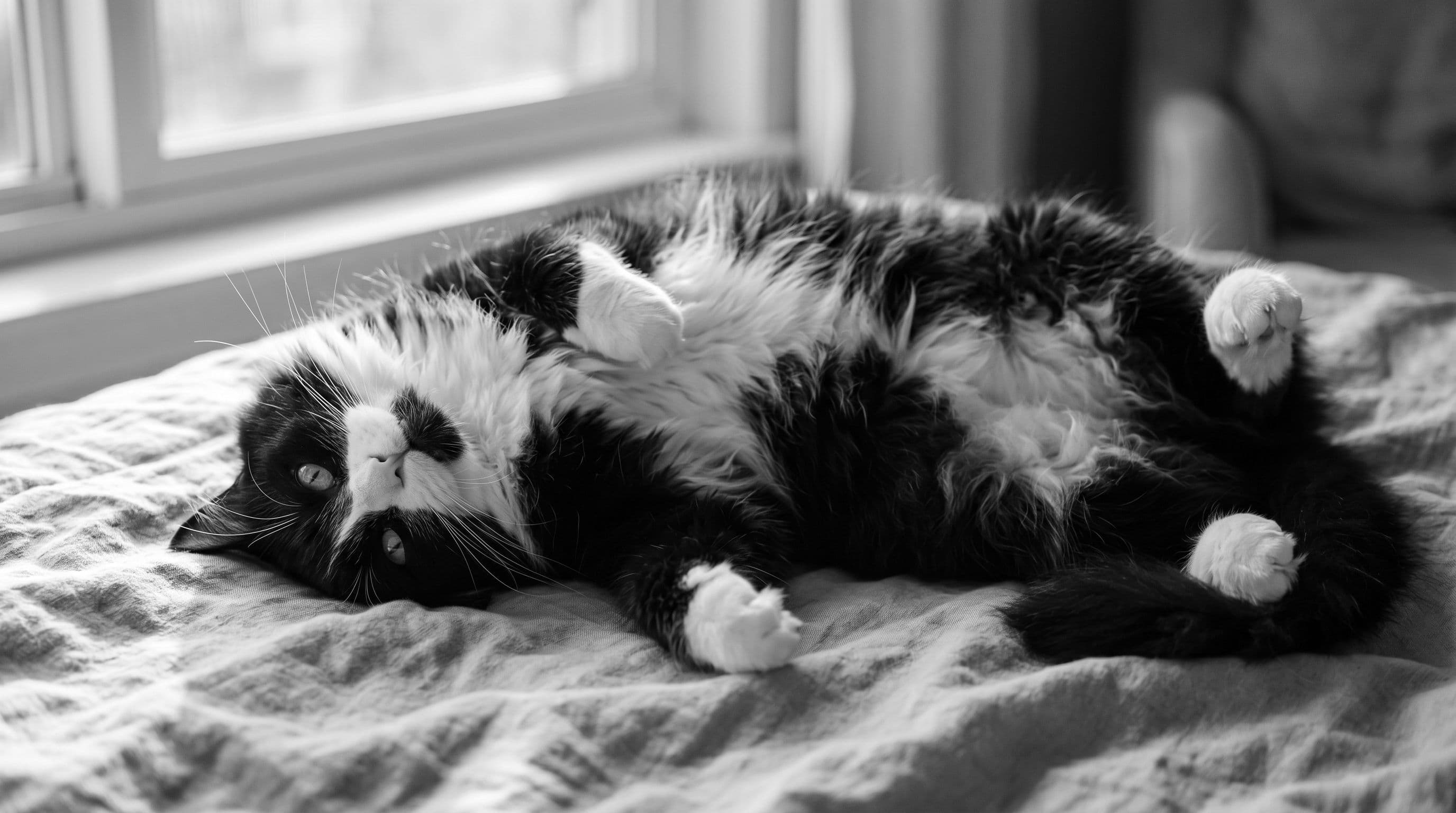
When Drooling Isn't About Happiness
I'd be doing you a disservice if I made this sound entirely charming. Not all cat drool is the happy kind, and learning to tell the difference has been one of the more important things I've picked up as a cat owner.
Excessive drooling in cats can have a medical cause: periodontal disease, oral tumours, kidney disease, upper respiratory infections, and ingestion of toxic substances are the ones that come up again and again in the veterinary guidance. A cat that suddenly starts drooling when it never did before, or one that drools outside of relaxation contexts, warrants a vet visit. Full stop.
What I lean on with Vino is consistency. His drooling pattern hasn't changed in character or frequency since I brought him home from that winery barn in northern Tasmania, and it's consistently tied to affection and relaxation. A stable, context-linked pattern is what the reassuring kind looks like; a change in that pattern is what would send us straight to the vet.
The lesson: context matters more than quantity. Vino's happy drool during a brushing session, especially when I work the stainless-steel deshedding comb through his chin and chest mane, is normal for him. Drool without an obvious trigger is worth investigating.
Drool Management: The Unglamorous Reality
Nobody writes about this part, but I'm going to, because I've earned the right through sheer laundry volume.
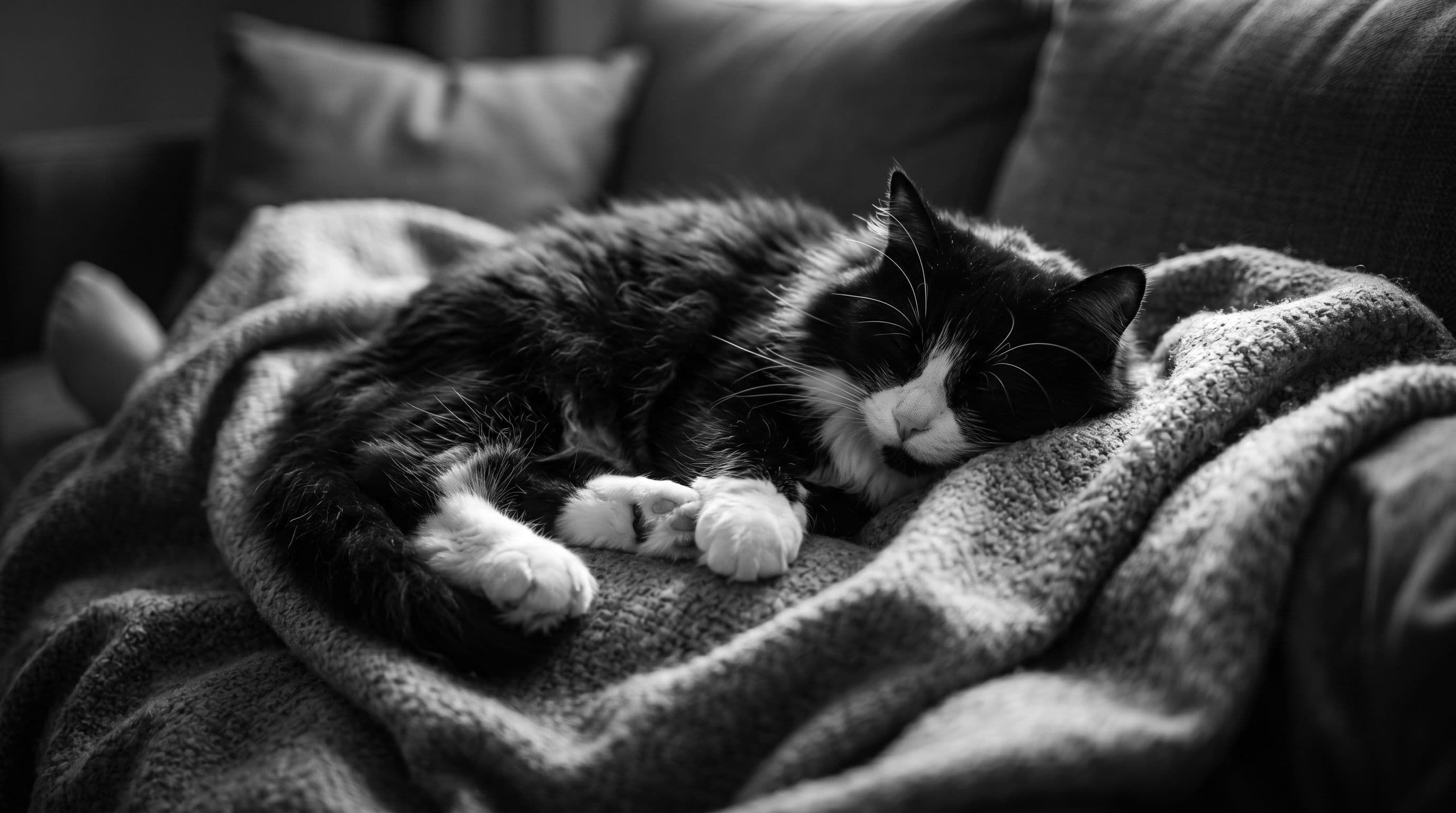
Living with a cat who drools as enthusiastically as Vino means keeping a small towel on the couch at all times. Not draped artfully over the armrest like some kind of decor choice; stuffed between the cushions where I can grab it one-handed while Vino is pinning my other arm to my lap. I've gone through three wool area rugs in the living room. The current one has a dark pattern specifically chosen to hide wet spots.
His medium-long fur complicates things. The drool doesn't just fall; it wicks into the fur around his chin and chest, creating damp clumps that then transfer to whatever surface he touches next. My fiancée has a black wool sweater she's stopped wearing around Vino entirely. Not because of the fur; that's a separate, ongoing battle. Because of the wet chin prints he leaves on her shoulder when he head-butts her for attention.
Bedtime is the main event. Vino sleeps on me. He always has. He settles on my chest or beside my pillow, and if I'm scratching behind his ears as I fall asleep, I'll wake up to a damp pillowcase. I've tried redirecting him. He responds by meowing at the bedroom door with the persistence of someone who has never once been told no and accepted it.
Stress Drooling vs. Happy Drooling: Vino's Two Modes
Here's something I haven't seen discussed in any of the top-ranking articles on this topic. Cats can drool from stress, and it looks different from the contented kind. I know this because Vino has demonstrated both, and the contrast is stark.
Happy drool: slow onset, accompanied by purring, relaxed body, kneading paws. This is daily Vino. This is Vino on my lap, Vino being brushed, Vino making biscuits on the bed at 11 p.m.
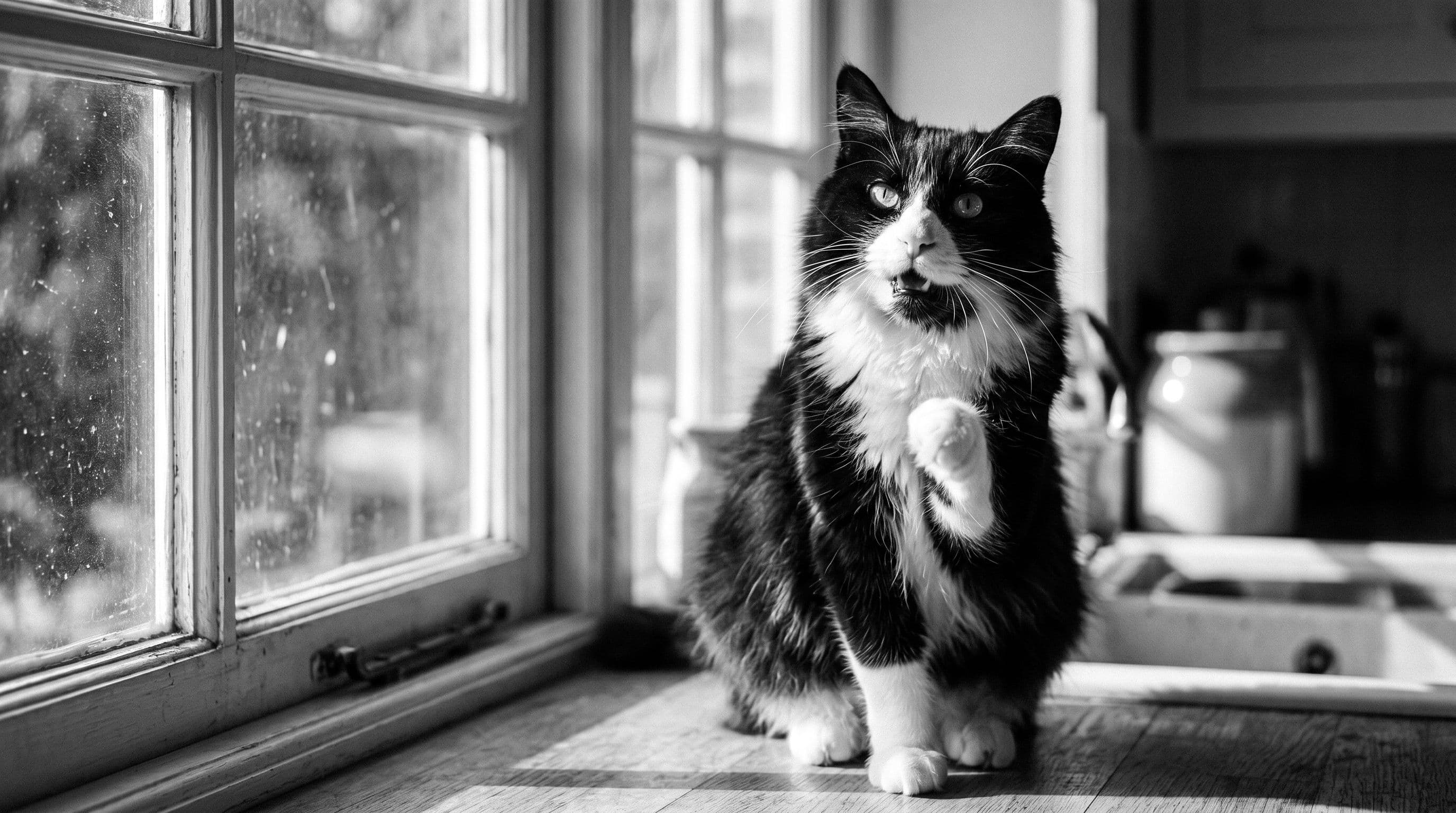
Stress drool: rapid onset, no purring, tense body, wide eyes. I've seen this exactly twice. Once during the half-bath incident, when his back legs needed cleaning after his medium-long fur caught something it shouldn't have. He growled, fought, and attempted to escape the entire time while drooling in thick, foamy strands that were nothing like his usual clear, relaxed drip. The second time was during a thunderstorm that hit at about 2 a.m., when he bolted under the bed and emerged 40 minutes later with a soaked chin and dilated pupils.
Cats don't just drool because they're happy or sick. The physiological stress response in cats can trigger excess salivation, the same kind of sympathetic nervous system activation that causes dry mouth in anxious humans, just expressed differently in our feline companions. I started paying closer attention to this one afternoon when a neighbourhood dog parked itself outside our window. Dr Mikel Delgado, a certified applied animal behaviourist who completed her PhD in psychology at UC Berkeley and researched feline behaviour as a postdoc at the UC Davis School of Veterinary Medicine, co-wrote Total Cat Mojo and Play With Your Cat!, and her work has shaped how I think about feline body language more broadly. Over time, living with Vino taught me to stop treating all drool as either cute or alarming and start reading it as communication. With Vino, context tells me everything: drool on my lap during a chin scratch means bliss, drool in the carrier on the way to the vet means something else entirely.
Zola, for the record, handles thunderstorms by calmly relocating to the top shelf of the cat tower and going to sleep. She handles the half-bath scenario by simply never requiring one. The divide between these two cats continues to astonish me.
I've got a post coming soon about Vino's relationship with water in all its forms: the drool, the excessive drinking, and the absolute fury of bath time. It's a spectrum, and he occupies every point on it simultaneously.
If you want more of Vino's particular brand of soggy charm, check out our posts on what tuxedo cats are actually like to live with and why Vino's medium-long fur creates problems I never anticipated. They're both relevant to today's topic, and significantly drier.