
Three pieces of evidence from this household suggest that cat dental care isn't the tidy, once-a-year affair most of us pretend it is. I've spent years living with Vino, a medium-long-haired tuxedo cat I brought home from a biodynamic winery in northern Tasmania, and in that time I've learned that keeping his teeth clean involves a mix of veterinary science, daily stubbornness, and a degree of patience usually reserved for hostage negotiators. What follows are three exhibits from real life: moments that changed how I think about feline oral health, each one anchored to a specific incident involving a cat who has never once made anything easy.
Before I get into it, a bit of context. Dental disease is one of the most common health problems in cats, and most show some sign of it within their first few years. That stunned me when I first read it. Vino was about two at the time, and I hadn't given his teeth a single serious thought. I'd been too busy keeping him off my keyboard, out of the chicken run, and away from the neighbour's Staffy. His mouth seemed like the one part of him that wasn't causing trouble. I was wrong.
Exhibit One: The Drool That Wasn't Just Drool
Vino drools. He drools when he's being patted, when he's making biscuits on the bed, and when he's claimed a guest's lap with the quiet confidence of someone who's never been told no. I'd always assumed this was just his thing: a quirk, like the five-second protest meow he deploys when I won't open the back door. So when the drooling increased by what felt like 30 percent over the span of about two weeks, I nearly missed it.
My fiancée noticed first. She pointed out that the wet patches on the couch cushions were larger, and that Vino seemed to be chewing his dry food on one side. That combination, a drool delta plus one-sided chewing, is exactly the pattern the veterinary guidance flags as worth a professional look: it's how gum trouble announces itself in a heavy drooler. Gingivitis and tartar (which I've since learned is also called calculus, a word that makes dental care sound like a university maths course) build quietly along the gum line, and they don't wait for you to notice.

Here's what that episode taught me: in a cat who already drools heavily, a change in drool volume is diagnostic information. Most cat dental care guides tell you to watch for bad breath, pawing at the mouth, or reluctance to eat. Those are valid signs. But if your cat is a prolific drooler like Vino, the signal is subtler. It's the delta, not the absolute. I wrote a bit about reading Vino's behavioural quirks in an earlier post, and this experience reinforced how specific you need to be when tracking what's normal for your particular cat.
Exhibit Two: The Toothbrush Standoff
After that scare, I went straight to the guidance. The American Veterinary Medical Association states that regularly brushing a pet's teeth is the single most effective thing an owner can do to keep them healthy between professional dental cleanings, and most cats show signs of periodontal disease within their first few years, so staying ahead of it seemed non-negotiable. Armed with this knowledge and a small finger brush designed for cats, I went home confident.
Vino had other plans.
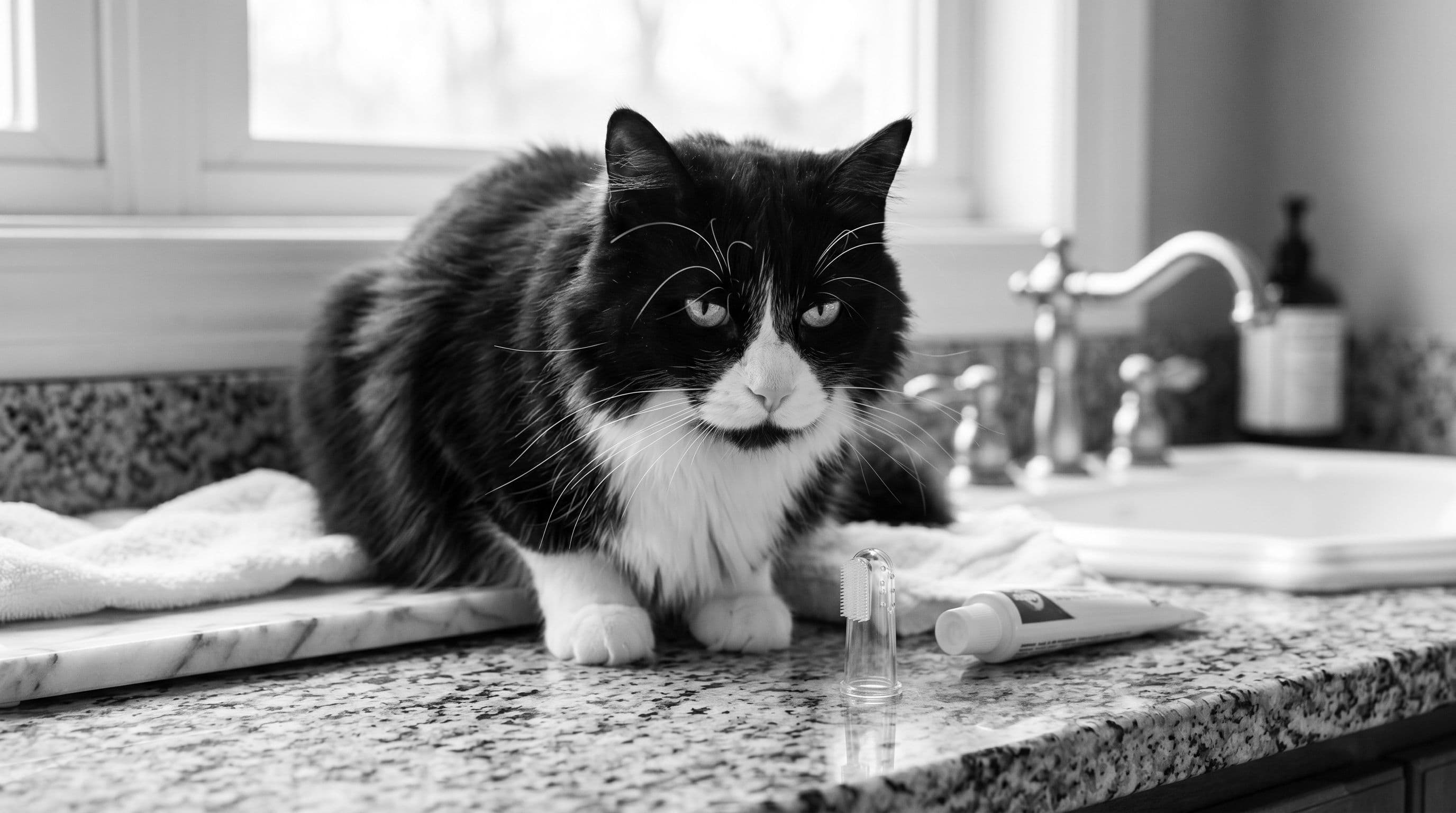
The first attempt lasted approximately eight seconds. I managed to lift his lip, touch the brush to one canine tooth, and then found myself holding a finger brush in one hand and nothing else, because Vino had launched himself off the bathroom counter and was already halfway down the hall, producing a grievance meow that could be heard from the chicken coop. Zola, who'd been sleeping on the cat tower with the serene indifference she reserves for all of Vino's crises, didn't even open her eyes.
The second attempt, two days later, went marginally better. The idea that most cats show signs of periodontal disease within their first few years lit a fire under me, and the gradual desensitisation approach I settled on was simple enough: start by letting the cat lick an enzymatic toothpaste (poultry-flavoured, because apparently that's what passes for a treat in the dental aisle), then progress to touching the gums with your finger, and only introduce the brush once the cat tolerates the finger. This protocol took me about 12 days with Vino. Twelve days of him licking poultry paste off my index finger, giving me a look that said "I'm tolerating this because the paste is acceptable, not because I respect you," and gradually allowing me to rub along his gum line.
We're now at a point where I can brush his teeth roughly four times a week. Each session lasts about 90 seconds. He doesn't enjoy it. He endures it with the resigned dignity of a cat who has also endured half-baths to remove things caught in his back-leg fur. But he sits still, mostly, and I get coverage on the outer surfaces of his teeth, which matters more than you'd think given how common dental disease is in cats.

The contrarian insight here, and the thing I haven't seen addressed in any of the top-ranking articles on this topic, is this: the emotional economics of cat dental care matter as much as the technique. If brushing becomes a fight that damages your relationship with your cat, you'll stop doing it. The twelve-day ramp-up wasn't wasted time; it was the only reason I'm still brushing Vino's teeth six months later. Compliance isn't about the brush. It's about the bond.
Exhibit Three: What a Proper Dental Check Actually Covers
The piece I can't do at home is the piece that matters most. A veterinary dental check isn't a quick glance at the front teeth; done properly, it grades the whole mouth on the veterinary dental scale (which runs from 0, perfectly clean, to 4, severe disease), and it's the only honest way to know whether the home brushing is actually working.
A thorough exam covers not just the teeth but the entire oral cavity: the tongue, the palate, the inside of the cheeks, the back molars that I can't reach with a finger brush no matter how cooperative Vino is being. Those back molars are the known blind spot of home brushing, because most owners (myself included) focus on the front teeth and canines. Dental diets and dental treats with published evidence behind them exist to cover exactly that gap, and I've added one to Vino's routine, offered once daily after his evening meal.
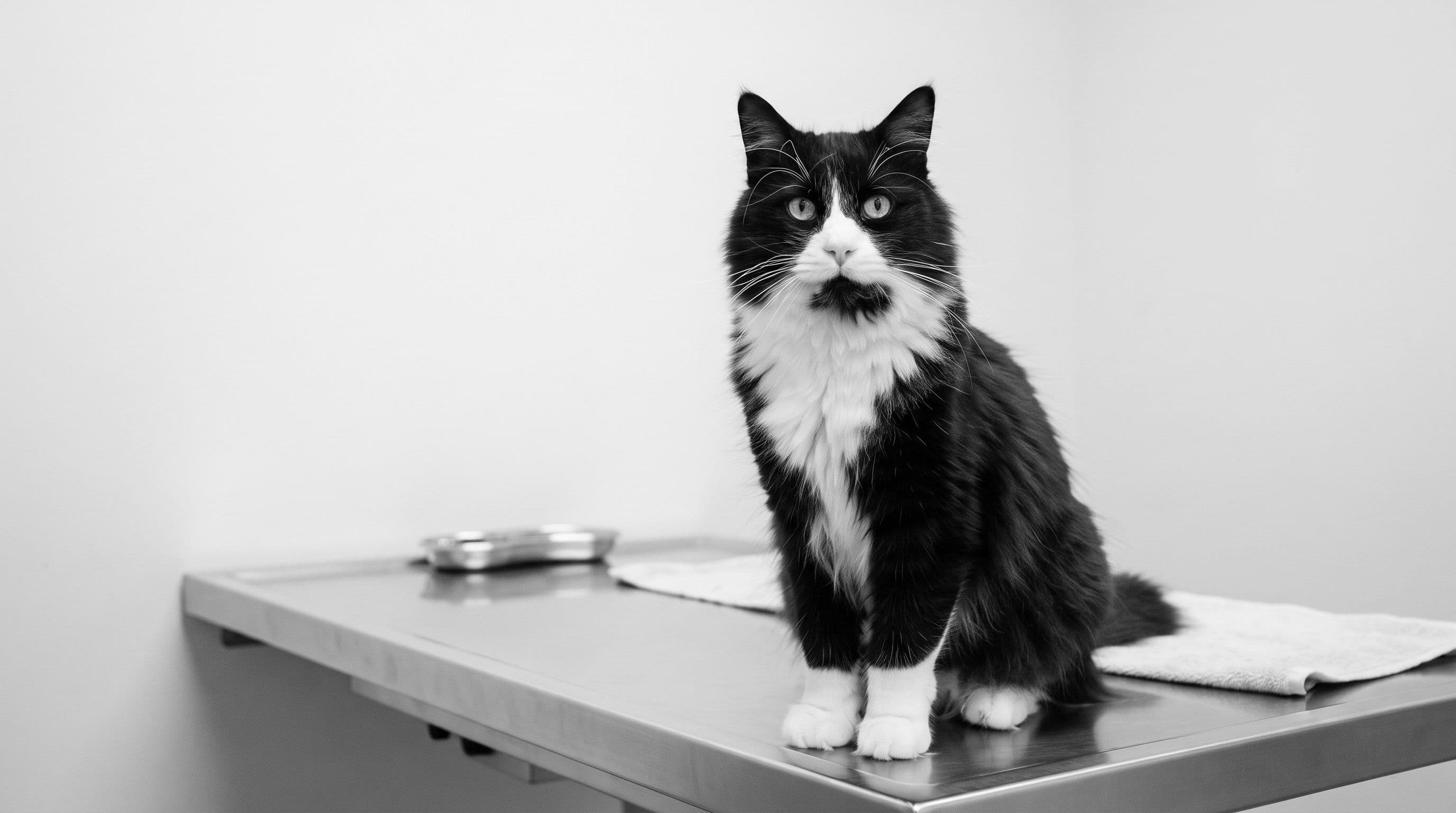
This exhibit matters because it illustrates something I think gets lost in the conversation around cat dental care: professional examinations catch what home care misses. It's easy to feel confident when the brushing is going well and the drooling is stable, while quietly neglecting the tooth surfaces you physically can't access. That's how mild plaque becomes moderate plaque, and moderate plaque becomes the sort of problem that requires anaesthesia, extraction, or both. I touched on the importance of building routines around Vino's health in a previous post, and dental checks are a non-negotiable part of that rhythm now.
What This Adds Up To
The three exhibits point to a single argument: effective cat dental care is a layered system, not a single intervention. The drool incident taught me to know my cat's baseline so well that I can detect a 30 percent deviation. The toothbrush standoff taught me that technique without patience is useless; patience without technique is just sitting there holding poultry paste. And professional exams are the layer that catches what home care misses: not an alternative to home care but its complement, each covering the other's blind spots.
Vino didn't ask for any of this. He'd prefer to spend his afternoons lying a metre from the fence, psychologically dismantling the neighbour's Staffy, or following me around the yard meowing at a volume that suggests I've personally wronged him. Dental hygiene ranks somewhere below "chasing Zola" and above "tolerating the rooster" on his list of priorities. But that's the job. He doesn't have to care about his teeth. I do.