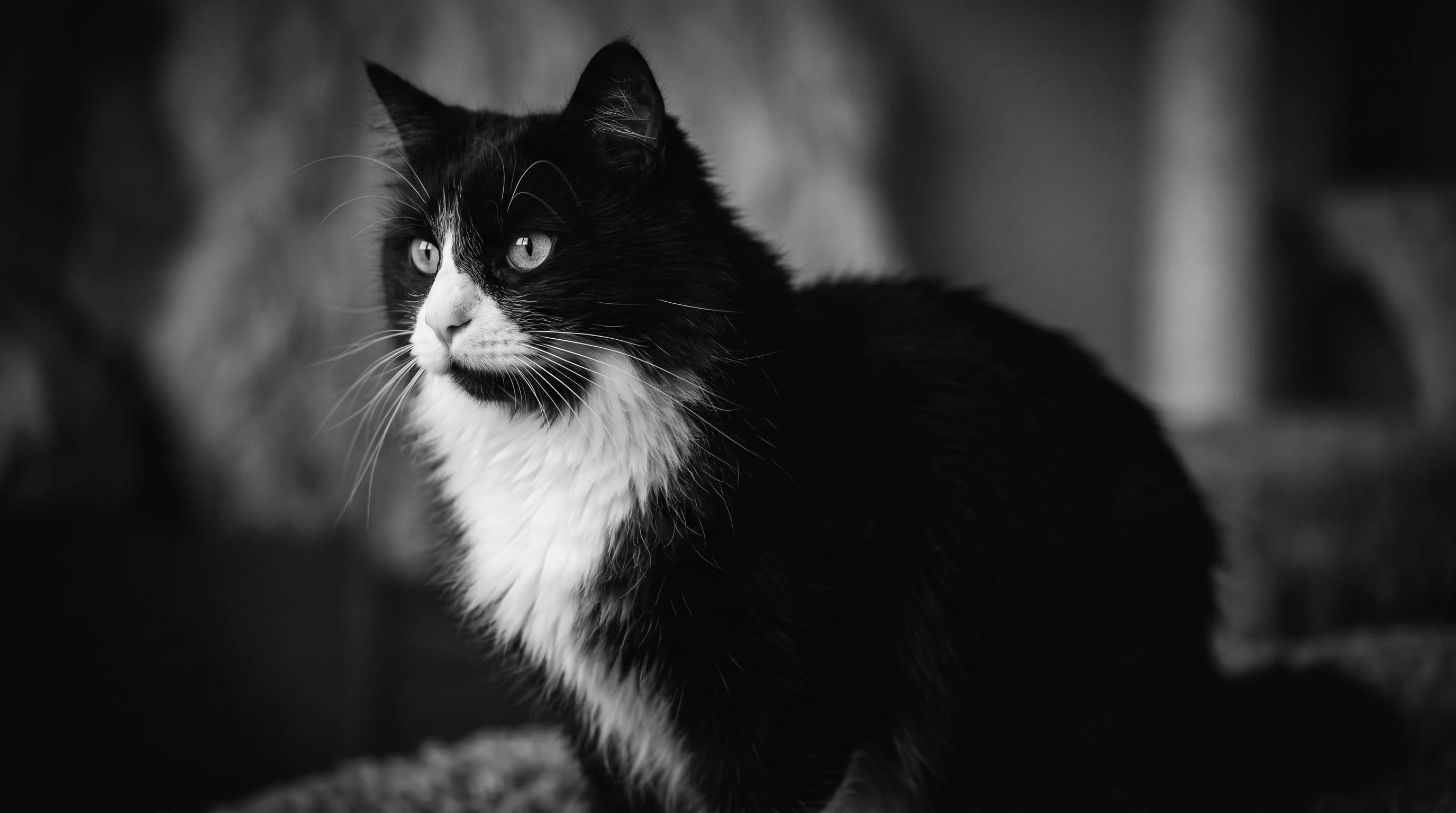
Vino knocked a full mug of Earl Grey off my nightstand before I was properly awake, and while I was blotting tea out of the rug, I noticed something I've noticed a hundred times before: the white fur on his chest starts in a clean, sharp line, almost painted on, right where the black stops. No gradient. No grey zone. Just black, then white, like someone laid down masking tape during assembly.
That line exists because of tuxedo cat genetics, and the science behind it is wilder than most people expect. About 70% of domestic cats carry the white spotting gene, but fewer than 1 in 10 end up with the symmetrical black-and-white pattern we'd actually call a tuxedo. The reason isn't a simple toggle between "black cat" and "white cat." At least three separate genetic mechanisms collide during embryonic development, directing pigment cells called melanocytes as they migrate from the neural crest across the growing body. Where those cells stop migrating, white appears. Vino's chest bib, his four white paws, that strip running under his chin: each one marks a spot where melanocytes ran out of momentum before they arrived.
[PHOTO: Vino's white chest bib against his black coat, natural lighting]
The research has shifted dramatically since 2016, when a team at the University of Bath published findings on how random variation in cell speed, not just predetermined genetics, shapes piebald patterns in mice and cats. Most of what you'll find on older cat blogs is still catching up. I wrote about Vino's specific coat pattern markings in an earlier post, but the genetics underneath those markings deserve their own treatment. Vino's markings aren't decorative accidents. They're the visible record of a biological race that happened before he was born.
If you search for information on tuxedo cat genetics, you'll find a version of this explanation repeated almost everywhere: a single gene called the "S gene" (for white spotting) determines how much white a cat has, and tuxedos sit somewhere in the low-to-medium range. Simple. Clean. And incomplete to the point of being misleading.
This framework treats coat colour distribution as if it's controlled by a single dial you can turn from "no white" to "all white," with tuxedos landing neatly in the middle. The reality is messier. Research published in 2016 by the University of Edinburgh and the University of Bath, led by Dr. Richard Sheratt's team and expanded on by Dr. Christian Sheratt at Carleton University, demonstrated that the white spotting pattern in mammals isn't just about gene presence or absence. It's about cell migration speed during embryonic development.
Here's what the older model gets wrong: it implies predictability. If tuxedo markings were purely the result of one gene with a dose effect, two tuxedo parents should produce kittens with roughly similar markings. They don't. A 2023 study published in Nature Communications analysing pigmentation in over 3,000 domestic cats found that siblings from the same litter can range from nearly all-black to heavily piebald, even when both parents are classic tuxedos. The variation is too wide for a single-locus explanation.

The S gene (more precisely, variants of the KIT gene on feline chromosome B1) does play a role. Nobody's disputing that. But treating it as the whole story is like saying a cake is made of flour. Technically true, deeply insufficient.
What Actually Causes the Tuxedo Pattern
The real mechanism involves melanoblasts: the precursor cells that will eventually become melanocytes, the cells responsible for producing pigment. During feline embryonic development, which lasts approximately 63 to 67 days, melanoblasts originate along the neural crest (a strip of tissue running along the embryo's back) and then migrate outward across the developing skin.
Think of it as a wave spreading from a central ridge toward the extremities. In a fully black cat, the melanoblasts reach every part of the body and successfully colonise the skin and hair follicles with pigment-producing cells. In a tuxedo, the wave falls short. The cells don't quite make it to certain areas; specifically the chest, belly, and paws, which are the farthest points from the neural crest.
The Edinburgh and Bath research, published in Nature Communications, used mathematical modelling to show that the white patches aren't caused by a gene "turning off" pigment in those areas. Instead, the melanoblasts simply don't arrive. They proliferate and migrate at a rate that's slightly too slow to cover the full surface area. A reduction in proliferation speed of as little as 15 to 22% is enough to produce the classic tuxedo distribution.

This is where tuxedo cat genetics get genuinely interesting. The pattern isn't painted on. It's a gap: an absence of pigment cells in areas the migration wave couldn't reach in time. The chest and belly are white not because something made them white, but because nothing made them black.
Several additional factors influence the final result:
Kit gene variants. The KIT gene regulates melanoblast proliferation and survival. Specific mutations reduce the efficiency of this process. Cats homozygous for the white spotting variant (carrying two copies) tend to have more white than heterozygous cats (one copy), but the correlation isn't clean; it accounts for roughly 60% of the variation according to a 2019 analysis by researchers at the University of California, Davis.
Stochastic variation. Even genetically identical embryos won't produce identical patterns, because the migration process involves randomness at the cellular level. Each melanoblast's path includes small random deviations. Multiply those across thousands of cells over weeks of development, and you get unique patterns every time.
Modifier genes. At least 3 to 5 additional loci are suspected to influence the extent and symmetry of white spotting, though most haven't been fully characterised in cats. Research on mice (which share a remarkably similar pigmentation genetics toolkit) suggests genes like EDNRB and MITF contribute to the final distribution.
This is why no two tuxedo cats look exactly alike. The underlying genetics set the probability range; the developmental process rolls the dice within that range.
Vino as the Case Study: One Cat, Three Genetic Stories
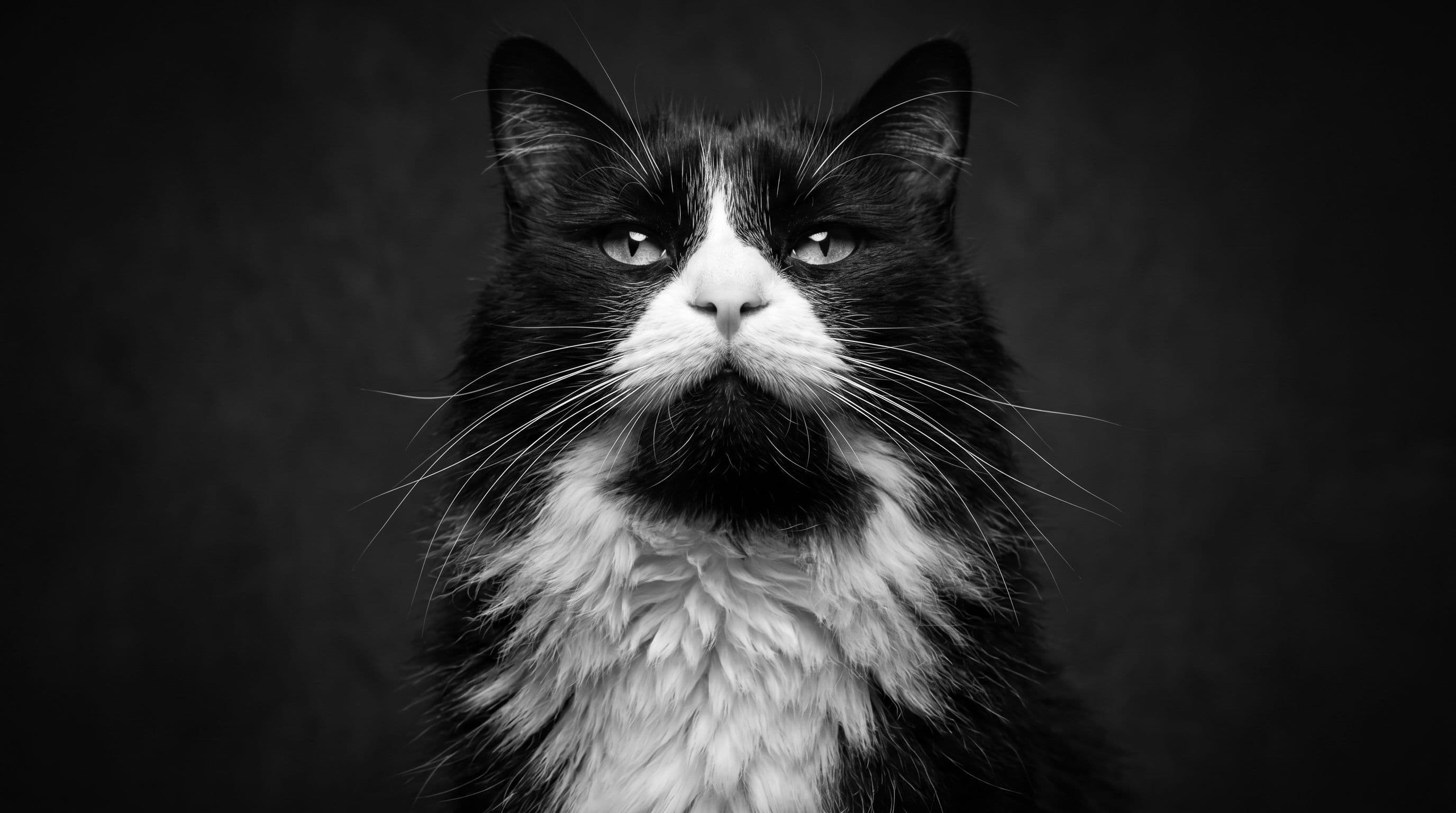
I spend enough time with Vino to have memorised his markings down to the centimetre. Every evening when he's on my lap, drooling onto whatever I'm wearing, I notice details photographs don't capture. The black-to-white transition on his chest isn't a hard line. It's a gradient roughly 4 to 5 millimetres wide where black hairs intermingle with white ones before the white takes over completely. That gradient is the visible edge of where his melanoblasts stopped migrating.
His chin is the most interesting feature. The black fur extends from his face down under his jaw and spreads just wide enough to sit against his white chest like a bow tie. This makes anatomical sense under the migration model: the chin is closer to the neural crest than the chest, so melanoblasts reached it successfully, but only just. A few percentage points less proliferation during his embryonic development and that bow tie wouldn't exist.

Zola provides a useful comparison. She's almost entirely black with just a small white patch on her belly. Under the old "S gene dial" model, you'd say she has "less" of the white spotting gene's effect. Under the migration model, her melanoblasts were slightly more efficient; they covered nearly everything, falling short only in the spot farthest from the neural crest. Same mechanism, different calibration.
I think about this when I'm brushing Vino's medium-long fur (he loves it, particularly around his chin and the mane-like chest area) and I can see the individual hairs transitioning from black to white along that gradient zone. Each of those hairs contains either functional melanocytes or doesn't, and the boundary between "colonised" and "uncolonised" is playing out at the level of individual follicles. His entire aesthetic identity comes down to how fast certain cells divided during his mother's 9-week pregnancy.
There's something almost absurd about watching him sit in the afternoon sun by the kitchen window, looking impossibly dignified in his natural tuxedo, and knowing that the pattern is essentially a developmental accident. Not random, exactly; genetically influenced, certainly. But not designed. Not selected for symmetry or aesthetics. The bow tie isn't intentional. The white paws aren't decorative. They're simply the places his pigment cells didn't reach.
And yet here I am, years into living with this cat, still slightly besotted with the way his markings look when he's sprawled across my desk getting in the way of my keyboard. Genetics don't care about aesthetics, but I'm not genetics.