
Vino was stretched across my desk last Tuesday morning, one white paw pinning down a stack of invoices I needed, his green eyes half-closed in that performative indifference he's perfected over the years. His black coat caught the light from the window behind him, and the white bib on his chest looked almost theatrical: a tuxedo pattern so crisp it borders on costume. I'd been reading through breed registries and genetics papers the night before, trying to answer a question that kept surfacing in our inbox. How rare are tuxedo cats, really? Staring at Vino, I realized I'd been living with the answer without bothering to look it up.
The "Perfect Tuxedo" Problem: Why Vino's Pattern Is Unusual Even If Tuxedo Cats Aren't
Most tuxedo cats don't look like they're wearing a tuxedo. They look like they got splashed with white paint during a renovation. Lopsided chest patches, random white splotches on the face, asymmetrical abstract piebald configurations that are technically bicolour but aesthetically chaotic: that's the norm. White spotting genes express with significant randomness during embryonic development, which is why even siblings from the same litter can look wildly different.
Vino's pattern, by contrast, is remarkably even. His black chin bleeds down into the white chest and genuinely resembles a bow tie. The white on his paws is symmetrical. The black on his back is unbroken. I'm not claiming he's show-quality; the Cat Fanciers' Association wouldn't know what to do with a vineyard mouser who drools on guests. But in terms of pattern clarity, he's in a minority within a common group.
Dr. Leslie Lyons, the Gilbreath-McLorn Endowed Professor of Comparative Medicine at the University of Missouri and one of the leading feline geneticists, works on the genetics of coat traits including the variable degree of white spotting. What we know from white-spotting gene research is that the gene itself is incompletely dominant, so one copy gives a typical bicolour tuxedo, two copies give a mostly-white or van-patterned cat, and the exact placement of white varies even between littermates. A "clean" tuxedo pattern with distinct boundaries between black and white represents a particular sweet spot in that inheritance, and I can tell you from living with Vino that the effect is genuinely arresting. It's common enough that you'll encounter it, but uncommon enough that when you do, the contrast hits you like a well-tailored dinner jacket on a creature who couldn't care less about your admiration.
I think this is the real answer to the rarity question. Tuxedo cats as a category aren't rare. Tuxedo cats with a pattern that actually earns the name sit in a smaller subset. And tuxedo cats with Vino's specific combination of medium-long fur, green-gold eyes, and a near-symmetrical pattern? I haven't found reliable data on that intersection, but anecdotally, in years of running this account, I've seen maybe a dozen that come close.
Zola, for what it's worth, is almost entirely black with a small white patch on her belly. She's technically bicolour. Nobody has ever called her a tuxedo cat. She doesn't seem to mind.

What Shelters and Rescues Won't Tell You About Tuxedo Cat Adoption Rates
Here's an angle I haven't seen addressed anywhere in the top-ranking articles on this topic, and it matters if you're thinking about adopting. Tuxedo cats sit in an odd position in shelter dynamics. They aren't rare enough to generate the "exotic" appeal that drives fast adoptions for breeds like Russian Blues or Bengals. But they aren't plain enough to suffer from "black cat syndrome," the well-documented phenomenon where solid black cats get overlooked and linger in shelters significantly longer than lighter-coloured cats, something I've witnessed firsthand volunteering at our local rescue where Vino's half-siblings sat in kennels for weeks after the tabby kittens had already found homes.
Tuxedo cats fall in between. That white chest patch is just enough visual contrast to catch an adopter's eye. I've talked to volunteers at Cat Protection Society of NSW who confirm this: tuxedo-patterned cats tend to move through adoption faster than solid blacks but slower than tabbies or calicos. They're the middle children of the shelter world.
This has a practical implication. If you're looking specifically for a tuxedo cat, shelters are your best bet precisely because the pattern is common. You won't need to hunt. You will, however, need to look past the marketing photos. Most shelter cats are photographed under fluorescent lighting in stainless steel cages, which makes every cat look like it's having the worst day of its life. Vino, photographed in the winery barn where I first met him, would have looked like a different animal than Vino photographed in a shelter intake room.
My specific advice: visit in person. Sit on the floor. Let the cats come to you. Vino selected me by walking between my legs and tripping me repeatedly in a barn; your tuxedo cat will probably be less aggressive about it, but the principle holds. The cat who wants your attention is the cat you should be paying attention to.
Beyond the Coat: What Actually Makes a Tuxedo Cat Different to Live With
I want to be careful here because the internet is saturated with claims about "tuxedo cat personality traits" that have zero scientific backing. You'll read that tuxedo cats are smarter, more affectionate, or more dog-like than other cats. There's no peer-reviewed evidence for any of this. The coat pattern is determined by pigment genes. Personality is shaped by early socialization, individual temperament, breed tendencies if any breed is identifiable, and environment.
That said, I live with one, and I can tell you what Vino is actually like.
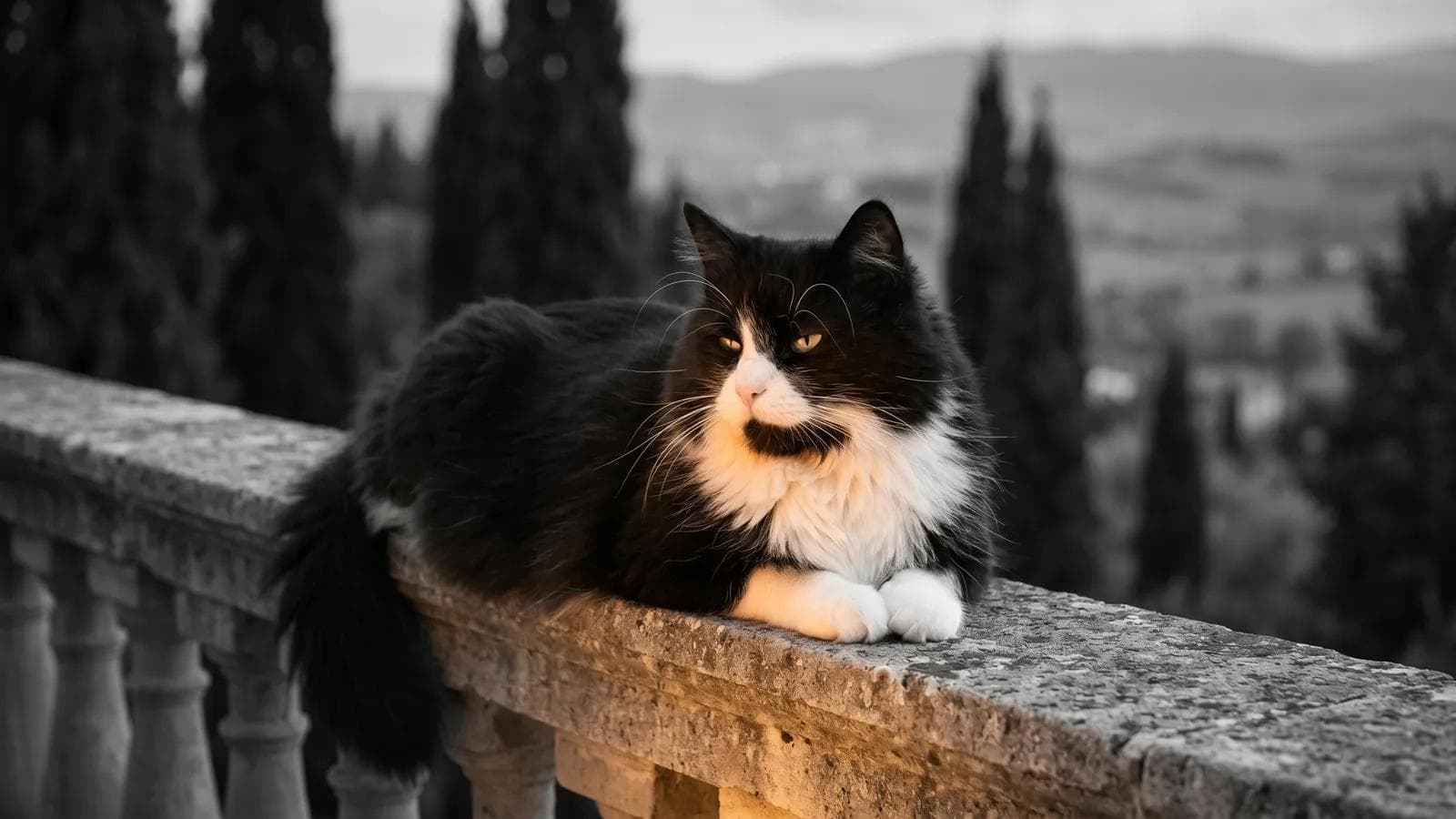
He's loud. Not occasionally vocal; loud as a default state. He meows when he wants food, when he wants outside, when he wants attention, when he's been given all three and simply has more opinions to express. His protest meow, a single sustained note held for five seconds or longer, is not a request. It's a formal objection entered into the household record.
He drools during cuddles. Extensively. He follows me around the same way he followed me around that winery barn before I brought him home. He claims the laps of guests he's barely met. He gets on my desk and sits on whatever I'm working on, which is exactly what he was doing when I started researching this article.
Is any of this because he's a tuxedo cat? Almost certainly not. It's because he's Vino. The coat pattern is a visual fact. The personality underneath it is entirely its own thing, shaped by two years on a Tasmanian vineyard, an elderly man who apparently called him "Messiah" before I ever met him, and whatever internal wiring makes a cat decide that every human interaction is an opportunity to insert himself directly into the centre of it.
If you're adopting based on coat pattern alone, you'll get a good-looking cat. If you're adopting based on connection, you might get a good-looking cat who also ruins your productivity, soaks your shirt with drool, and makes you write 1,800-word blog posts about him at 11 p.m. on a weeknight.
Vino is still on my desk as I finish this. He's shifted positions; one white paw now rests on my keyboard, and he's been intermittently pressing the letter "j" for the last ten minutes. Zola is asleep on the cat tower behind me, a black comma curled into the top perch. The rooster outside has been quiet since noon, which means Vino hasn't had anyone to compete with on the volume front. He's compensating. He just looked at me and produced a single, declarative meow: not a question, not a request. A statement that he's here, he's been here the whole time, and he doesn't particularly care whether his coat pattern is rare or common. He'd be exactly this insufferable in any colour.