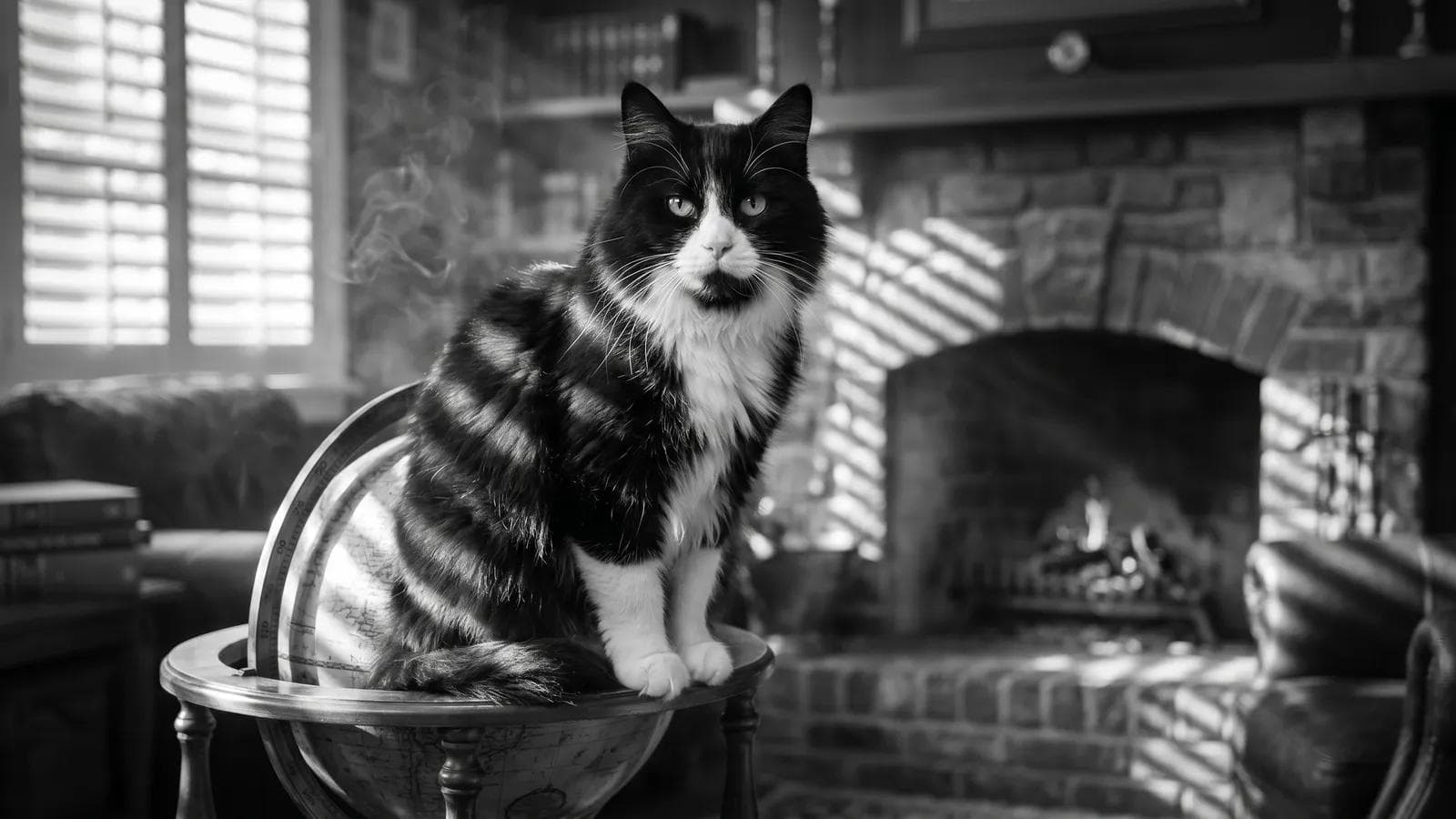
The answer is no. Tuxedo cats are not a breed. The black-and-white coat pattern that makes them instantly recognisable is produced by a gene, not by selective breeding of a specific lineage. That gene appears across dozens of different cat breeds and in mixed-breed cats with equal regularity. Vino, who arrived from a winery barn in northern Tasmania without a pedigree in sight, is as much a tuxedo cat as any show-quality British Shorthair wearing the same markings. The pattern defines the category. The paperwork does not.
I get asked this constantly. People stop at our gate, spot the white chest and socked paws, and immediately try to classify what they're looking at. They are not wrong to try. Tuxedo cats are so visually consistent, so immediately recognisable in their formal attire, that they look like a breed. The uniformity is almost suspiciously reliable. Two tuxedo cats from different continents, different bloodlines, different barns: they look like they share a tailor.
They do not. What they share is a gene.
What Actually Creates the Tuxedo Pattern?
The tuxedo coat is produced by a gene that controls white spotting, specifically one affecting the migration of pigment-producing cells during embryonic development. In cats carrying this gene, those cells fail to reach certain areas of the body during fetal development, leaving patches of white where the pigment never arrived.
The affected areas follow a consistent logic. Pigment cells migrate outward and downward from the spine. The extremities are the last destinations: the chest, paws, belly, and chin. In a cat with moderate expression of the white spotting gene, those are exactly the areas that end up white. The back and head stay dark. The chest and paws go white. The line between them is the tuxedo.
The gene's expression exists on a spectrum. Low expression produces a small white patch on the chest and nothing else. Higher expression spreads white further down the body. Very high expression approaches what breeders call a harlequin or van pattern, a mostly white body with colour only on the head and tail. Classic tuxedo markings sit in the middle range: enough white to read as formal, not so much that the dark base coat loses its authority.
Vino sits at the more defined end of that range. His chest, belly, and paws are white. The black extends to his chin, then drops to a point against the white chest: a natural bow tie that looks deliberate, as though the pattern had intentions. His eyes are green with a slight yellow hue. His coat is medium-long, not extreme but noticeably more substantial than a shorthair. Nothing about the markings is ambiguous.
Which Cat Breeds Carry the Tuxedo Pattern?
Because the white spotting gene is not exclusive to any one breed, tuxedo markings appear across the entire domestic cat population. Breeds documented to carry the pattern include the Maine Coon, the British Shorthair, the American Shorthair, the Norwegian Forest Cat, the Persian, the Ragamuffin, the Turkish Van, and the Manx, among others. Mixed-breed cats carry it in substantial numbers.
This is what surprises people. When they see a tuxedo cat, they are seeing the gene expressed. They are not seeing a breed. The Maine Coon tuxedo will be large and heavily furred and will need daily brushing. The British Shorthair tuxedo will be stocky, calm, and plush. The Persian tuxedo will be high-maintenance and demanding of grooming time. What they share is the coat pattern. Nearly everything else is determined by the breed underneath it.
With mixed-breed tuxedo cats, the calculus is different. There is no breed underneath to predict from. Vino is a mixed cat: no pedigree, no recorded lineage, no certifiable ancestry. He came from a winery barn where catching mice was the relevant qualification, not papers. What he brought to the household was the pattern, the personality, and whatever combination of genetics produced both. The tuxedo gene gave him the coat. The rest arrived separately and at considerable volume.
Does Tuxedo Describe Personality as Well as Coat?
This is what people are actually asking, even when they phrase it as a breed question. They want to know what a tuxedo cat is like to live with. The honest answer is that the coat pattern does not determine temperament. Breed does, for pedigree cats. Individual genetics and background do, for mixed cats.
What tuxedo cat owners consistently describe, and there are enough of them to constitute a pattern of observation, is something that tracks loosely with social confidence. Tuxedo cats, in sufficient numbers, seem to read rooms well. They tend toward presence over shyness. They arrive and make themselves apparent. Whether this is a genuine genetic correlation or an artefact of how common the pattern is in mixed-breed populations, meaning the full range of confident and sociable cats happen to show up wearing tuxedos because the gene is everywhere, is not a settled question.
What is settled: Vino has a specific character that is not reducible to coat pattern. He escorts visitors from the gate to the house. He does not wait to be invited. In the winery barn where he spent the first years of his life, he developed a protocol for greeting me when I came to collect things: walk between the legs to create a tripping hazard, jump onto whatever was being reached for, and demand attention until it was provided. He did not grow out of this approach. He carried it home and continued to deploy it in the yard, on the desk, and anywhere else someone was attempting to do something without consulting him first.
This is either a tuxedo cat trait or a Vino trait. The evidence points firmly toward the latter.
What the Winery Already Knew
Vino's origin story contains no pedigree documentation. He was living on a biodynamic vineyard in northern Tasmania when I first encountered him. The vineyard had been founded roughly forty years earlier by an elderly couple. The grandfather had passed away two weeks before I arrived to work there. Vino had belonged to him.
The family had been calling him Messiah. My partner suggested Vino, the vineyard connection being obvious. The full name settled on Viniferous "The Mischievous" Messiah: part vineyard etymology, part honest assessment of character, part tribute to the founder who had owned him. That founder, by all accounts, had a similarly lively personality. Two people who knew the same cat had arrived at the same conclusion from opposite directions.
The pedigree registries have no record of any of this. Vino is not enrolled in them. His coat remains impeccable. His character has not been diminished by the absence of documentation.
Famous Tuxedo Cats and the Breed They Were Not
The most recognisable tuxedo cats in popular culture carry no breed documentation either. Felix the Cat, who has appeared in cartoons since the 1920s, is a stylised tuxedo pattern. Sylvester, of Looney Tunes, the same. Socks, who lived in the Clinton White House from 1993 to 2001, was a mixed-breed domestic shorthair. Tuxedo Stan, who ran in Halifax's 2012 mayoral election on an animal welfare platform and received several thousand write-in votes, was a mixed-breed cat with no documented pedigree and considerable public presence.
What these cats share with Vino is the pattern, the visibility that accompanies it, and the quality of being memorable for reasons that have nothing to do with lineage. Sylvester is not famous for being formally dressed. Socks was not noted for his ancestry. Vino does not receive guests at the gate because he is wearing white paws.
The coat is the first thing visitors see. It is not the last thing they remember.
Vino was found in a barn. He was not waiting to be chosen. He had already decided the arrangement and was simply waiting for me to catch up with the situation. Some cats audit the process. Vino expedited it.
What Makes Something a Breed, Officially
Cat registries like The International Cat Association and the Cat Fanciers' Association define a breed by a written standard: a specific, documented set of physical traits, a closed or controlled breeding population, and generations of predictable inheritance verified through pedigree records. A breed is a lineage with paperwork behind it. A colour or pattern, by contrast, is just one visible trait that can show up inside dozens of different lineages, or in no lineage at all.
Tuxedo sits firmly in the second category, alongside terms like tabby, calico, and tortoiseshell. None of those are breeds either. They're coat descriptions that ride on top of whatever breed, or absence of breed, the cat actually has. A calico can be a Persian or a completely undocumented mixed-breed cat from a barn. So can a tuxedo. The registries have no tuxedo standard to submit a cat against, because there's nothing to standardise: the white spotting gene doesn't care what breed it's expressed in.
Vino makes the point better than any registry document could. He shares a house with Zola, who is solid black except for a small white patch on her tummy, more evidence that the white spotting gene reached her too, just barely, and stopped almost before it started. Same household, same general genetic lottery in play, two completely different results. If tuxedo were a breed, that kind of variation within one home, between two cats with no documented relation to each other beyond living under the same roof, wouldn't happen. Coat pattern doesn't work like breed inheritance. It's a single gene doing its own thing, mostly independent of everything else going on in the pedigree, or in Vino's case, the complete absence of one.
This matters practically, not just semantically. Someone hoping to predict temperament, size, or grooming needs from the word "tuxedo" alone is asking the coat pattern to do a job it was never built for. A tuxedo Maine Coon and a tuxedo domestic shorthair from a vineyard barn will diverge wildly in size, coat maintenance, and probably temperament, because the breed, or lack of one, underneath the pattern is doing that work, not the black-and-white markings sitting on top of it. Vino's coat tells you what he looks like. It has never told you anything reliable about who he is.