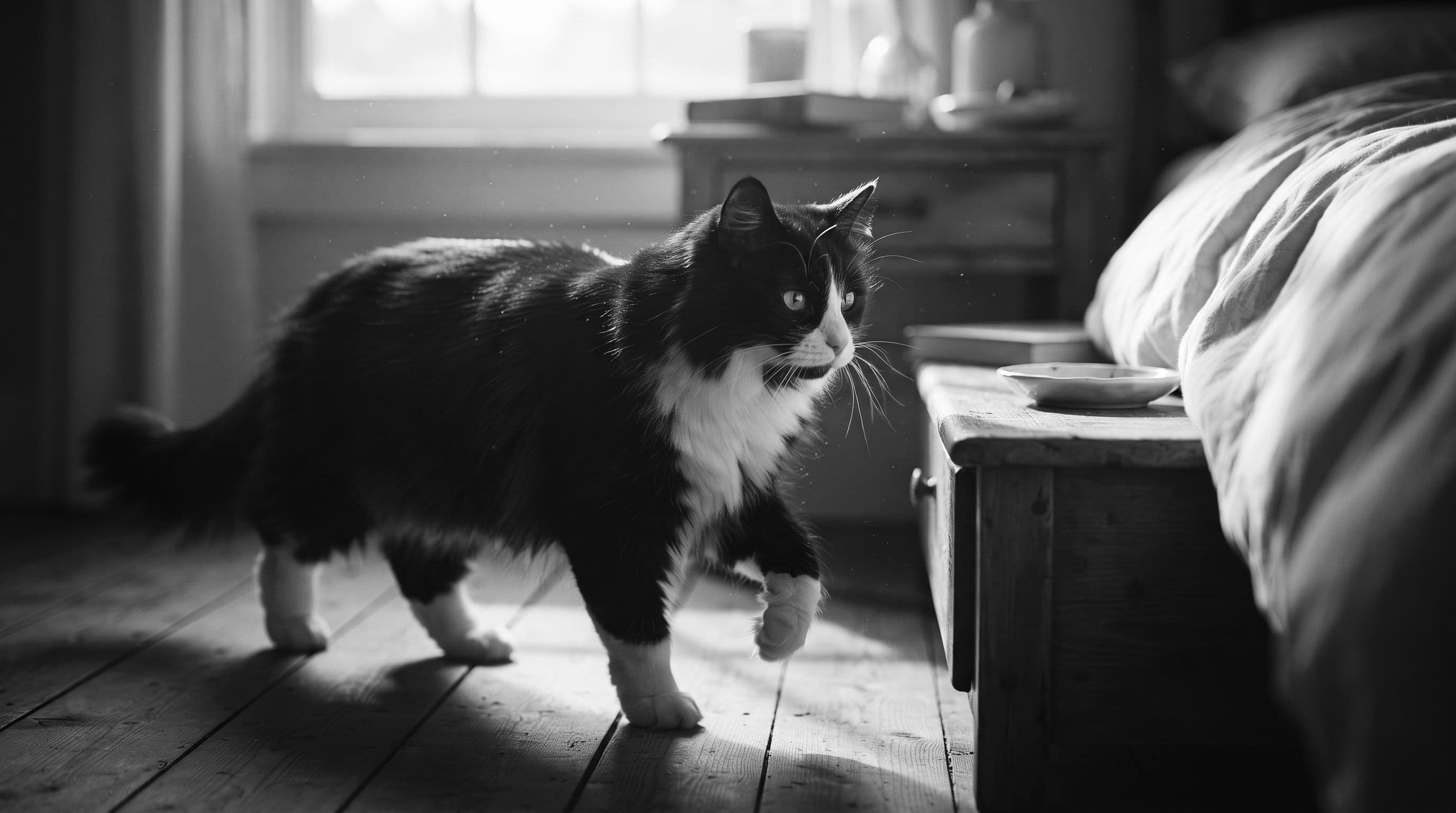
The rooster at that old rural place had a reliable trigger: first light, and he'd announce it without fail. A moment later, Vino would start his own campaign from my bedside table, meowing for his breakfast. He waited for the rooster, but he never waited long. That same sense of timing showed up elsewhere at that house, including his relationship with the neighbour's dog. This particular tuxedo cat and dogs story is about the Staffy that lived next door to that house.
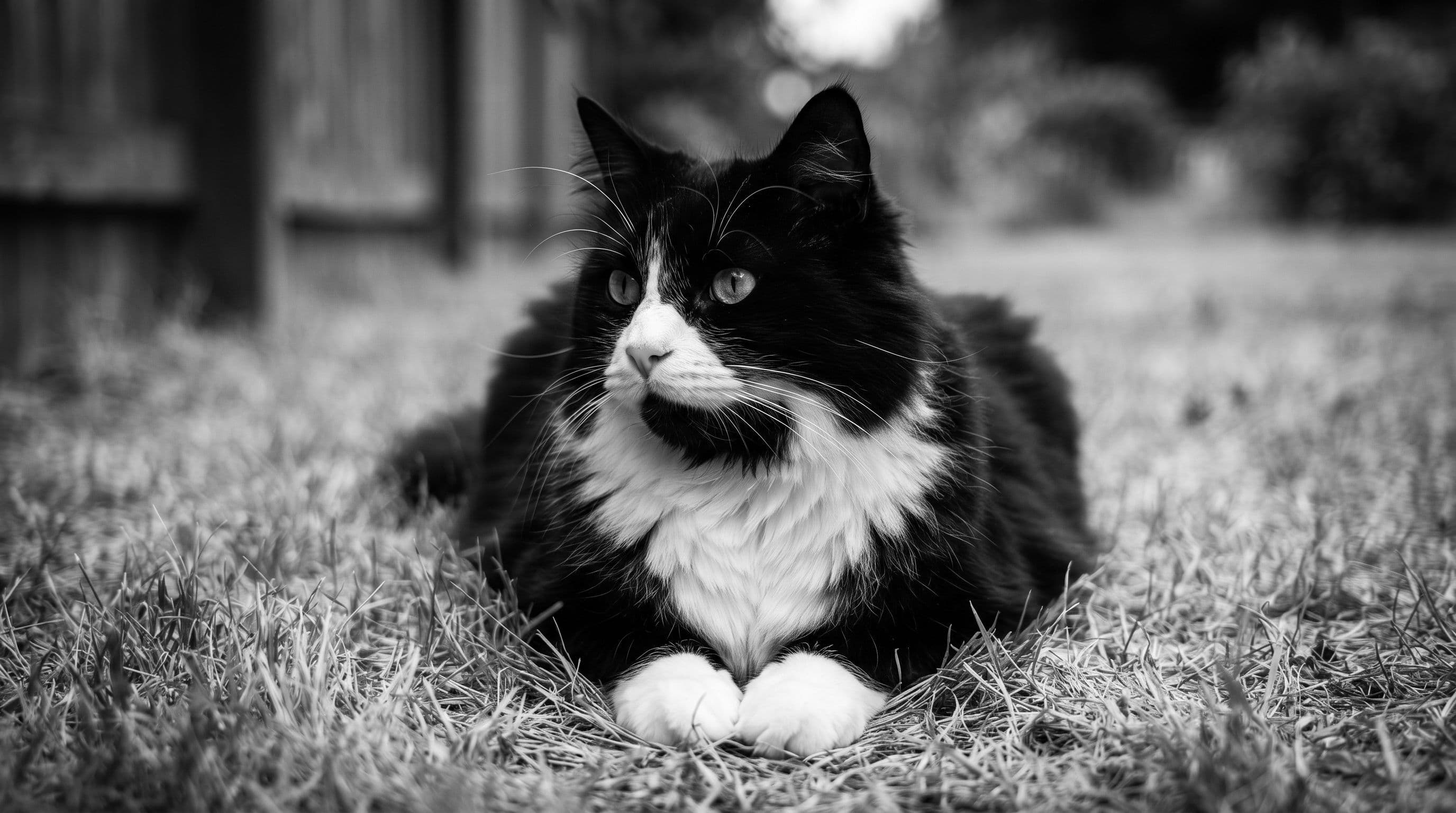
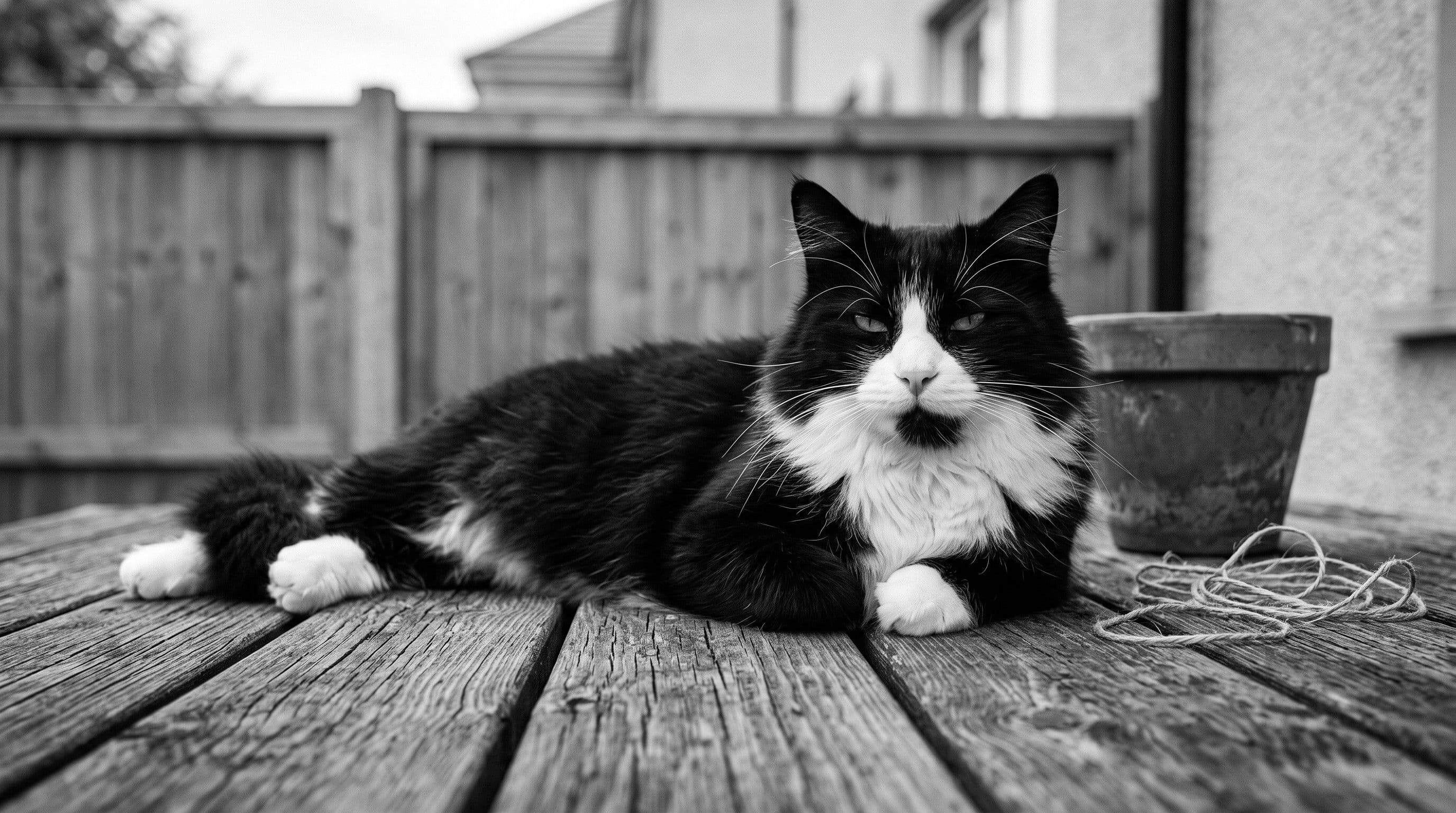
Most cats, I suspect, would have responded to a dog on the other side of the fence with avoidance, or the occasional arched-back patrol at a safe distance. Vino chose a different strategy entirely. He'd lie down roughly a metre from the fence, white chest and black bow-tie chin on full display, and stare into the middle distance as though the dog simply did not exist. The Staffy lost its mind. Vino did not flinch. He did not turn his head. He did not, under any circumstances, acknowledge that the dog was there.
This was not fear. I've seen Vino wary: the rooster at that same house intimidated him a little, and he'd find high ground where the bird couldn't easily reach him. With the Staffy he simply didn't react, and the not reacting was the provocation. I've had cats my whole life, and I've never seen one take on a dog with this particular flavour of passive aggression. Most standoffs I've watched between animals run on some version of threat assessment: who's bigger, who's faster, who has the better ground. Vino removed himself from that entirely. He declined to participate.
The Staffy could see him perfectly well. That was the point. Vino wasn't hiding; he was in plain view while withholding the one thing the dog seemed to want, which was recognition. A cat who runs invites a chase. A cat who hisses offers engagement, however hostile. But a cat who will not confirm your existence gives a dog nothing to work with, and as far as I ever saw, the Staffy never found an answer to it.
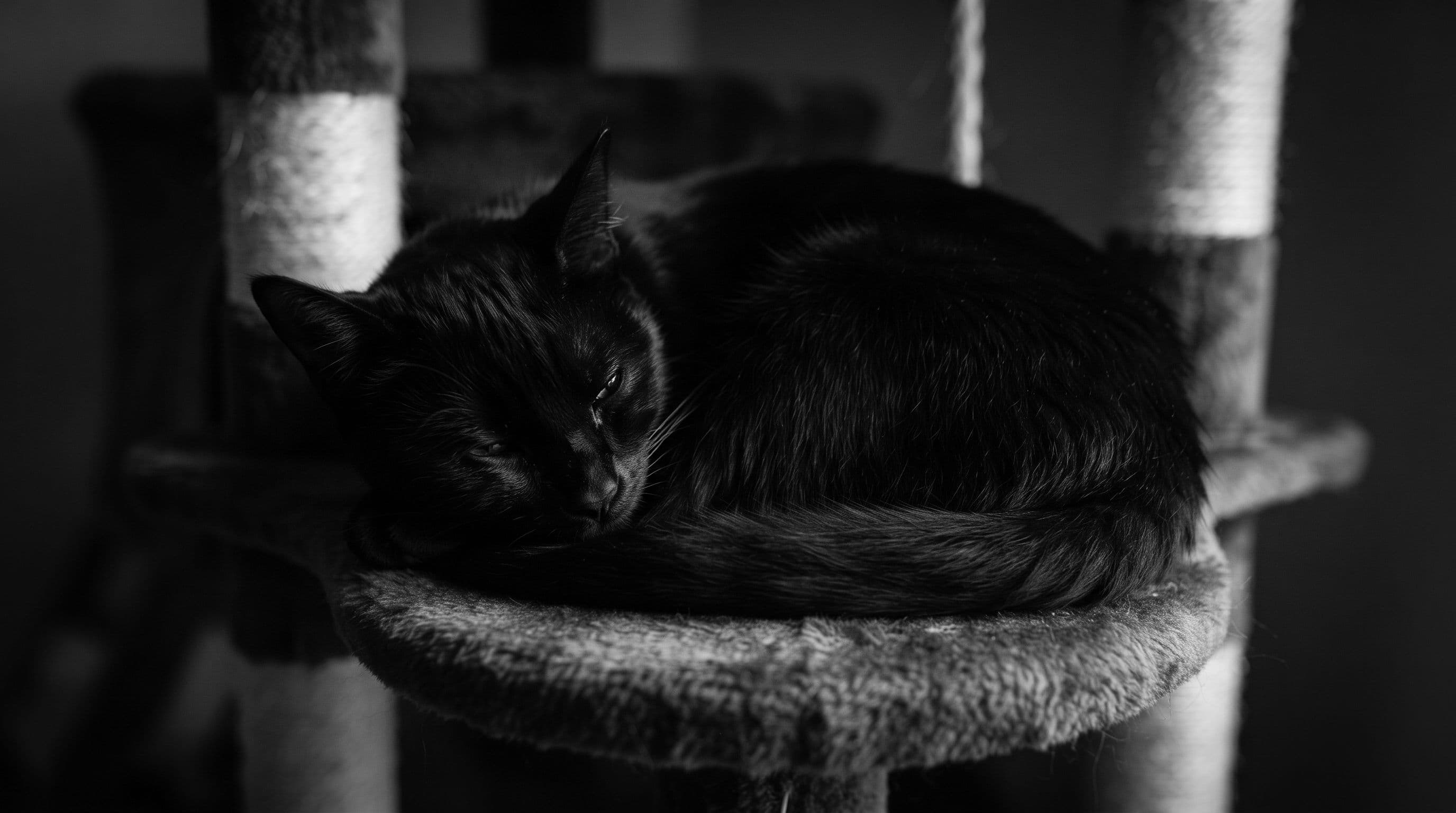
The Staffy routine was entirely Vino's. I don't have a matching story for Zola, and I'm not going to make one up. She came to us in June 2022, two months after Vino, and back then she was the laid-back, reserved one, the direct opposite of him. She's about 3.9 kg (September 2026) of sleek black composure to his 6 kg, and the two of them have rarely approached anything the same way. The contrast is one of the steady pleasures of living with both, and it's why I never generalise from one to the other when people ask me about cats.
The Staffy situation belongs to a house we've now left. We were there about three and a half years, in a rural setting with bushland around the property, and we moved to a suburban place in mid-to-late August 2026. There's no dog next door now. But I still think about that dynamic, because it revealed something about Vino that I hadn't fully grasped before: his provocations are always intellectual. He's not a physical brawler. Even when he plays with Zola, which he wants to do constantly, and which she never wants to do, though she'll wind him up and then hiss at him once he's engaged, because she's sassy like that, the energy is social, tactical, about the manipulation of response. The Staffy was just the largest-scale version of a pattern I'd already seen in miniature.
Tuxedo Cat and Dogs Story: What the Pattern Reveals
When people ask me whether tuxedo cats are good with dogs, I don't have a breed-level answer. The tuxedo isn't a breed; it's a colour pattern, bicolour black-and-white, and Vino's almost perfect distribution, white chest, belly, paws, that black chin extending down like a bow tie against the white, doesn't confer any behavioural trait. What I can offer is this specific tuxedo cat and dogs story, which suggests that individual personality matters more than pattern, and that some personalities approach interspecies contact as a kind of social engineering.
Vino's winery origin is relevant here. He spent a couple of years as a working cat on a biodynamic vineyard in northern Tasmania, catching mice, walking between my legs whenever I came into the barn, and demanding attention as a non-negotiable condition of his presence. He came to me lean and muscular, built by actual labour, and he's softened somewhat in domestic comfort since. I suspect that working life is where his confidence around other animals comes from. The chickens and rooster at the rural house were simply part of his environment; he'd try to play with the hens as though they were cats, which they didn't appreciate, and he'd negotiate the rooster's moods with practical caution. The Staffy was different because it was a dog, and dogs, in Vino's apparent assessment, respond to social cues in ways that can be exploited.
I've never seen him attempt anything similar with a cat. With Zola, his approach is exuberant and direct: he wants to play, he asks constantly, she refuses, and occasionally she initiates just to shut him down. That's a domestic negotiation, conducted at close quarters, with no audience beyond the household. The Staffy performance was public, spatial, and, I use the word carefully, theatrical. Vino understood that the fence created a safe stage. He could be seen without being reached. The metre of distance wasn't accidental; it was close enough for visual clarity, far enough to eliminate any physical risk. He worked within those constraints like a director blocking a scene.
The Quiet Aftermath of the Move
The rural house ended in August 2026, and the transition to suburbia has changed many things without changing Vino's core approach. He explored the new house immediately, settled within a couple of days, and resumed sleeping on my chest every single night, Zola on my leg, Vino on my chest, the positions identical to the old arrangement. His meowing didn't escalate despite the loss of unsupervised yard access. He simply found new projects. The sunroom in this new place has become his territory; he loves it and lies in the sun out there. There's no dog to ignore at this house, and I'm not going to pretend he's found a replacement.
Zola's change has been the real surprise of this move. The larger house has made her more active and more mischievous. She got into the bikkie container overnight and ripped open a big bag, something the old reserved Zola would never have attempted, and the change has stuck. Vino's stability is the constant. He moved house and, within the same week, had sixteen teeth out for an immune-mediated condition that had left his gums badly inflamed. The surgery was already booked and delayed. While I was measuring up the couch for the new house, he got spooked, jumped off the old one and knocked his top left canine loose, and that brought everything forward. It cost AUD $3,200. A few groggy days on heavy medication, then he was back to himself, though his mouth is still settling and he has sores on his top lip that are going back to the vet. The drooling, always extensive during cuddles, has reduced since the extractions but hasn't stopped.
What Vino's Staffy Strategy Teaches About Interspecies Dynamics
I don't offer this as advice. Every animal is different, and trying Vino's approach with a different cat and a different dog would be irresponsible without knowing both of them. But I think the principle underneath is real: Vino treated the Staffy not as a threat to be managed but as a system to be gamed. He worked out what the dog wanted, acknowledgment, some sign that its display had registered, and he refused to supply it. As far as I ever saw, the dog never found a way around that.
This is why I resist the standard tuxedo cat and dogs story templates you find online. They tend to generalise: tuxedo cats are smart, tuxedo cats are mischievous, tuxedo cats get along with dogs or don't because of their colouring. Vino's intelligence is real. He's easy to train and picks things up quickly. But it isn't a tuxedo trait. It's a Vino trait, shaped by a specific working life and expressed in specific ways. The Staffy was simply the biggest animal he ever tried it on.
Reading a Cat's Body Language in Cross-Species Encounters
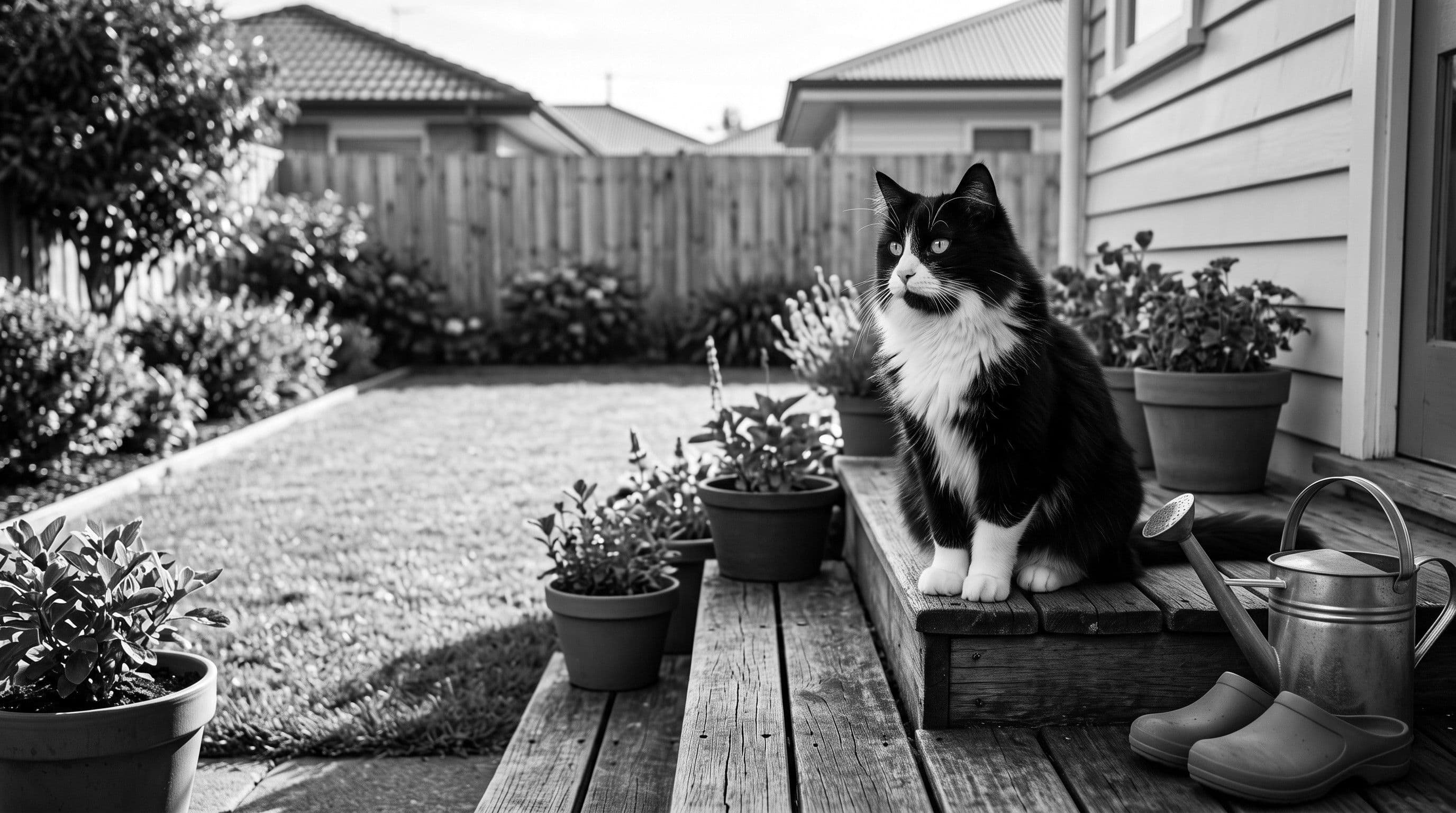
If you're trying to read your own cat's approach to dogs, I'd suggest looking for what Vino demonstrated: consistency of posture across time. Fear shows up as variation, ears flattening, tail tucking, position shifting as the threat moves. Vino's posture by that fence was identical every time I saw it. The black chin, the white chest, the green eyes with their slight yellow hue, all oriented away from the dog and toward nothing in particular. That sameness was the signal. A cat who is managing fear is working; a cat who is this still is resting in a strategy they've already solved.
Some cats will simply leave, and that's readable too: absence from the scene, not performed absence within it. What wouldn't be sensible, in my experience, is assuming all cats need the same thing. Some need space from dogs. Some need high escape routes; Vino used those with the rooster, finding ground the bird couldn't easily reach. And some, apparently, need to lie down a metre from the fence and practise radical non-engagement until the dog questions its own sanity. Has your cat ever had a dog it flatly refused to acknowledge? I'd like to hear how that went.