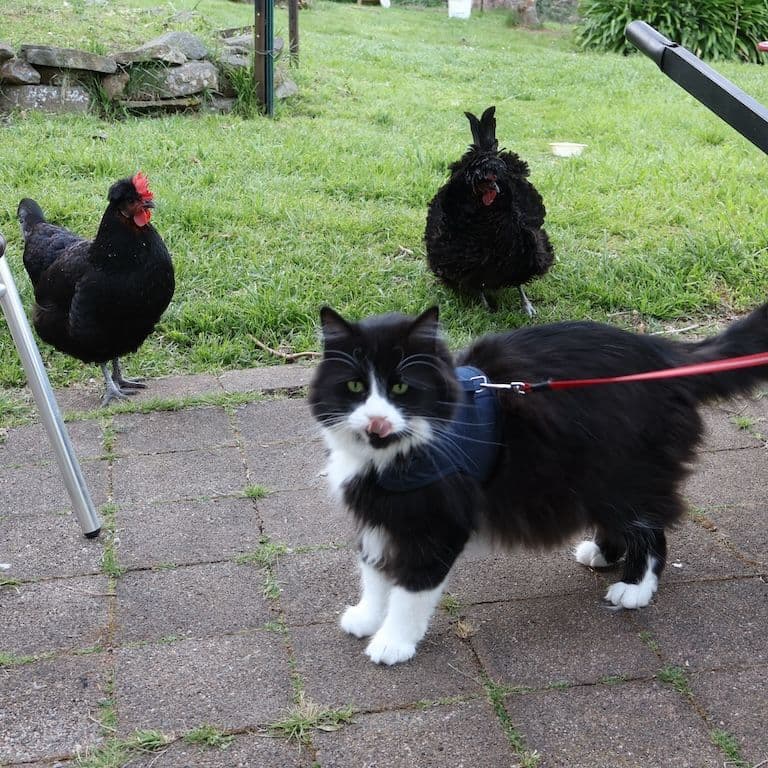
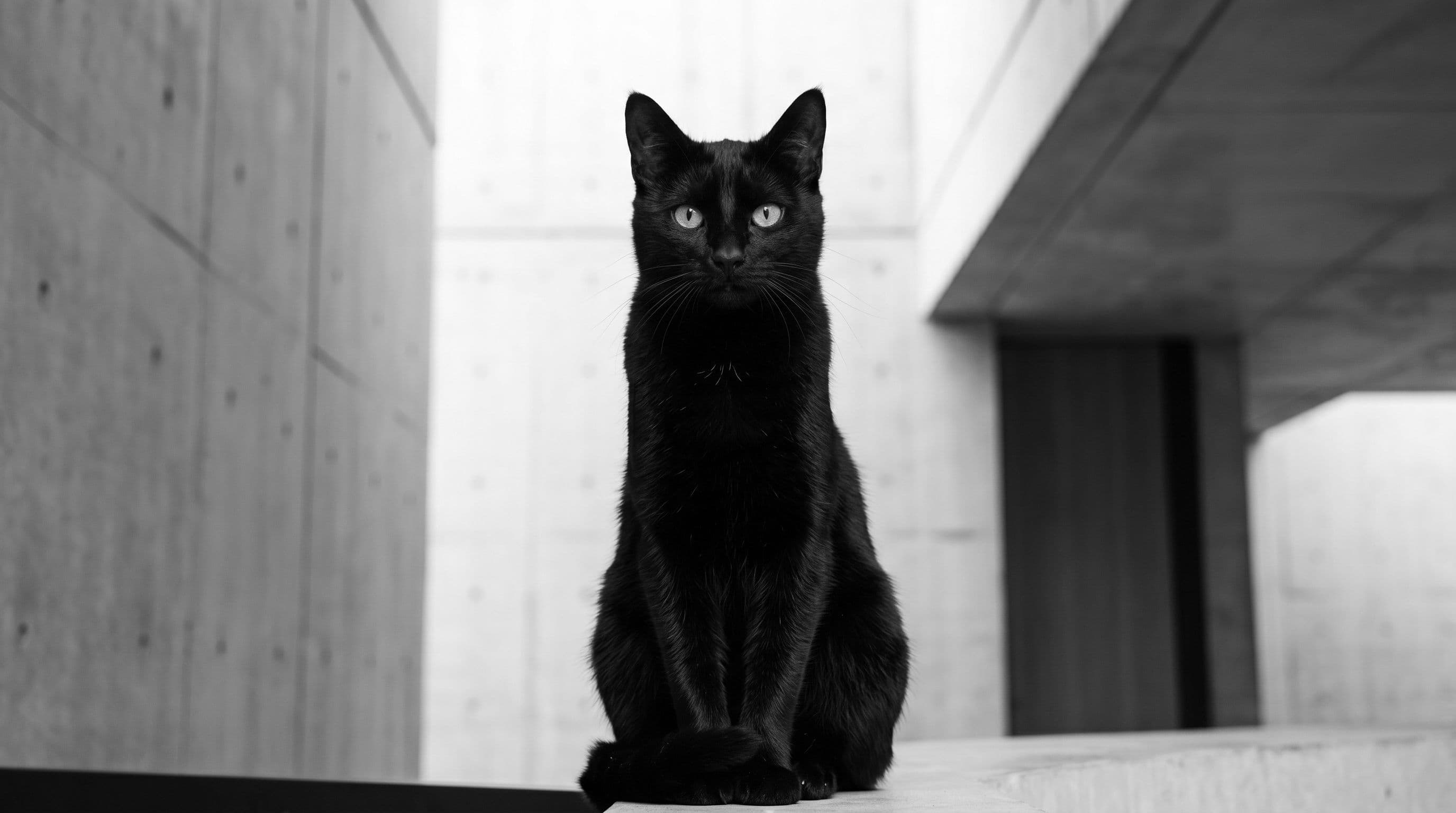
Vino greets every person who comes through our gate. Not the door. The gate. He hears them coming, positions himself at the entrance, and escorts them to the house. The toll is a pat. Everyone pays it.
I adopted him at two and a half from a winery barn where I used to work. He'd been a barn cat his whole life, running territory, making his own decisions, accountable to no one. When I brought him home, I wasn't sure how he'd be with people. Barn cats can go either way.
He had the first visitor assessed and approved within three minutes.
The short answer
Yes, tuxedo cats are typically friendly, but "friendly" doesn't quite capture what it looks like in practice. Vino doesn't warm up to people gradually over time. He makes a quick assessment, decides you're acceptable, and then proceeds as though you've always been there. The assessment takes about thirty seconds. If you pass, you get the full treatment: meow, headbutt, probably a lap visit within ten minutes.
If he decides you're not interesting, he'll sit nearby and watch you for a while. He's never unfriendly, exactly. Just more reserved with some people than others, and his standards are his own.
The dog-in-a-cat's-body thing
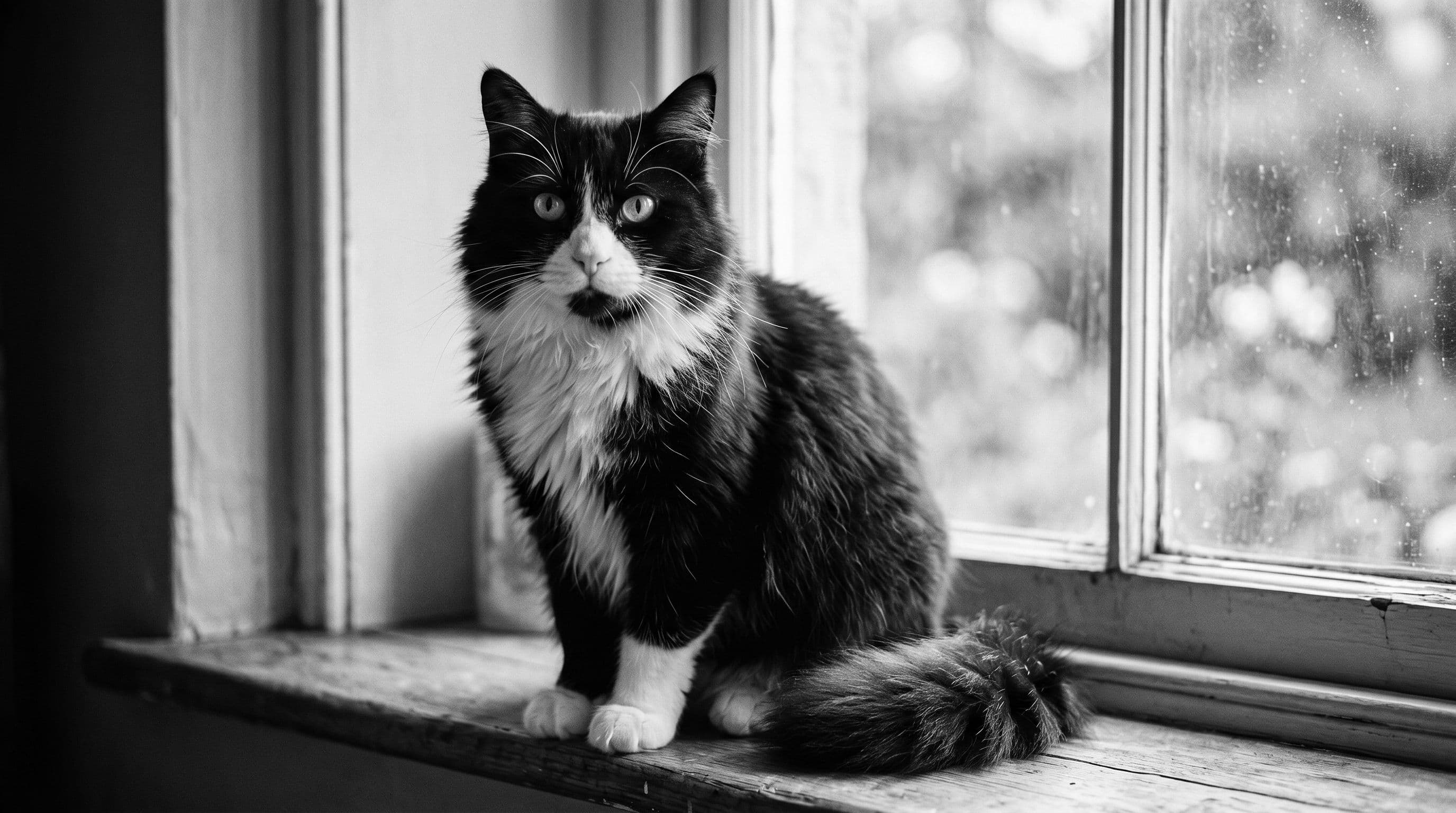
People who know Vino say he's a dog in a cat's body, and they're not wrong. He follows me from room to room. He comes when I call him. He chatters when I get home. He's learned my schedule well enough that he's at the door before I open it.
He also has a standing arrangement with the neighbour's Staffy. At the old house Vino would occasionally go over the fence and snoop around next door. It's not aggression. It's something between a social call and a performance. He comes back when he's done. The Staffy just watched.
Then there's Zola, our other cat. Publicly they maintain complete indifference to each other; you'd think they barely knew the other existed. Privately they share a can at every mealtime and Vino has been known to chase her around the house in a way that reads as affectionate rather than territorial. She loves him back but she'll never admit it.
He's also fine with the chickens. The rooster was a separate matter.
The training connection
Friendly cats are easier to train, and tuxedo cats, or at least Vino, tend to be both. He took to harness walking in under a week. He picked up the routine quickly and now bolts for the door when the afternoon walk time approaches, tail up, ready. The motivation was partly the outside world and partly the fact that he was raised in a working barn and the concept of navigating space with a human nearby wasn't foreign to him.
Zola took longer to get comfortable with the harness. Different cat, different pace. But Vino's openness to it (the way he just decided it was fine and committed immediately) is characteristic of how he handles most new things.
Building that friendliness
Vino was already socially confident when he arrived, which made things easier. Zola was less so. She needed more time, more patience, more of everything before she'd approach a stranger voluntarily. What worked for her: calm introductions where she could observe from a distance, treats for any movement toward a new person, short sessions that ended before she got overwhelmed. It took longer than it did with Vino, but she got there.
The harness walks have been part of it too. Regular outdoor access with human supervision, navigating spaces together and encountering things together, builds a particular kind of trust that pure indoor life doesn't always develop. Vino is at his most social on walk days.
Interactive play is the other one. Feather wands, specifically. He's mad for a feather wand and our evening sessions are the clearest expression of our dynamic: he plays with full commitment, I try to keep up, and then he collapses on my lap and insists on pats until one of us falls asleep.
The honest assessment
The original question was whether tuxedo cats are friendly. In my experience with Vino, the better question is whether they're social, and the answer to that is consistently, emphatically yes. He wants to know what's happening. He wants to be in the room where it's happening. He wants to know who the new person is and whether they're worth his time.
He's not passive about any of it. He engages. Whether that's tuxedo cats specifically or just this particular cat, I can't fully separate anymore.
The Chicken Diplomacy
Vino's friendliness gets tested most honestly with the birds. We keep four chickens and one rooster, and Vino's relationship with the flock isn't predator-and-prey so much as an ongoing, slightly one-sided friendship he's trying to have with animals who never signed up for it. He'll approach a chicken the exact same way he approaches Zola when he wants to play: low crouch, a slow stalking walk, a pounce that's more invitation than attack. The chickens do not appreciate this. They scatter, indignant, and Vino watches them go with what I can only describe as mild confusion. He tries again the next day.
The rooster was a different negotiation entirely. He's a genuinely intimidating bird when he's in a mood, and Vino, for all his confidence with strangers, dogs, and anything else that walks into the yard, is a little wary of him. Vino's solution isn't confrontation. It's geography. He finds elevated ground, a fence post, the top of the woodpile, somewhere the rooster can't easily reach, and holds his position there until the coast is clear. On calmer days, when the rooster's in a reasonable mood, Vino will sit quietly among the whole flock without incident, a black-and-white cat parked in the middle of four chickens like he'd been invited to the meeting.
It's a small thing, but it says something real about the shape of Vino's friendliness. It isn't indiscriminate. He reads the rooster correctly every time and adjusts. He reads the chickens as playmates even though the evidence keeps telling him otherwise. Both responses come from the same instinct: engage first, recalibrate only if the engagement clearly isn't working. With people, that instinct reads as warmth. With a rooster twice his confidence, it reads as something closer to good judgement.
None of this required training. Nobody taught Vino to respect the rooster's mood or to keep trying with the chickens despite the consistent rejection. Both are just extensions of how he treats every new relationship: assume goodwill first, adjust based on what actually happens. It's the same operating principle that gets a total stranger a headbutt and a lap visit within ten minutes of walking through the gate. The chickens just have more legs to run on.
Zola takes none of this the same way. New people get watched from a doorway before she'll consider closer contact, if she considers it at all. The chickens get ignored outright; she's never once shown interest in going near them. Vino's version of friendly is loud and immediate. Zola's, when it shows up, is slower and rarer, and it means just as much when it finally arrives. The two of them make it obvious that "friendly" isn't one fixed trait tuxedo cats either have or don't. It's a range, and Vino sits at the talkative end of it.
Frequently Asked
If you've ever wondered whether that friendliness extends to other animals: the Staffy situation was its own story. And if you're thinking about harness training a sociable cat like Vino, that's covered here.
How old was your cat when you adopted them, and how long did it take to settle in? Drop it in the comments. I'm genuinely curious how the barn-cat-to-house-cat timeline varies.