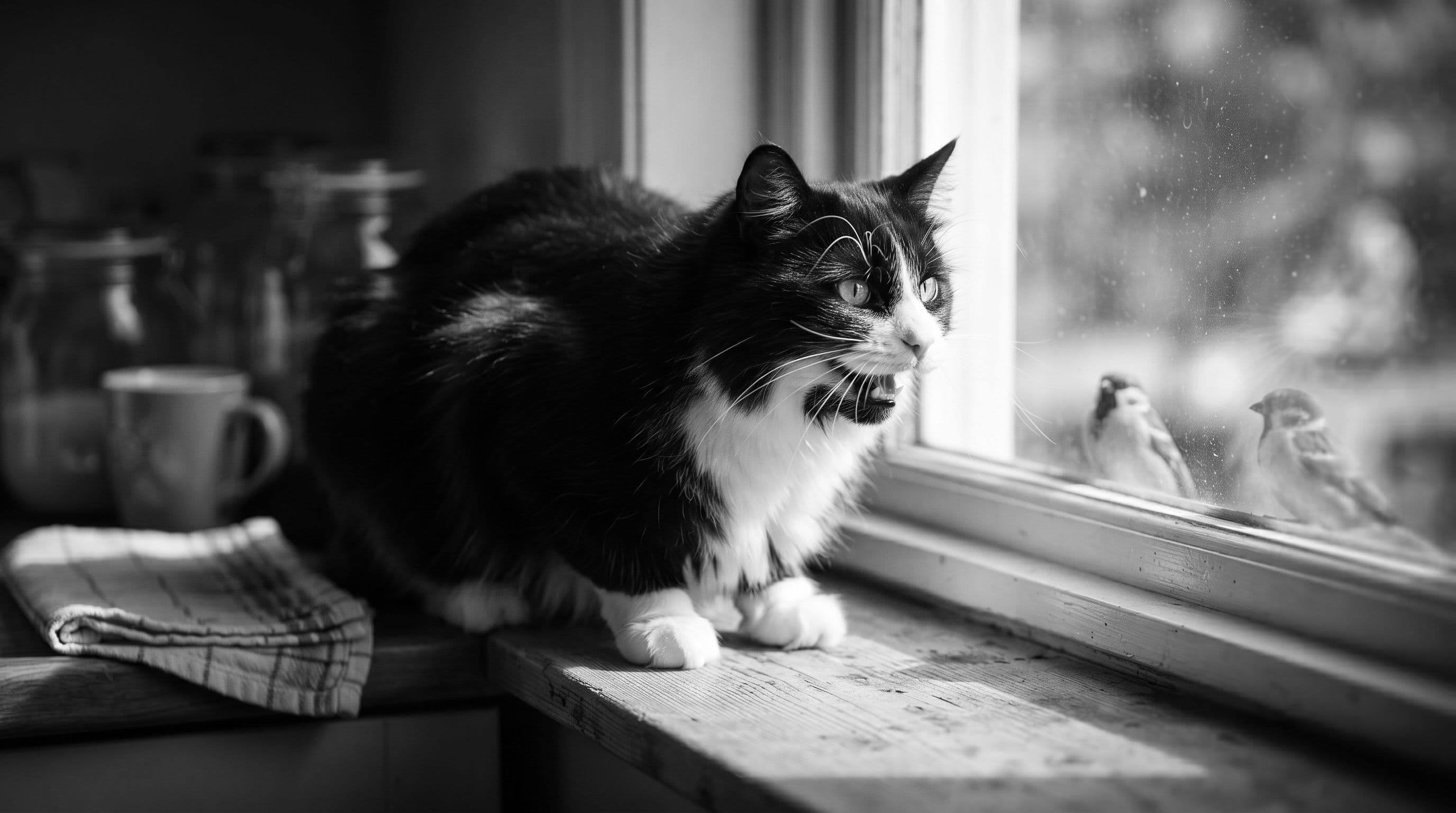
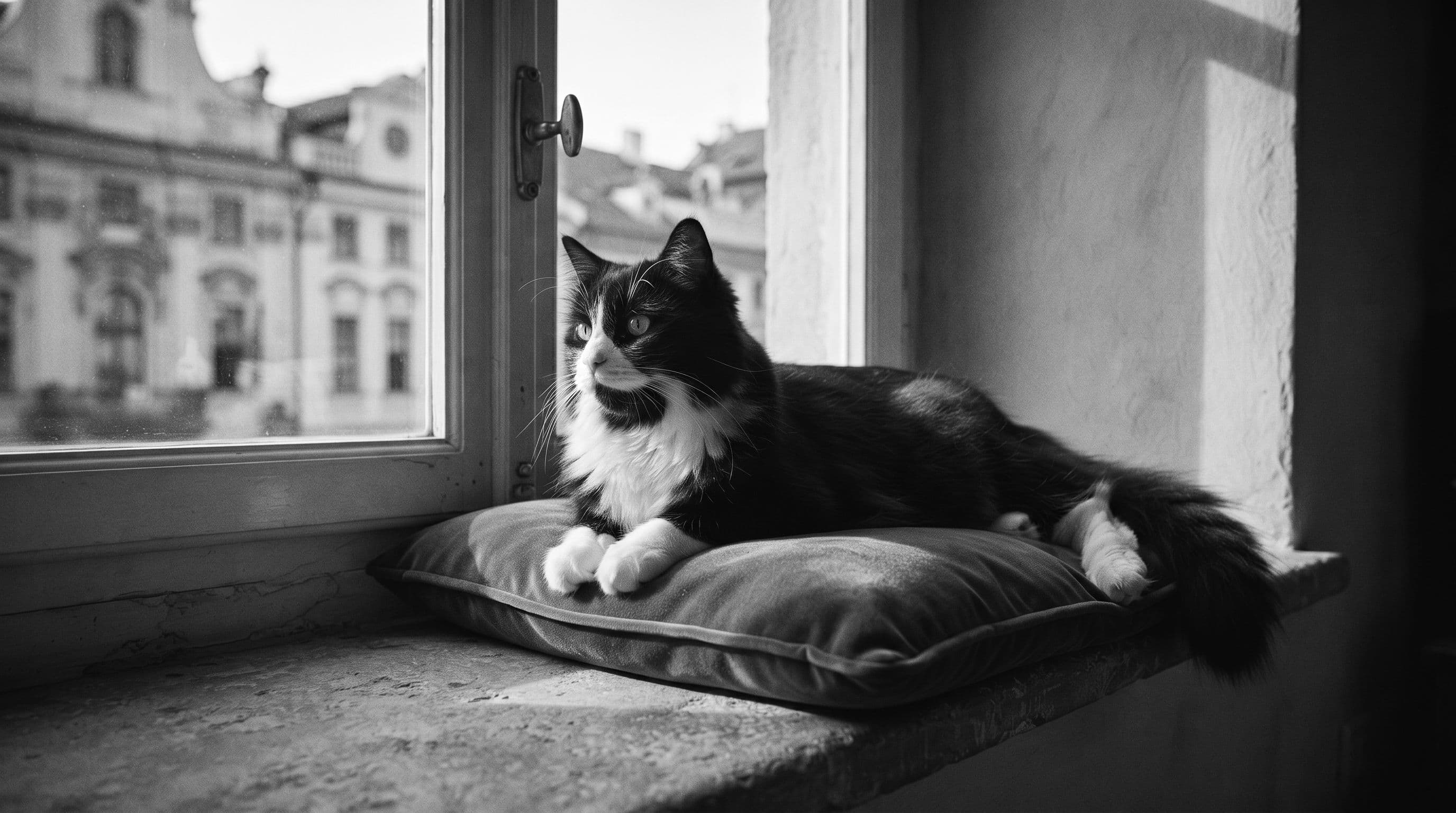
One afternoon last week, Vino was parked on the kitchen windowsill with his white paws tucked beneath him, staring at a pair of superb fairywrens hopping along the fence line. His jaw started chattering first: a rapid, almost mechanical clicking. Then came the chirp, a short stuttered sound halfway between a bird call and a broken meow, repeated three or four times in quick succession. If you've ever wondered why do cats chirp at birds, this is what it looks like in practice: his whole body was tense, his green eyes locked on those tiny iridescent birds, and his black tail twitched with an intensity that told me he'd forgotten I exist. After years of living with Vino, I've spent a probably unreasonable amount of time reading about it.
Why Do Cats Chirp at Birds? The Science Behind the Chatter
That windowsill scene isn't unique to Vino. Domestic cats across breeds and temperaments produce this distinctive vocalization, and it's one of those feline behaviors that still doesn't have a single tidy explanation. The chirping sound, sometimes called chattering or chittering, sits in a category of feline vocalizations that don't map neatly onto the ones we know best: the meow, the purr, the hiss.
In my experience living with Vino, adult cats seem to reserve meowing almost exclusively for interactions with humans. It's a learned social tool, not something they use much with each other. Chirping at birds is something different entirely. I've watched Vino do it hundreds of times from the windowsill, and it doesn't appear to be directed at a social partner. Instead, it seems to emerge involuntarily during moments of intense predatory focus, particularly when he can see a bird but can't physically reach it. His whole jaw chatters, his eyes go wide, and the sound that comes out is nothing like the polite little mew he gives me at dinnertime.
I've watched Vino chirp at birds through our living room window enough times to suspect that wild cats might use similar sounds for hunting, and there are anecdotal reports of wild margays in the Amazon producing calls that attract smaller prey species, though I haven't found a confirmed, peer-reviewed source I'd stake Vino's tuna ration on. Domestic cat chirping hasn't been conclusively linked to vocal mimicry as a hunting strategy, but watching Vino's jaw quiver and hearing those bizarre little sounds he makes at sparrows on our fire escape still raises fascinating questions about whether some feline vocalizations serve a predatory acoustic function we don't yet fully understand.
What we do know is that the behavior correlates strongly with arousal and frustration. Vino chirps exclusively when there's a barrier between him and the bird: a window, a screen, too much distance. When he's actually outside and a bird lands close enough to stalk, he goes silent. Completely silent. The chirp, it seems, belongs to the wanting, not the doing.
How Vino's Chirping Compares to What Other Cats Do
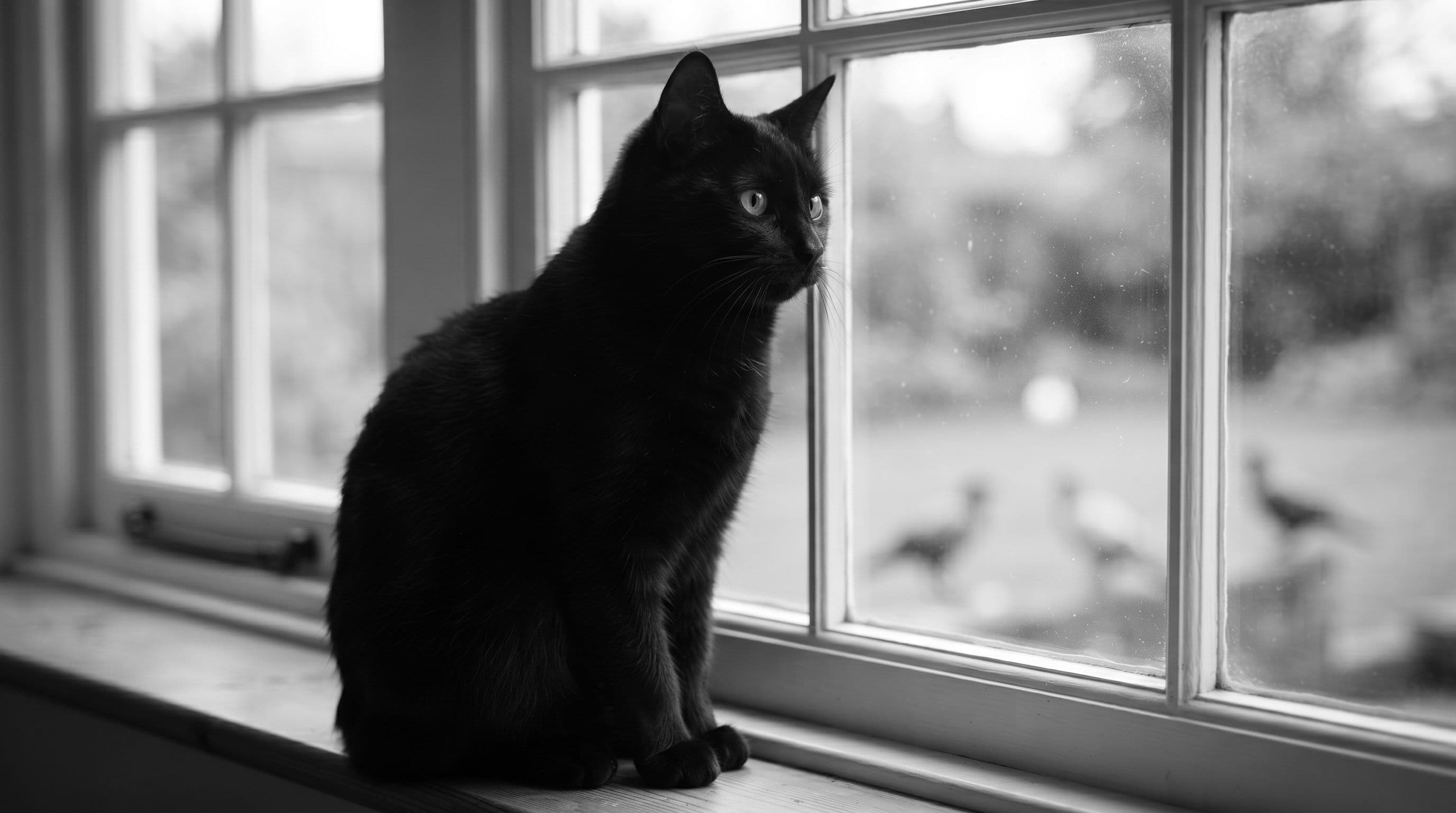
Not all cats chirp the same way, and some don't chirp at all. Zola, who shares the house with Vino and couldn't be more different in temperament, rarely makes the sound. She'll watch birds from the same window with a detached aristocratic interest, her slender black body barely moving. Occasionally her mouth opens slightly, but there's no audio. She processes the experience internally, which is consistent with everything else about her personality.
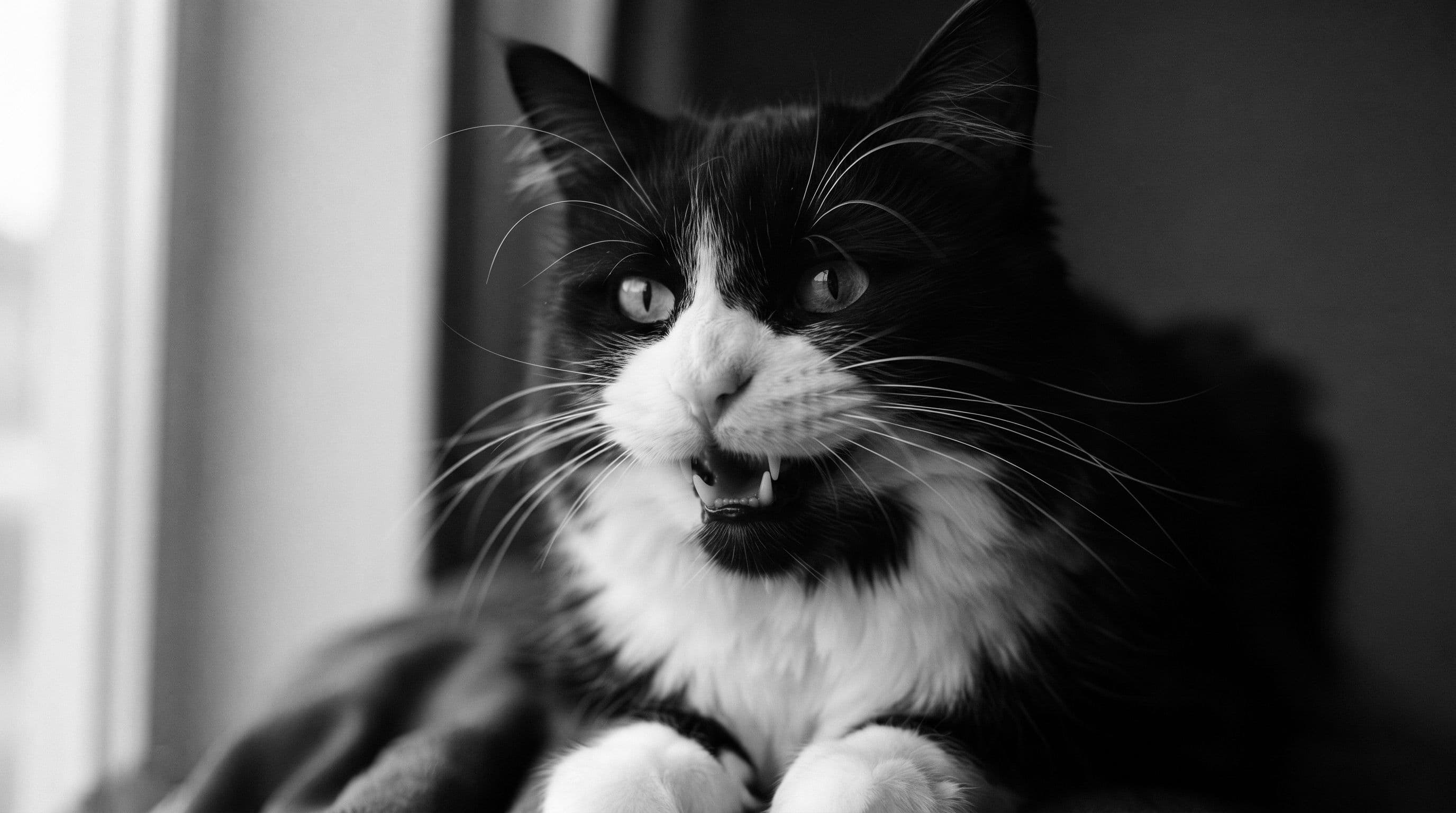
Vino, by contrast, produces a full vocal performance. His chirps are loud enough to hear from the next room. His jaw chatters so fast it almost looks like shivering. He'll sustain this for 2 to 3 minutes if the birds stick around, and he sometimes adds a low warbling sound at the end that I can only describe as a complaint.
Breed plays some role in chattiness generally. Vocal tendencies vary widely across breeds. Siamese and Oriental Shorthair cats are famously vocal across all contexts, while British Shorthairs tend toward the quiet end of the spectrum. Tuxedo cats aren't a breed but a coat pattern, so Vino's volume comes from individual personality rather than genetic predisposition toward vocalization. That said, I've compared notes with other tuxedo cat owners who report similar chirping intensity, so perhaps there's something in the water. Or the markings.
Dr. Sharon Crowell-Davis, Professor of Behavioral Medicine at the University of Georgia College of Veterinary Medicine, has documented that cats live in matrilineal colonies with individual recognition, dominance hierarchies, and cooperative behaviour. Her research paints a picture of cats as socially complex animals, not the aloof loners of popular myth. This tracks with Vino's profile perfectly. He's a cat who communicates constantly and with purpose: at me, at his food bowl, at the door, at the concept of being mildly inconvenienced. I've lived with him long enough to know that a cat who narrates his entire domestic life isn't going to stay quiet when something as exciting as a bird appears. Social complexity, in my household at least, comes bundled with a running commentary on everything that moves.
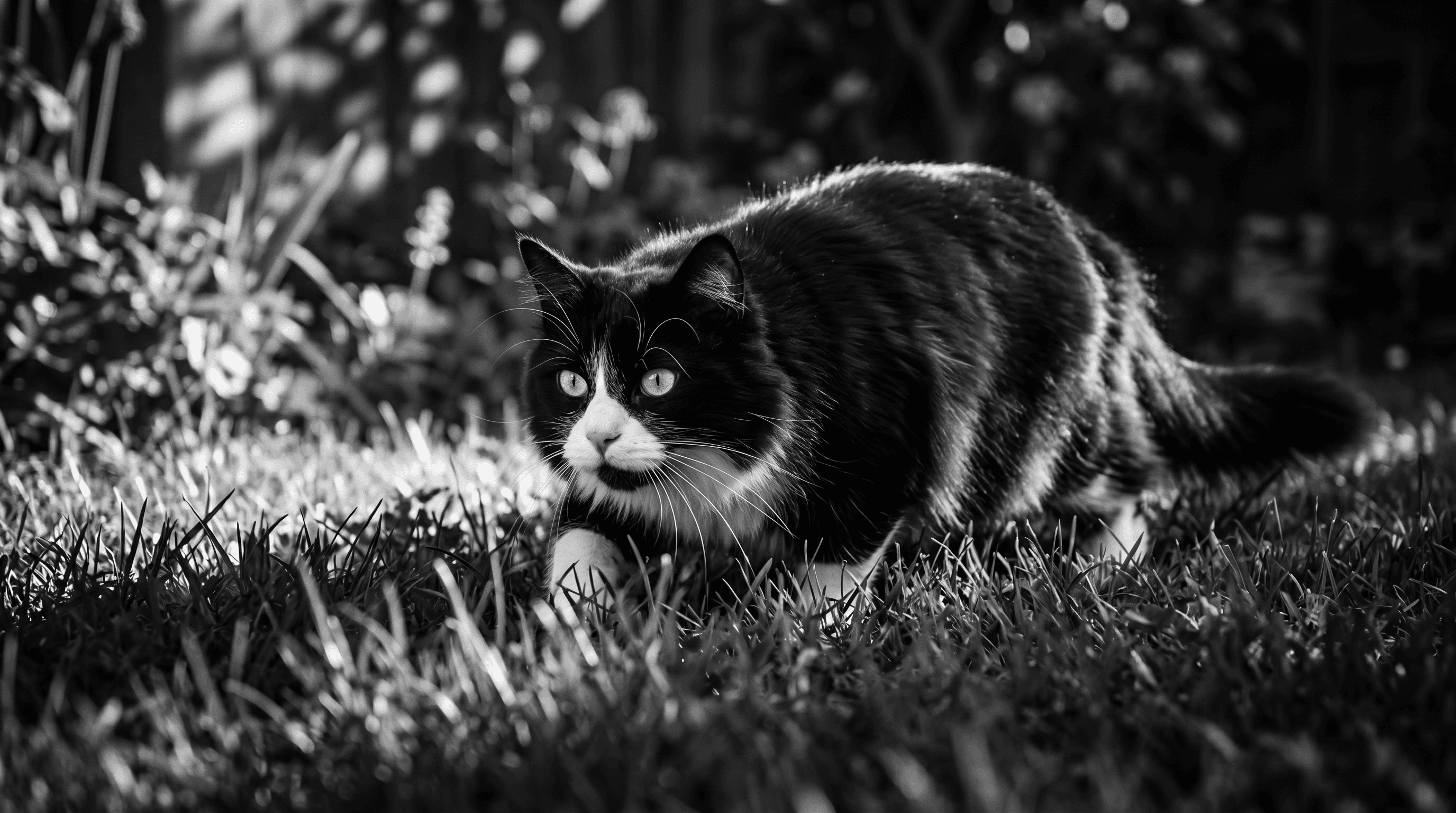
The frustration component matters too. For Vino, the frustration component matters too. Vino and Zola go outside for 1 to 2 hours each afternoon before dinner, with occasional morning sessions. During those outdoor hours, Vino stalks birds silently and with genuine focus. It's only behind glass that the chirping starts. The barrier transforms a predator into an audience member, and Vino has never been comfortable just watching.
I wrote about this sort of intensity in my post about understanding tuxedo cat behavior patterns, and it holds true here: Vino's emotional responses tend to operate at full volume.
What This Means for You and Your Chirping Cat
If your cat chirps at birds, you don't need to worry. It's ordinary predatory excitement, not distress. But it does tell you something useful about your cat's mental state: they're experiencing high arousal and, probably, some frustration. That information is worth paying attention to, because chronic frustration without an outlet can contribute to behavioral issues over time.
Here's what I've found actually helps.
Provide a dedicated bird-watching station. Vino's kitchen windowsill is his primary chirping spot, and I've made it comfortable on purpose. A folded wool blanket gives him a padded surface, and I keep the window cracked when the weather allows so he gets scent information alongside the visual. Multi-sensory enrichment matters. A cat who can smell and hear the birds, not just see them, gets a richer experience even through the glass.
Redirect the energy afterward. After a chirping session, Vino is wired. His predatory drive has been activated with no resolution, so he needs an outlet. I'll pull out a feather wand toy or toss a crinkle ball down the hallway. About 10 to 15 minutes of active play post-chirping seems to reset him. If I skip this step, he redirects that energy into pestering Zola, who expresses her displeasure through hissing and retreating to the top of the cat tower.
Don't punish or interrupt the chirping. Some owners find the sound odd or assume the cat is upset. Interrupting a chirping cat just adds confusion to the frustration. Let them process the experience. It's a natural part of their predatory behavioral repertoire, and suppressing it doesn't eliminate the underlying drive.
Consider a window-mounted bird feeder. I installed one on the kitchen window about 8 months ago. The effect on Vino's chirping frequency was immediate: it roughly doubled. He now stations himself there for 30 to 45 minutes at a stretch. Whether this counts as enrichment or torment is a philosophical question I haven't resolved, but he returns to the spot voluntarily every single day, so I think he's getting something out of it.
Track any changes in the behavior. If a cat who has never chirped suddenly starts, or a regular chirper suddenly stops, it's worth mentioning to your vet. Sudden changes in vocalization patterns can occasionally signal dental pain or other oral discomfort that's affecting jaw movement. For Vino, chirping has been consistent since I brought him home from that winery in northern Tasmania in April 2022, so his baseline is well established.
For more on keeping indoor time stimulating, my post about enrichment ideas for tuxedo cats covers the setup that works in our house.
What Timothy Actually Uses: I keep a simple stainless-steel feather wand toy near the kitchen windowsill for post-chirping play sessions. It's nothing fancy, but the feather attachment triggers the same predatory response that the birds activate, giving Vino a satisfying conclusion to the hunt cycle.
Frequently Asked
What the Chirping Actually Looks Like: A Front-Row Seat
Last Thursday morning I was trying to answer emails at the kitchen table. Vino had other plans. He'd stationed himself on the windowsill above the sink, his black chin tilted upward, tracking a magpie that had landed on the clothesline. His pupils dilated. His whiskers pushed forward. Then that mechanical clicking started in his jaw: rapid, rhythmic, like a tiny engine catching. The chirp that followed was stuttered, urgent, almost frustrated. His white paws stayed tucked beneath him but his black tail lashed once, twice, three times against the glass. He didn't blink for what felt like thirty seconds. I stopped typing. The emails could wait.
This is the same cat who, an hour earlier, had been draped across my lap on the couch, drooling onto my shirt during a pat session. The transformation is immediate and total. Domestic Vino, the biscuit-maker who meows at the bedroom door for breakfast, vanishes. Something older takes his place.
Why Do Cats Chirp at Birds? The Predatory Frustration Theory
The explanation I find most convincing after years of watching Vino is simple: the chirp is leaked intention. Your cat has spotted prey, assessed the distance, and found itself blocked. The jaw chatters because the killing bite is already being rehearsed in the nervous system. The sound escapes because the motor pattern runs ahead of the opportunity.
Vino's chirping follows a reliable pattern. It only happens when he can see a bird but cannot reach it. Through the kitchen window: constant chatter. Through the living room glass: the same. Outside in the yard, when he's actually stalking the chickens or watching wild birds from the fence? Silence. Complete focus, low body, slow steps. The chirp disappears because the gap between intention and action has closed. He's no longer a spectator. He's participating.
I've tested this accidentally dozens of times. If I slide the window open while he's mid-chirp, the sound cuts off instantly. He doesn't leap out; he assesses. Sometimes he loses interest entirely if the bird flies off before he's calculated his approach. The chirp belongs to a specific moment: the suspended state between wanting and doing.
The Social Layer: Is Your Cat Trying to Teach You?
Some observers suggest chirping is an attempt to communicate with human housemates or other cats, perhaps a kind of frustrated instruction. "Look at this. Help me get this." I can't rule it out entirely, but Vino's behaviour doesn't support it. He doesn't turn to me when he chirps. He doesn't seek eye contact. His whole body orients toward the bird, and the sound seems to surprise him as much as it surprises me. My fiancée has watched from the doorway without Vino acknowledging her at all. The cat is gone. Only the hunter remains.
Zola, our black cat, behaves differently. She'll watch birds with equal intensity but rarely chirps. When she does, it's softer, briefer. She doesn't share Vino's theatrical commitment to the performance. Their different approaches remind me that even in one household, with the same windows and the same fence-line birds, individual cats express this impulse uniquely. Vino's chirping is loud, prolonged, almost operatic. Zola's is a muttered aside.
When the Barrier Is Removed: What Vino Actually Does
The chirping doesn't predict successful hunting. Vino has never caught a bird in the years I've lived with him. He catches mice occasionally, and he once brought a skink inside that required a chaotic rescue operation involving a Tupperware container and a lot of swearing. But birds remain theoretical. His outdoor time is supervised, and his actual bird interactions are limited to watching, chirping, and occasionally making a doomed lunge at a fence-line magpie that saw him coming.
The chickens were a different story. He tries to play with them the same way he'd play with Zola. They do not appreciate this. The rooster intimidates him. Vino's workaround is elevation: he finds a spot the rooster can't reach and resumes his watching. No chirping, though. The chickens were too close, too possible. The sound only comes when the prey is definitively out of reach.
Vino's Verdict
Vino's documented reaction: sustained, repetitive chirping at any bird visible through glass; immediate cessation if the window opens or the bird departs; zero chirping during actual outdoor stalking. He has no opinion on evolutionary theories. He would like the window to be a portal. It is not.
FAQ
Why do cats chirp at birds instead of meowing?
Meowing is a social tool Vino uses almost exclusively on humans. His dinnertime mew is polite, calibrated, impossible to ignore. The chirp is involuntary, uncalibrated, directed at prey he can't reach. They're different systems entirely. One is communication. The other is leaked machinery.
Should I worry if my cat chirps at birds constantly?
I don't worry about Vino. His chirping is brief, self-limiting, and clearly tied to visible birds. If your cat seems distressed, panting, or fixated for hours without break, that's different. Vino chirps, the bird flies, he grooms his medium-long fur and finds a sun patch. It's one movement in a larger day.
Can I stop my cat from chirping at birds?
You could remove the stimulus: close the blinds, block the windowsill. I don't. Vino's windowsill time is clearly meaningful to him. The chirping is harmless, and the watching seems to satisfy something that his actual hunting never quite addresses. He is a cat who once worked a vineyard barn. Some part of him still expects to participate. The window lets him pretend he might.
What the Chirp Actually Sounds Like in This House
Vino's bird chirp is not the polite sound he uses to request dinner. It is a mechanical, staccato chatter that starts in his jaw and leaks out without his permission. I have heard it from the windowsill, from the sunroom, and from the back step at the rural house when he was fixed on a honeyeater in the grevillea. The sound is always the same: rapid, broken, somewhere between a bird call and a piece of machinery with a loose gear. His body goes rigid. His tail twitches in short, controlled arcs. And his eyes, green with that slight yellow hue, stay locked on the target until the bird leaves or he loses interest.
Zola does not do this. She watches birds, certainly. She will sit in the tower by the window with her sleek black composure and track a magpie's progress across the lawn with real attention. But she does not chirp. The sound is Vino's alone in this household, and that split matters: two cats, same environment, one vocalization. It suggests the chirp is not automatic exposure to birds but something specific to the cat who spent his first years catching mice in a winery barn.
The One Mechanism That Explains What I See
The explanation that matches Vino's behaviour is frustration-release. The chirp does not appear when he is stalking something he can reach. He does not chatter at toys on a wand, at Zola when he wants to play, or at food being prepared. It appears only when the prey is visible, desirable, and inaccessible: behind glass, across a lawn, or, in the case of the rural house, on the other side of a fence he used to clear but was stopped from clearing. The jaw chatter looks to me like the motor pattern for a killing bite, running without a target. The sound is the leak.
I do not need a study to tell me this. I need only compare two windows in the same house. At the rural property, Vino chirped at birds from the back step, then sometimes went over the fence and into the bush after them. When he did, the meowing started, constant, locational, the sound that let me track him through trees. He did not chirp once he was in motion. The chirp belongs to the moment before motion, to the gap between seeing and reaching. Now, in the suburban house with no outdoor access yet, the gap is permanent. He chirps more. The sound has become more frequent because the resolution never comes.
Vino's Verdict
| | |
|:---|:---|
| Trigger | Small birds at medium distance, visible but unreachable |
| Location observed | Kitchen windowsill, sunroom, rural house back step |
| Intensity | Rigid body, locked eyes, tail in short twitches; sound repeats 3–4 times |
| What ends it | Bird departs, or Vino is interrupted and complains about it |
He does not chirp at large birds. A crow or a currawong gets the sustained stare, the stillness, but not the jaw chatter. The superb fairywrens were ideal: small, quick, iridescent, and perpetually just out of reach. His favourite targets.
When the Chirp Means Something Else
There is a second chirp in Vino's repertoire, and I have learned not to confuse the two. When he wants me to play with the wand, the string-and-bird toy that both cats prefer, he produces a sharper, more directed sound. It is not mechanical. It is a request, aimed at me, and it stops when I pick up the toy. The bird chirp does not stop for human intervention. I have stood up from the desk, walked over to the windowsill, and spoken to him while his jaw continued its staccato rhythm. He did not acknowledge me. The sound is not social. That is the line.
I have also heard him make a similar chatter in his sleep, once, a soft clicking from the chest where he settles on me every night. The context was wrong for predation, he was warm, fed, unconscious, and the sound was quieter, less focused. I do not count this as the same behaviour. It may share a mechanism, but it does not share the trigger, and without the trigger I cannot call it a bird chirp.
Does Every Cat Do This?
Zola's silence on this topic is my only data point, and it is enough to say no. She came to us at five months old in June 2022, two months after Vino arrived, and has been in the same rooms with the same windows and the same birds for essentially his entire time with us. She tracks. She does not chatter. Whether this is temperament, early experience, or something else entirely, I cannot say. I know only that the winery barn produced a cat who chirps at birds, and the woman my fiancée worked with produced a cat who does not.
FAQ
Why does my cat chirp at birds but not at toys?
The toy is reachable. The bird, for most indoor cats, is not. Vino's chirp appears at the specific intersection of intense interest and physical barrier. His wand toy triggers pursuit, not frustration. If your cat chirps at a toy, the toy may be moving out of reach, under furniture, behind a barrier, or the cat may be responding to a different trigger entirely. Watch when the sound starts and what ends it.
Is chirping at birds a sign my cat wants to go outside?
Not directly. Vino chirped at birds through windows when he had unsupervised yard access, and he chirps now when he has none. The sound is about the bird, not about the door. What changed with the move to lead-only and then indoor life is the frequency: more unresolved sightings, more chirps. If your cat is new to chirping, consider whether a bird feeder or seasonal migration has created new visible targets, not whether the cat is issuing a request.
Should I discourage my cat from chirping at birds?
I do not discourage Vino's chirp itself. It is a sound, not an action, and stopping the sound would not change the underlying focus. What I do supervise is the behaviour that follows. At the rural house, if I saw him fixed on a bird and making that little chattering noise, I would go over and interrupt him before he reached the fence. That is the whole technique: watch, spot the tell, interrupt. The chirp is useful to me because it is the giveaway. Without it, I would have less warning.