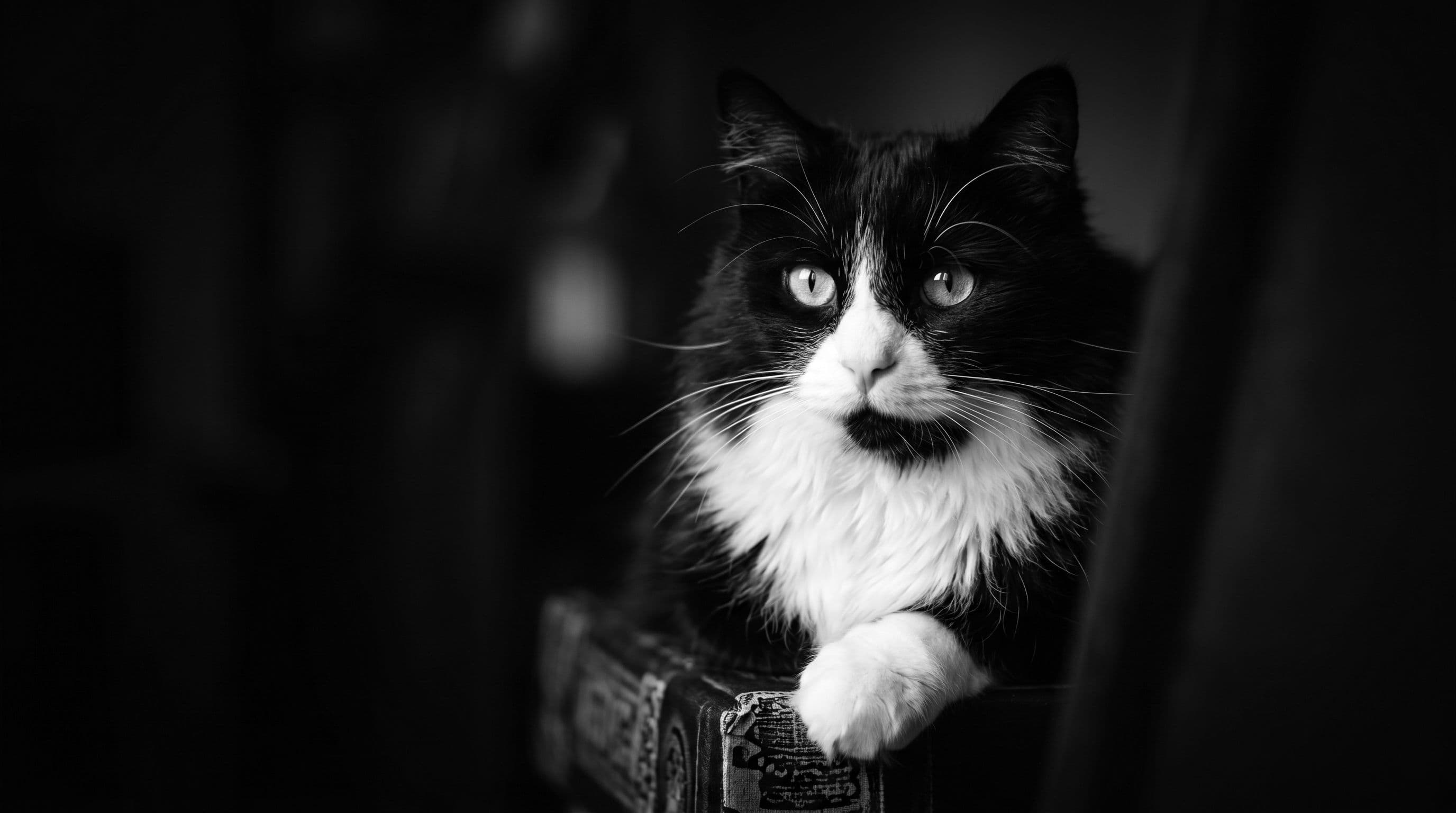
According to Susanne Schotz's Meowsic project at Lund University, which analysed 780 meows from 40 cats and compared two Swedish dialect regions, meow melody varies with context. John Bradshaw, the anthrozoologist who founded the Anthrozoology Institute at the University of Bristol and wrote Cat Sense, argues that much of how cats communicate with people is learned rather than innate. So when people ask why tuxedo cats are vocal, they're actually asking the wrong question. The bicolour pattern turns up across many different breeds, which means there's no single genetic profile behind that black-and-white coat that could wire a cat for chattiness. In my own household, I've watched the proof unfold over years: adult cats I've known don't bother meowing at each other all that much, but Vino meows at me constantly because I answer him every single time. What's really happening is a feedback loop between a specific cat's temperament and a specific household's responses. I talk to Vino, he talks back, and we've built a private dialect that has nothing to do with his dapper markings and everything to do with the fact that I'm a soft touch who replies to every chirp. I've got a 6-kilogram, medium-long-furred case study on my lap right now who proves it.
Vino hasn't stopped talking since I brought him home from a small biodynamic winery in northern Tasmania in April 2022. He talked in the barn there. He talked in the car on the way home. He's talking right now, barely past first light, because the rooster crowed 90 seconds ago and he considers that his cue. Zola, the other cat in this house: black, slender, silent unless provoked. Same household, same routines, same food. She watches Vino's theatrics with what I can only describe as quiet disdain.
The "Tuxedo Cats Are Naturally Vocal" Myth: Why Conventional Wisdom Gets It Wrong
If you spend any time on cat forums or social media, you'll encounter the confident assertion that tuxedo cats are simply louder than other cats. It's become a kind of folk wisdom, repeated so often it feels like established fact. But here's the problem: there's no peer-reviewed evidence linking the bicolour gene (the gene responsible for tuxedo patterning, which affects melanocyte distribution) to vocalisation frequency or intensity. John Bradshaw, the anthrozoologist who founded the Anthrozoology Institute at the University of Bristol and wrote Cat Sense, argues that much of how cats communicate with people is learned rather than innate. That distinction matters, because if cat-to-human vocalisation is a product of social learning, we'd expect it to vary by household, not by coat pattern. Susanne Schotz's Meowsic project at Lund University analysed 780 meows from 40 cats and compared two Swedish dialect regions, finding that meow melody varies with context. Context, not colour. I live with Vino, who'll yell at me from across the room if his dinner is forty-five seconds late, and I've known plenty of quiet tuxedos who wouldn't dream of such theatrics. Neither has the International Society of Feline Medicine weighed in with evidence to the contrary.
What does exist is confirmation bias on an industrial scale. Tuxedo cats are visually distinctive. People remember them. When a tuxedo cat meows loudly, the owner thinks, "Ah yes, tuxedo cats are vocal." When a tabby does the same thing, nobody attributes it to the coat. The pattern gets a personality trait assigned to it, and the internet reinforces the loop thousands of times a day.
This isn't to say tuxedo cat owners are imagining things. Their cats likely are vocal. But the mechanism isn't genetic destiny tied to fur colour. It's something more interesting and more individual.
Operant Conditioning and the Protest Meow: What Actually Drives Feline Vocalisation
John Bradshaw, the anthrozoologist who founded the Anthrozoology Institute at the University of Bristol and wrote Cat Sense, argues that much of how cats communicate with people is learned rather than innate. Cats meow because meowing works. A kitten meows, a human responds. The kitten files this away. I've watched Vino do exactly this: over weeks and months and years, he's refined his vocal repertoire based on which sounds produce which results. His 3 a.m. trill is nothing like his dinnertime yowl, and both are a far cry from the clipped chirp he uses when he wants me to open the bathroom door.
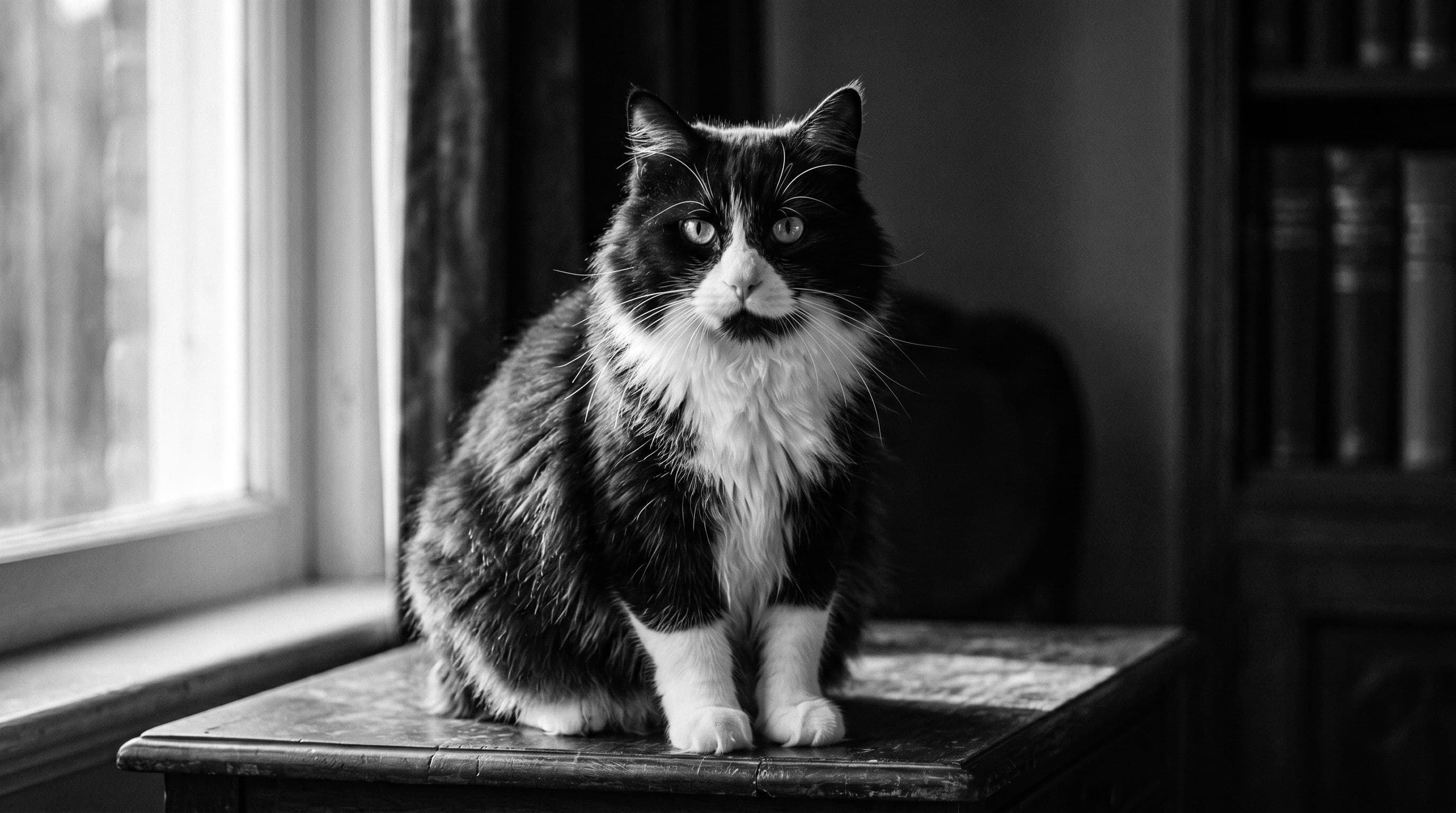
Susanne Schotz's Meowsic project at Lund University analysed 780 meows from 40 cats and compared two Swedish dialect regions, finding that meow melody varies with context. John Bradshaw, the anthrozoologist who founded the Anthrozoology Institute at the University of Bristol and wrote Cat Sense, argues that much of how cats communicate with people is learned rather than innate, and I'd say the evidence lives in my kitchen. The ASPCA's own guidance on cat vocalising backs this up: responding to a meow, even just to hush it, reinforces the sound, and repetition does the rest. It's a feedback loop, shaped by repetition and reward. I've seen this play out at home with ruthless clarity: Vino's learned that a particular rising chirp gets me out of my chair faster than his low grumble, so he deploys it with surgical precision whenever he wants dinner moved up by ten minutes.
Here's what this means in practice: a vocal cat isn't born vocal. A vocal cat is trained, by its humans, to be vocal. Every time you respond to a meow with food, attention, a door opening, or even eye contact, you've reinforced that behaviour. Do it consistently for years and you've built yourself a furry alarm system that won't shut off.
There's a second layer to this. Cats don't just learn that meowing works; they learn which meow works for which situation. Bradshaw's work argues that domestic cats have built out a wide vocal repertoire aimed specifically at communicating with people. Hungry meows differ acoustically from attention-seeking meows, which differ from the territorial yowl, which differs spectacularly from what I've come to call the protest meow.
The protest meow isn't a request. It's a grievance filing. It's sustained, single-tone, unvarying in pitch, and it goes on for five seconds or more. It exists in a category beyond operant conditioning; it's closer to a feline filibuster. And it's where Vino truly excels.
Why Are Tuxedo Cats Vocal? Vino as the Living, Breathing, Loudly Meowing Case Study
I need to set the scene. Last Thursday evening, my fiancée and I were on the couch. Vino had been outside for his usual one to two hours of afternoon yard time, during which he'd chased Zola twice, chirped at a currawong, and sat on the fence looking majestic for approximately 25 minutes. He'd come inside. He'd eaten. He'd received a thorough chin brush, which produced his customary drooling. By all objective measures, his needs were met.
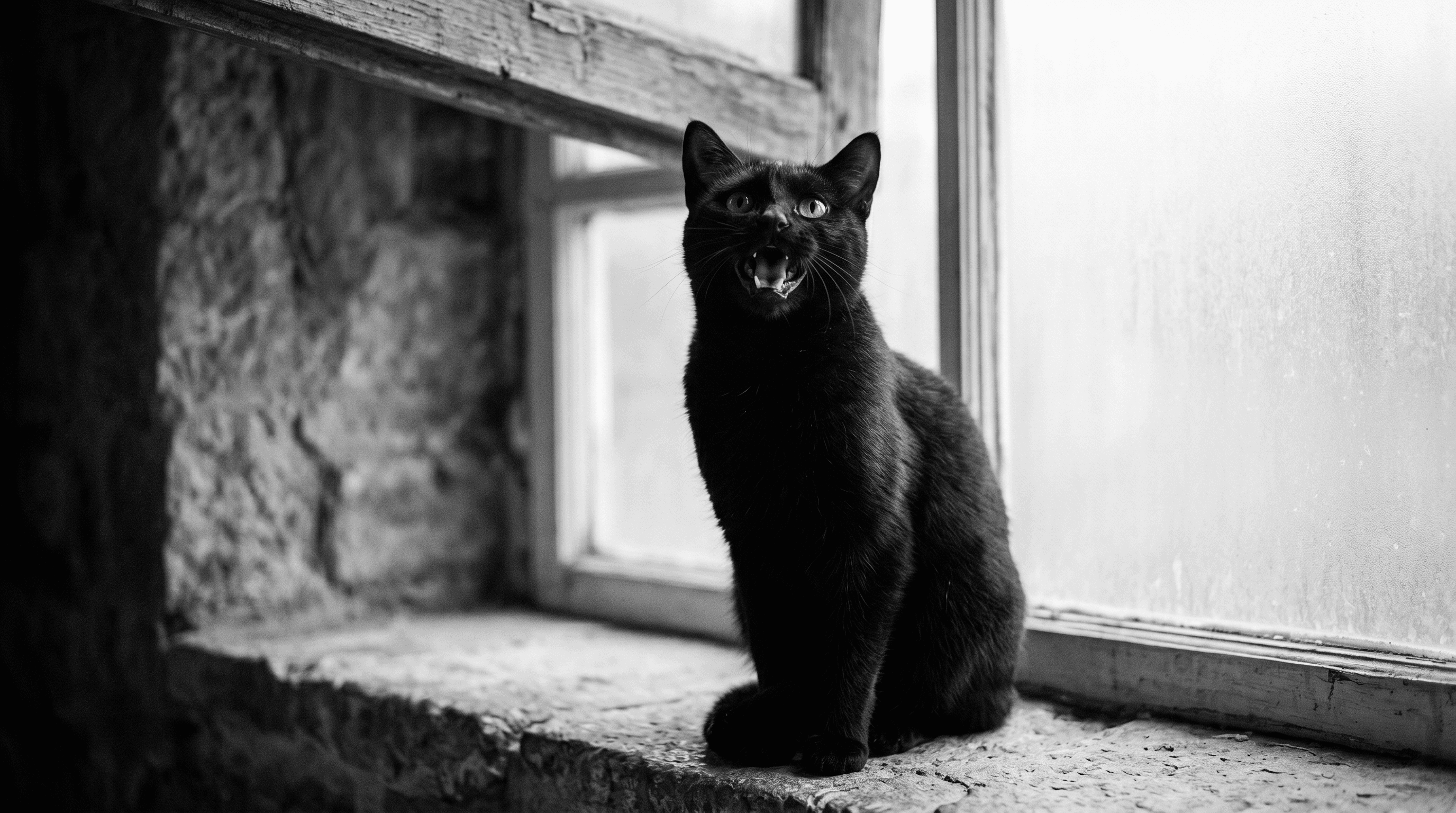
Then I opened my laptop to edit a short video we'd been working on, one of those silly things where we'd staged Vino on a miniature set that looked like a private jet cabin, complete with a tiny champagne flute and a window overlay of clouds. He'd been magnificent during filming: poised, unbothered, the picture of airborne sophistication. But now, four hours later, he wanted back outside. It was 8 PM. The answer was no.
What followed was 11 minutes of protest meowing. I timed it. He stood by the back door and produced one sustained note, paused for roughly three seconds, then produced it again. Same volume. Same pitch. Same absolute conviction that he was being wronged. Zola, who'd been asleep on the cat tower, opened one eye, assessed the situation, and closed it again. My fiancée didn't look up from her book. I sat there counting the intervals because at this point, after years, it's become a kind of perverse scientific observation.
Here's what I've documented over those years of living with Vino. He has, by my rough count, at least 8 distinct vocalisation types that I can reliably identify:
1. The breakfast demand: short, sharp, delivered from my bedside table within a couple of minutes of first light.
2. The outdoor request: medium length, rising tone, performed at the back door or kitchen window.
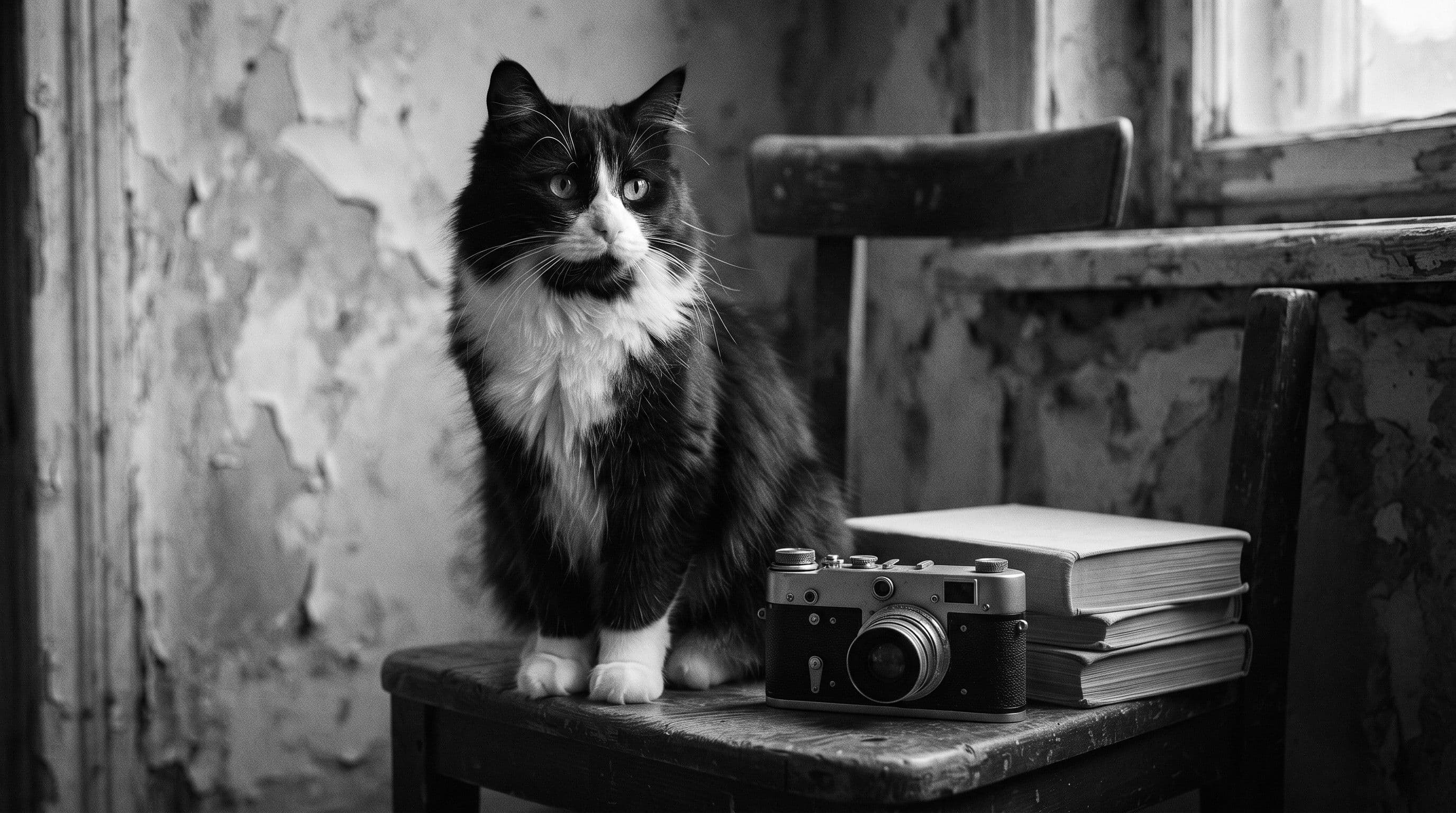
3. The protest meow: the sustained, flat, grievance-laden monotone described above.
4. The greeting chirp: a brief trill when someone enters a room or arrives at the property.
5. The bird chirp: a rapid, teeth-chattering staccato directed at wild birds through windows.
6. The pat solicitation: a soft, almost inaudible mew, deployed when he's already on your lap and wants chin scratches.
7. The Zola commentary: a mid-range meow delivered while watching Zola do something he considers interesting, like existing.
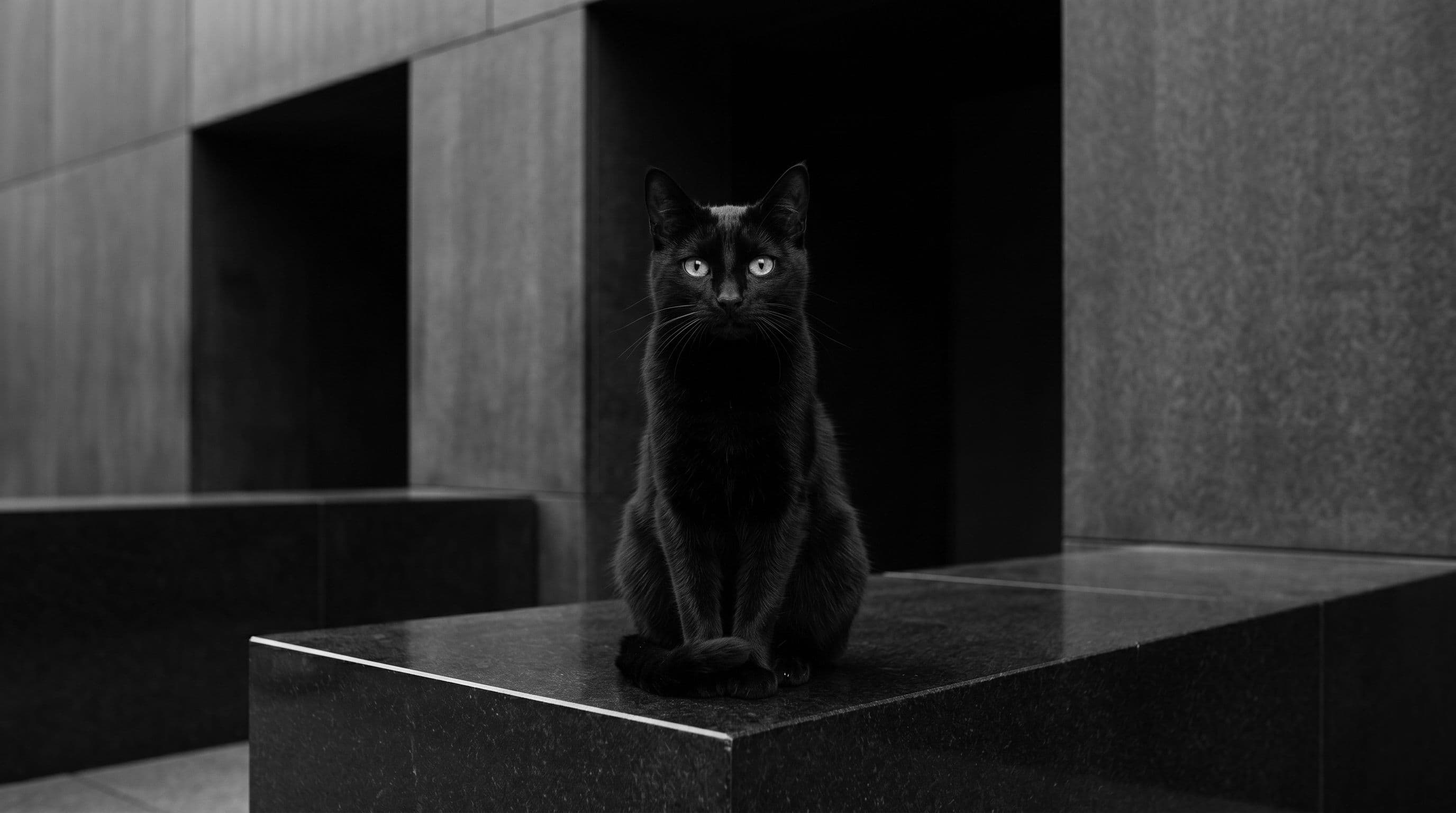
8. The carry-me yell: a loud, open-mouthed protest when picked up without his explicit consent.
Each of these produces a different response from me, my fiancée, or both. And that's the point. Vino isn't vocal because he's a tuxedo cat. He's vocal because he grew up in a winery barn where meowing at humans got him attention, moved into a house where meowing at humans continued to get him attention, and has spent approximately 1,460 days refining his technique. I've reinforced every single one of these behaviours, not through any training programme but through the simple, unavoidable act of living with him and responding to him.
The contrast with Zola is instructive. She doesn't meow for food; she sits near her bowl and stares. She doesn't meow to go outside; she sits near the door and stares. She has learned that silence and intense eye contact produce results in this household, because early on, that's what worked for her. Same environment, different conditioning history, completely different vocal profile.
If coat colour determined vocalisation, Zola's near-total blackness should predict something. It doesn't predict anything. She's quiet because quiet worked.