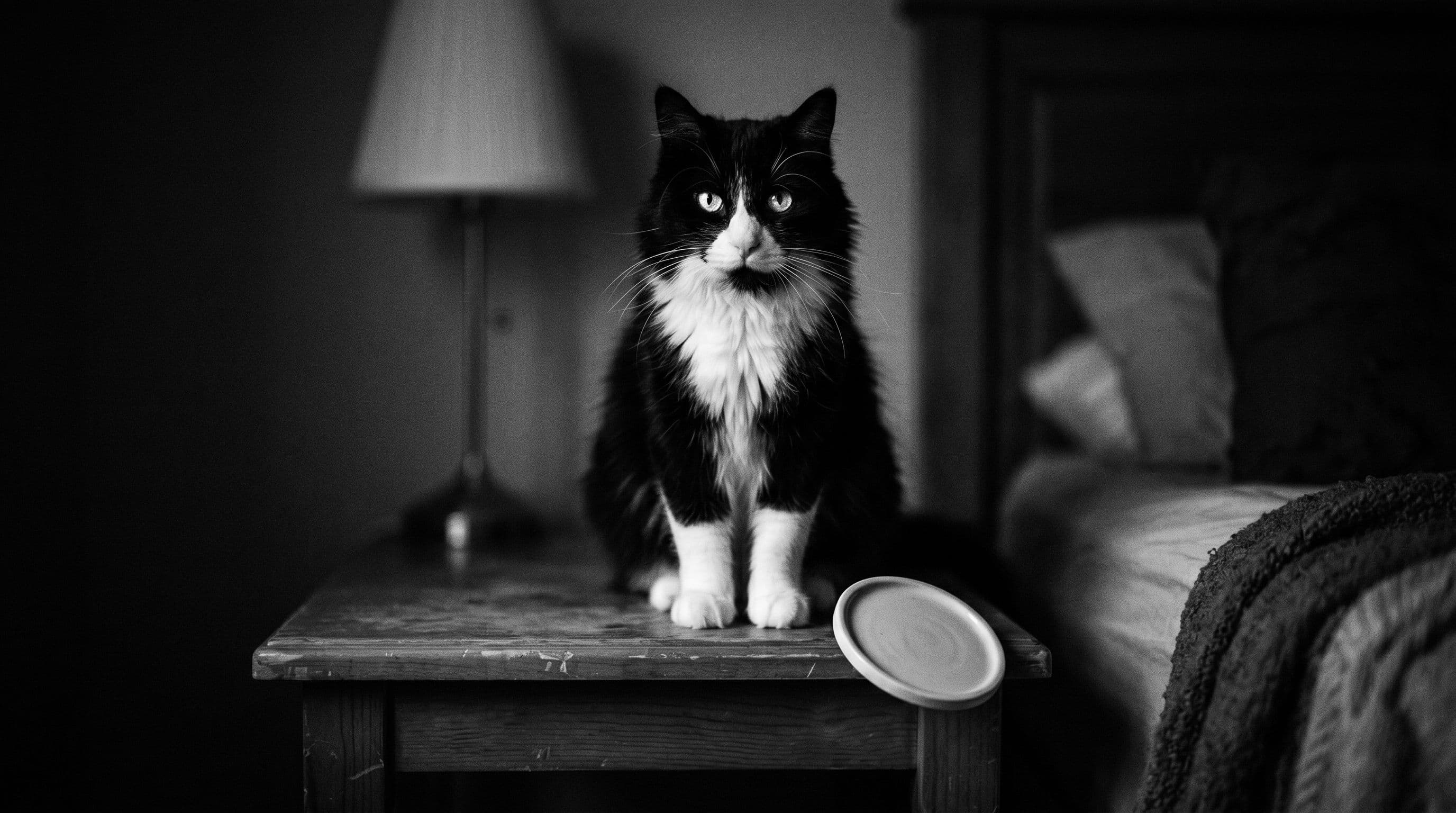
I woke in the dead of night to the sound of a ceramic coaster sliding off my bedside table, followed by a soft thud, followed by absolute silence. That silence was worse than the noise. I turned on my phone's flashlight and found Vino sitting exactly where the coaster had been, green eyes catching the light, his white chest practically glowing in the dark. He wasn't startled. He wasn't sorry. He looked, if anything, mildly inconvenienced that I'd woken up before he could knock the second coaster off. Tuxedo cat behavior at night is something I've spent years learning to coexist with, and I still haven't figured out whether Vino treats the hours between midnight and 5 a.m. as his personal obstacle course or his private performance art.
Tuxedo Cat Behavior at Night: It's Not Random, Even When It Feels Like It
I should be clear about something: Vino isn't technically nocturnal. No domestic cat is. The term veterinary behaviorists prefer is "crepuscular," meaning most active at dawn and dusk. Dr. Mikel Delgado, a certified applied animal behaviorist who completed her PhD in psychology at UC Berkeley and researched feline behavior as a postdoc at the UC Davis School of Veterinary Medicine, co-wrote Total Cat Mojo and Play With Your Cat! Her work sits squarely in this space, and the crepuscular pattern she and other feline behavior experts study traces back to the domestic cat's wild ancestors, the African wildcat (Felis lybica), which hunted small prey in low-light conditions. That instinct hasn't gone anywhere in the roughly 10,000 years since domestication began, and Vino performs a flawless reenactment of it every single morning before the sun is properly up.
But here's what the textbooks don't fully prepare you for: crepuscular doesn't mean "briefly active at sunrise and sunset, then politely asleep the rest of the night." In practice, it means Vino's energy peaks around twilight, stays elevated for hours, and produces a 3 a.m. coaster incident that has nothing to do with dawn or dusk and everything to do with a cat who's been lightly dozing since 9 p.m. and has decided it's time to do something about it.
Vino weighs about 6 kg. That's a decent amount of cat, and when he lands on the bedside table at full confidence, you hear it. His medium-long fur makes him look even larger in dim light; this enormous tuxedo shape materializing on surfaces where he shouldn't be. The white paws, white chest, and that distinctive black chin all become one blurred silhouette until he gets close enough for the details to resolve.
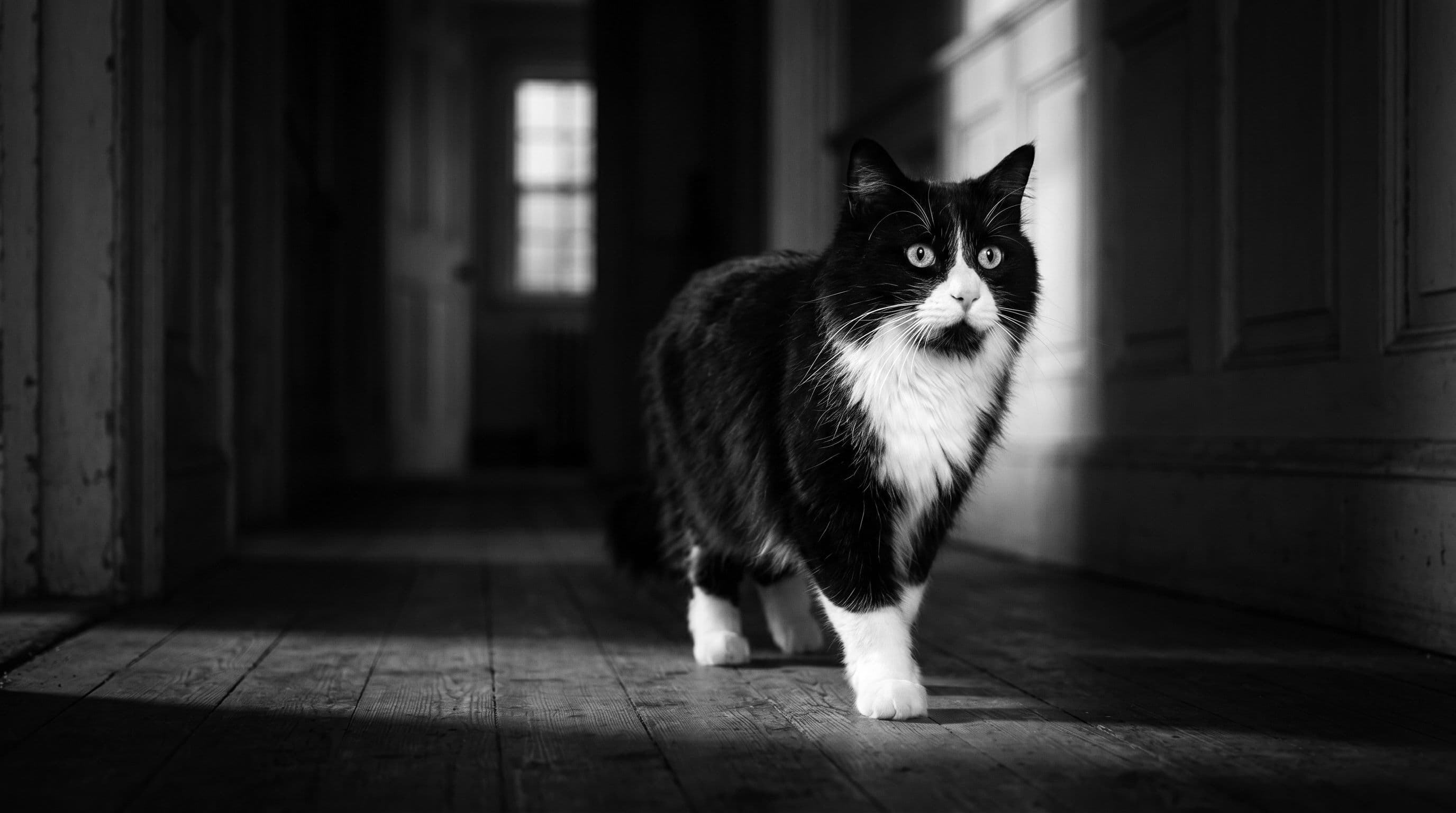
What I've noticed over the years is a pattern. The nights when Vino is most active tend to follow days when his afternoon outdoor time got cut short. He and Zola usually go outside for one to two hours before dinner, and on the days when weather or schedule compresses that window to 20 minutes or less, I can almost guarantee he'll be doing laps of the hallway at 1 a.m. It's not spite. It's unspent energy with nowhere to go. Understanding why tuxedo cats can be so vocal helps contextualize the soundtrack that accompanies these midnight sessions, because Vino doesn't prowl quietly. He narrates.
How Vino Compares to the "Average" Nighttime Cat
Most cats aren't actually tearing around the house at 3 a.m. the way people assume. From what I've observed with Vino, his wildest bursts of energy hit in the early evening and again just before dawn, with a secondary, smaller spike between 4 and 6 a.m. .
Vino didn't get the memo.
His pattern runs hotter and later than what that study describes. I don't have accelerometer data on him, but I do have years of disrupted sleep and a phone full of 2 a.m. notes I've typed with one eye open. His evening energy doesn't taper after 8 p.m.; it holds steady until roughly 10:30, dips for a couple of hours, then resurfaces between 1 and 3 a.m. with genuine enthusiasm. The morning spike is real, too, but it's linked directly to the rooster. The bird crows at first light, and within 30 seconds Vino is on the bedside table meowing for breakfast. At least that one's predictable.
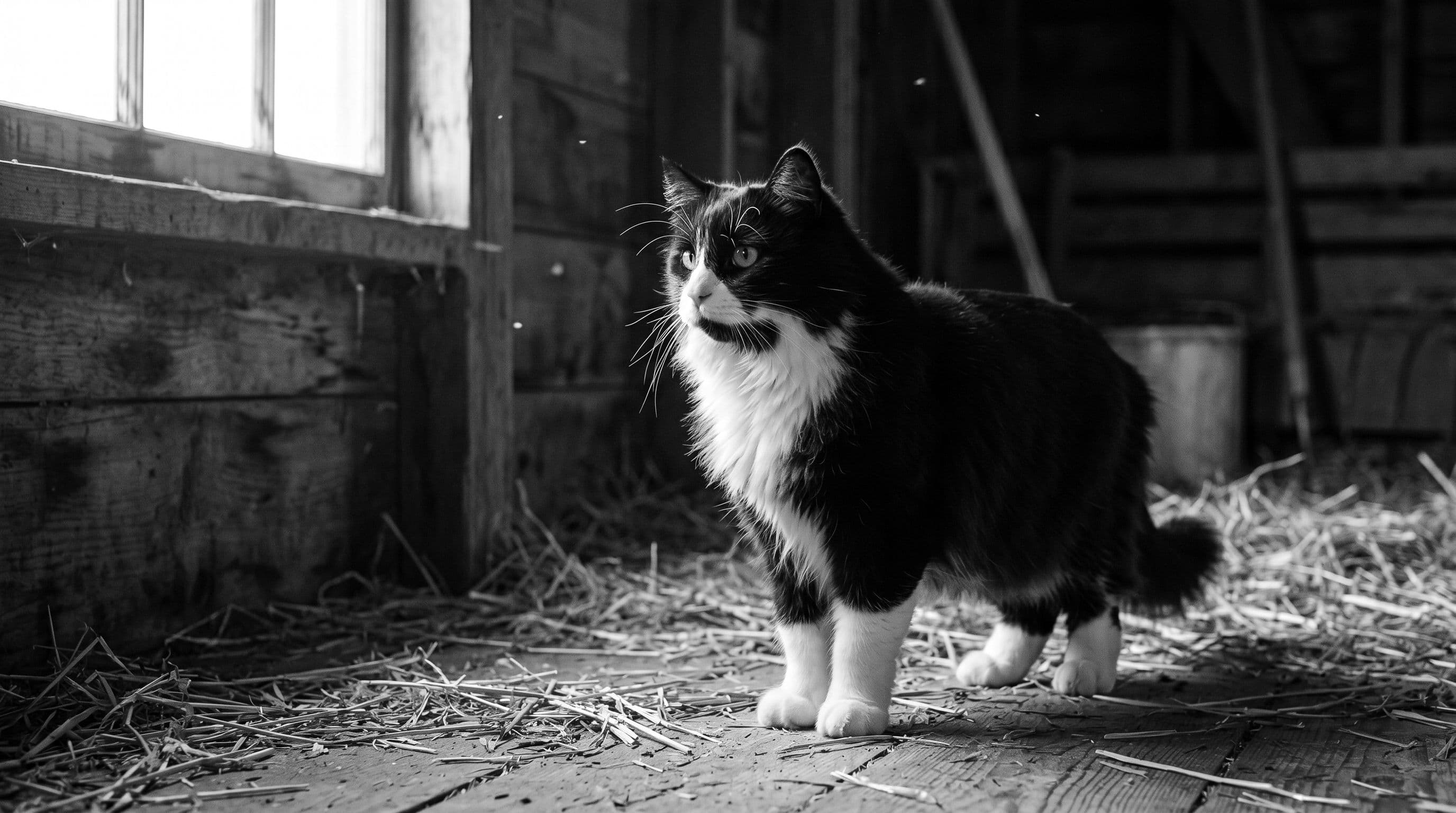
Zola, by contrast, fits the textbook pattern almost exactly. She's active in the early evening, settles by 9 p.m., and doesn't stir until morning. She's a slender black cat with a laid-back temperament that borders on philosophical. If Vino is the colleague who sends emails at midnight, Zola is the one who has her out-of-office on by 5 p.m. sharp. Their differences remind me that while we talk about breed tendencies and species-wide rhythms, individual variation is enormous. I've lived with cats for long enough to know that two animals sharing the same house, eating the same food, and sleeping on the same sofa can develop completely different schedules, preferences, and personalities. No generalization about feline behavior has survived a week under my roof without Vino or Zola punching a hole in it. I don't need a study to tell me this. I live it.
One factor that likely contributes to Vino's heightened nighttime activity is his origin. He spent his first couple of years as a working cat on a biodynamic vineyard in northern Tasmania, catching mice. That was a life structured around dusk-to-dawn hunting. The barn where I first met him was built for that rhythm: every evening, mice emerged, and every evening, Vino went to work. A crepuscular schedule wouldn't just have been natural there; it would have been rewarded daily with a fresh catch. You don't erase that wiring by moving a cat onto a couch and offering him a bowl of food twice a day. The instinct got built in, and it stayed.
I wrote about Vino's origin story at the vineyard in an earlier post, and looking back, it explains so much about the cat I share a bed with. He wasn't raised to sleep through the night. He was raised to own it.
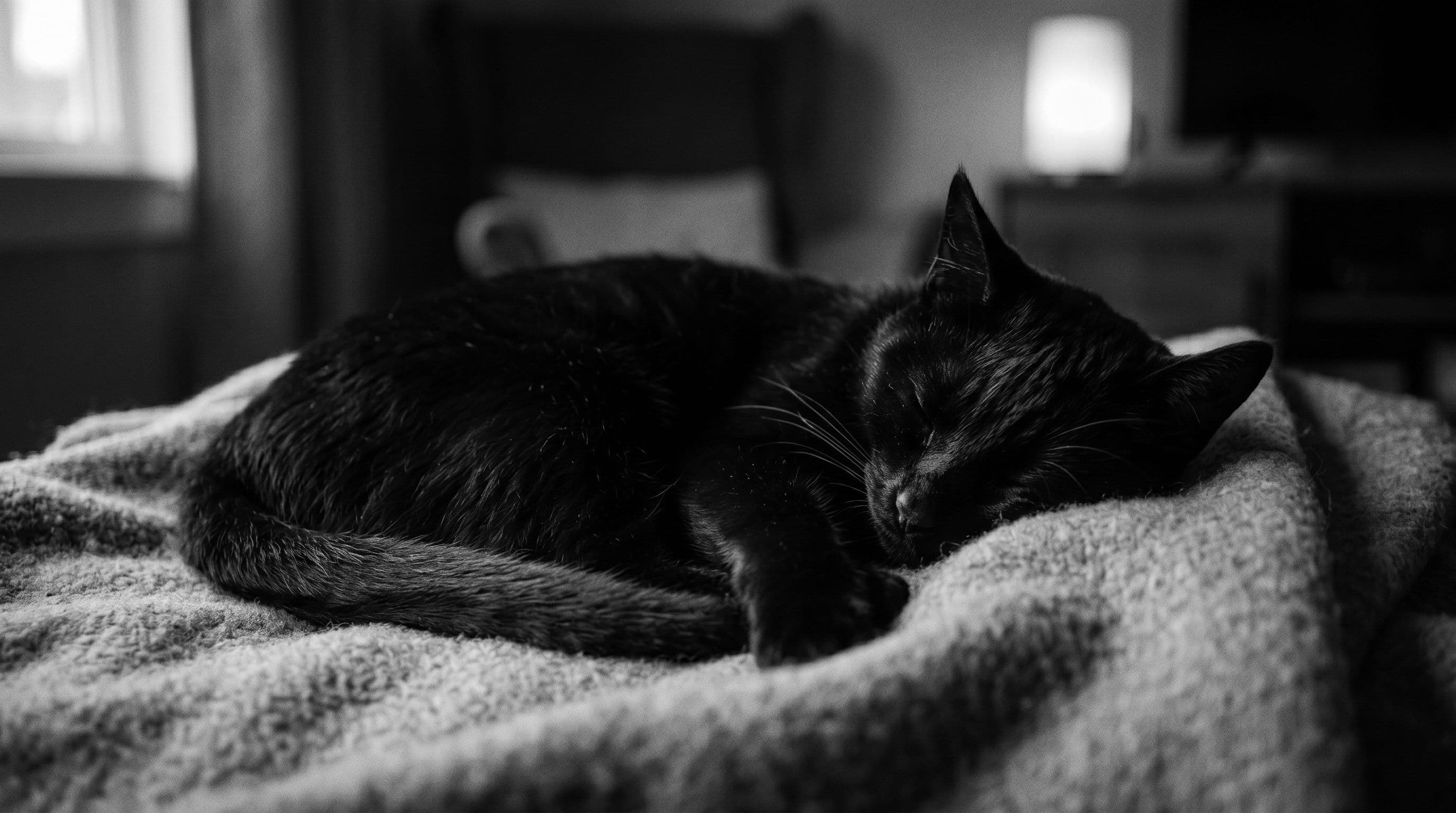
What You Can Actually Do About a Nighttime-Active Cat
I won't pretend I've solved this. But I've made it livable, and there are a few things that have genuinely helped.
Extend the evening play session. This is the single most effective change I've made. Around 8 p.m., I spend 15 to 20 minutes running Vino through an active play session with a wand toy. Not a lazy wave-it-around session; a proper one, where the toy mimics prey behavior and he's sprinting, leaping, and pouncing. Dr. Sarah Ellis, coauthor of The Trainable Cat and feline behavior specialist at the International Cat Care organization, recommends ending play sessions with a small meal to mimic the hunt-catch-eat-sleep cycle. I do exactly that. Vino gets his evening meal right after play, and it noticeably delays his first nighttime activation by about an hour or two.
Protect your sleep environment. I moved anything knockable off the bedside table. This took three broken items to learn. The coaster incident was the last straw. Now the surface has a lamp (bolted to a charging base that's heavy enough to resist him) and nothing else. If Vino lands on it at 3 a.m., there's nothing to push off, which removes about 60 percent of the fun.
Don't respond to midnight meowing. This is excruciating, and I won't sugarcoat it. Vino's protest meow, that sustained five-second tone he produces when something hasn't gone his way, is specifically designed to make you do something. Responding teaches him that 3 a.m. meowing produces results. I've spent months training myself to lie still and not engage, and it's reduced the duration of his nighttime vocal performances from 10 or 12 minutes down to about 3.
Enrich the daytime hours. A bored indoor cat stores up energy for the night. Vino has access to a cat tower, window perches where he watches the chickens and the wild birds, and a rotation of toys I swap out weekly. Puzzle feeders work well for some cats; Vino tolerates them but prefers to yell at me until I just give him the food directly. Know your cat.
Don't punish. Spraying water, yelling, or shoving a cat off the bed at 2 a.m. doesn't teach them anything except that you're unpredictable when tired. Vino spent his early life in a vineyard barn with an elderly man who, by all accounts, let him do whatever he wanted. That relationship built trust. I'm not going to undo it because I'm groggy and annoyed about a coaster.
Consider a second cat. This isn't a universal fix, and it comes with its own complications. But Zola's presence in the house gives Vino a social outlet that I physically can't provide at 4 a.m. They don't cuddle, and their relationship involves a fair amount of performative hissing, but they do chase each other in the evenings, and that burns energy. About 30 percent of Vino's nighttime restlessness seems to settle when he finds Zola already occupying the foot of the bed; he'll curl up near her (never touching) and stay put longer than he would alone.
Frequently Asked
The 3 A.M. Patrol Route: Mapping Vino's Nightly Circuit
Around two months ago, I started paying closer attention to where Vino actually goes during his nighttime activity bursts. Not just the sounds; the route. I left a few interior doors ajar and stayed awake one Friday night with a book and a cold cup of tea, tracking his movements from my bedroom doorway. What I discovered is that Vino doesn't wander randomly. He runs a loop.
It starts at the living room windowsill, where he checks whatever's happening outside. Then he drops to the floor, crosses to the kitchen counter (a hop he's not supposed to make but executes flawlessly), sits there for thirty seconds or so, then jumps down and sprints through the hallway to the bedroom. That's one rotation, and he'll run it two or three times before dawn if I haven't provided enough entertainment during the evening. Tuxedo cat behavior at night, at least in this house, looks less like chaos and more like a security patrol with a cardio component.
[PHOTO: Vino perched on the living room windowsill at dusk, green eyes reflecting the fading light]
Zola, at about 3.9 kg, sometimes joins the circuit on certain nights but treats it more like a loose suggestion than a fixed route. She'll skip the kitchen entirely or simply sit in the hallway watching Vino thunder past. Vino, at about 6 kg, makes enough noise for both of them. His white paws on hardwood floors at 3 a.m. sound like someone dropped a bag of small potatoes down a staircase.
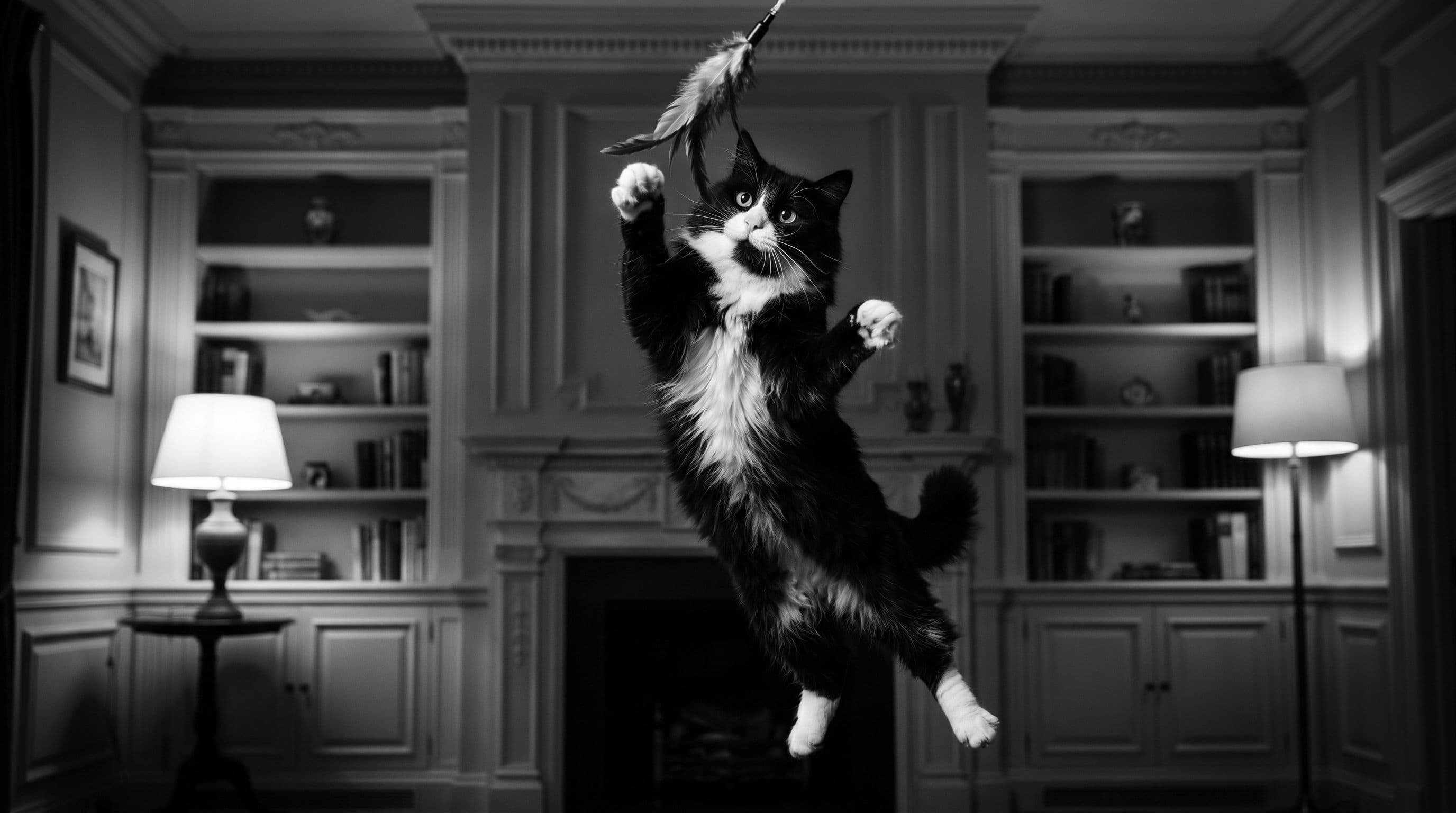
The single most effective thing I've done to reduce the nighttime chaos is adding a solid 15-minute interactive play session right before I turn off the lights. I use a Da Bird feather wand, and Vino will chase it until he's panting. That doesn't eliminate the patrol. Nothing eliminates the patrol. But it pushes his first loop from the small hours closer to dawn, which buys me an extra couple of hours of unbroken sleep. I'll take it.
[PHOTO: Vino mid-leap chasing a feather wand toy, black and white coat blurred with motion]
Why Does My Tuxedo Cat Get Hyper at Night?
That crepuscular instinct I mentioned earlier doesn't shut off because the lights are out. Vino's energy peaks overlap with twilight hours, but the residual drive carries well into the night. If he hasn't burned enough energy through play or mental stimulation before bedtime, he'll find his own outlet. That outlet is usually my coasters, a pen left on the desk, or the bathroom doorstop, which makes a spectacular boing at 2 a.m. that echoes through the entire flat.
Indoor cats like Vino also respond to sounds and movements outside that I can't detect from bed. A fox trotting past the window, moths flickering against the glass, a neighbour's cat prowling the garden: all of these trigger a spike in alertness. I've noticed Vino's wildest nights correlate with warm weather, when I leave windows cracked and the outside world pours in.
Should I Stop My Tuxedo Cat From Being Active at Night?
Trying to suppress all nighttime activity would be like trying to stop water from being wet. Vino's wired for it. What I focus on instead is redirecting and reducing the intensity. A puzzle feeder loaded with a few kibbles, left out before bed, gives him something to work on quietly. The Da Bird session I mentioned handles the physical energy. And keeping bedroom surfaces clear of anything knockable protects both my sleep and my ceramics.
[PHOTO: Vino investigating a puzzle feeder on the kitchen floor, one white paw reaching inside]
Does Coat Pattern Affect Nighttime Cat Behavior?
I've seen this claim floating around online, and I'll be honest: nothing in my house supports it. Vino's tuxedo markings don't make him more or less active at night than Zola, who's also a tuxedo. Their activity levels differ because their personalities differ. Vino's an instigator; Zola's an observer. Coat pattern is cosmetic. Temperament is individual. If your tuxedo cat's running laps at 3 a.m., that's a cat thing, not a colour thing.
FAQ
How Do I Get My Tuxedo Cat to Sleep Through the Night?
You probably won't achieve a full eight hours of feline stillness. What works in this house is a vigorous play session before bed, a small portion of food right at lights-out, and removing tempting objects from surfaces. Vino still wakes, but the episodes are shorter and less destructive when he's been properly tired out.
Is It Normal for Tuxedo Cats to Be Loud at Night?
Absolutely. Vino's nighttime soundtrack includes galloping, the occasional chirp at the window, and whatever object he's chosen to push off a surface that evening. Cats are crepuscular, so bursts of activity during dark hours are biologically normal. If the vocalisation is excessive or sounds distressed, that's worth a vet conversation.
Should I Lock My Cat Out of the Bedroom at Night?
I tried this once. Vino sat outside the door and scratched it rhythmically for forty-five minutes. The sleep I saved was negative. Some cats adjust to a closed door; Vino treated it as a personal challenge. I now leave the door open and accept the occasional 4 a.m. face pat as the cost of cohabitation.