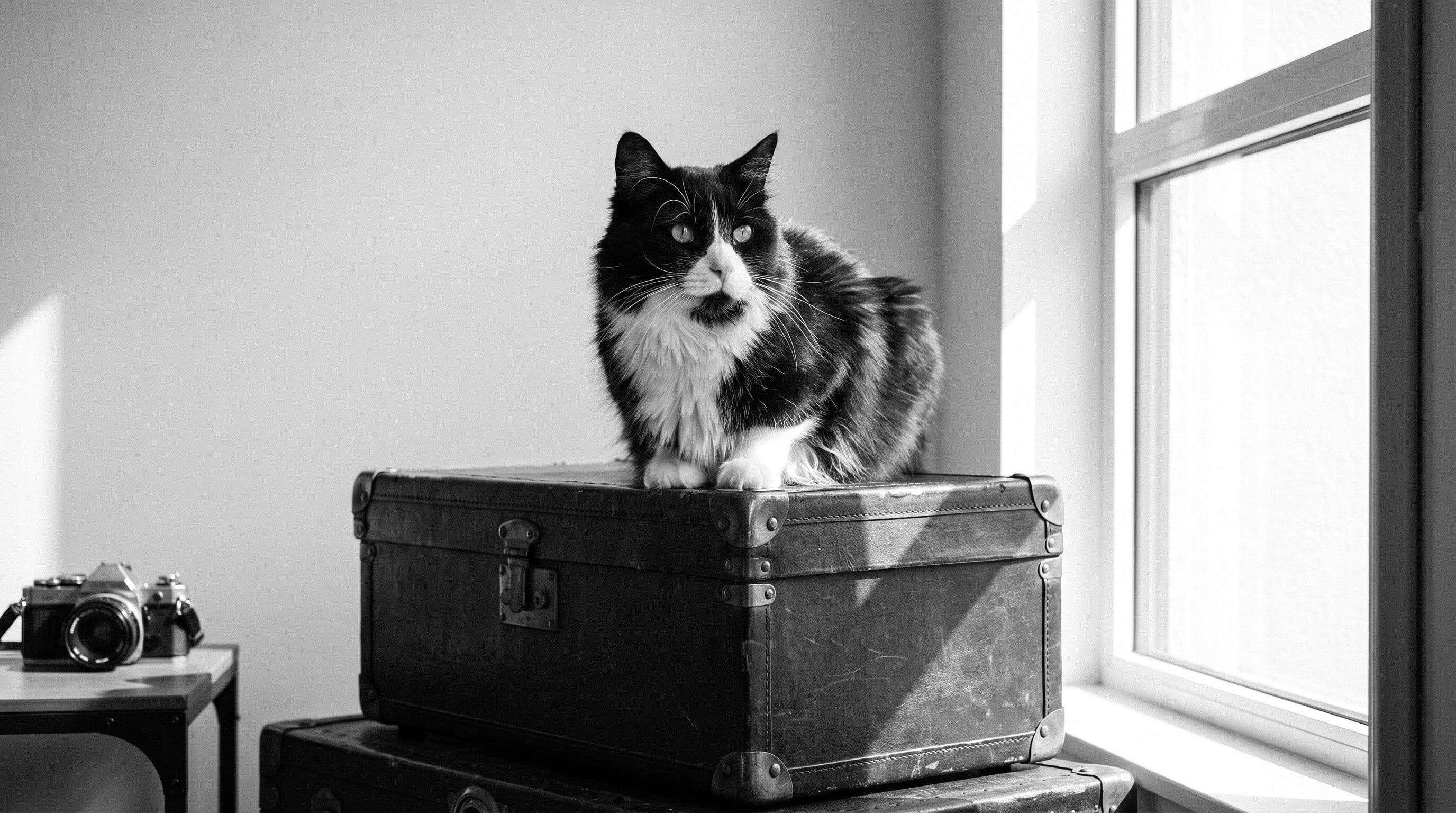
Vino on the Correct Conduct for Receiving Guests
The position of Senior Receiving Officer was never advertised. There was no interview, no handover of duties, no formal announcement to the household. Vino simply assumed the role, as he has assumed every other role of consequence in our home, and has been conducting himself accordingly ever since. I've largely accepted this arrangement without protest. I open the door. He does the rest.
What follows is an account of how that process actually works: the protocols Vino has established, the standards he enforces, and the cautionary example of one local Staffy who has, repeatedly and without apparent self-reflection, failed to meet them.
The Lap Assessment: What It Means When Vino Sits on You
It would be flattering to interpret it as warmth. It isn't. Or rather, it isn't only that.
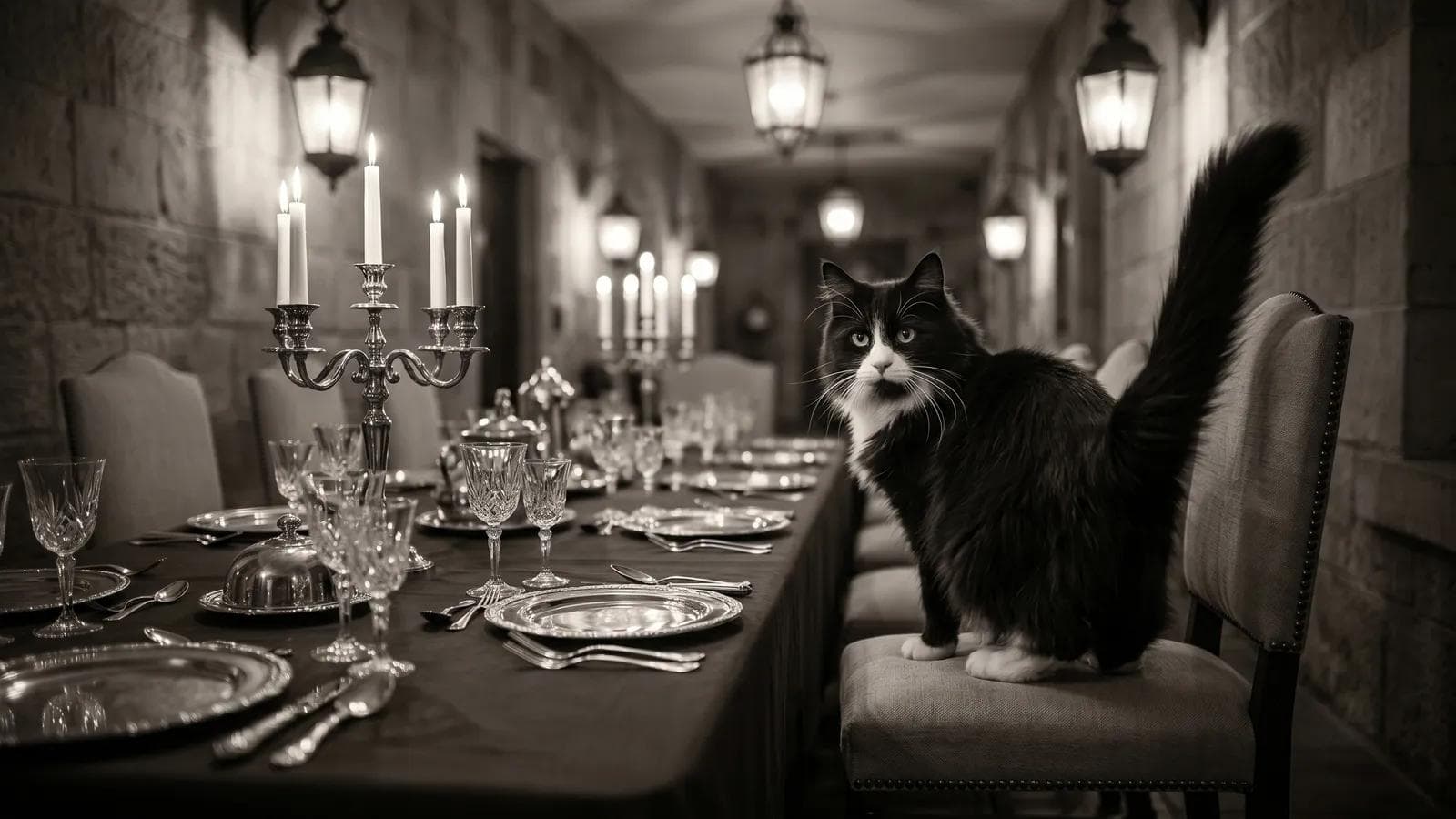
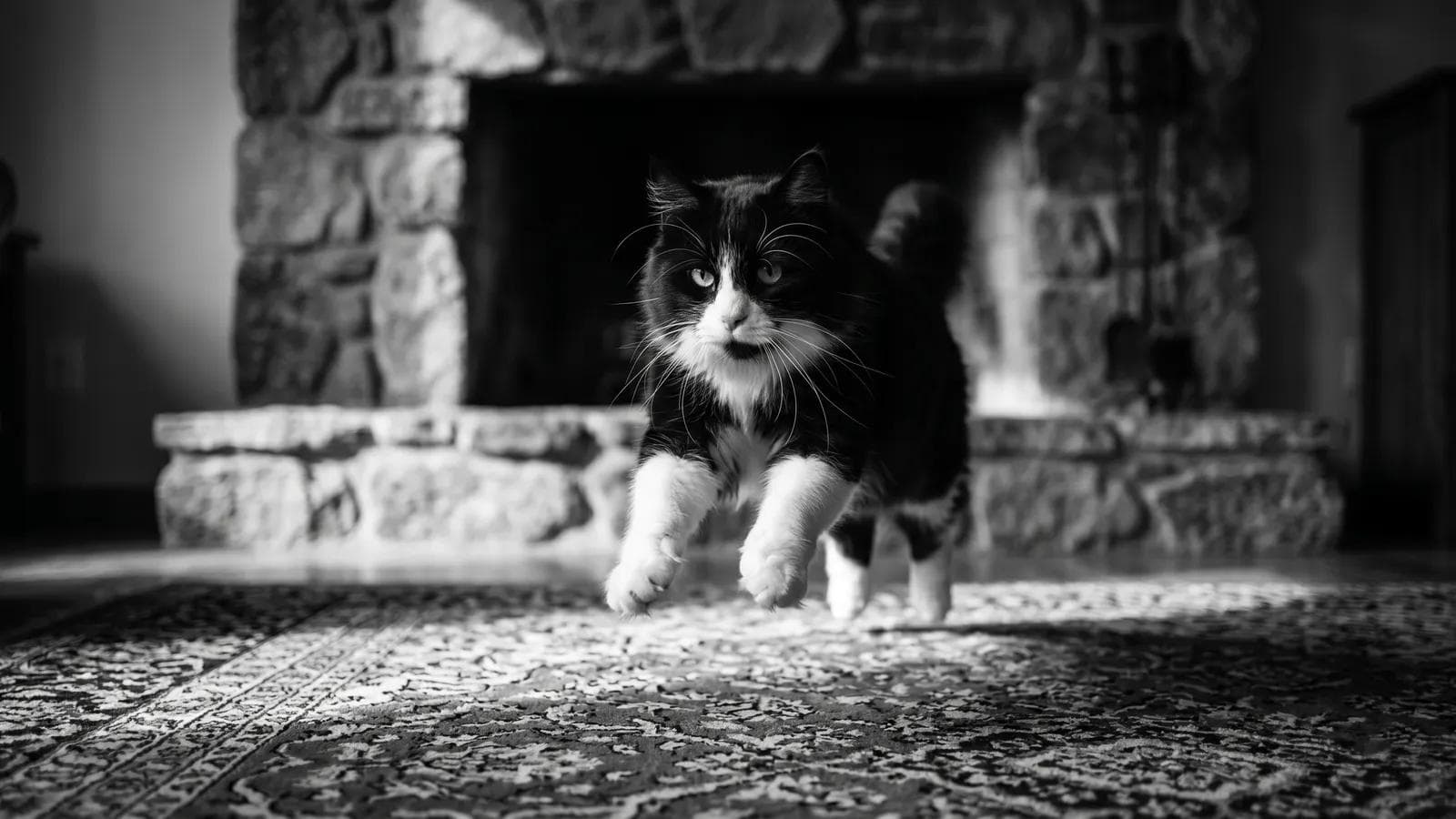
When a guest settles into a seat in our home, the evaluation begins. It doesn't look like an evaluation. It looks like a medium-long-furred tuxedo cat padding across the room with the measured confidence of someone who has somewhere important to be. It looks like him pausing, briefly, to weigh his options. And then it looks like him placing all four of his white-pawed feet onto a guest's lap and arranging himself there with the unhurried deliberateness of a judge taking the bench.
This is the lap assessment. It has been running, by all observable evidence, since I brought Vino home in April 2022.
The criteria he applies are not fully documented. What is known: he doesn't require prior acquaintance. He doesn't need to have met you before. He needs you to be seated, to have made yourself available, and to be prepared to remain still for as long as he requires. Guests who shift uncomfortably, who check their phones, who attempt to relocate him before the session is complete, receive a long, considering look. They are noted.
Guests who sit correctly, who offer a hand when it is appropriate and refrain when it isn't, who do not make the error of assuming this is cuddling, tend to pass. What passing looks like, in practice: Vino remains for the duration of their visit. He returns to them if he leaves. He may, in exceptional circumstances, produce the deep chest rumble that I privately consider high praise, though it would be unwise to say this out loud where Vino might hear it.
He drools, during these sessions. This is not a design flaw. This is Vino at maximum approval. A guest who comes away from a lap assessment with a small damp patch on the knee has, by any reasonable measure, been endorsed.
It is worth being clear: Vino is not a difficult cat to receive an endorsement from. He's broadly willing to make himself available to most guests who present themselves correctly. What he will not do is pretend that the process is casual. It isn't. He takes it seriously, and I've learned to take it seriously on his behalf.
The Walk-In Protocol: Entry Procedure, as Established by the Senior Officer
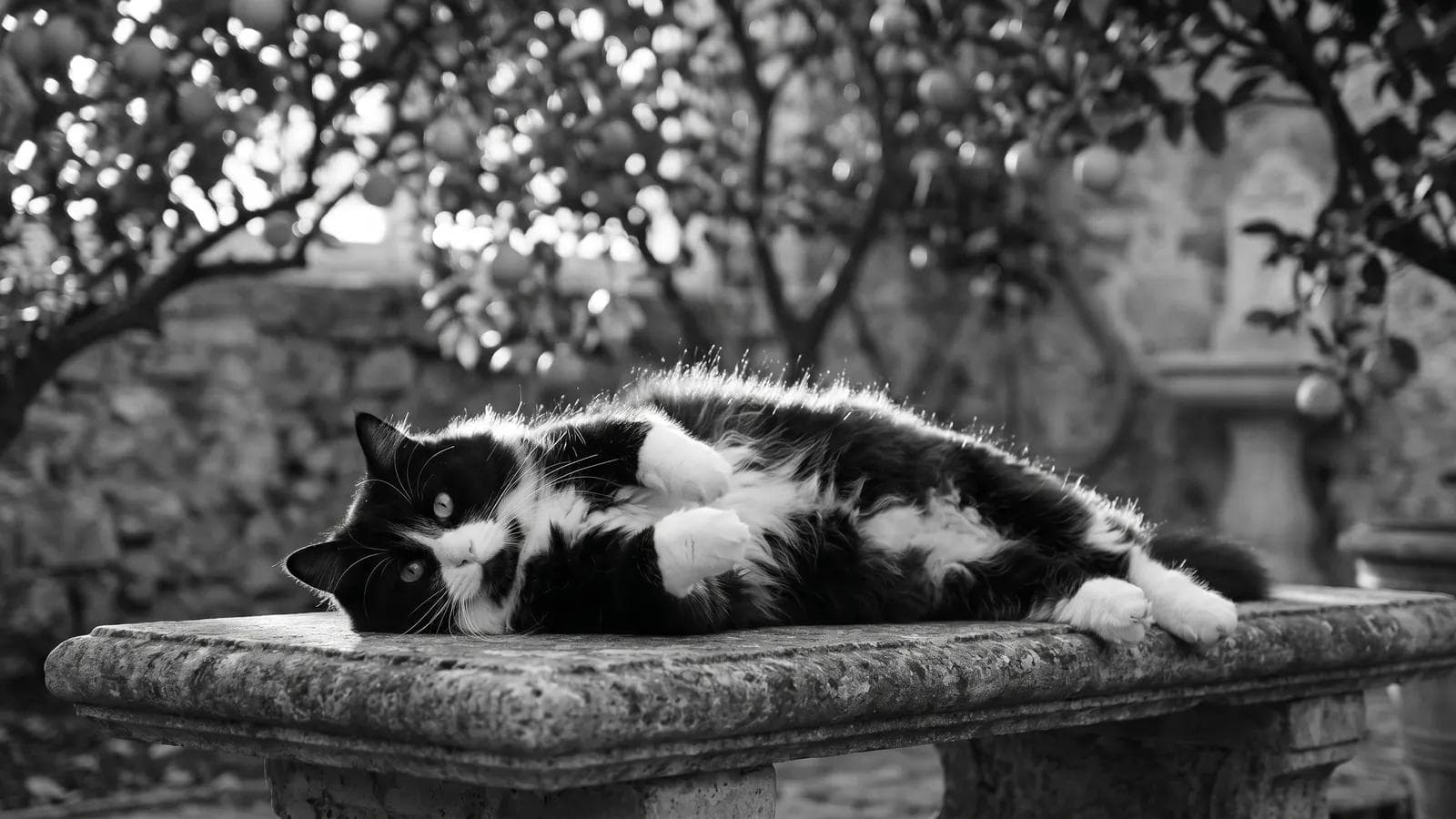
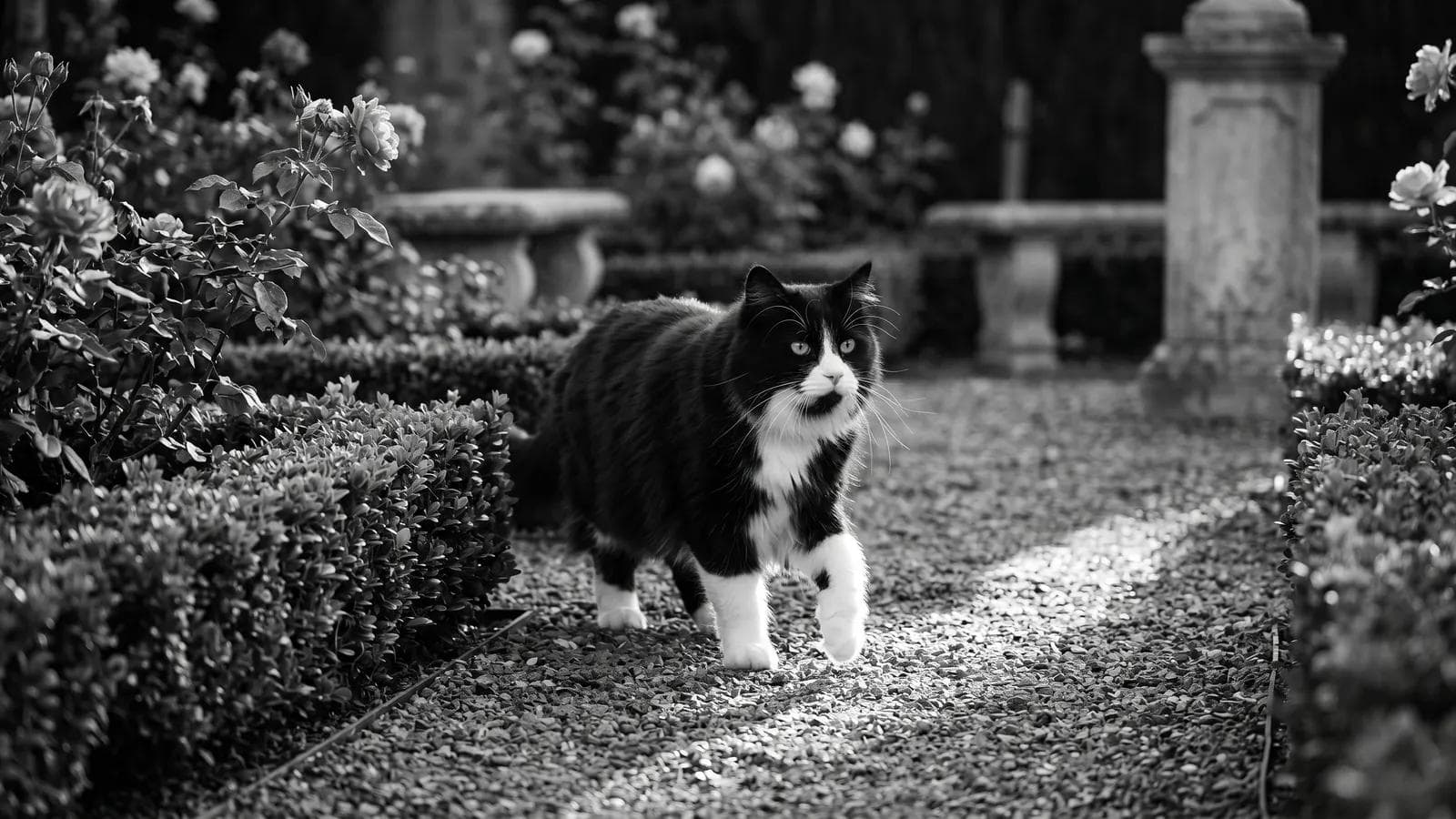
Vino spends a portion of each afternoon outside. He wanders the yard, sits in sun patches, chirps at birds that are clearly not going to come any closer, and conducts whatever private assessments outdoor life requires of him. He is, by all accounts, reasonably content out there. The fence line is his boundary and his territory simultaneously.
It's at the fence line, or somewhere near it, that the walk-in protocol operates.
When a visitor arrives at the property and Vino happens to be outside, he will walk in with them. Not invited. Not called. Not directed by me, and I would be the first to admit I have no particular influence over the matter. He simply falls into step beside the incoming guest, or sometimes slightly ahead of them, and enters the house as though this were always the plan.
It wasn't always the plan. There was no plan. This is Vino's plan, arrived at independently, and it has been operating consistently enough that it can now be described as protocol.
What he's doing, structurally, is what he's always done. At the winery in northern Tasmania where he lived before, before I brought him home in April 2022, the behaviour was identical. Every time someone entered the barn, Vino was immediately present, immediately inserting himself, immediately making clear that whatever was about to happen was now his business too. He walked between legs. He jumped onto surfaces that had nothing to do with him. He demanded acknowledgement and kept demanding it until he received it.
The walk-in protocol is that instinct, refined. He doesn't trip anyone at the gate these days. He's more measured about it. But the underlying position hasn't changed: if you're coming in, he's coming in with you, and the courtesy of being escorted by our home's Senior Receiving Officer ought to be received with the appropriate gratitude.
Some guests, to their credit, do manage this. They arrive, find themselves walking alongside a medium-long-furred tuxedo cat with a natural bow-tie marking on his chest and green-gold eyes that suggest he's already decided how this is going to go, and they have the good sense to accept the escort. These guests tend to do well in the lap assessment that follows.
The Staffy Situation: A Case Study in Failed Guest Conduct
There is, next door, a Staffy.
The Staffy was never a guest of the household in any formal sense. It lives adjacent to the property, separated from Vino's domain by a fence. But it presents itself, repeatedly and with considerable energy, at that fence, and it is therefore subject to the same standards that Vino applies to all incoming parties. The Staffy has not, across any observed visit, met those standards.
The failure is not one of malice. It is, more precisely, a failure of conduct. Of composure. Of the basic understanding that when you enter another party's sphere of awareness, you do not immediately begin screaming.
Vino's response to this is, and this requires emphasis, masterful.
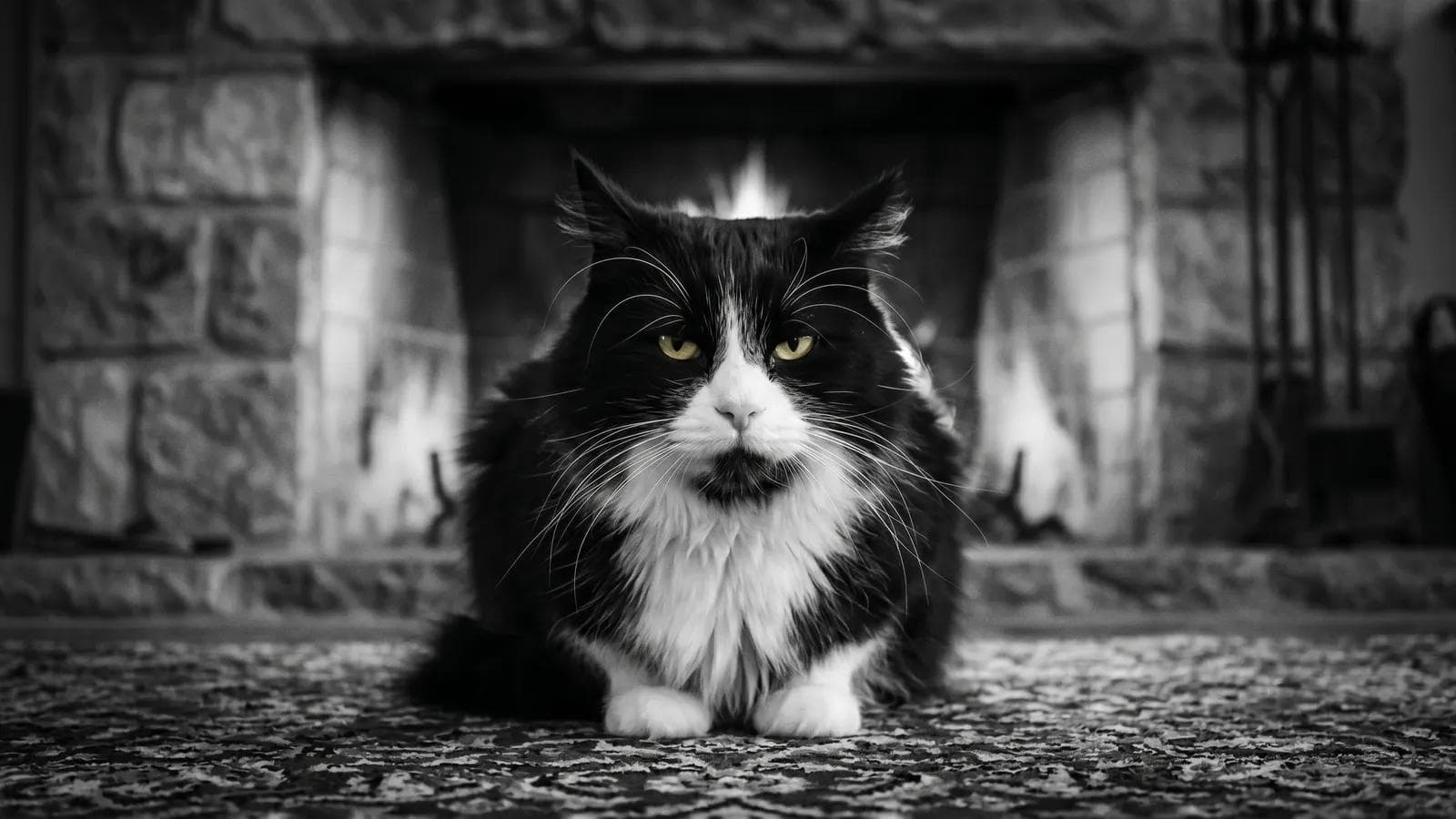
He does not react. He does not approach the fence. He does not engage, escalate, or in any way acknowledge that a dog is losing its composure approximately three metres away. What he does, instead, is lie down somewhere in the approximate vicinity of the fence line, position his gaze at a point in the middle distance that is clearly not the Staffy, and remain there. Perfectly still. Fur unruffled. Eyes calm. White paws arranged as though he might be posing for a portrait, if portraits were his sort of thing, which frankly they might be.
The Staffy continues. The Staffy escalates. The Staffy produces the full range of sounds that Staffies, when they have entirely abandoned self-regulation, are capable of producing.
Vino does not look at the fence.
This is, if you are paying attention, the provocation. He didn't need to jump the fence. He doesn't need to hiss, or posture, or do anything at all that could be described as a response. The absolute refusal to acknowledge the other party is itself the act. It says, without saying anything, that the Staffy does not clear the threshold required to receive a response from Vino. That the commotion next door is being registered at some administrative level, filed under "not my concern," and that the Senior Receiving Officer has returned to whatever he was considering before this interruption began.
The Staffy, to be generous about it, was dealing with something it didn't have the tools to manage. Vino's ignoring is a form of communication, and the Staffy can feel it. The silence is an assessment. The silence is, unmistakably, a verdict.
It's a study in the gap between incorrect conduct and correct conduct. The Staffy presents itself at volume, without composure, without any apparent awareness of how this reflects on it. Vino receives this, and returns nothing. Not because he can't be bothered, but because the Staffy has not demonstrated conduct sufficient to merit the full engagement of the Senior Receiving Officer's attention.
I find this enormously funny. Vino has not acknowledged that.
Zola's Approach: A Different Department
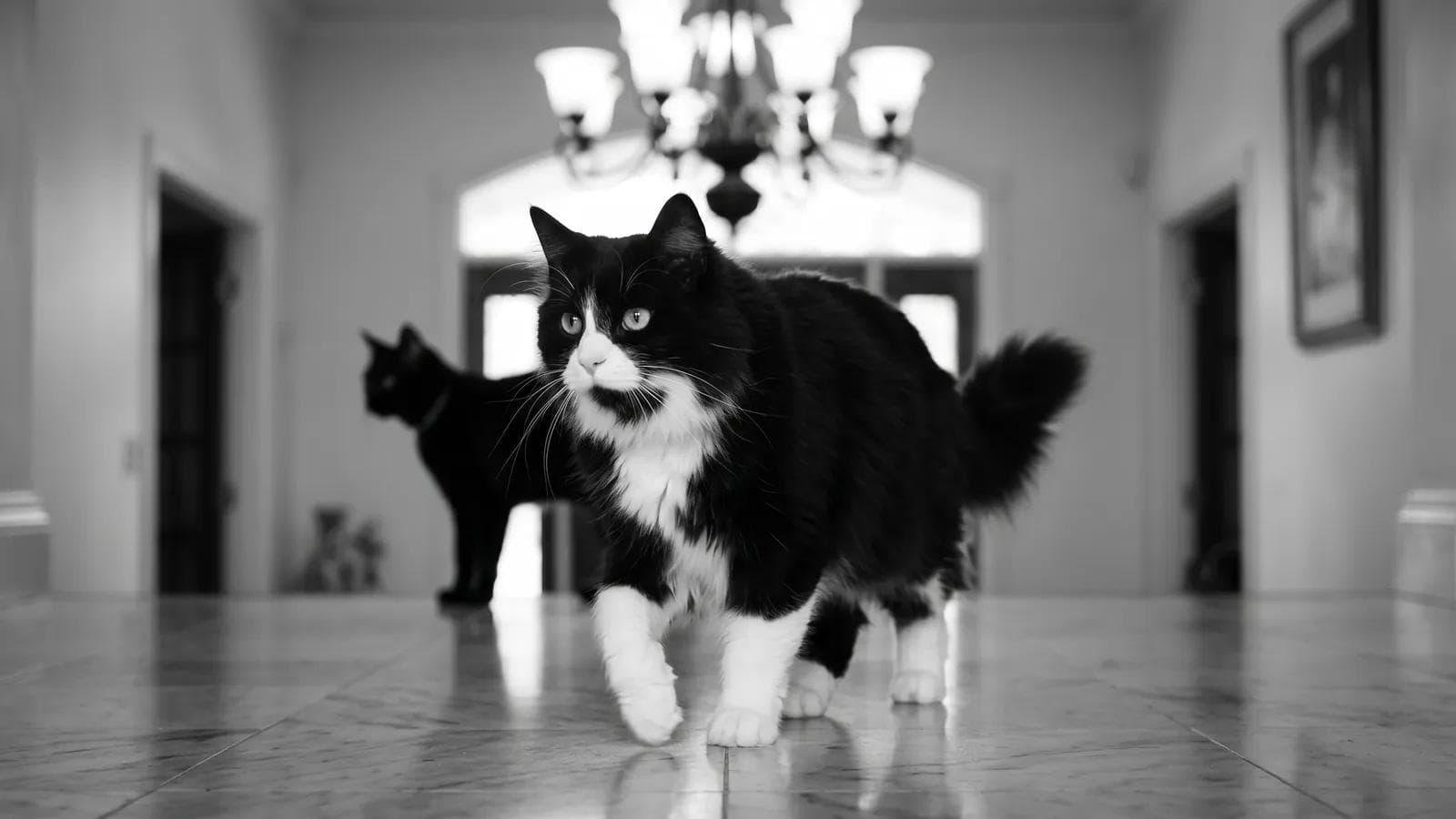
Our household also contains Zola, who is black, slender, and in possession of a small white tummy patch that she does not make available for general inspection. Zola is not, by any reasonable reading, the Senior Receiving Officer. She has not applied for the position. She has not expressed an interest in it.
What she has, instead, is her own process. And it is worth documenting, because it represents a fundamentally different model of guest assessment.
Where Vino is broadly available, Zola is selective. Where Vino moves toward a guest with the measured confidence of someone who has done this before and intends to continue doing it, Zola operates on a timeline that is entirely her own and does not telegraph itself in advance. She may be present during a visit. She may not be. She may appear at the precise moment when a guest has stopped expecting her, settle nearby, and produce, without ceremony, the quiet weight of her attention.
This is not less welcoming. That's the point. It's simply a different architecture. Where Vino's assessment is a structured process with observable stages, Zola's is closer to a private review that concludes when she's ready and is communicated, if at all, in terms that require some interpretation.
Guests who receive Zola's attention tend to feel it as a particular kind of endorsement, not because she's rare, exactly, but because the threshold isn't visible. You don't know you've passed until you have.
What we have, then, is two distinct reception systems operating simultaneously. Vino's is formal, consistent, and runs according to protocols he established himself. Zola's is quiet, its own, and runs according to criteria she has not shared. Between the two of them, every guest to our home is, in some way, assessed. The results are not compared. They're not combined. They simply both exist, each from a different vantage, each entirely confident in its own conclusions.
FAQ: Tuxedo Cats and Guest Behaviour
Do tuxedo cats behave differently with strangers than other cats?
Tuxedo cats are not a distinct breed, so the pattern differences you'll observe come from individual temperament rather than coat pattern. What they do carry, as a generalisation, is a reputation for personality: high-engagement, opinionated, frequently theatrical about it. Whether that reputation is accurate is a question best put to a household that contains one. Vino has not made himself available for comment on this, but his conduct with guests provides a working answer.
Why does a cat sit on the lap of a guest it doesn't know?
The standard explanation involves warmth, elevated heart rate, and novelty. The explanation that better fits Vino's observed behaviour: assessment. He's not sitting on a guest because he's confused about who they are. He's sitting on them because he has decided they meet the baseline standard required to support his evaluation process. Being sat on by Vino is not a comfort gesture. It's an inspection.
It's not common, in the sense that most cats don't do it. Vino does it because he's constitutionally unsuited to being outside when there's activity inside. Something is arriving. That thing involves our household. His presence is therefore, from his perspective, not optional. Guests who find this disconcerting have usually recalibrated by the time the door closes behind them.
It's very much a Vino thing. Vino does it because he's constitutionally unsuited to being outside when there's activity inside. Something is arriving. That thing involves his household. His presence is therefore, from his perspective, not optional. Guests who find this disconcerting have usually recalibrated by the time the door closes behind them.
What does it mean when a cat ignores a dog that's barking at it?
In clinical terms, it can mean the cat is practising a learned avoidance behaviour. In Vino's specific case, it means something different. He has assessed the dog, found its conduct unworthy of a formal response, and communicated this through the precise mechanism of returning absolutely nothing. Cats who are afraid of dogs tend to retreat. Vino, notably, doesn't go anywhere. He lies down. The distance between "afraid" and "entirely unimpressed" is a metre of open yard and a fence line, and Vino remains on his side of it, unbothered.
Do cats that are confident with guests make better companions?
"Better" is doing a lot of work in that question. Confident cats with guests are certainly more observable companions, in the sense that their conduct is easy to track. What they provide is consistency, a known process, a reliable set of responses that guests can learn to read. Vino's guests, by the third or fourth visit, generally understand the protocol. They sit down. They wait to be approached. They don't presume. I didn't teach them this. Vino did.
A Final Observation
The standards that Vino maintains for visitors to our home are not written down anywhere. They don't need to be. They are expressed, continuously and without ambiguity, through the precise calibration of his response to each new arrival: how long before he moves toward them, how he positions himself for the assessment, whether he stays or departs before the visit concludes.
The Staffy next door has now been operating in proximity to these standards for a considerable period. It has not improved. It continues to present itself at the fence line with the same volume, the same energy, the same disregard for the basic principle that composure is the minimum requirement for receiving the attention of our home's Senior Receiving Officer.
Vino continues to lie in the yard, gaze directed at something considerably more interesting than a fence, and demonstrate, without a word, what correct conduct actually looks like.
The gap between them remains exactly as wide as Vino intends it to be.