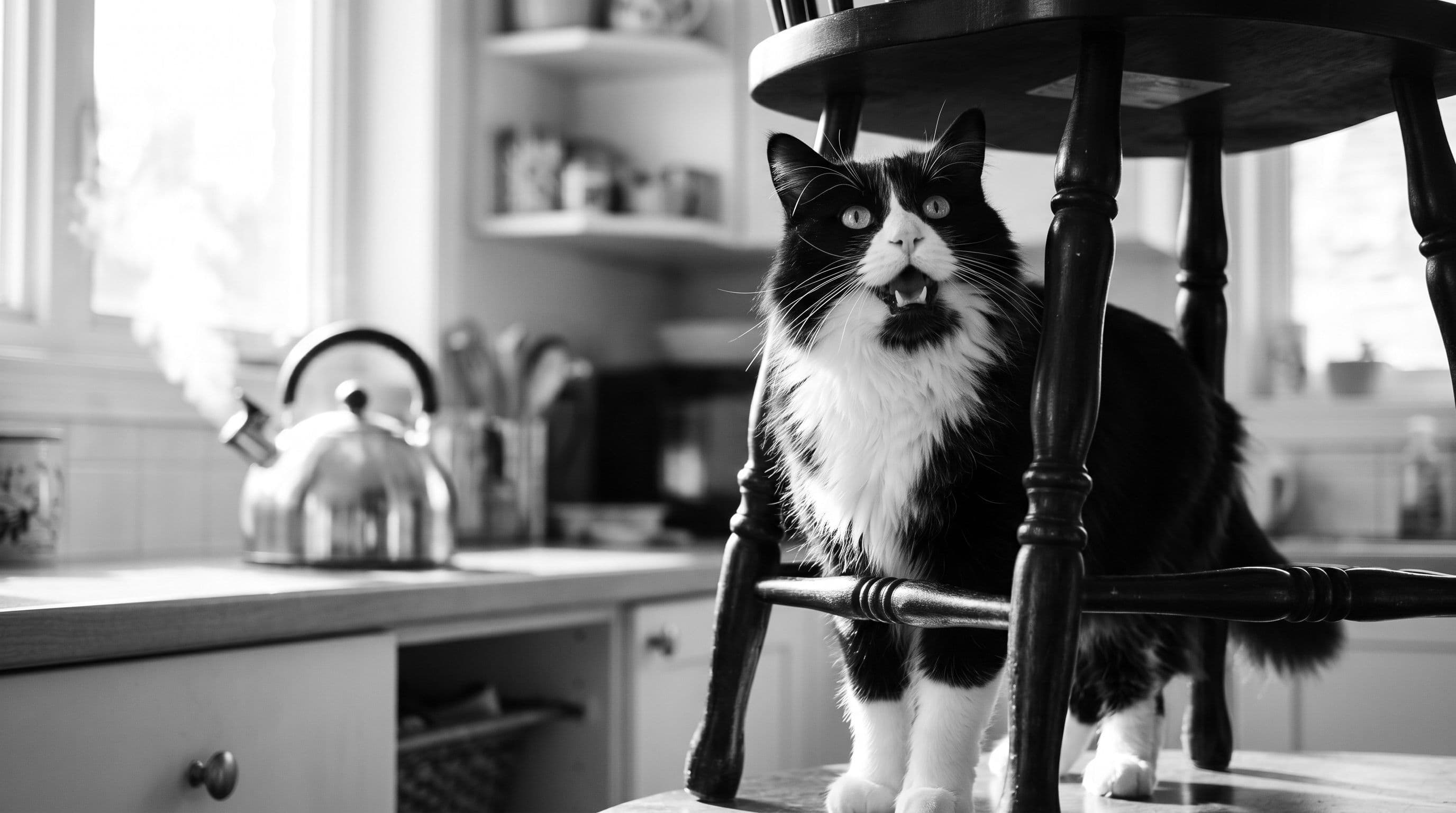
I was standing at the kitchen counter first thing one morning, waiting for the kettle to boil, when I felt the familiar pressure of a body weaving between my ankles. People ask me all the time, "why does my cat follow me everywhere," and I don't wonder anymore because I live with the answer: he weighs roughly 6 kg and he'd already eaten his breakfast. This wasn't about food. Vino sat on my left foot, looked up, and produced one of his sustained, five-second protest meows: not because anything was wrong, but because I'd been vertical for three minutes without acknowledging him. I shuffled sideways to grab a mug. He followed. I moved to the fridge for milk. He followed. I sat down at the table. He was on my lap before the chair stopped sliding.
Why Does My Cat Follow Me Everywhere: Attachment, Not Accident
There's a temptation to chalk up shadowing behaviour to simple hunger or boredom, and sometimes that's all it is. But when a cat follows you from room to room with the reliability of a postal worker, something deeper is usually operating. Vino doesn't just follow me when I'm near the treat cupboard. He follows me to the bathroom, the laundry, the back door, and the desk where I'm trying to work. He's done it since the day I brought him home from a small biodynamic winery in northern Tasmania in April 2022, and he did it at the winery before that: walking between my legs in the barn, jumping onto whatever I was reaching for, meowing until I gave him my full attention.
This kind of persistent following is something I've come to think of as Vino's version of social devotion. He doesn't trail me because he's confused about who I am or because he thinks I'm a large, clumsy cat. He treats me as a social partner whose presence he's learned to value, and his behavior reflects a bond built through years of shared routine. A 2019 Oregon State University study published in Current Biology found that 64.3% of cats showed a secure attachment to their caregiver, closely mirroring the rate seen in human infants. In the same Oregon State University attachment research, a six-week training course produced no significant change in attachment style, suggesting the cat-owner bond stays stable once formed. That tracks with everything I've seen at home. Vino's loyalty to me hasn't wavered since he was a kitten, regardless of any deliberate effort on my part to shape it. I suspect he'd have tested at about 97 percent attachment. The remaining 3 percent is reserved for whoever happens to be sitting down when guests arrive.
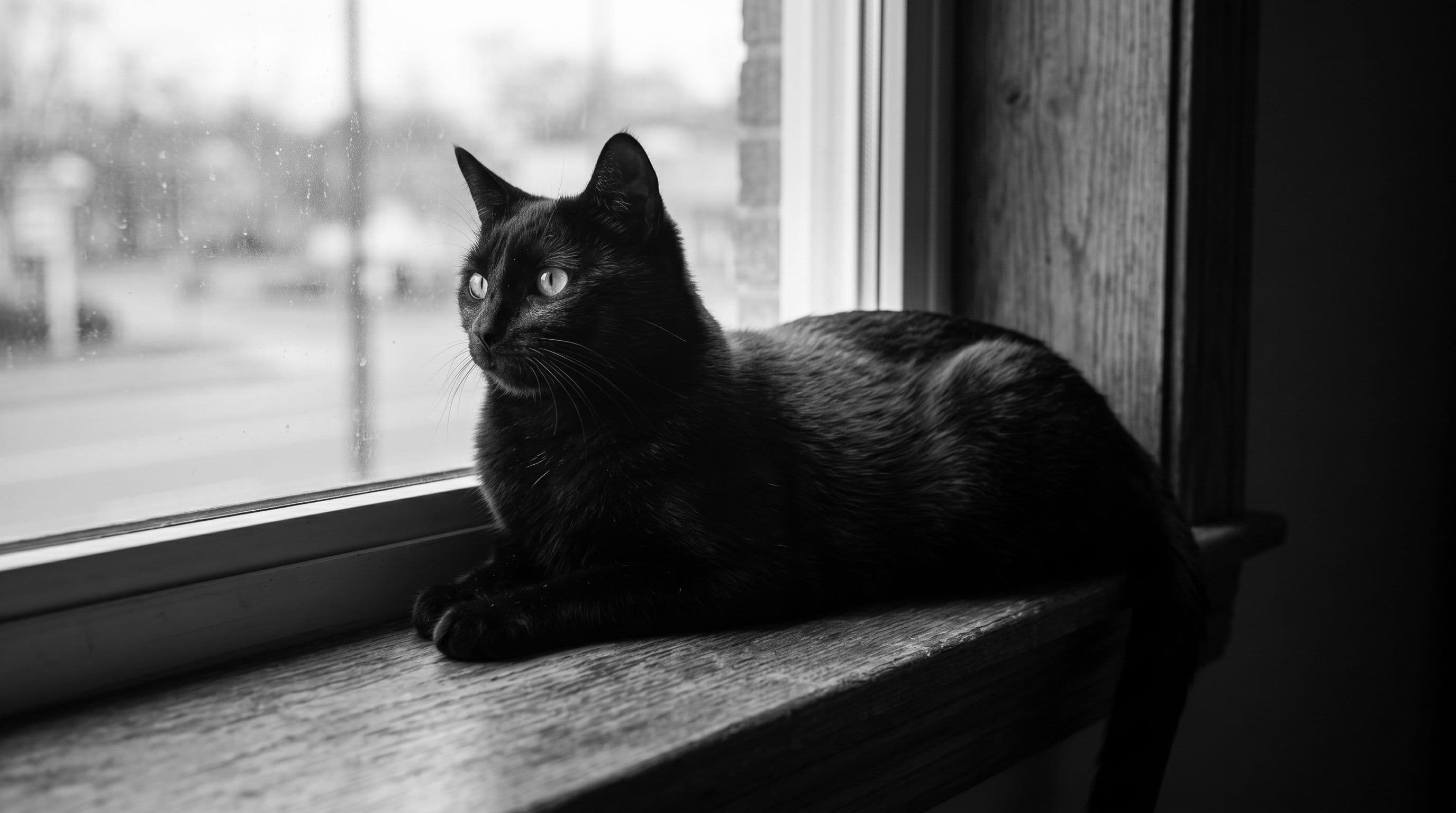
The distinction between following and separation anxiety matters. A cat who follows you because he enjoys your company will settle once he's near you. He might sit on your lap, lie at your feet, or simply park himself on the nearest elevated surface and watch. A cat experiencing genuine separation distress will exhibit destructive behaviour, excessive vocalisation when you leave, or inappropriate elimination. Vino meows constantly, but he does that whether I'm home or not. Zola, by contrast, barely registers my movements. She's a black domestic shorthair, slender and self-contained, and if I walked out the front door right now, she'd glance up from whatever sunlit patch she's claimed and go back to sleep. Two cats in the same household, same environment, radically different attachment expressions. That tells you it's temperament as much as circumstance.
How Vino's Shadowing Compares to Other Cats (and What the Research Says)
Not every following cat is doing it for the same reasons, and breed tendencies play a role. Siamese cats, for instance, are notorious followers; the Cat Fanciers' Association's own breed profile describes them as wanting to be with you, on you, or actively involved in whatever you're doing, and their vocalisation rivals Vino's on his most theatrical days. Ragdolls earned the nickname "puppy cats" partly because they'll trail their owners through the house with a relaxed, floppy devotion that looks nothing like Vino's insistent, occasionally aggressive brand of companionship. Maine Coons tend to be "in the same room" cats rather than "on your actual body" cats.
Vino doesn't fit neatly into any of these profiles. Tuxedo cats aren't a breed; they're a coat pattern that appears across domestic shorthairs, domestic longhairs, and various pedigrees. There's no genetic basis for claiming tuxedo cats are more affectionate than other bicolour patterns, despite what you'll read in listicles. What Vino has is an individual personality shaped by his early life. He spent his first couple of years as a working barn cat on a vineyard, catching mice, and he belonged to the property's elderly founder. That man passed away about two weeks before I started working there. I never met him. By all accounts, he was a warm, lively character, and Vino had clearly bonded with him. When I showed up, Vino transferred that energy onto me with zero hesitation and maximum physical interference.
A 2019 Oregon State University study published in Current Biology found that 64.3% of cats showed a secure attachment to their caregiver, closely mirroring the rate seen in human infants. That number doesn't surprise me one bit. Vino's early life on the vineyard meant daily human interaction in a working environment: people coming and going, tasks being performed, a cat inserting himself into all of it. That's not the same as a kitten raised in isolation or a feral cat socialised late. It's a cat who learned, probably before he was 12 months old, that humans are where the warmth, food, and attention are. I've watched him with visitors, with delivery drivers, with my neighbours, and the pattern holds: Vino treats people as a resource worth investigating, not a threat worth avoiding. Whatever bonding happened in those early months on the vineyard, it stuck.
I've written before about how Vino's personality shapes our daily routine, and his following behaviour is the thread that runs through every part of it. Morning: he's on the bedside table the moment it gets light. Afternoon outside time: he trails me around the yard for the full one to two hours, meowing and demanding pats. Evening: he's on my lap on the couch, then on me in bed. The only time he's not following me is when he's lying a metre from the neighbour's fence, ignoring the Staffy next door with such exquisite passive aggression that the dog loses its mind. Even then, he'll abandon the performance if I walk past.
What to Actually Do When Your Cat Won't Leave Your Side
If your cat follows you everywhere and you're reading this with mild concern, here's what I'd suggest based on years of living with a professional shadow.
First, rule out medical issues. A sudden increase in following behaviour, especially in an older cat, can signal pain, cognitive decline, or hyperthyroidism. Cats over 10 years old are particularly susceptible. If the behaviour is new, a vet visit should be your first step, not your fifth.
Second, distinguish between secure attachment and anxiety. Watch what happens when you leave the house. If your cat settles quickly and gets back to its normal routine, you're likely dealing with a bonded cat who simply prefers your company. If destruction, prolonged howling, or litter box issues follow your departure, consult a veterinary behaviourist. The International Association of Animal Behavior Consultants maintains a directory of certified professionals who can help.
Third, provide environmental enrichment so following you isn't the only stimulating option. Vino has a cat tower, window perches, and toys scattered across the house. He also has Zola, who serves as a reluctant but effective source of entertainment. Despite all of this, he still follows me. But enrichment takes the edge off; on days when he's had a solid two hours outside chasing birds and exploring the yard, he's noticeably calmer indoors. If you don't have outdoor access, vertical space and rotating puzzle feeders make a genuine difference.
Fourth, don't punish the behaviour. Pushing a following cat away, shutting doors in his face, or raising your voice will either increase anxiety or damage the bond you've built. I've learned to work around Vino. When he gets on my desk and lies across my keyboard, I move him to the chair beside me. He stays for about 90 seconds before he's back on the keyboard, but the redirect buys me enough time to finish a sentence. It's a negotiation, not a correction.
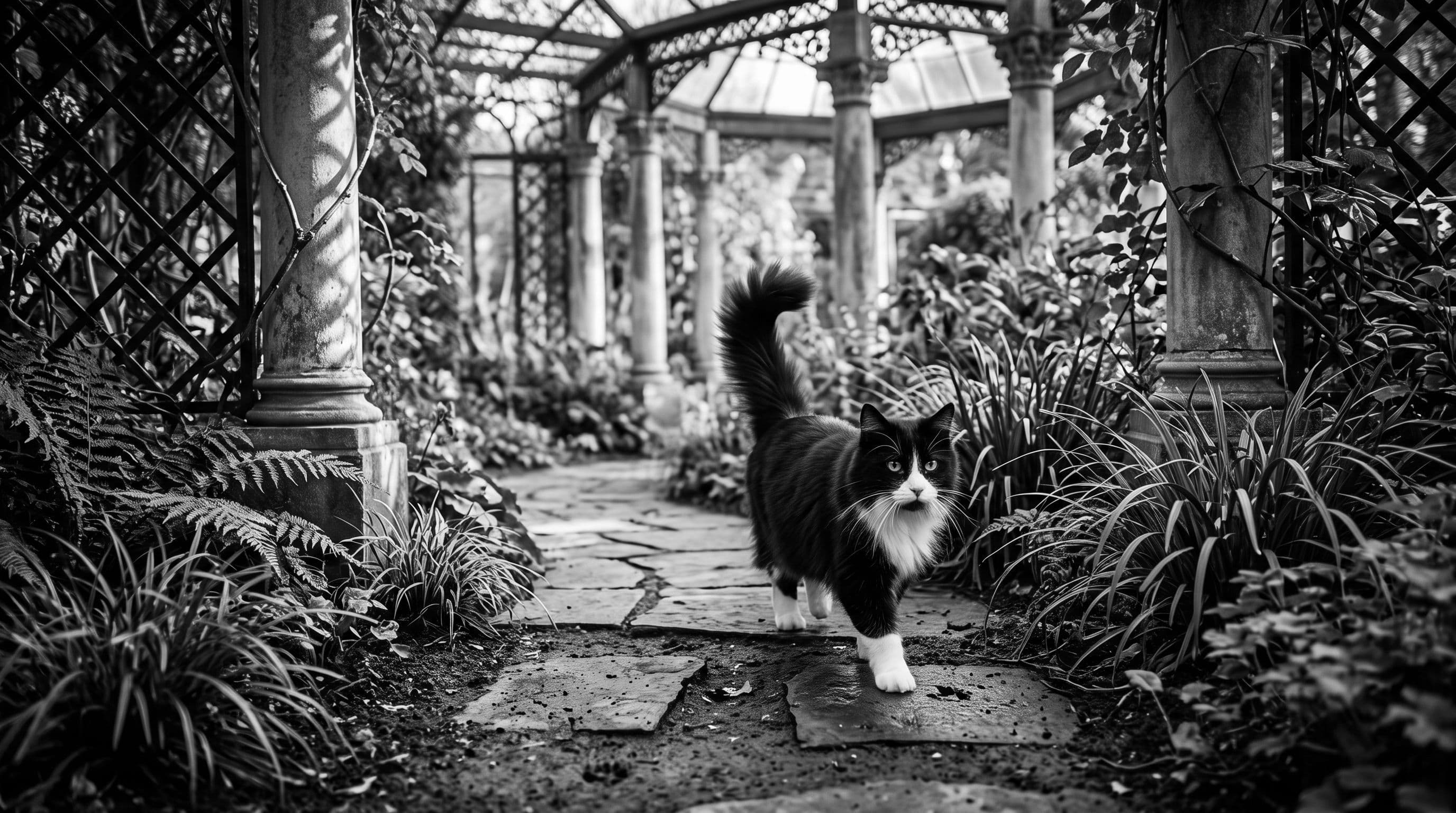
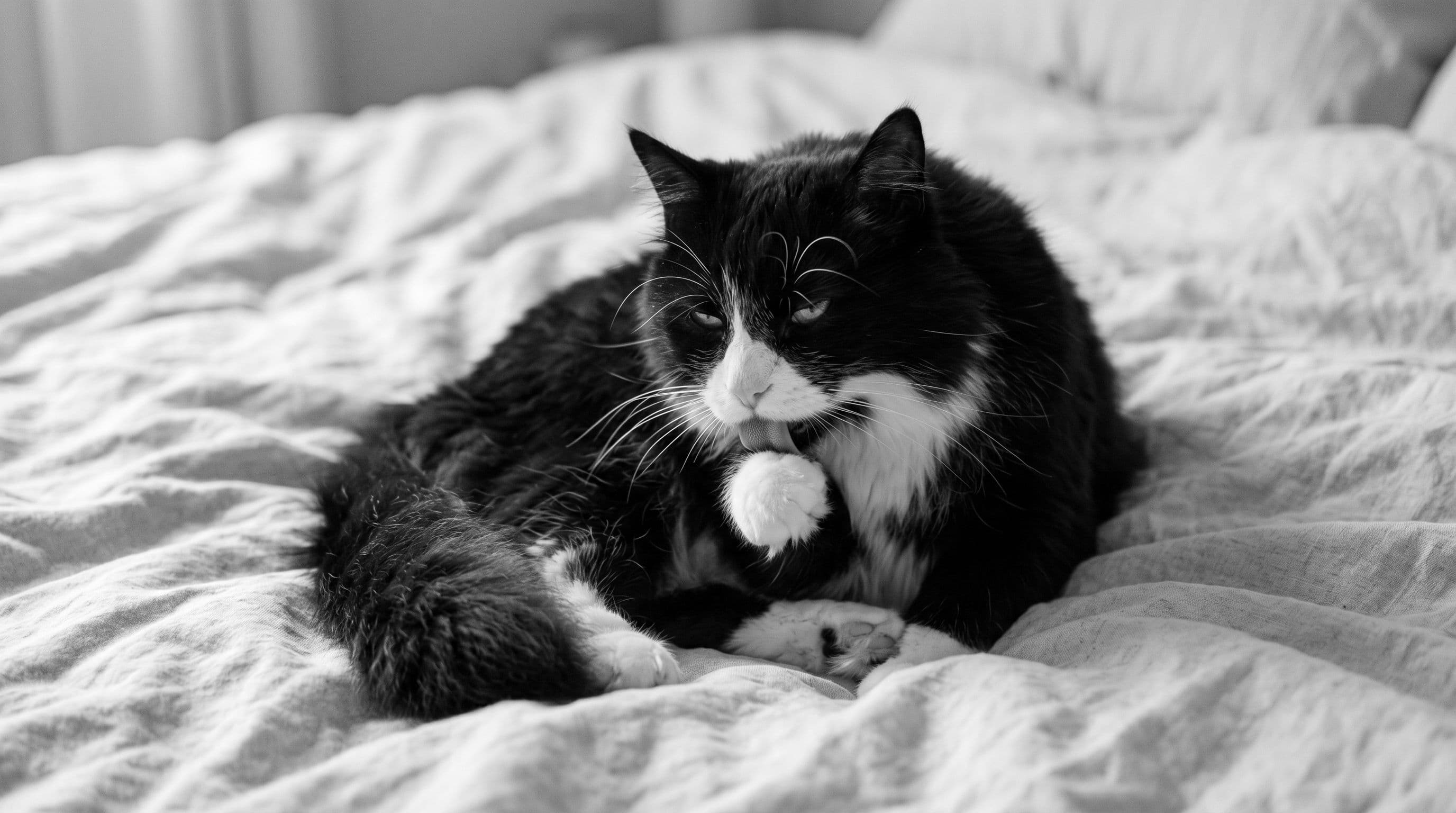
Fifth, reinforce settling behaviour. When Vino lies near me without actively climbing onto whatever I'm doing, I'll reach down and scratch his chin, the spot where his black fur meets the white chest in that natural bow-tie shape he's got. He drools. Extensively. But the message lands: being near me is rewarding even when he's not on top of me. This approach aligns with what behaviourists call "capturing calmness," and over the years, I've seen a modest but real shift. He still follows. He just occasionally does it from a distance of 30 centimetres instead of zero.
If you're curious about how environmental setup affects cat behaviour more broadly, I covered some of that in my post about creating indoor spaces that actually work for cats.
Frequently Asked
The Bathroom Test: Following Without a Reason to Follow
Three nights ago I ran a bath after dinner. Vino was asleep on the couch in his usual position: belly up, one white paw tucked against his black chest bib, the other dangling off the cushion edge like a tiny surrender flag. I didn't open any food containers. I didn't shake a treat bag. I walked quietly down the hall, closed the bathroom door, and started the tap. Within forty seconds I heard the thump of him hitting the floor, then the soft gallop of paws on hardwood, then the insistent scratching at the door that means "you've made a boundary error and I'm here to correct it."
I let him in. He sat on the bath mat, stared at the water with visible disapproval, then turned his back to the tub and faced me. He didn't want to play. He didn't want food. He wanted to be in the room where I was. That's it. That's the whole motivation.
[PHOTO: Vino sitting on the bath mat with his back to the tub, white chest bib prominent against dark tiles]
If you're asking "why does my cat follow me everywhere," the bathroom test is the one that tells you the most. A food-motivated cat won't bother trailing you to a room with no kibble. A bored cat might follow once and then lose interest. But a cat who scratches open a closed door just to sit near you while you do something that holds zero benefit for them: that cat has decided you're part of their social architecture. Vino doesn't follow Zola this way. She weighs about 3.9 kg, she's been in the household just as long, and she registers somewhere between furniture and mild inconvenience in his worldview. I'm the one he shadows. Anyone else in the house gets a passing glance. I get the full escort service.
What I've learned from years of this is that following behaviour isn't one thing. Some mornings it's purely transactional: Vino knows where the Whiskas pouch gets opened and he intends to supervise. But the evening follows, the bathroom follows, the "I walked to the mailbox and he sat at the window tracking me until I came back" follows: those come from something quieter and more persistent. He's built a routine around my presence, and any disruption to that routine produces a response. Not anxiety exactly. More like editorial dissatisfaction.
[PHOTO: Vino perched on windowsill watching the front path, ears forward, late afternoon light]
Does a Cat Following You Mean They're Anxious?
Not necessarily, and in Vino's case I'd say no. An anxious cat following you tends to show other signals: excessive grooming, hiding when you leave, refusing food. Vino does none of that. When I leave the house he reportedly naps on whatever surface I last sat on, eats on schedule, and occasionally torments Zola. He doesn't panic in my absence; he simply prefers my presence. There's a difference between a cat who can't cope without you and a cat who'd rather not bother trying. Vino falls squarely in the second camp.
Should I Worry if My Cat Follows Me to Every Room?
If the following comes paired with normal eating, regular sleep, and relaxed body language, there's nothing to worry about. Vino follows me to every room in this house and he's the most relaxed animal I've ever lived with. His 6 kg frame goes boneless the moment he settles on my lap. Following behaviour on its own is social, not symptomatic. If your cat also shows signs of distress when you leave or stops eating, that's a different conversation worth having with your vet.
Can You Encourage a Cat to Follow You Less?
You can, but you'd need to be more stubborn than the cat, and I haven't met many people who qualify. Providing enrichment in other rooms helps: puzzle feeders, window perches, a second cat if your household supports it. Zola occasionally distracts Vino long enough for me to use the bathroom alone. Occasionally. I've mostly accepted that wherever I go in this house, a small tuxedo shadow goes with me, and honestly, there are worse problems to have.
The Barn-to-Desk Pipeline: How Vino Manufactures Proximity
Vino does not follow me by accident. He engineers closeness with the same intensity he once applied to tripping me in the winery barn. The technique has evolved; the motive hasn't.
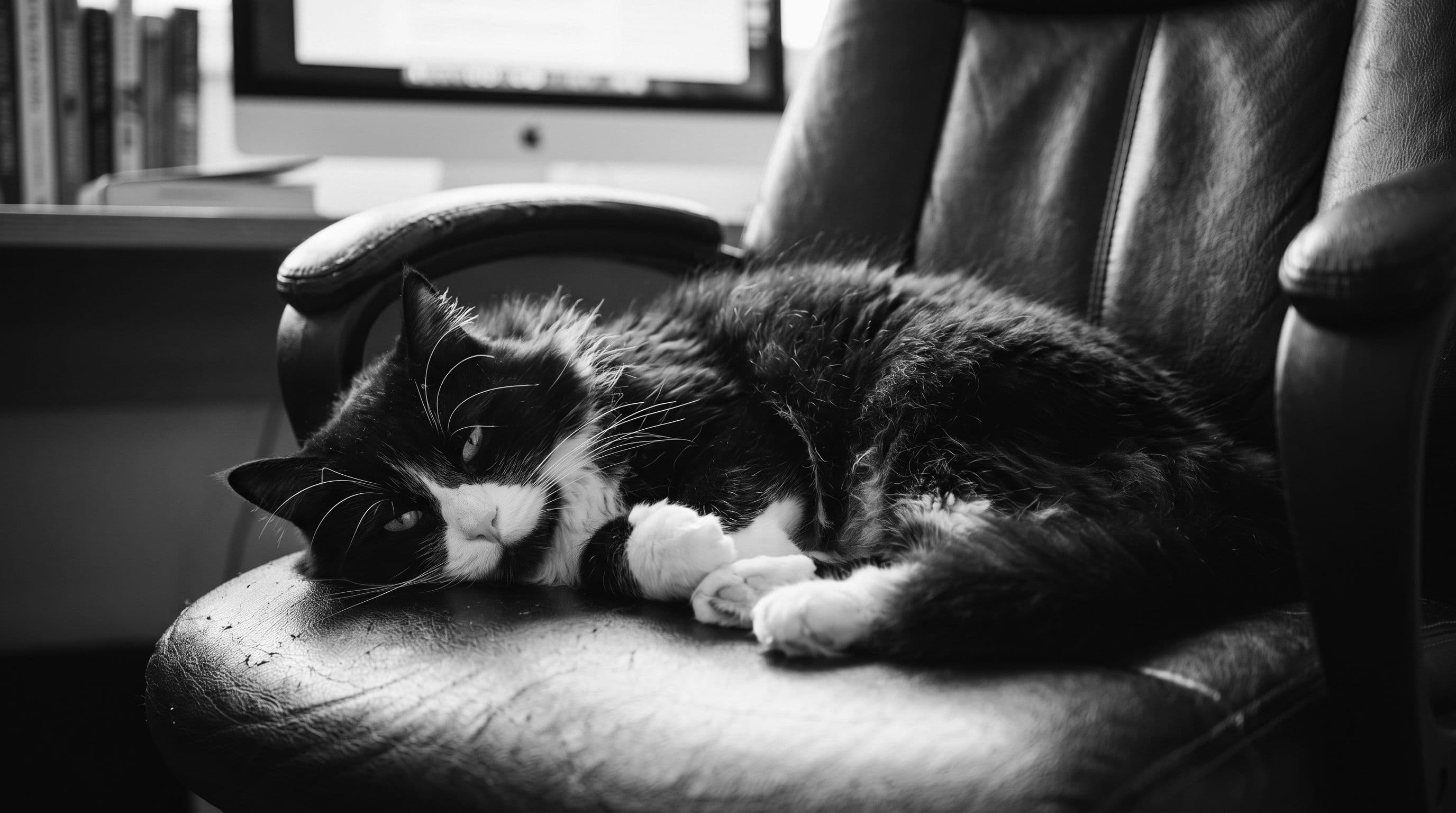
At the desk, his method is spatial occupation. He does not sit beside the keyboard. He sits on it, across it, or draped over it like a small black-and-white avalanche. If I shift him left, he expands right. If I lift him to the floor, he reappears at my elbow inside of two minutes. This is not persistence in the sense of trying again after failure. It is persistence in the sense of never having accepted that the desk has any purpose beyond supporting him.
The lap transfer is equally systematic. I will be reading on the couch, Vino will be asleep on the tower by the window, and I will make the mistake of standing to refill my water glass. By the time I return, he is in the warm depression I left behind, looking at me with green eyes that contain no apology whatsoever. He did not race. He simply identified an opportunity and executed.
What separates this from generic cat behaviour is the specificity of the trigger. Vino does not follow movement. He follows my movement, and only when that movement suggests I am about to become occupied with something that is not him. The kettle boiling, the computer opening, a book being picked up: these are signals that I am leaving the shared social space and entering a private one. His response is to collapse that distance by whatever means necessary.
Vino's Verdict
Photographed: Vino occupying 60% of a laptop keyboard, looking directly into the camera with his chin resting on the space bar.
His documented reaction to being followed himself is indifference. Zola has trailed him to the sunroom, to the tower, to the kitchen window. He does not acknowledge her. The behaviour is not reciprocal because the need is not reciprocal. Vino requires proximity; he does not require being proximate to.
FAQ
Why does my cat follow me to the bathroom?
In my experience, the bathroom represents two things to a cat: a closed door and a seated human. Vino will sit outside a closed bathroom door and produce his five-second protest meow until it opens. Once inside, he treats the space as any other room: he finds my foot, sits on it, and resumes his campaign for attention. The closed door is the provocation; my presence is merely the location where he registers his complaint.
Is my cat following me because they're anxious?
Vino's following behaviour increased after our August 2026 move to a new house, but the form of it did not change. He explored the unfamiliar rooms, located the sunroom as his preferred territory, and continued his barn-to-desk pipeline without interruption. A genuinely anxious cat, in my observation, hides or freezes. Vino inserts. The distinction matters: following from confidence looks like following from need, but the underlying mechanism is social expectation, not distress. If your cat follows you and also eats normally, sleeps soundly, and plays with their usual enthusiasm, anxiety is unlikely to be the driver.
How do I stop my cat from following me everywhere?
I have never successfully stopped Vino, and I have stopped trying. What I have managed is redirecting the behaviour to locations where it does less damage. The second cat tower, purchased after Vino and Zola's months-long standoff over the first, gave him an alternative elevated position near where I work. He uses it sometimes. He uses my lap the rest of the time. My advice, such as it is: accept the following as a tax on having built a relationship, and invest in surfaces you do not mind occupying.