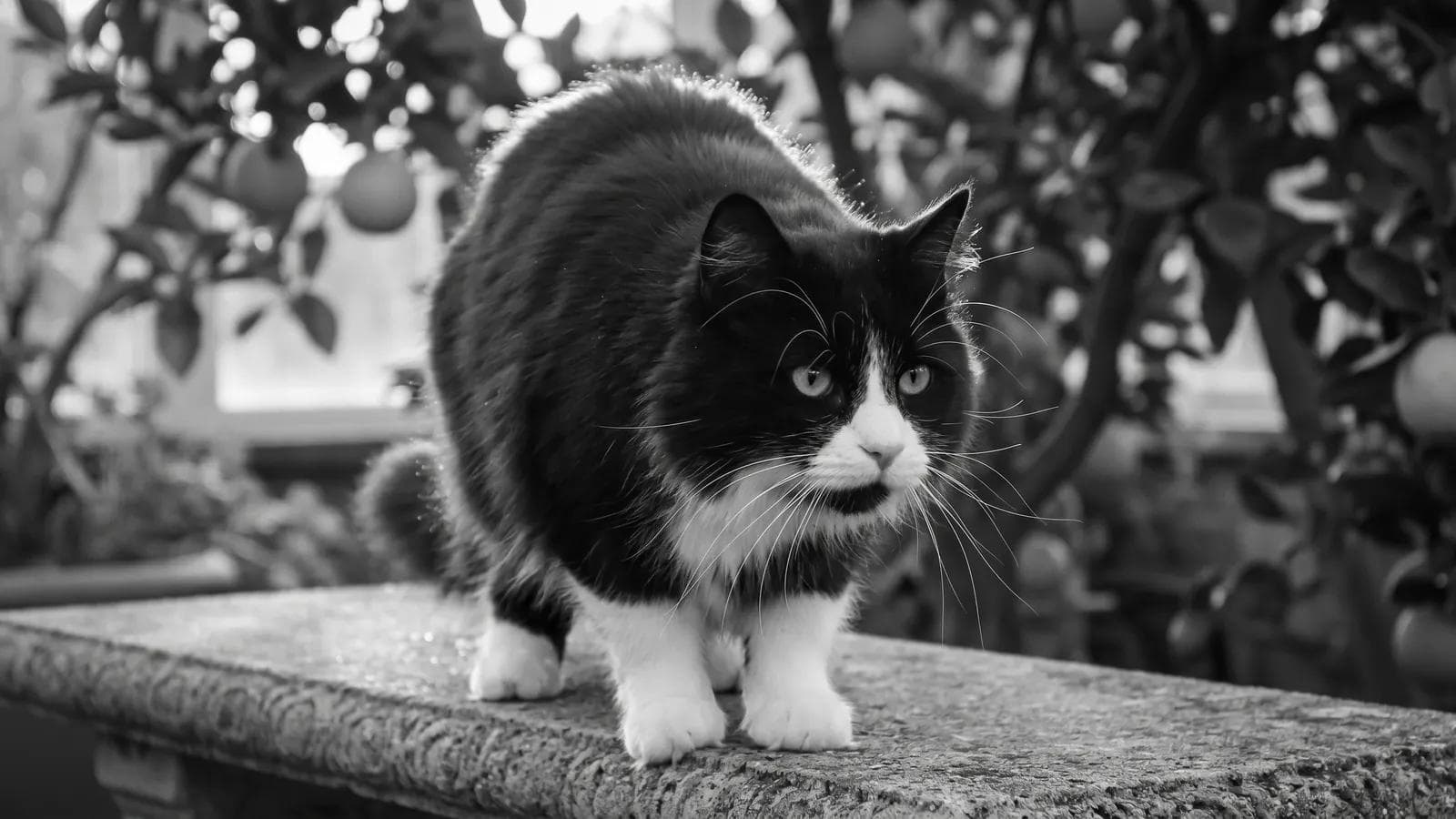
Tuxedo cats are affectionate. Emphatically, persistently, and in a manner that strongly suggests they've never once considered whether the timing was convenient. The question isn't whether they'll give affection. The question is whether you're prepared for how much, and on whose schedule it arrives.
Vino, for instance, is currently on my lap. He was on it before I fully sat down. He didn't ask.
I've been noting this sort of thing for four years.
What "Affectionate" Means When Applied to a Tuxedo Cat
There's a version of feline affection that involves a cat drifting gracefully toward you on its own timetable, accepting a brief stroke, and then removing itself to a more comfortable location. Clean. Dignified. Mutual.
That is not what tuxedo cat affection looks like in practice.
Vino's approach to affection begins the moment someone enters the room. It doesn't require an invitation. It doesn't require that the person in question sit still, or stop working, or put down whatever they're carrying. He arrives at the same velocity regardless of circumstances. In the winery barn where he spent the first years of his life, he'd walk between the legs of anyone who came through the door, causing them to stumble, then position himself on whatever surface they were trying to reach. He wasn't being difficult. He simply required that the visit include him, and he wasn't going to wait to find out if it would.
He brought this policy home with him. He's never revised it.
Affection, in Vino's vocabulary, is an ongoing state. It manifests as: sitting on the nearest available lap without announcement; following me from room to room with a commentary of meows; pressing his considerable white-bibbed chest against a forearm mid-task; and lying across whatever documentation, keyboard, or project currently has my full attention. He drools during cuddles. This is not a symptom. It's enthusiasm.
He's affectionate in the way that a force of nature is affectionate. You don't negotiate with it. You simply understand that it's happening and plan accordingly.
The Guest Experience
One of the more reliable measures of a cat's baseline affection is how they respond to people they don't know.
Vino finds strangers extremely interesting. Specifically, he finds the portion of the stranger that is currently sitting down the most interesting part of the entire visit.
He's selective, in the loose sense that he doesn't immediately install himself on every guest with equal enthusiasm. He conducts a brief assessment. Then, having completed it, he makes himself comfortable on whoever seems most amenable and begins the slow work of redistributing himself across their lap until he reaches maximum coverage. He doesn't need to know them. He needs them to be still.
This isn't random warmth toward the nearest available human. It's a genuine interest in the new arrival, expressed through the only medium Vino considers appropriate: physical contact, initiated immediately, without a formal introduction.
The guests, for their part, tend to be either charmed or slightly startled. Vino takes both reactions equally in stride. He doesn't require enthusiasm in return. He's providing the enthusiasm. That's the arrangement.
What Affection Looks Like at the Other End of the Scale
Zola shares the household. She is black, slender, and in possession of an elegance that Vino admires so much he's spent years trying, unsuccessfully, to get closer to it. She is not, by any reasonable measure, an unfriendly cat. She is, however, a cat with considered opinions about proximity.
She and Vino will share a windowsill. They'll sleep near each other. They'll exchange slow blinks on the occasions when he hasn't recently launched himself at her from a distance. She allows contact on her schedule: a single, brief acknowledgement, administered with the economy of someone who's decided you've earned it today.
One hiss from Zola undoes whatever composure Vino had assembled in the preceding hour. He seems genuinely surprised by this every time.
The comparison is useful. Both are tuxedo-patterned cats living in the same household, receiving the same food, and operating under the same basic conditions. Their affection styles are almost entirely opposite. Zola's is architectural: precise, occasional, placed with intent. Vino's is oceanic.
What this suggests is that "affectionate" is a reasonable general characteristic of the type, but the specific expression of it varies substantially by individual. What you're getting when you take on a tuxedo cat is a cat predisposed toward engagement with the humans in its household. What that engagement looks like will be its own business.
The Flip Side of Affection: The Sustained Protest Meow
Affection, sustained over time, develops its own specific vocabulary. Vino's includes a meow that deserves its own documentation.
When something hasn't gone his way, most commonly when he's been told the outside door will not be opening right now, he produces a meow of sustained, unwavering volume. Same tone. Same pitch. Five seconds or more, without variation. It isn't a question. It isn't escalating. It's a statement of record: this is not what was agreed, and I should understand that it has been noted.
This is still affection, in its own way. A cat who didn't care wouldn't bother. The protest meow exists because he's formed expectations around what he should receive, and he's close enough to the humans in his household to feel entitled to express when those expectations haven't been met. It's the sound of a very attached cat who's confident his grievance will be heard.
It will be heard. The meow ensures this.
He walks around the house meowing for most of the day, in a range of registers and for a range of reasons: he'd like breakfast; he'd like to go outside; he's outside and would like to come in; he'd like company; he has company and would like more; the general conditions of the morning are worth remarking on. None of this is distress. It's simply a very vocal cat maintaining a running correspondence with everyone in the building.
Affection in Practice: What You Should Expect
If you're considering a tuxedo cat and wondering whether you'll get affection, the answer is yes. If you're wondering whether it'll be the refined, deferential sort of affection that comes and goes on the cat's terms while leaving your schedule largely intact, the records suggest: probably not.
What you're likely to get is a cat who decides where you're sitting and joins you. A cat who monitors your movements through the house. A cat who meets you at the door when you've been out, not because it was waiting anxiously, but because it noticed the sequence of sounds that means you've returned and has already formed an opinion about what should happen next. A cat who drools on you during cuddles, specifically because the cuddle is going well.
The affection is real. It's also relentless. These are not separable things.
I've long since accepted that my movements are tracked, my work is monitored, and my lap is considered shared property. I didn't negotiate this arrangement. Vino established it, and it has held for years without amendment.
This is, by any measure, a deeply affectionate animal. It simply expresses that affection in terms that don't include the word "later."
Frequently Asked Questions
Are tuxedo cats affectionate?
Yes. Tuxedo cats tend to be highly affectionate, social cats that form strong bonds with the humans in their household. They're inclined toward contact rather than distance, and most will seek out company throughout the day rather than spending long periods alone. Individual cats vary widely, and Vino sits at the sustained, active end of that range.
Do tuxedo cats like to be held?
Many do, though "held" often understates the position. In my experience, comfort with being carried, cuddled, and draped across a person for extended periods comes down to the individual cat, not the coat pattern. Vino, for instance, treats the nearest available lap as his own, regardless of the wishes of the person attached to it. Vino's own tolerance runs long: prolonged contact over brief handling, every time.
Are tuxedo cats cuddly?
In general, yes. They're not typically the sort of cats that accept a single stroke and retreat. Extended sessions, full-weight lap installations, and sleeping in contact with the humans in the household are the norm rather than the exception for most.
Do tuxedo cats get attached to one person?
They often form a primary bond, but "attached to one person" undersells the range. Vino has a particular preference for the main members of our household, but he will extend his affections to visitors without much hesitation. Tuxedo cats are social enough that attachment tends to spread. You're unlikely to end up with a cat that tolerates only one human.
Are tuxedo cats good with strangers?
Generally, yes. Most are curious rather than shy, and will investigate a visitor before deciding what to do with them. Vino's standard approach is to assess, then join. Guests who are sitting still are particularly vulnerable.
Why does my tuxedo cat follow me everywhere?
Because it has decided that's how things should go. Tuxedo cats are highly social and tracking the movements of the people they live with is simply part of how they engage. Vino follows me from room to room as a matter of course, often with commentary. It isn't anxiety. It's attention, directed at you specifically, more or less constantly.
I have no official position on whether this level of affection is convenient. Vino hasn't asked for one. He's busy being on my lap right now, drooling very slightly onto my leg, entirely undisturbed by the inconvenience this may represent.
Four years in, I think I've seen enough.