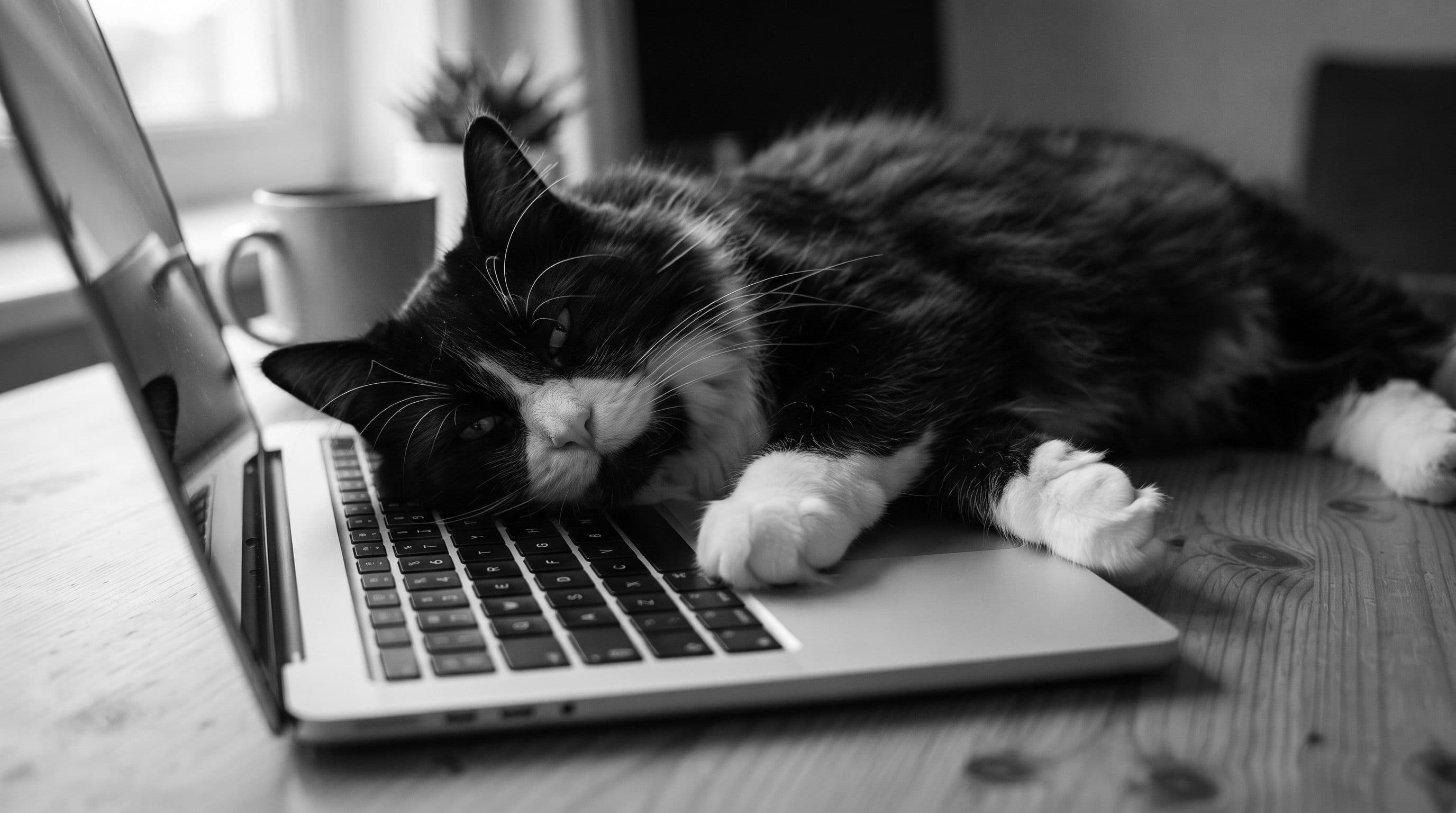
Sometime around 2 p.m. on a Wednesday, mid-sentence in an email I'll never finish, Vino placed one white paw on my laptop trackpad, scrolled the document sideways, and then lowered his full 6 kg onto the keyboard. The screen filled with a string of lowercase g's. He looked at me with those green-gold eyes, slow-blinked once, and began to purr. I backspaced 47 characters. He settled deeper. Working from home with a cat isn't a lifestyle choice so much as a series of small, daily surrenders, and I've been losing ground since the day I brought him back from that winery in northern Tasmania.
Why Working From Home With a Cat Becomes a Territorial Negotiation
I should clarify: I didn't set out to share my workspace. Before Vino, I had a clean pine desk, a second monitor, and a reasonable expectation of personal space. That lasted roughly 48 hours before Vino discovered that the warm air rising from the laptop's exhaust vent made the keyboard an ideal resting spot. Zola, for her part, has zero interest in my desk. She prefers the wool area rug beneath the living room window, where she can watch rosellas in the eucalyptus without anyone bothering her. She's a model housemate. Vino is not.
The issue isn't that he wants attention; it's that he wants to be physically occupying whatever surface I'm trying to use. This is the same cat who, back at the vineyard where he spent his first couple of years, would walk between my legs every time I entered the winery barn, then jump onto whatever shelf or bench I was reaching for. The barn behaviour translated seamlessly to the home office. He doesn't distinguish between a barrel rack and a standing desk. Both are surfaces. Both are his.
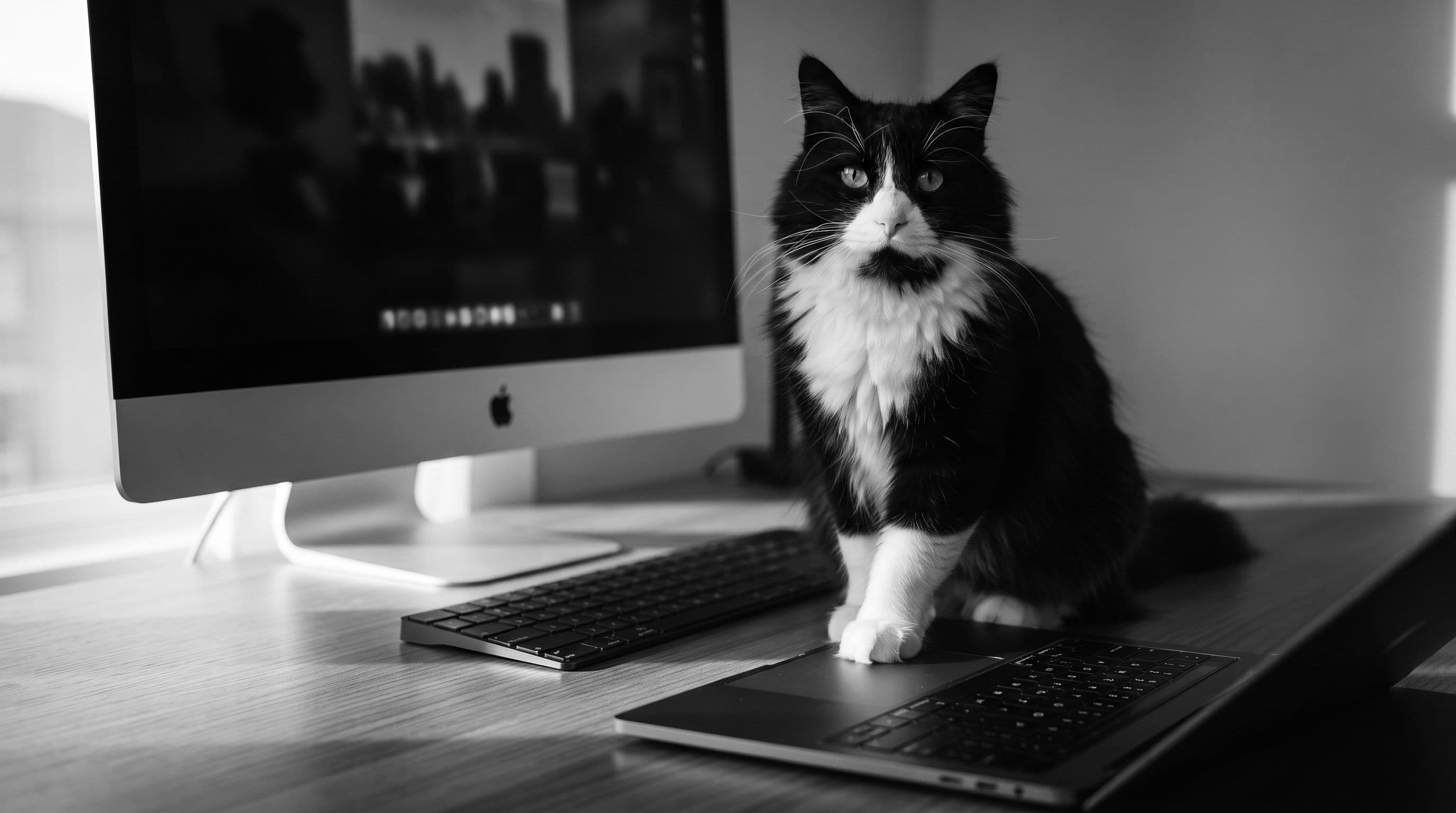
His toolkit is extensive. There's the slow approach: he'll sit on the floor beside my chair, meow once, wait 30 seconds, meow again, then escalate to what I can only describe as a sustained foghorn. If that doesn't work, he jumps. Once on the desk, he positions himself between my hands and the keyboard with the precision of someone who's studied the geometry. His medium-long black fur sheds onto everything; I've pulled tuxedo cat hair out of my USB ports more than once. And if I'm on a video call, he'll walk directly in front of the camera, pause, and present his white chest bib to whoever I'm speaking with. He isn't showing off. He simply doesn't acknowledge that anyone else's priorities exist.
How Vino's Desk Invasion Compares to the Typical Remote-Work Cat
Most cat owners I know who work from home describe a version of this, but the intensity varies wildly. My friend Eleanor, who lives in Sandy Bay with a British Shorthair named Fergus, says Fergus will sit on her desk for 10 minutes, get bored, and leave. Her biggest complaint is that he occasionally bats a pen off the edge. That's a mild inconvenience. That's amateur hour.
Vino doesn't get bored. He commits. A standard desk occupation lasts 45 minutes to an hour, during which he'll cycle through sitting on the keyboard, draping himself across my forearms, and kneading the mousepad while drooling onto it. The drool is a signature move: thick, warm, and continuous, especially when he's being scratched under the chin. I've wiped saliva off my trackpad so many times that I keep a microfibre cloth permanently stationed next to the monitor.
Zola's temperament, by contrast, makes her the control group in this experiment. She's black, slender, and fundamentally uninterested in competing for desk real estate. She'll occasionally walk through the office doorway, glance at Vino sprawled across my workspace, and turn around. There's a hierarchy at play, though it isn't about dominance. It's about desire. Vino wants to be where I am. Zola wants to be where Zola is. When I wrote about how differently these two operate under the same roof, the dynamic came down to parallel living with occasional hissing. That still holds. The desk is Vino's theatre. Zola doesn't audition.
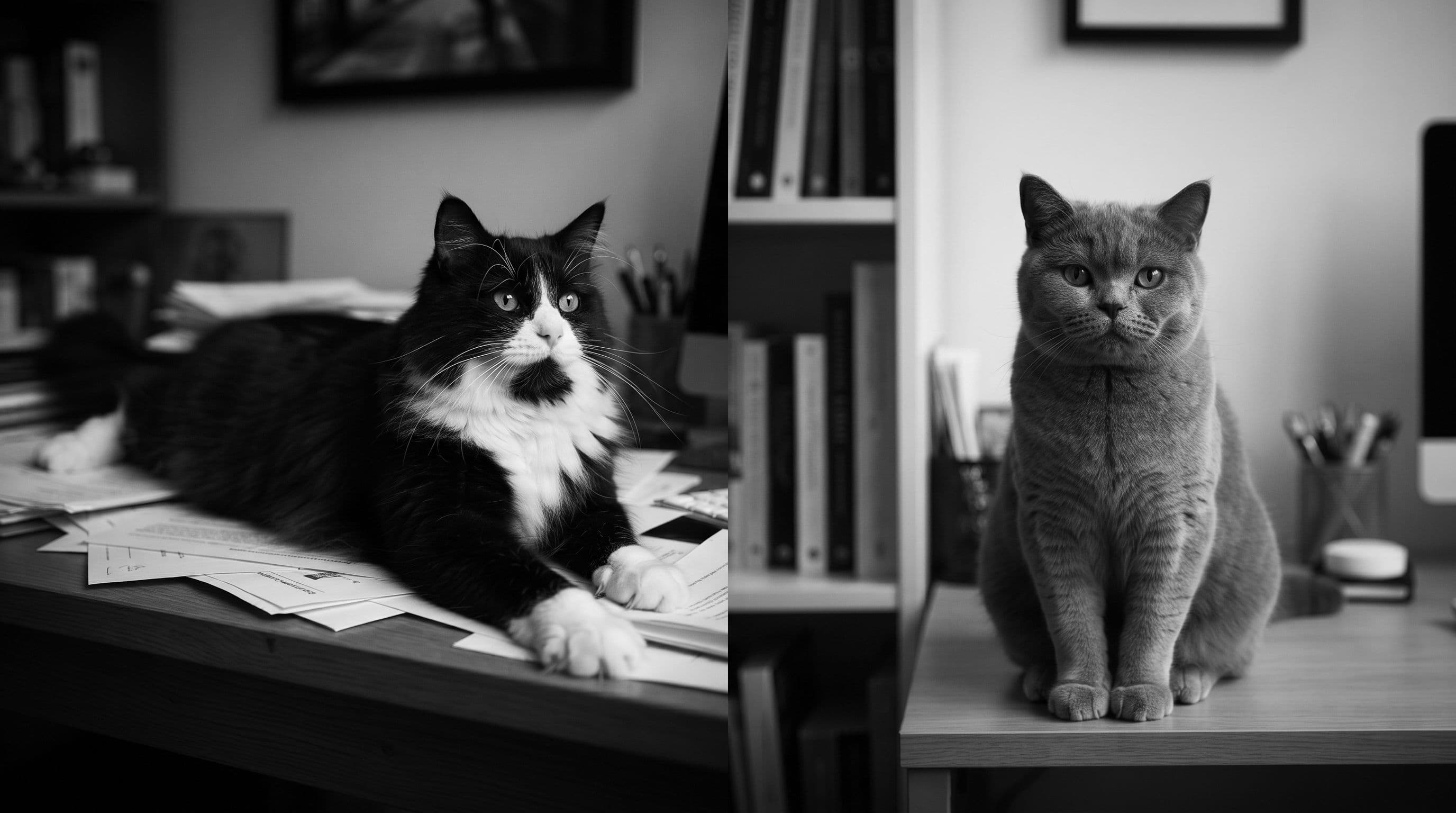
The breed factor matters here too. Tuxedo cats aren't a breed in the formal sense; they're a colour pattern that shows up across many breeds. But the behavioural reputation for boldness and sociability isn't nothing. Fergus the British Shorthair has the stocky, low-key disposition his breed is known for. Vino has the unshakeable confidence of a cat who spent his formative years running a vineyard barn like it was his personal office. The environment shaped him, and now my environment has to accommodate the result.
Every morning, at first light, Vino is on my bedside table, meowing for breakfast. By the time I've fed him, fed Zola, made coffee, and opened my laptop, he's had 20 minutes of being awake and is already primed for his second social engagement of the day: ruining my work. The morning window between 8 and 10 a.m. is consistently his most aggressive desk-invasion period. After lunch, he mellows. By 3 p.m. he's usually on the couch or hunting a sun patch. But those first 2 hours are a write-off.
Practical Strategies for Sharing a Home Office With a Determined Cat
I won't pretend I've solved this, because I haven't. But I've found a few things that shift the odds from "total chaos" to "manageable chaos," and that's the best anyone working from home with a cat can realistically aim for.
Give them an alternative warm surface. I placed a self-heating pet mat on the far end of my desk, away from the keyboard. It took Vino about a week to start using it. He doesn't use it every time; some mornings the keyboard is simply where he needs to be. But on good days, he'll settle on the mat and I'll get 90 minutes of uninterrupted typing. The mat cost less than the laptop he's been slowly destroying.
Tire them out before your first meeting. I've started doing a 15-minute play session with Vino before I sit down to work. A feather wand, a crinkle ball, anything that gets him running. This buys me roughly an hour of calm. It doesn't eliminate the desk visits, but it takes the edge off his intensity. His post-play state is drowsy rather than manic, and a drowsy Vino on the desk is at least a stationary Vino.
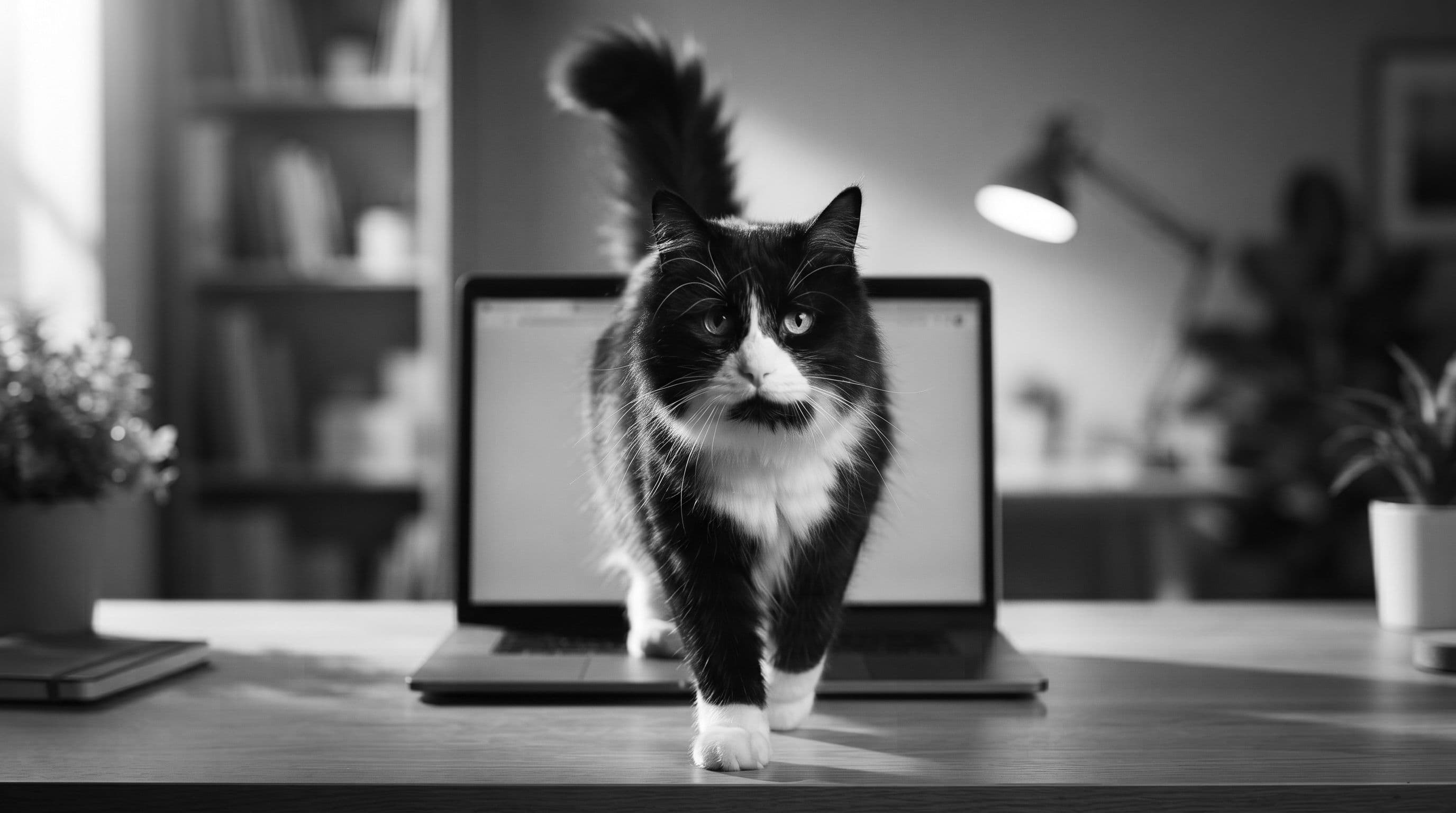
Accept the camera appearance. I stopped apologising for Vino walking across the screen during video calls. Most people find it charming. One colleague now asks where he is if he doesn't show up. Fighting him off-camera was creating more disruption than just letting him do his walk-through. He pauses, displays the chest bib, and moves on. The whole thing takes 8 seconds.
Protect your hardware. A silicone keyboard cover has saved me from cat hair, drool, and the occasional claw snag. I also keep my headphone cable routed behind the monitor where he can't reach it, after he chewed through one last winter. Generic replacements are cheap; the interruption of losing audio mid-call is not.
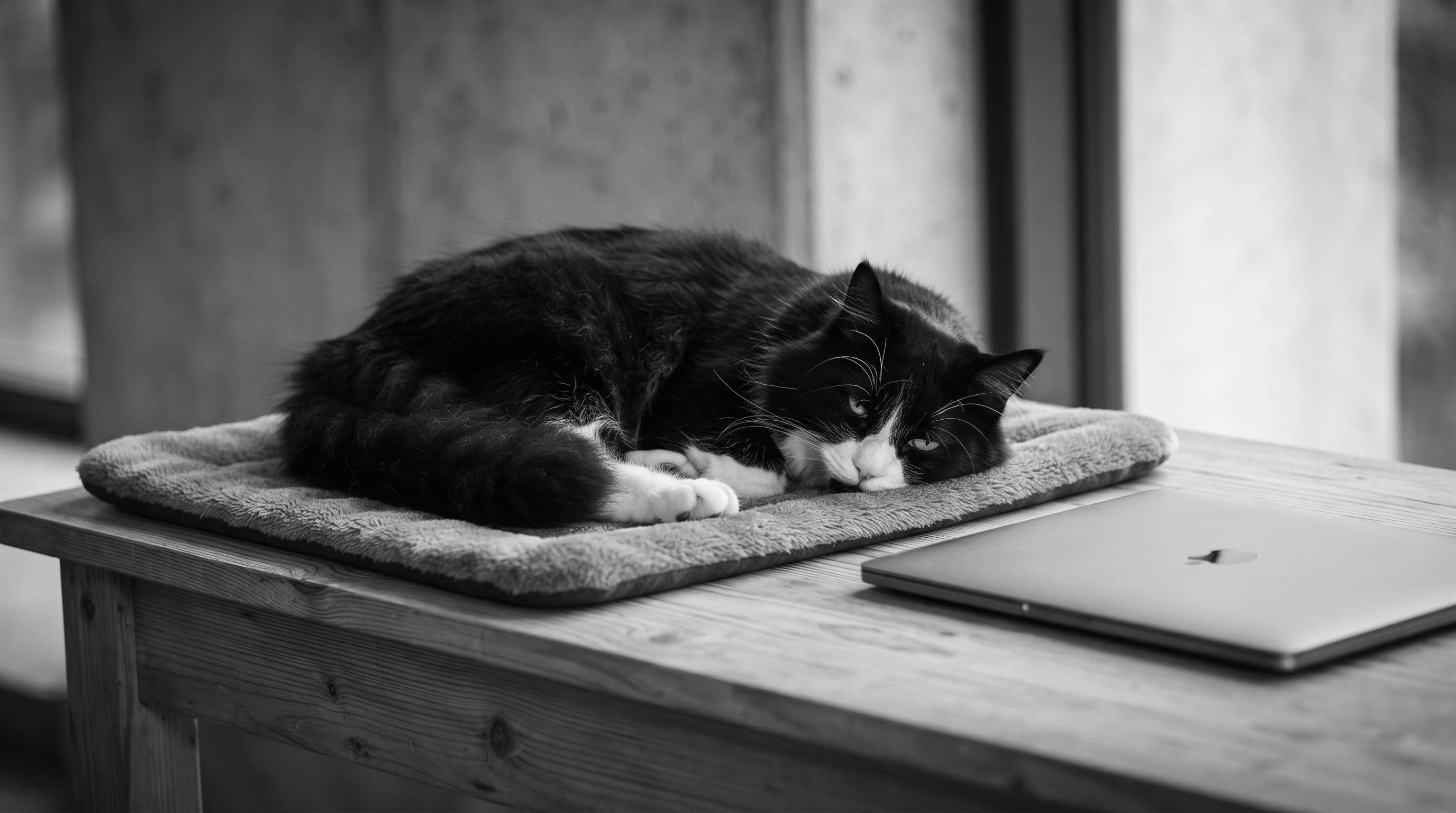
Don't close the door. I tried shutting the office door exactly once. Vino produced his protest meow: a single, sustained note, same tone, same volume, for what felt like an eternity but was probably 5 or 6 seconds. Then he did it again. And again. The scratching started within a minute. A closed door doesn't create a boundary with Vino; it creates a siege. I wrote more about his vocal range and what different meows mean in a previous post, and the protest meow remains his most effective weapon.
Schedule around their rhythms. This is the single most useful adjustment I've made. Vino's peak disruption window runs from about 8 to 10 a.m. I now schedule my deep-focus work for after lunch, when he's typically asleep in the living room. Mornings are for emails, admin, and tasks that can survive a 6 kg interruption. It's not ideal. It's functional.
> Vino's Verdict: Years of remote work have taught me that Vino doesn't recognise the concept of a workspace that isn't his. The only winning strategy is restructuring your day around his schedule, not the other way around. He's not being difficult; he's being exactly who he was in that winery barn, and always will be.